
What occupational impairment means for PTSD is how symptoms affect a veteran’s ability to function at work and in social life. The U.S. Department of Veterans Affairs associates total occupational and social impairment with a 100% disability rating for certain mental health conditions. A PTSD diagnosis alone doesn’t determine the rating; the effects of symptoms on day-to-day functioning matter.
It can be difficult to connect what you experience at work, at home, and in relationships with the VA’s rating language. The criteria describe different levels of impairment, from occasional work difficulties to problems affecting most areas of life.
This article explains how the VA uses occupational and social impairment to evaluate PTSD, what rating levels mean, and how total impairment is understood. You’ll also learn why evidence describing the practical effects of symptoms can make a claim clearer.
Key Takeaways
- Understand how the VA connects symptoms to your ability to work, maintain relationships, and manage daily responsibilities.
- Learn what distinguishes the PTSD rating levels and why the overall impact of symptoms matters.
- Recognize what the VA means by total occupational and social impairment.
- See how DBQs and medical evidence education can help describe the functional effects of PTSD in a claim.
What Is Occupational and Social Impairment?
For VA ratings, occupational and social impairment describes how mental health symptoms affect work, relationships, judgment, and daily activities. The VA considers PTSD’s overall effects, not the diagnosis in isolation.
Combined Effects of Symptoms
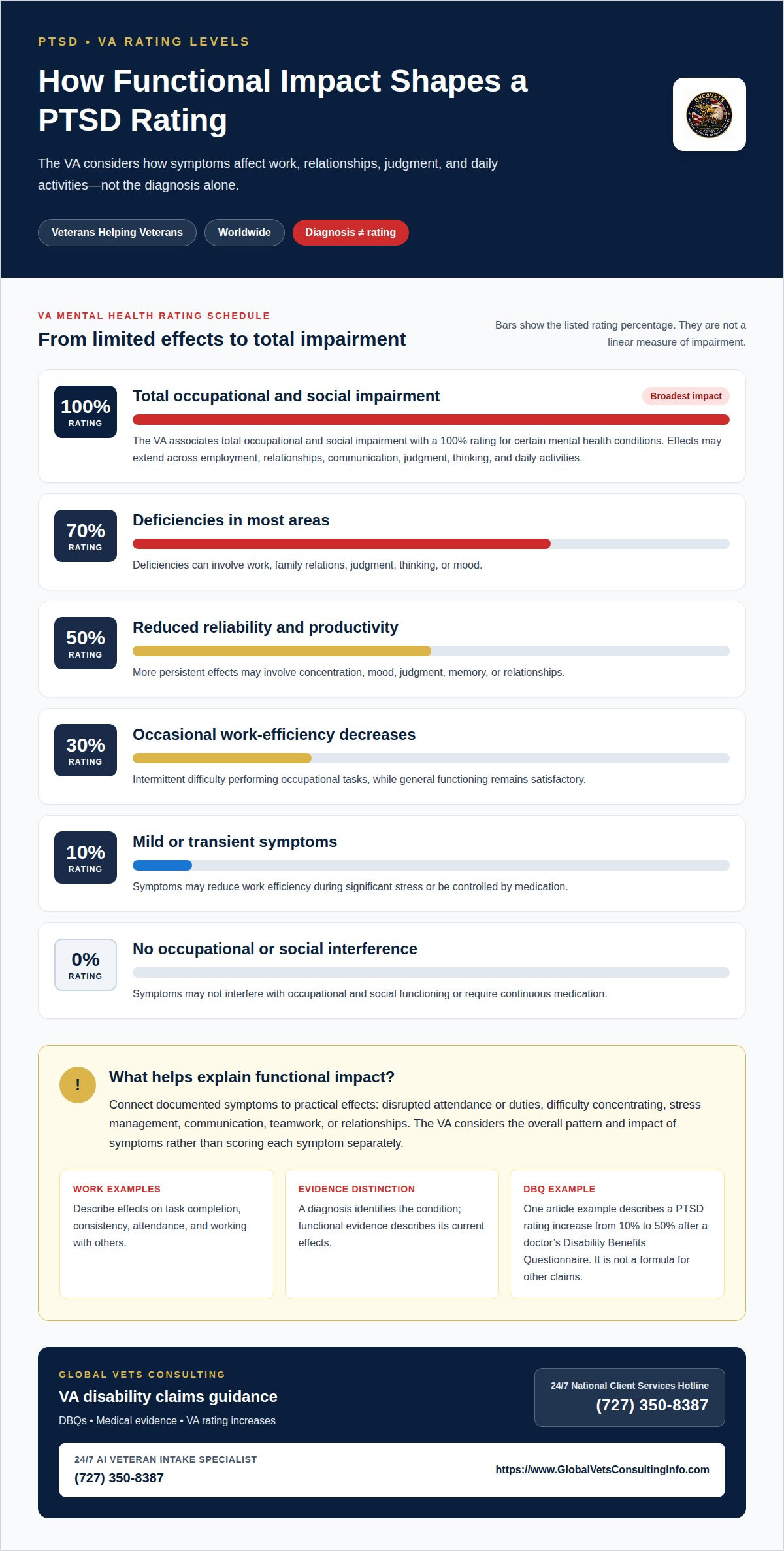
Combined effects means assessing how symptoms work together to affect functioning across different parts of life. According to the U.S. Department of Veterans Affairs, a 30% PTSD rating involves occasional decreases in work efficiency and intermittent difficulty with occupational tasks, while general functioning remains satisfactory. At 50%, reduced reliability and productivity may reflect more persistent effects on concentration, mood, judgment, memory, or relationships. The VA associates total occupational and social impairment with a 100% disability rating for certain mental health conditions.
The VA evaluates the pattern and impact of symptoms rather than scoring each symptom separately. For example, poor sleep, irritability, and difficulty concentrating may together affect attendance, teamwork, and task completion.
PTSD and the Ability to Work
PTSD can interfere with work through symptoms such as difficulty concentrating, managing stress, or interacting with coworkers. Clinicians assess occupational impairment by considering how symptoms affect practical tasks, consistency, communication, and functioning; a veteran’s work history and examples of disrupted duties can help describe those effects.
Under the ADA, workers with PTSD may have protections related to disability discrimination and reasonable accommodations, depending on their circumstances. Helpful adjustments may include written instructions, a predictable schedule, or a quieter workspace. The appropriate option depends on the employee’s needs and job duties.
Rating criteria describe different levels of impact, not a checklist every veteran must match. A 70% rating concerns deficiencies in most areas, such as work, family relations, judgment, thinking, or mood. At total impairment, effects may extend across employment, relationships, communication, judgment, thinking, and daily activities.
VA Schedule of Ratings and PTSD diagnostic code 9411
The VA uses the General Rating Formula for Mental Disorders to evaluate PTSD and other mental health conditions. PTSD appears under Diagnostic Code 9411 in 38 CFR 4.130. The schedule includes ratings of 0%, 10%, 30%, 50%, 70%, and 100%. These levels describe how symptoms affect functioning, not simply whether a diagnosis exists.
A 10% U.S. VA PTSD rating applies when symptoms are mild or transient, reduce work efficiency during significant stress, or are controlled by medication, according to the U.S. Department of Veterans Affairs. At 0%, symptoms may not interfere with occupational and social functioning or require continuous medication. At 30%, the criteria describe occasional work-efficiency decreases and intermittent difficulty performing occupational tasks, with generally satisfactory functioning.
Higher levels reflect broader or more persistent effects. A 50% rating describes reduced reliability and productivity. A 70% rating involves deficiencies in most areas, including work, family relations, judgment, thinking, or mood. The 100% level corresponds to total occupational and social impairment. These descriptions help distinguish how substantially symptoms affect daily functioning.
A licensed professional’s diagnosis identifies PTSD as a disorder, while the VA separately evaluates the disability rating. PTSD can develop after traumatic experiences, but a diagnosis alone doesn’t establish a specific percentage. The rating considers symptom severity and functional effects, including persistence and impact on work and relationships. Depression or anxiety may also be evaluated under mental health criteria when relevant to the claim.
For veterans reviewing how medical evidence relates to a mental health rating, mental health ratings education can help clarify the distinction between a diagnosis and documented functional effects.
Occupational and social impairment rating levels
PTSD ratings reflect how symptoms affect functioning, including the ability to work and maintain relationships. Occupational impairment can influence the rating by showing how symptoms affect reliability and performance.
Criteria Across Rating Levels
Rating levels describe increasing effects on work, relationships, and other areas of life. The VA evaluates PTSD, depression, and anxiety under mental health criteria, focusing on symptom severity and functional impact rather than diagnosis alone.
A 30% level describes occasional work-efficiency decreases; 50% describes reduced reliability and productivity. At 70%, deficiencies affect most areas, such as work, family relations, judgment, thinking, or mood. Total occupational and social impairment corresponds to the 100% level for certain mental health conditions.
For a service-connected PTSD claim, distinguish between evidence connecting the condition to service and evidence describing its current effects. Occupational examples can show whether symptoms interfere with performing duties, maintaining attendance, or working with others. A diagnosis identifies the condition, while functional evidence helps explain the rating level.
Examples of Rating Decisions
Examples show why the number of symptoms alone doesn’t explain a rating decision. In one case, a veteran remained at 10% after two panic attacks in the preceding 12 months did not cause lost work time. The work impact helped distinguish reported symptoms from demonstrated occupational impairment.
In another case, a 63-year-old veteran’s PTSD rating increased from 10% to 50% after a doctor’s Disability Benefits Questionnaire. These examples aren’t a formula for another claim. They show how medical evidence and concrete effects on work can inform the VA’s assessment of a stress disorder.
To understand an individual decision, connect each documented symptom with a practical example. Explain, for instance, whether concentration problems disrupt task completion or persistent stress affects workplace interactions. Clear evidence of these effects helps show how PTSD affects occupational and social functioning.
Meaning of total occupational and social impairment
Total occupational and social impairment describes symptoms that severely disrupt a person’s functioning across work and social life. The U.S. Department of Veterans Affairs associates total occupational and social impairment with a 100% disability rating for certain mental health conditions. The rating reflects overall functional effects, not one isolated event or symptom.
“Total” describes the breadth and severity of impairment; it doesn’t mean every veteran has identical limitations. The VA criteria cover areas such as employment, relationships, communication, judgment, thinking, and daily activities. Symptoms might affect someone’s ability to communicate consistently, make decisions, or manage ordinary responsibilities. Evidence should describe the actual effects in these areas.
Consider how symptoms appear across different situations. A veteran might struggle with workplace interactions, withdraw from family relationships, and have difficulty completing daily activities. Someone else may experience different limitations. What matters is how symptoms affect functioning together, not whether one dramatic event is present. Clear examples help explain the overall pattern.
Medical records and examination information can help describe symptoms and their functional impact. Connect an observed difficulty with a concrete effect, such as trouble concentrating that interrupts a task or impaired judgment affecting everyday decisions. Treatment or therapy records may provide context, while evidence about work and relationships can show how symptoms affect life outside appointments.
Total impairment is a rating standard, not a judgment about a veteran’s character or effort. Physical health, life events, and mental health symptoms may all be part of a person’s circumstances, but the rating concerns the documented effects of the service-connected mental condition. Compensation follows the VA’s assigned rating, and an accurate description of functioning helps present those circumstances clearly.
If you’re preparing for a VA Compensation and Pension Examination, use examination preparation education to organize examples of how symptoms affect daily functioning.
Global Vets Consulting (GVC4Vets)
Global Vets Consulting (GVC4Vets) helps veterans understand how evidence about PTSD symptoms relates to VA mental health ratings. If you’re preparing for a claim decision or considering a rating increase, its Mental Health Ratings Education can clarify how functional effects fit the rating criteria. Disability Benefits Questionnaires (DBQ), Independent Medical Evidence Education, and C&P Examination Preparation Education can also help you understand documentation and examination preparation.
For veterans worldwide, the focus is clear, practical education about VA disability claims. The 24/7 National Client Services Hotline and 24/7 AI Veteran Intake Specialist are available at (727) 350-8387. Contact Global Vets Consulting (GVC4Vets) to discuss educational support for your next step, or use its primary resource at https://www.GlobalVetsConsultingInfo.com.
Make Your Next Step Clear and Focused
Understanding occupational impairment in PTSD can help you describe how symptoms affect your work and daily life. Make sure the evidence presents those effects clearly, using specific examples that connect symptoms to changes in functioning. A clear account can help the VA understand your circumstances and evaluate your claim.
If you’re unsure how to organize medical evidence or prepare for the next stage of your VA claim, Global Vets Consulting (GVC4Vets) offers educational support for veterans. Choose the support that fits your questions, then move forward at a pace that feels manageable.
Contact Global Vets Consulting (GVC4Vets) to discuss your next step. You deserve clear information as you work through the process, and you can take it one informed decision at a time.
Frequently Asked Questions
What is post-traumatic stress?
Post-traumatic stress describes psychological effects that can follow exposure to a traumatic event. PTSD is a mental health diagnosis involving symptoms that persist and affect a person’s functioning. The duration criterion described for PTSD requires symptoms to persist for at least one month after the traumatic event. A licensed professional can assess symptoms and determine whether they meet diagnostic criteria.
What is work-related PTSD and how can I treat it?
Work-related PTSD describes PTSD associated with a traumatic event experienced through work, such as responding to an emergency. A health care professional may be able to help assess symptoms and discuss care options. A GP can also provide information and connect someone with relevant support services or trauma-informed mental health professionals. If symptoms affect your work, describing specific difficulties can help guide that conversation.
What does occupational impairment mean in PTSD?
Occupational impairment means PTSD symptoms interfere with a person’s ability to carry out work responsibilities. To understand what occupational impairment from PTSD means, consider practical effects such as difficulty concentrating on reports or disrupted sleep affecting punctuality. The term describes work-related functioning, not someone’s job title, hours, or duties compared with another person’s.
What are examples of PTSD-related occupational impairment?
Examples include struggling to focus during meetings, having difficulty completing tasks after a stressful trigger, or finding workplace interactions harder to manage. A worker might need repeated instructions because concentration is disrupted or struggle to maintain a steady routine. These examples illustrate functional effects; the key details are how symptoms affect the person’s actual duties and workday.
How is occupational impairment described in PTSD diagnostic criteria?
Clinical PTSD criteria address symptoms following trauma, while occupational impairment describes how those symptoms affect work. Understanding occupational impairment in PTSD can help distinguish a clinical diagnosis from its practical effects. The VA’s rating language considers broader occupational and social functioning. A diagnosis identifies a condition, while work-related examples explain its impact; the diagnosis alone doesn’t describe every workplace limitation.
What documentation is needed to show PTSD-related work impairment?
Useful documentation can include relevant medical records, a Disability Benefits Questionnaire (DBQ), and specific examples of how symptoms affect job duties. Records showing changes in attendance, task completion, or workplace responsibilities can add practical context. A personal account can explain when difficulties occur and which work activities they affect. The aim is to connect documented symptoms with clear effects on functioning.

Article by
Willie Daniel
Willie Daniel is the Founder and Chief Executive Officer (CEO) of Global Vets Consulting (GVC4Vets) – National Veterans Disability Services, a veteran-led educational and medical evidence support organization dedicated to helping veterans better understand VA disability rating increases, DBQ medical evidence, secondary claims education, and C&P examination preparation.
He is a retired U.S. Army Medical Service Corps Officer with more than 27 years of honorable military service, a decorated Iraq combat veteran, and a retired federal official with the U.S. Department of Veterans Affairs. Throughout his military and federal career, Willie Daniel served in leadership, healthcare administration, operational, and veteran-support roles focused on improving services and support systems for servicemembers, veterans, and their families.
Drawing from decades of military leadership, healthcare administration, veteran advocacy, and federal government experience, Willie Daniel brings a practical, veteran-centered perspective to Global Vets Consulting’s educational articles, AI-powered veteran resources, video education initiatives, and outreach programs. His experience navigating military systems, medical documentation processes, and veteran-related administrative operations provides valuable insight into many of the challenges veterans face when seeking to better understand VA disability rating criteria, medical evidence, documentation strategies, and secondary condition education.
Through GVC’s “Veterans Helping Veterans” mission, his focus is on delivering clear, educational, and easy-to-understand information designed to empower veterans with knowledge, resources, and educational tools that may help them make more informed decisions regarding their individual VA disability journeys.
The information provided through GVC is intended for educational and informational purposes only and should not be considered legal or medical advice.
Disclaimer
Disclaimer: Global Vets Consulting, LLC (“GVC”) is a veteran-led educational and medical evidence support organization. GVC is not a law firm, is not a Veterans Service Organization (VSO), and is not affiliated with the U.S. Department of Veterans Affairs (VA) or any government agency.
Global Vets Consulting does not provide legal advice, medical advice, medical treatment, or healthcare services. GVC does not prepare, file, or submit VA disability claims on behalf of veterans. All information provided through this website, blog articles, videos, educational materials, AI tools, dashboards, templates, and communications is intended solely for general educational and informational purposes.
Veterans are encouraged to consult with accredited representatives, licensed attorneys, qualified medical providers, or Veterans Service Organizations regarding their specific legal, medical, or VA-related matters. VA disability decisions, ratings, and outcomes are determined solely by the U.S. Department of Veterans Affairs based on applicable laws, regulations, medical evidence, and individual circumstances. Past results do not guarantee future outcomes.