
What if the difference between a 30% and a 70% VA Mental Health Rating isn’t your diagnosis, but the specific words used to describe your worst days? It’s a frustrating reality for many veterans who walk into a C&P exam feeling like they have to “perform” their trauma, only to receive a lowballed decision that ignores their daily struggles. You aren’t alone if you find the VA’s criteria for social and occupational impairment confusing and stressful. It’s difficult to translate your internal battles into the rigid, administrative language of a bureaucratic system.
We believe you deserve a rating that reflects the true impact of your service-connected conditions. This guide will help you understand exactly how the VA evaluates mental health and how you can secure the compensation you’ve earned through precise medical evidence. We’ll explore the current rating tiers, including the 2026 COLA adjustments that brought the 100% rate to $3,938.58 per month. You’ll also learn how documenting your symptoms through a Disability Benefits Questionnaire (DBQ) provides the clarity needed to turn a confusing process into a predictable path forward.
Key Takeaways
- 🇺🇸 Understand the General Rating Formula for Mental Disorders and how the VA measures your social and occupational impairment.
- 📊 Learn the specific symptom thresholds for each tier to determine if your current VA Mental Health Rating is actually accurate.
- 📞 Discover how a properly prepared DBQ provides the objective medical evidence needed to support your claim for a higher rating.
- 🌐 Identify the common pitfalls that lead to lowballed ratings and the specific steps you can take to avoid them.
Understanding the VA General Rating Formula for Mental Disorders (38 CFR 4.130) 🇺🇸
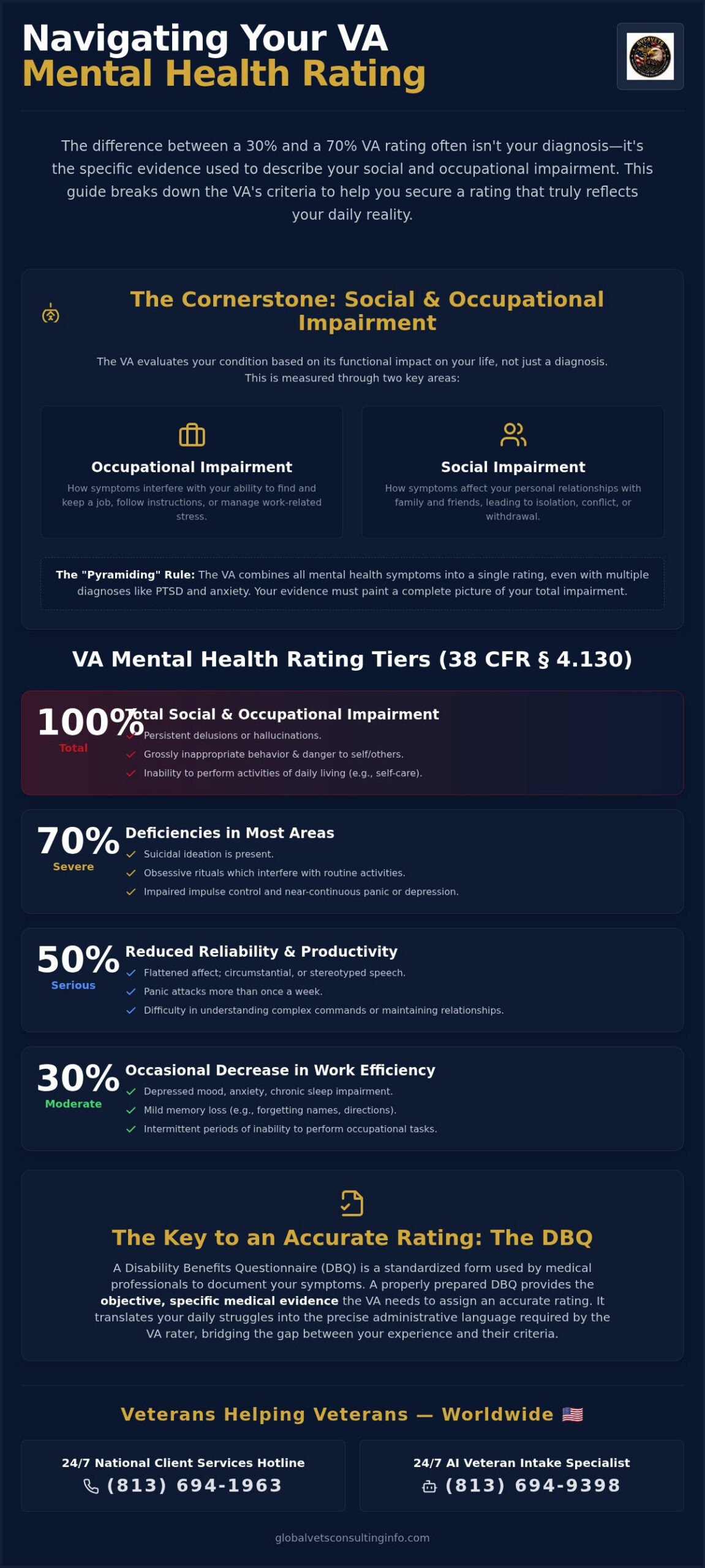
The VA assesses your struggle based on how it disrupts your daily life rather than the specific clinical label you’ve been given. Whether you’re managing PTSD, depression, or anxiety, your VA Mental Health Rating is determined by a universal schedule. This system ensures that your compensation is tied directly to your functional limitations. Ratings are assigned in specific tiers: 0%, 10%, 30%, 50%, 70%, or 100%. By focusing on “Social and Occupational Impairment,” the VA attempts to quantify the invisible weight you carry every day.
It’s vital to understand the “pyramiding” rule before you file. You can only receive one rating for mental health conditions, even if you have multiple diagnoses. If you’re living with both anxiety and PTSD, the VA combines those symptoms into a single evaluation rather than adding separate percentages. This is why your medical evidence must capture the full scope of your symptoms. The VA relies on the General Rating Formula for Mental Disorders to provide a standardized framework for these evaluations. This approach prioritizes the reality of your lived experience over a simple diagnosis code.
What is Social and Occupational Impairment?
This phrase is the cornerstone of your VA Mental Health Rating. It’s the metric used to determine which percentage bracket you fall into. Occupational impairment refers to how your symptoms interfere with your ability to earn a living. This might look like missing work frequently, having trouble following instructions from a supervisor, or being unable to maintain long-term employment. Social impairment focuses on your personal life. It includes things like isolating yourself from friends, experiencing frequent outbursts of anger, or struggling to maintain a healthy marriage and family relationships.
The Role of 38 CFR 4.130 in Your Claim
38 CFR 4.130 is the federal regulation that serves as the official rulebook for mental health disability evaluations. When a VA rater looks at your medical evidence, they aren’t making a guess; they’re matching your documented symptoms to the specific language found in this regulation. Understanding this “rulebook” allows you to speak the same language as the VA. This ensures your symptoms are documented in a way that the system recognizes and rewards with an accurate rating. Every piece of evidence you submit should aim to bridge the gap between your daily challenges and the specific criteria listed in this regulation.
Breaking Down the VA Mental Health Rating Percentages 📊
The VA uses a specific hierarchy of symptoms to assign your percentage. Each tier represents a different level of severity in how your condition impacts your life. According to the criteria found in 38 CFR § 4.130, the rater looks for specific clinical markers that align with these percentages. This structured approach helps ensure that veterans receive compensation that matches their level of disability.
- 100% Rating: This represents total occupational and social impairment. You may experience persistent delusions or hallucinations; or be unable to manage self-care and basic daily activities. It often involves a complete inability to function in a work or social environment.
- 70% Rating: This tier involves deficiencies in most areas, such as work, school, and family relations. Symptoms often include suicidal ideation; near-continuous panic or depression; and impaired impulse control.
- 50% Rating: This reflects occupational and social impairment with reduced reliability. Common symptoms include flattened affect; panic attacks that occur more than once a week; and difficulty understanding complex commands or maintaining focus.
- 30% Rating: This is assigned for an occasional decrease in work efficiency and intermittent periods of inability to perform tasks. You might deal with chronic anxiety, suspiciousness, or mild memory loss during periods of high stress.
The Jump from 50% to 70%: The Most Common Threshold
Many veterans find themselves stuck at a 50% VA Mental Health Rating even when their symptoms feel much more severe. The transition to 70% is often the most difficult threshold to cross. To reach this level, your medical evidence must show “deficiencies in most areas.” This usually requires documentation of high-level symptoms like suicidal ideation, obsessive rituals that interfere with daily routine, or a near-total inability to maintain a job. If you feel your current rating doesn’t reflect your reality, Mental Health Ratings Education can help you understand how to document these specific symptoms accurately.
0% And 10% Ratings: What They Mean
A 0% rating is often frustrating, but it’s actually a significant win. It establishes a formal service connection, meaning the VA acknowledges your condition started during your time in uniform. This makes it much easier to file for a VA Mental Health Rating increase later if your symptoms worsen. A 10% rating is typically reserved for “mild or transient” symptoms. These are issues that might decrease your work efficiency during periods of high stress but are generally manageable with medication or therapy. Establishing this baseline is the first step toward securing the benefits you’ve earned.
How to Secure an Accurate Rating with a Mental Health DBQ 📞
The Disability Benefits Questionnaire (DBQ) is the standardized tool the VA uses to evaluate the severity of your symptoms. Without a clear, clinical map of your daily struggles, the rater is left to interpret your condition based solely on a brief interview. To secure an accurate VA Mental Health Rating, you must take control of the documentation process through a structured approach.
- Step 1: Obtain the specific DBQ for mental health conditions that matches your diagnosis.
- Step 2: Work with a qualified medical professional to document your symptoms using the 38 CFR § 4.130 criteria.
- Step 3: Ensure the DBQ captures the frequency, severity, and duration of your symptoms to clearly demonstrate your level of social and occupational impairment.
Private DBQ vs. the C&P Exam
A Compensation and Pension (C&P) exam is often a rushed experience where a veteran has only a few minutes to recount years of trauma. This time pressure frequently leads to missing details and a lower VA Mental Health Rating. In contrast, a private DBQ allows for a thorough medical review in a safe environment. When you submit a well-prepared private DBQ, it acts as “fully developed” evidence, providing the rater with a complete picture before they even see you.
The Importance of Independent Medical Evidence
The VA is legally required to consider private medical evidence that is “competent and credible.” Detailed documentation is your best defense against VA claim denials for lack of evidence. By presenting an independent medical opinion, you ensure that your “worst days” are part of the record, not just the snapshot captured during a stressful government exam. If you’re ready to document your symptoms with precision, Global Vets Consulting provides the education you need to move forward with confidence.
Strategies for a VA Rating Increase and Avoiding Denials 🌐
Your mental health journey isn’t static. If your symptoms have worsened over time, your current compensation may no longer cover the actual cost of your disability. You have the right to file for a VA disability rating increase whenever your condition progresses. Many veterans hesitate to do this because they fear a reduction, but with the right medical evidence, you can protect your existing benefits while pursuing the higher tier you’ve earned.
A common pitfall during this process is downplaying your symptoms. Many of us were trained to “tough it out” and answer “I’m fine” when asked how we’re doing. In a C&P exam, this pride can lead to a lowballed VA Mental Health Rating. You must follow the “Bad Day” Rule. This means describing your symptoms as they are on your absolute worst days, not how you feel during a brief moment of clarity in the doctor’s office. Global Vets Consulting streamlines this evidence-gathering process by helping you document these fluctuations before you ever step into an exam room.
When to File for an Increase
You should consider filing for an increase when your symptoms begin to cause new, measurable disruptions in your life. This might include losing a job due to panic attacks, experiencing increased social isolation, or needing more intensive therapy. Gathering fresh medical evidence is the most critical step for a successful supplemental claim. New treatment records or a current DBQ can show the VA exactly how your VA Mental Health Rating criteria have changed since your last evaluation.
Secondary Service Connection
Sometimes, mental health struggles are the direct result of a physical injury. You can link conditions like depression or anxiety secondary to chronic back pain or other service-connected disabilities. This is where Nexus letters become essential. They provide the medical bridge connecting your physical pain to your mental health. By identifying these secondary connections, you can ensure your total disability rating accurately reflects the full impact of your service on your overall well-being.
Take Control of Your Disability Claim Today
Securing an accurate VA Mental Health Rating requires more than just showing up to an exam. It demands a strategic approach that combines a deep understanding of 38 CFR 4.130 with high-quality medical evidence. You’ve learned how the VA measures social and occupational impairment and why a private DBQ is often the missing link in a successful claim. By focusing on your worst days and identifying secondary connections, you move from being a passive participant to an empowered advocate for your own well-being.
As a veteran-owned and operated team, we understand the weight of this process. We provide standardized DBQ documentation support to ensure your symptoms are recorded with the precision the VA requires. Our 24/7 National Client Services Hotline is always available to help you manage the next steps of your journey. Ready to secure the evidence you need? Contact Global Vets Consulting for DBQ Support today! You’ve served your country with honor; now it’s time to ensure the system serves you.
Frequently Asked Questions
What is the average VA rating for mental health?
The most common rating assigned for mental health conditions like PTSD is 70%. While the VA doesn’t publish a single “average” for every veteran, data shows that most veterans with a service connection for mental health fall into the 50% or 70% tiers. This is because these levels represent the “occupational and social impairment” that many veterans experience after transitioning to civilian life.
Can the VA reduce my mental health rating?
Yes, the VA can propose a reduction if they find evidence of “material improvement” in your condition under ordinary conditions of life. However, they must follow strict procedures before lowering your VA Mental Health Rating. They usually require a new examination to prove that your symptoms have consistently decreased over time and that the improvement isn’t just a temporary “good day.”
How do I prove my mental health condition is service-connected?
You must establish three specific elements: a current clinical diagnosis, an in-service event or stressor, and a medical “nexus” connecting the two. Providing strong medical evidence, such as a private DBQ or a Nexus letter, is the most effective way to bridge this gap. This documentation proves to the VA that your current struggles are a direct result of your military service.
Does a PTSD diagnosis automatically mean a 70% rating?
No, a diagnosis alone doesn’t guarantee any specific percentage. The VA assigns your VA Mental Health Rating based on the severity of your symptoms and how they interfere with your work and relationships. You could be diagnosed with severe PTSD but only receive a 30% rating if your medical records don’t clearly document high-level symptoms like suicidal ideation or near-continuous panic.
What happens if I miss my C&P exam for mental health?
Missing a scheduled C&P exam without a valid reason often leads to an immediate claim denial. The VA views the exam as a critical piece of evidence. If you miss it, they will likely decide your claim based on the evidence already in your file, which is rarely enough to secure a favorable rating. If you miss an appointment, you must contact the VA immediately to provide “good cause” for the absence and request a reschedule.

Article by
Willie Daniel
Willie Daniel is the Founder and Chief Executive Officer (CEO) of Global Vets Consulting (GVC4Vets) – National Veterans Disability Services, a veteran-led educational and medical evidence support organization dedicated to helping veterans better understand VA disability rating increases, DBQ medical evidence, secondary claims education, and C&P examination preparation.
He is a retired U.S. Army Medical Service Corps Officer with more than 27 years of honorable military service, a decorated Iraq combat veteran, and a retired federal official with the U.S. Department of Veterans Affairs. Throughout his military and federal career, Willie Daniel served in leadership, healthcare administration, operational, and veteran-support roles focused on improving services and support systems for servicemembers, veterans, and their families.
Drawing from decades of military leadership, healthcare administration, veteran advocacy, and federal government experience, Willie Daniel brings a practical, veteran-centered perspective to Global Vets Consulting’s educational articles, AI-powered veteran resources, video education initiatives, and outreach programs. His experience navigating military systems, medical documentation processes, and veteran-related administrative operations provides valuable insight into many of the challenges veterans face when seeking to better understand VA disability rating criteria, medical evidence, documentation strategies, and secondary condition education.
Through GVC’s “Veterans Helping Veterans” mission, his focus is on delivering clear, educational, and easy-to-understand information designed to empower veterans with knowledge, resources, and educational tools that may help them make more informed decisions regarding their individual VA disability journeys.
The information provided through GVC is intended for educational and informational purposes only and should not be considered legal or medical advice.
Disclaimer
Disclaimer: Global Vets Consulting, LLC (“GVC”) is a veteran-led educational and medical evidence support organization. GVC is not a law firm, is not a Veterans Service Organization (VSO), and is not affiliated with the U.S. Department of Veterans Affairs (VA) or any government agency.
Global Vets Consulting does not provide legal advice, medical advice, medical treatment, or healthcare services. GVC does not prepare, file, or submit VA disability claims on behalf of veterans. All information provided through this website, blog articles, videos, educational materials, AI tools, dashboards, templates, and communications is intended solely for general educational and informational purposes.
Veterans are encouraged to consult with accredited representatives, licensed attorneys, qualified medical providers, or Veterans Service Organizations regarding their specific legal, medical, or VA-related matters. VA disability decisions, ratings, and outcomes are determined solely by the U.S. Department of Veterans Affairs based on applicable laws, regulations, medical evidence, and individual circumstances. Past results do not guarantee future outcomes.