

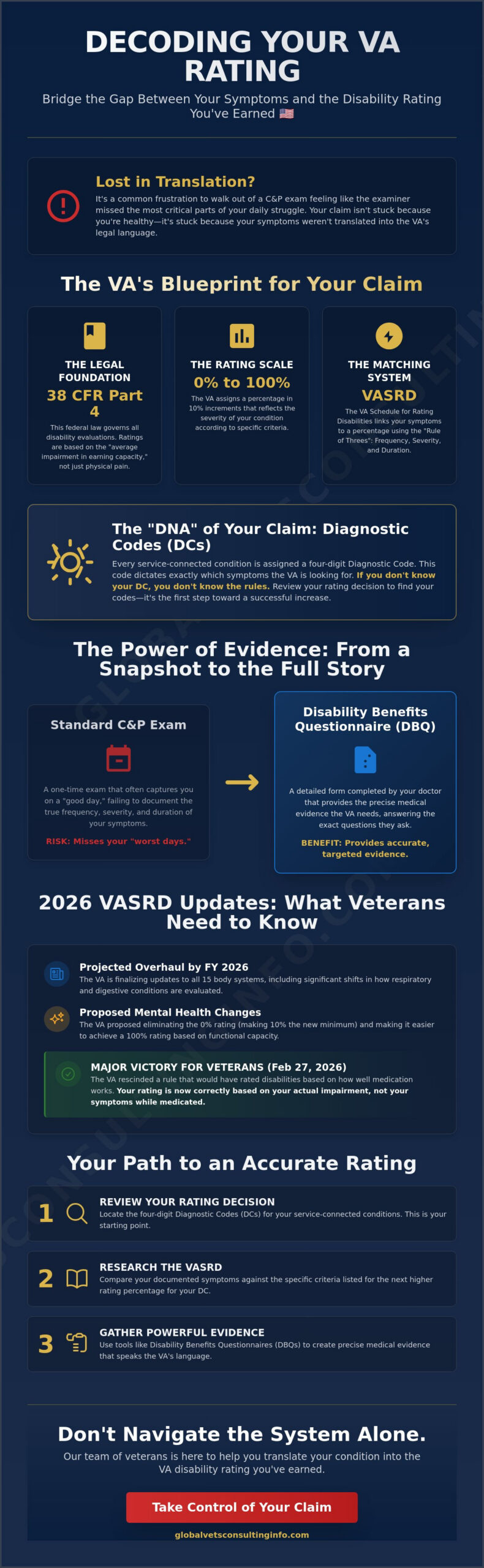
What if the reason your claim feels stuck isn’t because you are healthy, but because your symptoms were simply lost in translation? It is a common frustration to walk out of a C&P exam feeling like the examiner missed the most critical parts of your daily struggle. Truly understanding va schedular rating is about more than just reading a pay chart. It’s about learning how to speak the VA’s legal language so your medical evidence, like your DBQs, leads to the correct decision.
We understand the anxiety that comes with 38 CFR Part 4 legal jargon and the fear that your physical pain won’t match your assigned percentage. It’s our mission to ensure no veteran feels neglected by a complex system. This guide will help you master the complexities of the VASRD and show you how medical evidence determines your compensation level in 2026. We’ll walk through the latest diagnostic codes, explain the impact of the recent 2.8% COLA increases, and provide a clear path to bridging the gap between your symptoms and the higher disability rating you’ve earned. 🇺🇸
Key Takeaways
- Learn how the VA uses the 0% to 100% scale under 38 CFR Part 4 to evaluate your service-connected conditions.
- Master the role of Diagnostic Codes as the “DNA” of your claim, which is essential for understanding va schedular rating and how the VA matches symptoms to specific percentages.
- Discover why standard C&P exams often miss your “worst days” and how Disability Benefits Questionnaires (DBQs) provide the precise medical evidence needed for an accurate rating.
- Identify the specific steps to review your current rating decision and compare your symptoms against the next higher tier in the VASRD.
What is a VA Schedular Rating and Why Does It Matter?
A schedular rating is the standard method the VA uses to evaluate your service-connected conditions. understanding va schedular rating starts with knowing that the VA assigns a percentage based on how your symptoms match specific legal criteria. These ratings range from 0% to 100% in increments of 10. It’s important to realize that these numbers don’t just measure physical pain; they represent the “average impairment in earning capacity” for a veteran with that specific diagnosis. This means the VA is looking at how your condition would theoretically impact a person’s ability to work and support themselves.
The Legal Foundation: 38 CFR Part 4
The entire system is built upon 38 CFR Part 4, which is the federal law governing disability evaluations. The VA organizes this law into different body systems, such as the Musculoskeletal System or the Respiratory System. For example, when evaluating psychological conditions, the VA relies on the General Rating Formula for Mental Disorders to assign a percentage. This structure ensures a level of consistency across all claims, though it often requires precise medical evidence to prove you meet the higher tiers. Each body system has its own set of rules, and knowing which one applies to you is the first step in a successful claim.
Schedular vs. Extra-Schedular Ratings
While the vast majority of veterans receive a schedular rating, there are exceptions. If your symptoms are so severe or unusual that the standard schedule cannot accurately capture your level of disability, you might qualify for an extra-schedular rating. This process is more complex and typically requires approval from the Under Secretary for Benefits. It serves as a safety net for those whose cases don’t fit the standard mold. Gaining a deep understanding va schedular rating standards helps you identify if your case requires this specialized path or if it fits within the traditional framework.
Relying on a C&P examiner to find these nuances can be risky. Many veterans find that educating themselves on their specific diagnostic codes and using tools like a Disability Benefits Questionnaire (DBQ) helps bridge the gap between their daily reality and the VA’s legal requirements. This proactive approach is often the key to securing the compensation you’ve earned. It’s about moving from a place of confusion to a position of steady confidence in your claim’s outcome.
How the VA Schedule for Rating Disabilities (VASRD) Works
The VASRD acts as the blueprint for your entire claim. It isn’t just a list of illnesses; it’s a precise matching system that links your symptoms to a specific percentage. Deepening your understanding va schedular rating mechanics requires looking at the VA Schedule for Rating Disabilities (VASRD). The VA uses this legal framework to ensure that two veterans with similar symptoms receive similar compensation. They evaluate your condition based on the “Rule of Threes”: frequency, severity, and duration. If your symptoms don’t meet all three criteria for a higher tier, the rater will keep you at the lower level. You should also be aware of the “pyramiding” rule, which prevents the VA from rating you twice for the same functional impairment. For example, if one symptom is caused by two different service-connected conditions, you’ll only receive one rating for that specific limitation.
Understanding Diagnostic Codes (DCs)
Every service-connected condition is assigned a four-digit Diagnostic Code. This code is the “DNA” of your claim because it dictates exactly which symptoms the VA is looking for. If you don’t know your DC, you don’t know the rules you’re playing by. Reviewing your rating decision to identify this code is the first step toward a successful increase. It allows you to target your medical evidence to the specific requirements of that code rather than providing general information that doesn’t move the needle.
2026 VASRD Updates: What Veterans Need to Know
The VA is currently finalizing updates to all 15 body systems, with the full overhaul projected to finish by the end of fiscal year 2026. This includes significant shifts in how respiratory and digestive conditions are evaluated. For mental health, the VA has proposed eliminating the 0% rating entirely, making 10% the new minimum. They’ve also proposed making it easier to reach a 100% rating based on functional capacity. Conversely, proposed changes for sleep apnea and tinnitus may make those ratings more difficult to obtain in the future. A critical victory for veterans occurred on February 27, 2026, when the VA rescinded a rule that would have rated disabilities based on how well medication works. Your rating is once again based on your actual impairment, not your symptoms while medicated. If you’re concerned about how these changes affect your specific condition, reviewing educational resources on VA rating increases can provide the clarity you need. Remember, if you already have a rating, you’re generally protected by “grandfathering” rules; the VA won’t automatically reduce your percentage just because the schedule changes.
The Role of Medical Evidence in Your Schedular Rating
Many veterans walk into a C&P exam feeling like their entire future depends on a fifteen-minute conversation. The reality is that a single exam often fails to capture your “worst days.” If you’re having a relatively good day during the appointment, the examiner’s report might reflect a level of health that doesn’t exist most of the time. Truly understanding va schedular rating requires you to realize that the VA makes decisions based on the written record, not just your physical presence. This is why a Disability Benefits Questionnaire (DBQ) is so powerful. It “speaks the VA’s language” by checking the specific boxes found in the VA Schedule for Rating Disabilities (VASRD).
It’s frustrating when a doctor says you’re “fine” while you’re living in constant pain. This disconnect often happens because traditional medical records focus on treatment rather than functional impairment. A properly completed DBQ bridges this gap by focusing on how your symptoms meet the VA’s specific legal criteria. It provides a structured way to present your medical evidence so a rater can see exactly where you fit on the scale.
DBQs: The Bridge Between Pain and Percentages
For conditions like chronic back pain, the VA looks for objective data like Range of Motion (ROM) testing. If your doctor notes your pain but fails to measure exactly where your movement stops, you might be stuck with a lower rating. This is equally critical for DBQs for mental health conditions. These forms translate subjective feelings of anxiety or depression into objective data points about social and occupational impairment. By focusing on the frequency and severity of your symptoms, you ensure the VA has the full picture.
Independent Medical Evidence vs. VA Examiners
When your private medical evidence conflicts with a VA examiner’s report, the “Equipoise Rule” should apply. This legal principle states that when evidence for and against a claim is equal, the benefit of the doubt goes to the veteran. To make this work, your evidence must be “probative,” meaning it is relevant, credible, and detailed. Education on how to present medical evidence for VA service-connected compensation ensures your claim is actionable for the rater. It moves you from being a passive participant to a knowledgeable advocate for your own health and benefits.
Steps to Secure a Rating That Reflects Your True Condition
Securing the compensation you’ve earned is a methodical process that requires precision. It begins with your latest rating decision letter. You must identify the four-digit Diagnostic Code assigned to your condition, as this code serves as the roadmap for your benefits. By understanding va schedular rating criteria for that specific code, you can see exactly what the VA requires for the next higher percentage tier. If your symptoms have progressed since your last exam, your current rating likely no longer reflects your daily reality.
Follow these actionable steps to build a stronger case for an increase:
- Review your current medical records to identify “missing” symptoms that align with higher rating tiers.
- Master the VA disability claims process to understand timing and evidence submission.
- Gather independent medical evidence that clearly documents your functional limitations.
- Submit a DBQ for a VA disability rating increase to provide the objective data raters need.
Self-Assessment Using the VASRD
You need to read the rating criteria like a claims adjuster. If the 70% tier for your condition requires “occupational and social impairment in most areas” but your records only mention “occasional” issues, you’ve identified a critical evidence gap. This process isn’t about exaggerating; it’s about ensuring every symptom you experience is documented in the specific language the VA understands. Check your records for keywords used in 38 CFR Part 4 to ensure your functional loss is accurately represented.
Taking Action with Global Vets Consulting
Our “Veterans Helping Veterans” approach simplifies the administrative burden of the VA system. We provide the educational resources and documentation support you need to present a meticulous case. We focus on accuracy and thoroughness because we know that well-documented evidence is the fastest path to a fair rating. 🇺🇸
🌐 Worldwide: GlobalVetsConsultingInfo.com
📞 24/7 National Client Services Hotline: [Insert Number]
🤖 24/7 AI Veteran Intake Specialist: Available on our website
Take Control of Your Disability Rating Today
You now have the tools to move from confusion to clarity. We’ve explored how diagnostic codes dictate your percentage and why private medical evidence is the key to capturing your true functional impairment. Mastering the process of understanding va schedular rating standards is the first step toward the compensation you’ve earned. By focusing on objective data and specific VASRD criteria, you can ensure your claim reflects your actual service-connected conditions. Your daily struggles deserve to be recognized by the system accurately.
Global Vets Consulting has been veteran-owned and operated since 2021. We specialize in standardized DBQ documentation to help you bridge the gap between your symptoms and the VA’s legal requirements. If you’re ready to move forward, our 24/7 AI Veteran Intake Specialist is available on our website to assist you immediately. Secure the evidence you need for a fair VA rating at Global Vets Consulting. You’ve served your country with honor. Now it’s time to ensure you receive the benefits you deserve. Stay steady and keep pushing for the result you’ve earned. 🇺🇸
Frequently Asked Questions
What is the difference between a schedular and extra-schedular rating?
A schedular rating is based on the standard criteria found in the VASRD, while an extra-schedular rating is reserved for exceptional cases where symptoms don’t fit the established schedule. If your service-connected condition causes unique functional impairment that isn’t captured by the standard rules, the VA may assign an extra-schedular rating. This process requires clear evidence that your disability is so severe or unusual that the standard percentage is inadequate.
Can the VA lower my schedular rating in 2026?
Existing ratings are typically protected by “grandfathering” rules in 2026 even if the VASRD criteria for your specific condition change. The VA won’t automatically reduce your percentage just because they updated the rating schedule. However, they can still propose a reduction if a new medical exam shows sustained, material improvement in your condition. Staying informed is a key part of understanding va schedular rating protections and maintaining your earned benefits.
How does ‘VA Math’ affect my combined schedular rating?
VA math uses a “combined rating” system where percentages are calculated based on your remaining efficiency rather than being added together. For example, if you have two 50% ratings, the first takes 50% of your whole health, leaving 50% remaining. The second rating then takes 50% of that remaining 50%, resulting in a 75% combined rating. The VA rounds this final number to the nearest 10%, which would be 80% in this case.
What is a Diagnostic Code in a VA rating decision?
A Diagnostic Code (DC) is the four-digit identifier the VA uses to link your medical condition to the specific rating criteria in the VASRD. You can find this code on your rating decision letter. It tells the rater exactly which symptoms to look for when assigning a percentage. Knowing your DC is essential for understanding va schedular rating requirements and ensuring your medical evidence matches the VA’s specific legal language.
How do I know if I qualify for a schedular rating increase?
You likely qualify for an increase if your current symptoms match the requirements of a higher tier in the rating schedule. Start by reviewing your medical records and comparing your daily limitations against the criteria for the next percentage level. If you find that your condition has progressed or worsened, gathering updated medical evidence through a DBQ is the most effective way to prove you deserve a higher rating.

Article by
Willie Daniel
Willie Daniel is the Founder and Chief Executive Officer (CEO) of Global Vets Consulting (GVC) – National Veterans Disability Services, a veteran-led educational and medical evidence support organization dedicated to helping veterans better understand VA disability rating increases, DBQ medical evidence, secondary claims education, and C&P examination preparation.
He is a retired U.S. Army Medical Service Corps Officer with more than 27 years of honorable military service, a decorated Iraq combat veteran, and a retired federal official with the U.S. Department of Veterans Affairs. Throughout his military and federal career, Willie Daniel served in leadership, healthcare administration, operational, and veteran-support roles focused on improving services and support systems for servicemembers, veterans, and their families.
Drawing from decades of military leadership, healthcare administration, veteran advocacy, and federal government experience, Willie Daniel brings a practical, veteran-centered perspective to Global Vets Consulting’s educational articles, AI-powered veteran resources, video education initiatives, and outreach programs. His experience navigating military systems, medical documentation processes, and veteran-related administrative operations provides valuable insight into many of the challenges veterans face when seeking to better understand VA disability rating criteria, medical evidence, documentation strategies, and secondary condition education.
Through GVC’s “Veterans Helping Veterans” mission, his focus is on delivering clear, educational, and easy-to-understand information designed to empower veterans with knowledge, resources, and educational tools that may help them make more informed decisions regarding their individual VA disability journeys.
The information provided through GVC is intended for educational and informational purposes only and should not be considered legal or medical advice.
Disclaimer
Disclaimer: Global Vets Consulting, LLC (“GVC”) is a veteran-led educational and medical evidence support organization. GVC is not a law firm, is not a Veterans Service Organization (VSO), and is not affiliated with the U.S. Department of Veterans Affairs (VA) or any government agency.
Global Vets Consulting does not provide legal advice, medical advice, medical treatment, or healthcare services. GVC does not prepare, file, or submit VA disability claims on behalf of veterans. All information provided through this website, blog articles, videos, educational materials, AI tools, dashboards, templates, and communications is intended solely for general educational and informational purposes.
Veterans are encouraged to consult with accredited representatives, licensed attorneys, qualified medical providers, or Veterans Service Organizations regarding their specific legal, medical, or VA-related matters. VA disability decisions, ratings, and outcomes are determined solely by the U.S. Department of Veterans Affairs based on applicable laws, regulations, medical evidence, and individual circumstances. Past results do not guarantee future outcomes.