
What if the only thing standing between you and a fair rating isn’t the severity of your condition, but the specific format of your medical evidence? You’ve likely felt the stress of staring at a mountain of technical documents, wondering if one wrong box checked by a doctor will trigger an immediate denial. It’s a common frustration among the veteran community, and you shouldn’t have to be a legal expert to receive the benefits you earned through your service.
Having the va form 21-0960 series explained is your first step toward taking control of your claim and reducing the anxiety of the “lack of evidence” trap. These Disability Benefits Questionnaires, or DBQs, are the standardized tools the VA uses to translate your medical history into a disability percentage. This guide provides a clear roadmap to help you identify the correct form for your condition, understand the 2026 digital submission standards, and build a strategy to use these forms for a successful rating increase.
Key Takeaways
- Discover how the VA Form 21-0960 series serves as the “standardized language” the VBA uses to translate your medical evidence into a disability rating.
- Learn how to identify the correct sub-series for your specific condition, ensuring your documentation matches the requirements for musculoskeletal, mental health, or neurological claims.
- Understand the strategic advantage of having this va form 21-0960 series explained so you can provide the precise documentation needed to avoid a claim denial.
- Find out how leveraging private medical evidence through these forms can offer a more thorough representation of your symptoms than a standard C&P examination.
What is the VA Form 21-0960 Series? 🇺🇸
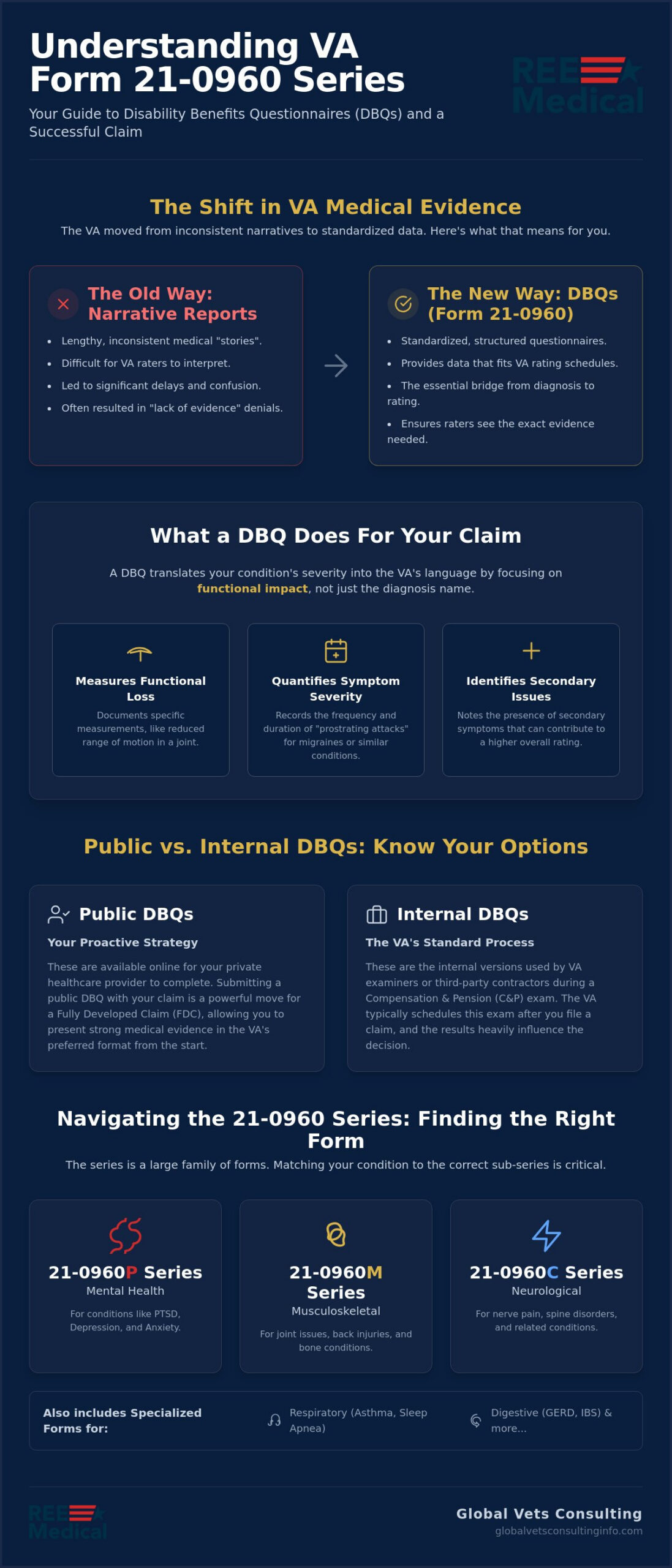
The VA Form 21-0960 series is the official designation for what most veterans know as Disability Benefits Questionnaires. Years ago, the VA relied on lengthy, narrative medical reports that were often inconsistent and difficult for raters to interpret. This system caused significant delays and confusion for everyone involved. To solve this, the VBA created the 21-0960 series to standardize how medical evidence is collected. Think of these forms as the essential bridge between your medical diagnosis and your final VA rating percentage.
Having the va form 21-0960 series explained means understanding that the VA has moved away from “storytelling” in medical records. Instead, they want data that fits into their specific rating schedules. These structured questionnaires ensure that the evidence you submit is exactly what the rater needs to see to make a decision on your claim.
The Core Purpose of a DBQ
A Disability Benefits Questionnaire (DBQ) focuses on the severity of your condition rather than just the name of the illness. The VA grants compensation based on how a condition affects your daily life and ability to work. These forms ensure your doctor documents the exact functional limitations the VA rater is looking for, such as:
- Specific measurements of reduced range of motion.
- The frequency and duration of “prostrating attacks” for conditions like migraines.
- The presence of secondary symptoms that might increase your overall rating.
Public vs. Internal DBQs
You’ll encounter two main types of these forms: internal and public. Internal versions are used by VA examiners or third party contractors during a C&P exam. Public versions are available for your private healthcare providers to fill out. Submitting a public DBQ is a powerful strategy for a Fully Developed Claim (FDC). It allows you to present your medical evidence in the VA’s own language before an exam is even scheduled. This proactive approach helps ensure your medical evidence isn’t ignored or misinterpreted during the va disability claims process step by step.
Navigating the 21-0960 Series: Finding the Right Form
Navigating the VA’s library of documents can feel like searching for a needle in a haystack. The 21-0960 series isn’t a single document but an umbrella covering dozens of specific forms categorized by body systems. Choosing the wrong form can delay your claim by months. You need to look for the specific alpha-numeric suffix that matches your diagnosis. For example, a veteran seeking a rating for a back injury needs a different form than one filing for a knee condition, even though both fall under the musculoskeletal category.
It’s vital to use the most current version available in 2026. The VA frequently updates these documents to reflect new rating criteria and legislative changes like the Elizabeth Dole Act. You can find the full list of Publicly Available DBQs on the official VA website. If you submit an outdated form, the rater might reject it as insufficient evidence. This is why having the va form 21-0960 series explained is a strategic advantage for your claim.
Commonly Used 21-0960 Forms
Most veterans will interact with a few primary sub-series. The 21-0960P series is used for a DBQ for mental health conditions, including PTSD, depression, and anxiety. For joint or bone issues, you’ll look for the 21-0960M series, which covers musculoskeletal conditions. If you’re dealing with nerve pain or spine disorders, the 21-0960C series for neurological conditions is the correct choice.
Forms for Specialized Conditions
Specialized forms exist for internal systems that are often overlooked. Respiratory forms cover conditions like Sleep Apnea and Asthma, which have seen increased scrutiny in recent years. There are also specific forms for digestive and gastrointestinal claims, such as GERD or IBS. If you’re overwhelmed by the options, Global Vets Consulting can help you identify exactly which document aligns with your medical history.
Strategic Use of 21-0960 Forms to Win Your Claim
Submitting a private DBQ is one of the most effective ways to take control of your claim. While the VA often relies on their own examiners, you have the right to provide evidence from your own healthcare providers. Using the 21-0960 series effectively ensures that your medical evidence is presented in a way that the VA cannot easily dismiss. These forms are designed to force the VA rater to address specific functional limitations and symptoms that directly correlate to your earned rating.
Many veterans find their VA claim denied for lack of evidence because their records are disorganized or vague. Having the va form 21-0960 series explained helps you bridge that gap. When your doctor completes these forms, they must understand the “more likely than not” standard of proof. This legal threshold means there’s at least a 50% chance your condition is service-connected or as severe as you claim. Without this specific terminology, even the best medical records can fall short of VA requirements.
Private DBQs vs. C&P Exams
A standard C&P exam can be a source of high anxiety. These appointments often last only 15 to 20 minutes with a provider who has never met you before. In contrast, your private physician understands your full medical history and the daily impact of your disability. By utilizing Publicly Available VA DBQ Forms, you allow a trusted professional to document your condition thoroughly. This often results in a more accurate reflection of your health than a rushed government examination.
Maximizing Your Rating Increase
If your service-connected condition has worsened over time, you don’t have to wait for the VA to notice. You can proactively use a dbq for va disability rating increase to document new symptoms or increased pain. It’s essential to document “flare-ups” and functional loss during these evaluations. The VA rater needs to know how you function on your worst days, not just the day of your appointment. If you’re ready to secure the benefits you’ve earned, Global Vets Consulting is here to guide you through every step of the documentation process.
How Global Vets Consulting Simplifies the 21-0960 Process
Global Vets Consulting operates with a clear mission: Veterans Helping Veterans. We understand that behind every form is a person who served, and we treat your medical evidence with the respect it deserves. Having the va form 21-0960 series explained is only half the battle; the other half is ensuring that your specific medical story is documented with surgical precision. Our team focuses on standardized medical documentation to ensure your claim “speaks VA” from the very first submission.
Meticulousness isn’t just a goal for us; it’s our primary duty. We help you navigate the 21-0960 series to document the severity of your conditions accurately, reducing the risk of being overlooked by a busy rater. If you have immediate questions or feel overwhelmed by the technical paperwork, our 24/7 National Client Services Hotline is available to provide guidance whenever you need it. 🇺🇸
Expert Assistance for Accurate Documentation
One of the most common reasons for claim delays is a “kickback,” where the VA deems a form incomplete or insufficient. We provide a thorough review of medical status and limitations to ensure every box is checked and every measurement is recorded according to current 2026 standards. By focusing on the details that matter most to the VBA, we help you avoid the administrative back-and-forth that often adds months or years to a claim’s timeline.
Your Path to a Successful Rating
Our goal is to reduce the administrative burden that keeps many veterans from seeking the rating increases they deserve. We streamline the va disability claims process step by step, allowing you to focus on your health while we focus on the documentation. Don’t let confusing form numbers stand in the way of your earned benefits. Partner with a knowledgeable advocate who understands the system and is dedicated to your success. 🌎
Take Control of Your VA Rating Today
You served with honor, and your disability benefits should reflect the true impact of your service-connected conditions. Having the va form 21-0960 series explained gives you the power to speak the VA’s language and submit evidence that raters can’t ignore. Accurate documentation of your functional limitations is the key to avoiding denials and securing a rating increase that matches your current health status.
Global Vets Consulting is veteran-owned and operated since 2021, providing worldwide support to US veterans. We offer a 24/7 AI Veteran Intake Specialist to ensure you can start your journey toward better benefits at any time. Our mission is to simplify complex administrative hurdles so you can focus on your well-being while we focus on the precision of your medical documentation.
Don’t let technical paperwork stand between you and your earned outcomes. Contact Global Vets Consulting for Professional DBQ Preparation 🌎 and partner with an advocate who understands the system from the inside out. You’ve earned these benefits; it’s time to secure them.
Frequently Asked Questions
Can I fill out a VA Form 21-0960 myself?
No, you cannot fill out these forms yourself because they require a licensed medical professional’s signature and clinical assessment. The VA requires a healthcare provider to verify your symptoms and functional limitations through an objective medical lens. While you can provide your doctor with personal notes about your “worst days” to help them understand your condition, the final clinical data must be recorded by the physician to count as valid medical evidence.
Do private doctors have to use the 21-0960 series forms?
Private doctors aren’t legally required to use these forms during standard treatment, but using them is highly recommended for your disability claim. Using the standardized 21-0960 series ensures your doctor provides the exact data points the VA rater needs to assign an accurate percentage. If a doctor uses standard clinical notes instead, the rater might miss critical information, which often leads to a claim denial for “lack of evidence.”
What happens if the VA ignores my private 21-0960 form?
If the VA ignores your private medical evidence, it may be a violation of their duty to consider all evidence of record. You have the legal right to request a Higher-Level Review (HLR) if a rater fails to address a properly completed DBQ in your decision letter. Having the va form 21-0960 series explained helps you identify when a rater has overlooked specific evidence that should have triggered a higher rating percentage.
Are the 21-0960 forms the same as a Nexus Letter?
No, these forms are not the same as a Nexus Letter. A DBQ focuses on the current severity and symptoms of a condition to determine your rating percentage. A Nexus Letter is a separate document that establishes a formal link between your current condition and your military service. While both are critical pieces of medical evidence, they serve different purposes in the VA disability claim process and should be used together for maximum impact.
How do I find the specific 21-0960 form for my condition in 2026?
You can find the correct form by visiting the official VA website and searching for the public DBQ list categorized by body system. In 2026, the VA continues to organize the 21-0960 series by medical specialty, such as musculoskeletal or respiratory conditions. It’s essential to download the most current PDF version to ensure your doctor provides the specific data points required by the VBA under the latest rating schedules.

Article by
Willie Daniel
Willie Daniel is the Founder and Chief Executive Officer (CEO) of Global Vets Consulting (GVC) – National Veterans Disability Services, a veteran-led educational and medical evidence support organization dedicated to helping veterans better understand VA disability rating increases, DBQ medical evidence, secondary claims education, and C&P examination preparation.
He is a retired U.S. Army Medical Service Corps Officer with more than 27 years of honorable military service, a decorated Iraq combat veteran, and a retired federal official with the U.S. Department of Veterans Affairs. Throughout his military and federal career, Willie Daniel served in leadership, healthcare administration, operational, and veteran-support roles focused on improving services and support systems for servicemembers, veterans, and their families.
Drawing from decades of military leadership, healthcare administration, veteran advocacy, and federal government experience, Willie Daniel brings a practical, veteran-centered perspective to Global Vets Consulting’s educational articles, AI-powered veteran resources, video education initiatives, and outreach programs. His experience navigating military systems, medical documentation processes, and veteran-related administrative operations provides valuable insight into many of the challenges veterans face when seeking to better understand VA disability rating criteria, medical evidence, documentation strategies, and secondary condition education.
Through GVC’s “Veterans Helping Veterans” mission, his focus is on delivering clear, educational, and easy-to-understand information designed to empower veterans with knowledge, resources, and educational tools that may help them make more informed decisions regarding their individual VA disability journeys.
The information provided through GVC is intended for educational and informational purposes only and should not be considered legal or medical advice.
Disclaimer
Disclaimer: Global Vets Consulting, LLC (“GVC”) is a veteran-led educational and medical evidence support organization. GVC is not a law firm, is not a Veterans Service Organization (VSO), and is not affiliated with the U.S. Department of Veterans Affairs (VA) or any government agency.
Global Vets Consulting does not provide legal advice, medical advice, medical treatment, or healthcare services. GVC does not prepare, file, or submit VA disability claims on behalf of veterans. All information provided through this website, blog articles, videos, educational materials, AI tools, dashboards, templates, and communications is intended solely for general educational and informational purposes.
Veterans are encouraged to consult with accredited representatives, licensed attorneys, qualified medical providers, or Veterans Service Organizations regarding their specific legal, medical, or VA-related matters. VA disability decisions, ratings, and outcomes are determined solely by the U.S. Department of Veterans Affairs based on applicable laws, regulations, medical evidence, and individual circumstances. Past results do not guarantee future outcomes.

