
Is your monthly check actually keeping up with the rising cost of living, or is “VA Math” leaving you behind? With the 2.8% COLA increase officially taking effect, understanding the new 2026 va disability rates is the first step toward financial stability. We know it’s frustrating when your rating doesn’t reflect your daily health struggles, especially when inflation seems to move faster than your benefits.
You’ve earned this compensation through your service, and you shouldn’t have to guess what your next deposit will look like. We promise to provide the most accurate, up-to-date 2026 pay charts so you can plan your future with confidence. This article breaks down the new monthly totals for every percentage level, explains how dependents increase your take-home pay, and highlights how medical evidence like DBQs can help you secure a rating increase that matches your true condition.
Key Takeaways
- Review the updated 2026 va disability rates to see exactly how the 2.8% COLA increase affects your monthly tax-free compensation.
- Learn how your household status impacts your pay; ratings of 30% or higher qualify for additional monthly support for spouses, children, and parents.
- Explore the requirements for Special Monthly Compensation, including Aid and Attendance benefits for veterans with spouses needing daily assistance.
- Understand why Disability Benefits Questionnaires (DBQs) are the most vital pieces of medical evidence for proving the severity of your service-connected conditions.
- Discover a clear path toward a VA rating increase through comprehensive education on secondary claims and technical documentation.
2026 VA Disability Rates and the 2.8% COLA Increase 🇺🇸
VA disability compensation is a monthly, tax-free benefit paid to veterans who have injuries or illnesses that occurred or worsened during active military service. For the 2026 calendar year, the federal government has confirmed a 2.8% Cost-of-Living Adjustment (COLA). This increase ensures that your benefits maintain their purchasing power as the price of goods and services rises. These new va disability rates are officially effective as of December 1, 2025, meaning you’ll see the adjusted amount in your January 1, 2026, payment. Because this compensation is provided by the U.S. Department of Veterans Affairs, it remains completely exempt from federal and state income taxes. This allows you to keep every dollar you’ve earned through your service.
How COLA Affects Your Monthly Benefit
The annual increase isn’t a random number. It’s determined by the Social Security Administration (SSA) using the Consumer Price Index for Urban Wage Earners and Clerical Workers (CPI-W). This metric tracks inflation and dictates how much benefits must rise to keep pace with the economy. You don’t need to file any paperwork or submit a new claim to receive this 2.8% bump. The VA applies the adjustment automatically to all existing accounts, so your focus can remain on your health rather than administrative hurdles. This predictable growth helps provide peace of mind for those living on a fixed income.
Eligibility for 2026 Disability Compensation
To qualify for these updated va disability rates, you must have a current physical or mental health condition that is service-connected. This means your military service caused or aggravated the issue. While many people think of physical injuries first, these rates also apply to mental health conditions such as PTSD, anxiety, and depression. If your current rating doesn’t accurately reflect your symptoms, obtaining updated medical evidence like a Disability Benefits Questionnaire (DBQ) is a critical step in securing a VA rating increase. We’re here to help you understand how to document your condition so you receive the full compensation you deserve.
2026 VA Disability Pay Charts: Monthly Rates by Percentage
Knowing the exact dollar amount of your monthly benefit is essential for your household budget. The official VA disability pay charts provide a standardized baseline for all veterans based on their combined disability rating. These va disability rates are designed to compensate for the average loss in earning capacity caused by service-connected conditions. While the numbers are fixed by federal law, ensuring your rating actually matches your medical evidence is where many veterans struggle. If your symptoms have worsened, you may be eligible for a VA rating increase to reflect your current health status.
Rates for 10% and 20% Disability Ratings
For veterans with lower-tier ratings, the monthly compensation is a flat rate. At these levels, the VA does not provide additional funding for dependents like spouses or children. This is because the administrative system assumes these ratings have a more modest impact on your overall ability to maintain steady employment. For the 2026 calendar year, the va disability rates for these tiers are:
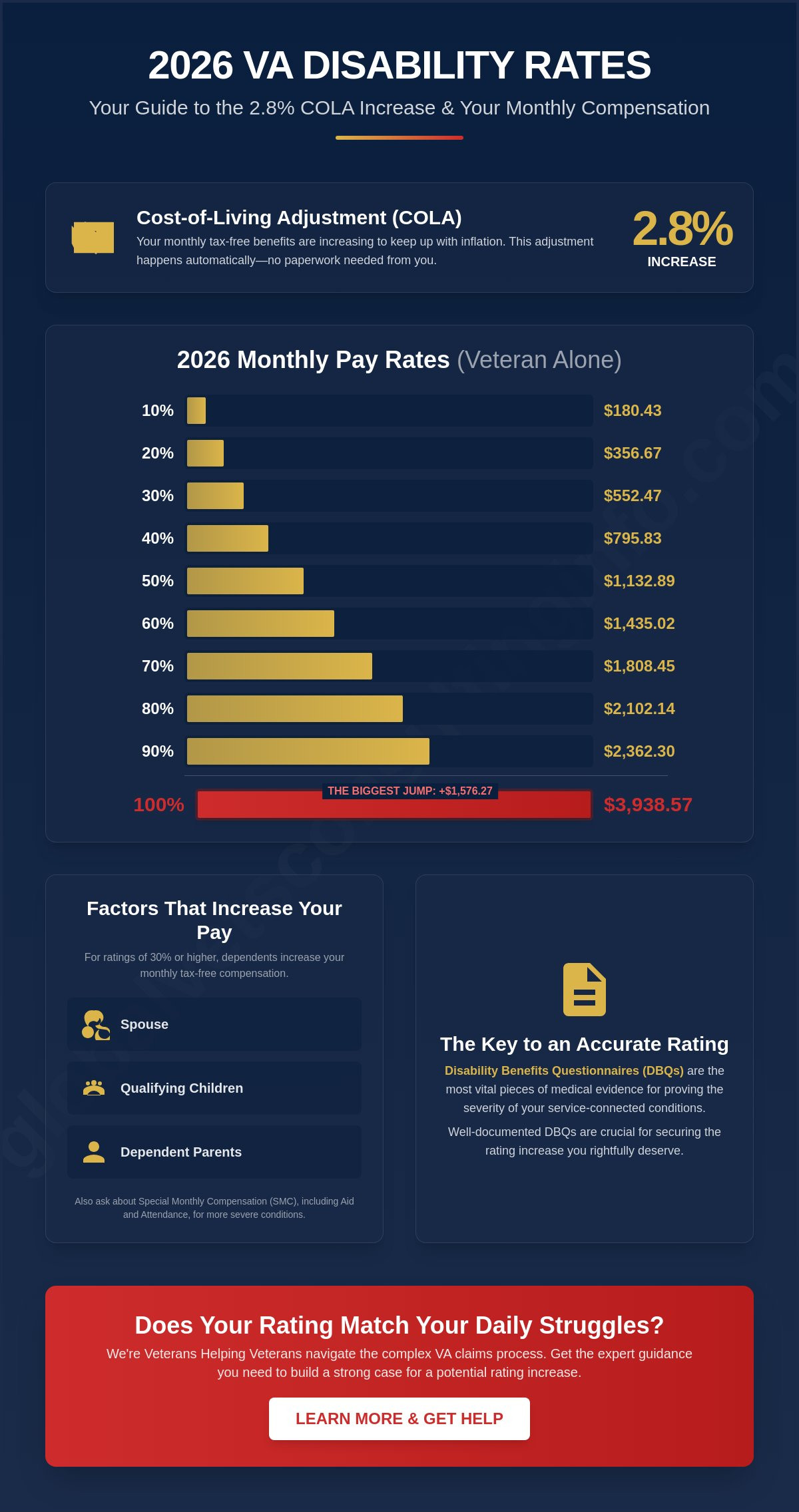
- 10% Disability Rating: $180.43 per month
- 20% Disability Rating: $356.67 per month
Rates for 30% to 100% Disability Ratings (Veteran Alone)
Once you reach a 30% rating, the compensation structure changes. You become eligible to add dependents to your claim, which increases your monthly total. However, the baseline for a “Veteran Alone” (no dependents) shows a steady climb for every 10% increment. The most dramatic shift occurs at the top of the chart. The financial leap between a 90% and 100% rating is the most significant gap in the entire system, representing a difference of over $1,500 per month. For those with permanent conditions, achieving 100% P&T VA Disability status provides long-term financial security and additional protections. The 2026 baseline rates are:
- 30% Rating: $552.47
- 40% Rating: $795.83
- 50% Rating: $1,132.89
- 60% Rating: $1,435.02
- 70% Rating: $1,808.45
- 80% Rating: $2,102.14
- 90% Rating: $2,362.30
- 100% Rating: $3,938.57
Factors That Increase Your Monthly VA Pay
Your baseline rating is only one part of the equation. While the va disability rates provide a foundation, several factors can significantly increase your monthly check. The most common way to boost your compensation is by adding eligible dependents to your claim. Once you reach a 30% disability rating, the VA acknowledges the additional financial responsibility of supporting a family. This includes your spouse, children under 18, or up to age 23 if they are enrolled in school, and even dependent parents. If your spouse requires daily assistance for personal needs, you might also qualify for “Aid and Attendance” (A/A) benefits, which adds a specific allowance on top of your standard dependent rate.
Beyond family status, many veterans overlook the impact of secondary conditions to increase va rating. A primary service-connected condition often causes new medical issues over time. For example, a service-connected knee injury might lead to a compensatory back condition due to an altered gait. Documenting these secondary links is often the most effective path to reaching a higher tier in the va disability rates chart. For veterans whose service-connected conditions prevent them from maintaining substantially gainful employment, total disability individual unemployability (TDIU) can bridge the gap between a lower rating and the full 100% compensation rate. For those with severe disabilities, such as the loss of use of a limb or specific sensory impairments, Special Monthly Compensation (SMC) provides even higher tiers of pay that can exceed the standard 100% rate.
Adding Dependents to Your VA Claim
The transition from a “Veteran Alone” status to a “Veteran with Spouse” can add over $200 to your monthly payment at the 100% level. For the 2026 calendar year, a veteran with a spouse receives $4,158.16 compared to the $3,938.57 paid to a veteran alone. You must proactively notify the VA of any life changes like marriage, divorce, or the birth of a child to ensure your checks are accurate. These adjustments are tied to the annual Cost-of-Living Adjustment (COLA), which ensures your family’s support keeps pace with inflation. If you need help documenting these family benefits, reach out to our team at Global Vets Consulting for expert resource awareness.
Understanding “VA Math” and Combined Ratings
Reaching a higher rating isn’t as simple as adding percentages together. The VA uses a “combined rating” system where they subtract each disability from your “whole” health. This means two 50% ratings result in an 80% combined rating, not 100%. To bridge this gap, you need airtight medical evidence that proves your level of impairment. Having the combined disability rating explained is essential for understanding exactly how the VA calculates your final percentage and where opportunities exist to maximize your benefits. Using a dbq for va disability rating increase allows you to present your symptoms in the exact format the VA requires to justify a higher percentage. This technical precision is often the difference between staying at your current level and securing the maximum benefit you’ve earned.
How to Secure an Accurate Rating with DBQs 📞
A Disability Benefits Questionnaire (DBQ) is the essential medical evidence the VA uses to determine the severity of your service-connected conditions. These standardized forms allow medical professionals to document your symptoms in a way that aligns directly with the VA’s rating schedule. Without a detailed and accurate DBQ, you risk being assigned a percentage that doesn’t reflect your daily reality. If you’re stuck at a lower tier of the va disability rates than your health justifies, Global Vets Consulting is your partner for professional DBQ documentation education and medical evidence resources. We help you bridge the gap between your current rating and the compensation you’ve earned.
The Advantage of Private Medical Evidence
Many veterans rely exclusively on a VA-scheduled Compensation and Pension (C&P) examination. While these exams are a standard part of the process, they can often feel rushed, sometimes lasting only a few minutes. A private DBQ offers a significant advantage because it allows for a thorough, comprehensive review of your medical history. This detailed level of documentation ensures that every symptom is captured accurately. Our what is a dbq guide provides a clear roadmap for veterans to understand the specific evidence required to support a successful claim for a rating increase.
Next Steps: Increasing Your 2026 VA Rating
Compare your current medical records against the 2026 va disability rates charts. If your health has declined or you’ve developed new secondary conditions, your monthly check should reflect those changes. Taking action now ensures you don’t miss out on the 2.8% COLA increase applied to a higher rating tier. We provide constant support to ensure you’re never navigating the system alone.
- 🇺🇸 24/7 National Client Services Hotline for immediate guidance.
- 🤖 24/7 AI Veteran Intake Specialist to start your journey instantly.
- 🌎 Worldwide Support for veterans serving or living abroad.
Don’t let “VA Math” or incomplete evidence keep you from your maximum benefits. Our mission is to provide the education and resources you need to secure a fair outcome. Maximize your VA disability rating with Global Vets Consulting.
Secure the Compensation You’ve Earned in 2026
The 2.8% COLA increase is a vital step in maintaining your standard of living, but it’s only one part of the financial picture. The true value of your monthly check depends on an accurate rating that reflects your current health. Whether you’re adding dependents or documenting secondary conditions, having precise medical evidence is the only way to ensure the va disability rates you receive match the severity of your service-connected conditions.
Global Vets Consulting has been veteran-owned and operated since 2021, and we specialize in providing the medical evidence education you need to succeed. Our mission is to simplify the complex administrative hurdles that often stand between you and your maximum benefits. With our 24/7 AI Veteran Intake Specialist and expert resources for Disability Benefits Questionnaires (DBQ), we provide a clear, predictable path forward for your claim. You’ve served your country with honor; now it’s time to ensure the system works for you.
📞 Contact our 24/7 National Client Services Hotline to secure your earned rating.
You don’t have to face the system alone. We’re ready to help you take the next step toward the stability and peace of mind you deserve.
Frequently Asked Questions
What is the 2026 VA disability COLA increase?
The cost-of-living adjustment for 2026 is 2.8%. This percentage is determined by the Social Security Administration based on inflation data to ensure your benefits keep their purchasing power. You don’t need to apply for this raise; the VA applies it automatically to all va disability rates starting with your January 1, 2026, payment.
Is VA disability pay considered taxable income?
No, your monthly disability compensation is completely tax-free. This exemption applies at both the federal and state levels. Because these payments are for service-connected injuries or illnesses, the IRS doesn’t count them as gross income. You don’t need to report this money on your tax returns, allowing you to keep the full amount for your household needs.
How much does the VA pay for a spouse and child in 2026?
The exact amount depends on your combined disability rating. For a veteran with a 100% rating, a spouse and one child, the monthly payment is $4,318.98. If you’re rated at 50%, that same family status results in $1,322.57. These va disability rates are tiered, so adding more children or dependent parents will further increase your total monthly check.
Can I receive VA disability and Social Security at the same time?
Yes, you can receive both benefits simultaneously. Receiving VA compensation doesn’t disqualify you from Social Security Disability Insurance (SSDI) or Social Security retirement benefits. While VA pay is based on service connection, Social Security is based on your work history and total disability. It’s a common way for veterans to secure their financial future through multiple earned streams of support.
What happens to my rate if my condition gets worse in 2026?
You have the right to request a VA rating increase if your symptoms have worsened since your last evaluation. To move to a higher pay tier, you must submit fresh medical evidence that documents your current level of impairment. Using a technical document like a Disability Benefits Questionnaire (DBQ) is the most effective way to show the VA that your condition justifies a higher monthly rate.

Article by
Willie Daniel
Willie Daniel is the Founder and Chief Executive Officer (CEO) of Global Vets Consulting (GVC) – National Veterans Disability Services, a veteran-led educational and medical evidence support organization dedicated to helping veterans better understand VA disability rating increases, DBQ medical evidence, secondary claims education, and C&P examination preparation.
He is a retired U.S. Army Medical Service Corps Officer with more than 27 years of honorable military service, a decorated Iraq combat veteran, and a retired federal official with the U.S. Department of Veterans Affairs. Throughout his military and federal career, Willie Daniel served in leadership, healthcare administration, operational, and veteran-support roles focused on improving services and support systems for servicemembers, veterans, and their families.
Drawing from decades of military leadership, healthcare administration, veteran advocacy, and federal government experience, Willie Daniel brings a practical, veteran-centered perspective to Global Vets Consulting’s educational articles, AI-powered veteran resources, video education initiatives, and outreach programs. His experience navigating military systems, medical documentation processes, and veteran-related administrative operations provides valuable insight into many of the challenges veterans face when seeking to better understand VA disability rating criteria, medical evidence, documentation strategies, and secondary condition education.
Through GVC’s “Veterans Helping Veterans” mission, his focus is on delivering clear, educational, and easy-to-understand information designed to empower veterans with knowledge, resources, and educational tools that may help them make more informed decisions regarding their individual VA disability journeys.
The information provided through GVC is intended for educational and informational purposes only and should not be considered legal or medical advice.
Disclaimer
Disclaimer: Global Vets Consulting, LLC (“GVC”) is a veteran-led educational and medical evidence support organization. GVC is not a law firm, is not a Veterans Service Organization (VSO), and is not affiliated with the U.S. Department of Veterans Affairs (VA) or any government agency.
Global Vets Consulting does not provide legal advice, medical advice, medical treatment, or healthcare services. GVC does not prepare, file, or submit VA disability claims on behalf of veterans. All information provided through this website, blog articles, videos, educational materials, AI tools, dashboards, templates, and communications is intended solely for general educational and informational purposes.
Veterans are encouraged to consult with accredited representatives, licensed attorneys, qualified medical providers, or Veterans Service Organizations regarding their specific legal, medical, or VA-related matters. VA disability decisions, ratings, and outcomes are determined solely by the U.S. Department of Veterans Affairs based on applicable laws, regulations, medical evidence, and individual circumstances. Past results do not guarantee future outcomes.