
A standard medical exam often fails to capture the reality of living with chronic back pain, leaving many veterans with ratings that don’t reflect their actual physical limitations. You likely feel that your daily struggle with stiffness and flare-ups is far more severe than what a quick range-of-motion test suggests during a hurried C&P exam. It is frustrating to see your service-connected injury reduced to a few checked boxes on a dbq for degenerative disc disease that miss the “worst day” scenarios you face regularly.
This guide will show you how to properly document your condition to ensure your medical evidence reflects the true severity of your pain. By documenting your functional loss accurately, you can pursue a rating that aligns with the 2026 VA disability compensation rates, such as the $1,808.45 monthly payment for a 70% rating. We will examine the specific requirements of the Back (Thoracolumbar Spine) Conditions questionnaire, form VBA-21-0960M-14, and provide a clear path toward submitting a successful Fully Developed Claim.
Key Takeaways
- Identify the specific Thoracolumbar Spine DBQ form and understand why it serves as the clinical foundation for your disability claim.
- Learn how the VA applies the “Painful Motion” rule to ensure your rating is based on your actual functional limits rather than just physical measurements.
- Discover the essential steps for preparing your dbq for degenerative disc disease, including how to use imaging and pain journals to support your clinical narrative.
- Understand why meticulous documentation of incapacitating episodes is vital for moving beyond a standard 20 percent rating.
- See how partnering with a veteran-owned specialist ensures every section of your DBQ is backed by clinical facts to minimize the risk of a low-ball rating.
Understanding the DBQ for Degenerative Disc Disease (DDD)
The Disability Benefits Questionnaire (DBQ) is more than just paperwork; it is the primary tool the VA uses to translate your medical history into a disability rating. For veterans suffering from back pain, the specific form required is the Thoracolumbar Spine DBQ. While Degenerative Disc Disease is considered a high-value claim due to its significant impact on daily life, it’s frequently underrated because of insufficient or poorly organized evidence. A properly completed dbq for degenerative disc disease acts as a clinical map that guides the rater through your functional limitations.
The VA views your mid and lower back as a single functional unit rather than separate segments. This means the rater looks at the overall range of motion for the entire thoracolumbar spine. If your documentation doesn’t account for how these regions interact during a flare-up, you risk a rating that fails to capture your true level of impairment. Using a comprehensive dbq for degenerative disc disease ensures that every limitation is recorded according to VA standards, leaving no room for guesswork by the rater.
What the VA Specifically Looks for in a DDD Claim
The VA requires objective clinical findings to grant a service connection. First, you need clear imaging, such as X-rays or MRIs, that confirms the presence of disc degeneration. Second, you must establish a direct link between your current spinal issues and specific events from your military service. Finally, the rater prioritizes objective measurements, like range of motion degrees, over subjective reports of “it hurts.” Without these specific data points, your claim may stall or result in a lower rating than you deserve.
Why a Private DBQ is a Strategic Advantage
Choosing a private evaluation over a standard C&P exam often changes the trajectory of a claim. A typical C&P exam might last only ten minutes, which is rarely enough time to discuss how your back feels on your worst days. A private DBQ allows for a thorough, clinical evaluation that supports a Fully Developed Claim (FDC). This approach provides the VA with all the necessary evidence upfront, which often leads to faster processing and a more accurate initial decision because the evidence is already complete and compliant.
Critical Rating Factors: How the VA Evaluates Your Back
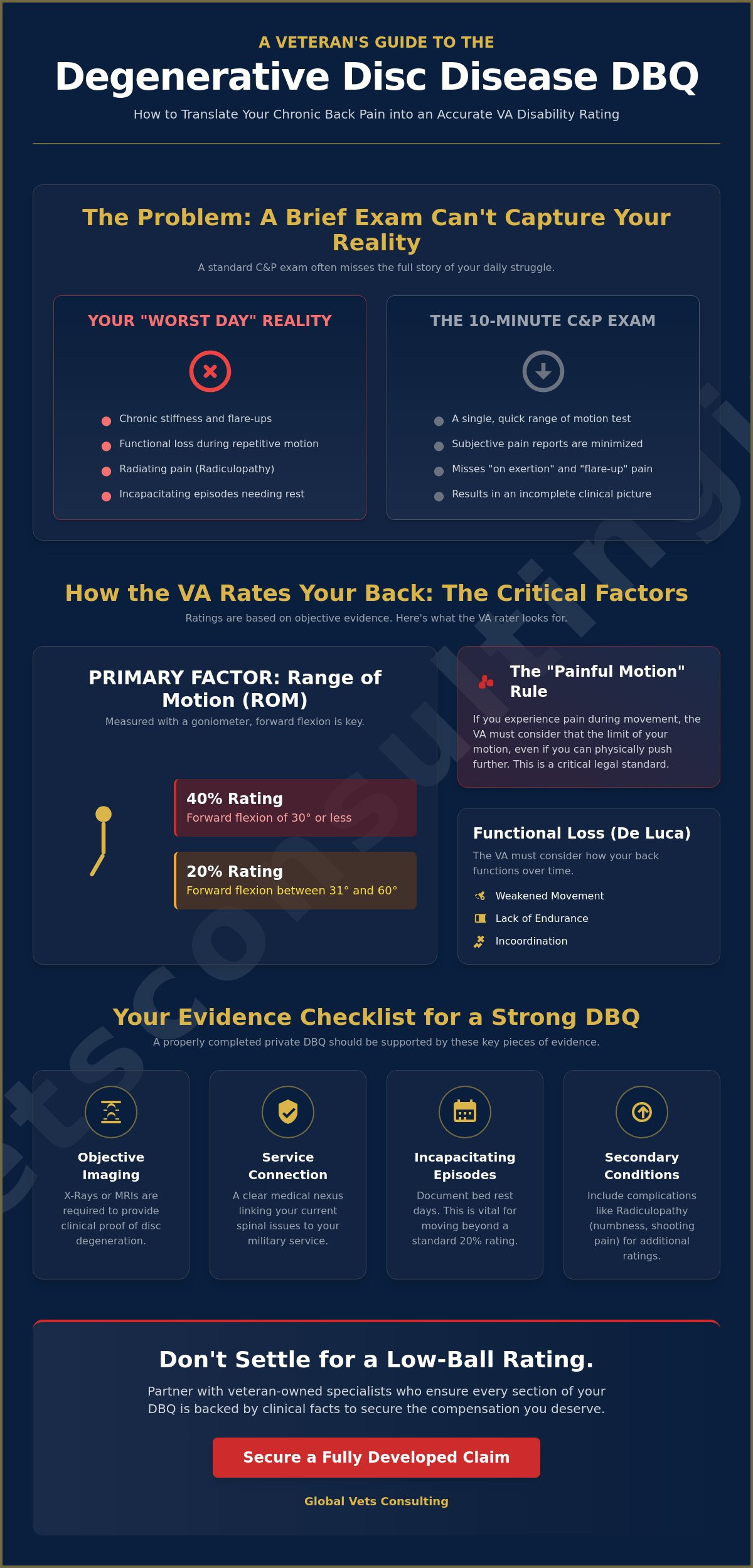
The VA evaluates spinal conditions primarily through the lens of mobility and physical limitation. Under 38 CFR § 4.71a, the diagnostic codes 5242 and 5003 focus on how much you can move before your body stops you. When completing a dbq for degenerative disc disease, it’s vital to record not just how far you can bend, but exactly when the pain starts. The “Painful Motion” rule is a cornerstone of VA law; if you experience pain during a movement, the examiner must record that specific point as the limit of your range of motion, even if you could technically push further.
Understanding Degenerative Disk Disease Symptoms and Causes helps you articulate the “invisible” parts of your condition during an exam. For example, radiculopathy often manifests as numbness or shooting pain in the legs. This isn’t just a symptom; it’s a secondary condition that can lead to additional disability ratings beyond the base back rating. Ensuring these neurological complications are linked to your DDD within the DBQ is essential for a rating that reflects your total functional loss.
The Importance of Range of Motion (ROM) Testing
Range of motion is the primary metric for spinal disability ratings in 2026. Examiners are required to use a goniometer, a specialized protractor, to measure your flexion and extension in degrees. For the thoracolumbar spine, a forward flexion of 30 degrees or less typically triggers a 40% rating, while movement between 31 and 60 degrees often results in a 20% rating. If you find the clinical terminology confusing, you can review professional DBQ resources to better understand how your specific measurements impact your claim.
Functional Loss and De Luca Criteria
The VA must also consider functional loss through the De Luca criteria, which evaluates how your condition affects you over time. This includes factors like weakened movement, lack of endurance, and incoordination caused by repetitive use. Even if you have a decent range of motion during a single test, the dbq for degenerative disc disease should document how your mobility degrades after several repetitions or during a flare-up. This ensures the VA sees the reality of your “worst days” rather than just a snapshot of a “good day” in the clinic.
How to Prepare for Your DDD DBQ Documentation
Preparing your medical evidence before an evaluation is the most effective way to prevent an inaccurate rating. You should follow a structured process to ensure your dbq for degenerative disc disease captures every detail of your physical impairment. This proactive approach moves your claim into the category of a Fully Developed Claim (FDC), which the VA typically processes with greater efficiency. By organizing your records ahead of time, you reduce the risk of an examiner overlooking critical symptoms that define your daily life.
- Step 1: Gather all service treatment records and recent imaging. Imaging like MRIs or CT scans from the last 12 months provide the objective proof required to confirm a diagnosis.
- Step 2: Maintain a “Pain Journal.” Document the frequency and duration of your flare-ups, specifically noting any “incapacitating episodes” where a doctor prescribed bed rest.
- Step 3: Identify secondary conditions. Degenerative changes in the spine often lead to sciatica or hip pain, which may warrant separate ratings.
- Step 4: Review form VBA-21-0960M-14. Understanding the specific questions allows you to provide more precise answers during your appointment.
Gathering Your Medical Evidence
Current imaging is the bedrock of a successful claim. The VA often dismisses older records, so having a scan within the last year is vital for showing the current state of your spinal health. You should also collect buddy statements from family or coworkers. These personal accounts provide context that a clinical exam cannot, such as how your back pain prevents you from completing a full shift at work or participating in family activities. These statements help bridge the gap between clinical measurements and your daily reality.
While managing your own health is the priority, many veterans also find that supporting the vitality of their service or companion dogs is essential for daily well-being; Paws & Whiskers provides clean-label supplements to help these loyal partners stay strong.
Communicating with Your Medical Provider
When you speak with your doctor, use functional terms rather than just stating your pain level on a scale of one to ten. Instead of saying “it hurts a lot,” explain that “I can’t bend over to tie my shoes” or “I can’t sit for more than fifteen minutes without numbness.” This specific language helps the physician accurately complete the dbq for degenerative disc disease. Ensure they document any periods where your condition was so severe that bed rest was medically required, as this is a key factor in achieving a rating that matches your level of disability. To ensure your documentation is handled with clinical precision, get started with a professional DBQ review today.
Secure Your Claim with Global Vets Consulting
The path to a fair VA rating shouldn’t be a solitary struggle against a complex bureaucracy. Global Vets Consulting operates as a veteran-owned partner, bringing a deep sense of duty and clinical meticulousness to every dbq for degenerative disc disease we prepare. We understand that a successful claim depends on more than just a diagnosis; it requires a narrative where every clinical finding is supported by undeniable fact. Our process ensures that your medical evidence is ready to submit, reducing the anxiety that often accompanies the claims process. We focus on accuracy because we know that a single missed check-box can result in a denial or an underrated claim.
A Veteran-Centric Approach to Medical Evidence
Working with professionals who understand the specific language of the VA provides a distinct advantage. We bridge the gap between your physical reality and the rigid documentation requirements the VA demands. Many veterans find that their private doctors are excellent at treating pain but struggle to translate that pain into the specific metrics needed for a rating. We ensure your dbq for degenerative disc disease is comprehensive, accurate, and reflects the true impact of your service-connected injuries. This meticulous preparation helps ensure that the VA rater has a clear, clinical picture of your functional loss from the moment they open your file.
Take the Next Step in Your VA Claim
You don’t have to settle for inadequate C&P exams that ignore your flare-ups or functional loss. By providing the VA with a high-quality, private DBQ, you take control of the evidence in your file. This proactive step moves you closer to the benefits you earned through your service and sacrifice. It’s time to secure a rating that accurately reflects your daily life and provides the financial support you deserve. Don’t leave your future to chance or a rushed ten-minute evaluation. Get Your Professional DBQ from Global Vets Consulting and move forward with confidence.
Secure the Rating You’ve Earned
Achieving an accurate rating requires a shift from simply reporting pain to documenting functional loss with clinical precision. By focusing on critical factors like the “Painful Motion” rule and ensuring your range of motion is measured accurately, you move beyond subjective reports and toward objective, rateable facts. A thoroughly prepared dbq for degenerative disc disease acts as your clinical voice, ensuring that the rater sees the true impact of your condition on your ability to work and live.
Global Vets Consulting is a veteran-owned and operated organization with over 5 years of mission-driven service. We specialize in VA documentation compliance to help you bridge the gap between medical reality and bureaucratic requirements. Our team is dedicated to providing meticulous, ready-to-submit evidence that reduces the stress of the claims process. You’ve already served your country; now it’s time to ensure the system serves you with the integrity and accuracy you deserve.
Secure your accurate medical evidence with a professional DBQ from Global Vets Consulting and take the next step toward the benefits you’ve earned with confidence.
Frequently Asked Questions
Can I use a private DBQ for my degenerative disc disease claim?
You can absolutely use a private physician to complete a dbq for degenerative disc disease. The VA officially recognizes these forms as a way for veterans to submit competent medical evidence from their own doctors. This approach often provides a more comprehensive look at your functional loss than a standard, time-limited C&P exam. It allows your doctor to spend the necessary time documenting your symptoms on your worst days.
What is the highest VA rating for degenerative disc disease?
The maximum rating for degenerative disc disease is typically 20 percent based on range of motion limitations alone. However, this rating can increase if you experience frequent incapacitating episodes or if the condition leads to secondary issues like radiculopathy. In cases of unfavorable ankylosis of the entire thoracolumbar spine, the VA may grant a rating as high as 100 percent if the spine is completely fixed in a curved position.
Do I still have to attend a C&P exam if I submit a private DBQ?
You may still be required to attend a C&P exam even after submitting a private DBQ. The VA typically schedules these exams if they determine the submitted medical evidence is incomplete or doesn’t provide enough information to assign a rating. However, a thoroughly completed private dbq for degenerative disc disease can sometimes serve as the sole basis for a decision if it meets all clinical requirements and provides a clear narrative of your limitations.
How does the VA distinguish between DDD and a simple back strain?
The VA distinguishes between these conditions primarily through objective imaging like X-rays, MRIs, or CT scans. While a back strain is often considered a temporary soft tissue injury, degenerative disc disease involves the physical breakdown of the spinal discs. The VA requires clinical evidence of this degeneration, such as disc space narrowing or osteophyte formation, to grant service connection under the specific diagnostic codes for the musculoskeletal system.
What happens if the C&P examiner disagrees with my private DBQ?
If a C&P examiner’s findings contradict your private DBQ, the VA rater must weigh both pieces of evidence based on their clinical depth and supporting facts. The VA is required to give probative value to the most thorough and well-supported medical opinion. If both opinions are equally strong, the benefit of the doubt rule favors the veteran, meaning the rater should lean toward the evidence that supports the higher rating.

Article by
Willie Daniel
Willie Daniel is the Founder and Chief Executive Officer (CEO) of Global Vets Consulting (GVC) – National Veterans Disability Services, a veteran-led educational and medical evidence support organization dedicated to helping veterans better understand VA disability rating increases, DBQ medical evidence, secondary claims education, and C&P examination preparation.
He is a retired U.S. Army Medical Service Corps Officer with more than 27 years of honorable military service, a decorated Iraq combat veteran, and a retired federal official with the U.S. Department of Veterans Affairs. Throughout his military and federal career, Willie Daniel served in leadership, healthcare administration, operational, and veteran-support roles focused on improving services and support systems for servicemembers, veterans, and their families.
Drawing from decades of military leadership, healthcare administration, veteran advocacy, and federal government experience, Willie Daniel brings a practical, veteran-centered perspective to Global Vets Consulting’s educational articles, AI-powered veteran resources, video education initiatives, and outreach programs. His experience navigating military systems, medical documentation processes, and veteran-related administrative operations provides valuable insight into many of the challenges veterans face when seeking to better understand VA disability rating criteria, medical evidence, documentation strategies, and secondary condition education.
Through GVC’s “Veterans Helping Veterans” mission, his focus is on delivering clear, educational, and easy-to-understand information designed to empower veterans with knowledge, resources, and educational tools that may help them make more informed decisions regarding their individual VA disability journeys.
The information provided through GVC is intended for educational and informational purposes only and should not be considered legal or medical advice.
Disclaimer
Disclaimer: Global Vets Consulting, LLC (“GVC”) is a veteran-led educational and medical evidence support organization. GVC is not a law firm, is not a Veterans Service Organization (VSO), and is not affiliated with the U.S. Department of Veterans Affairs (VA) or any government agency.
Global Vets Consulting does not provide legal advice, medical advice, medical treatment, or healthcare services. GVC does not prepare, file, or submit VA disability claims on behalf of veterans. All information provided through this website, blog articles, videos, educational materials, AI tools, dashboards, templates, and communications is intended solely for general educational and informational purposes.
Veterans are encouraged to consult with accredited representatives, licensed attorneys, qualified medical providers, or Veterans Service Organizations regarding their specific legal, medical, or VA-related matters. VA disability decisions, ratings, and outcomes are determined solely by the U.S. Department of Veterans Affairs based on applicable laws, regulations, medical evidence, and individual circumstances. Past results do not guarantee future outcomes.