
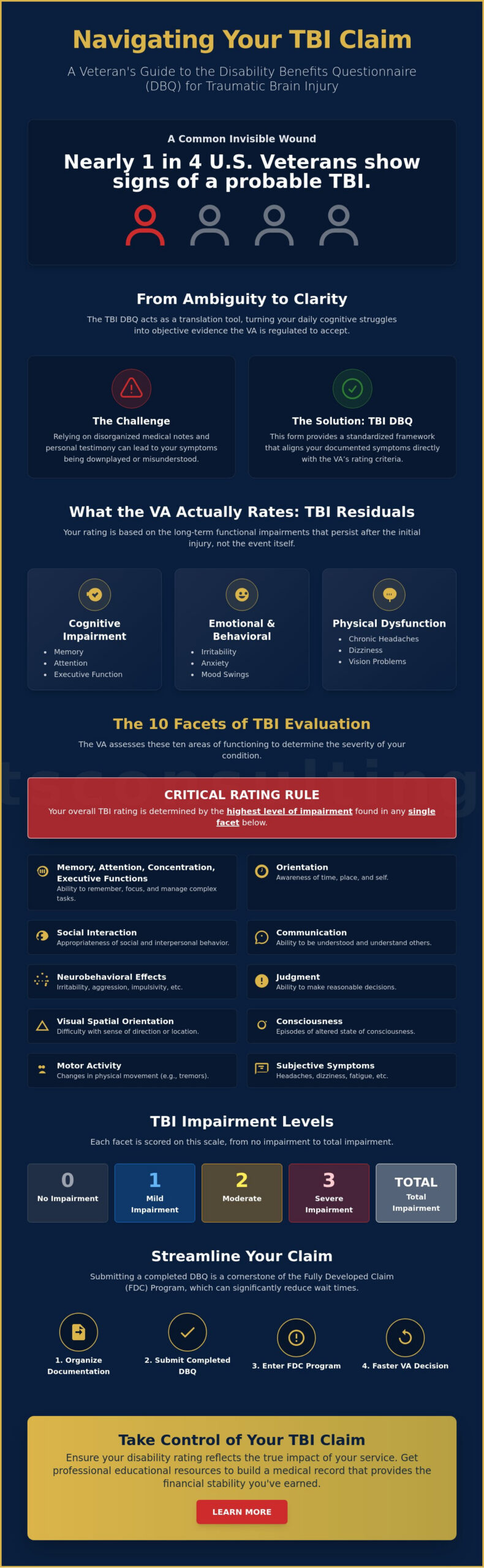
Nearly one in four U.S. veterans show signs of a probable traumatic brain injury, yet many find it difficult to prove symptoms like memory loss or mood swings during a C&P exam. It’s common to feel that your invisible wounds are being downplayed by a system that values standardized documentation over personal testimony. Using a dbq for traumatic brain injury (tbi) acts as a translation tool, turning your daily cognitive struggles into objective evidence the VA is regulated to accept.
We understand the anxiety that comes with trying to explain how a TBI affects your life, especially when you’re worried about how it overlaps with conditions like PTSD. This guide will teach you how to accurately document TBI residuals to ensure your VA disability rating reflects the true impact of your service. You’ll gain a clear understanding of the 10 rating facets, learn about the 2026 compensation increases, and discover how to build a medical record that provides the financial stability you’ve earned. We’ll walk through the specific evidence requirements the VA looks for so you can approach your next exam with confidence.
Key Takeaways
- Understand how a dbq for traumatic brain injury (tbi) shifts the focus from your initial injury to the long-term residuals that impact your daily functioning and quality of life.
- Learn about the 10 facets of cognitive impairment used by the VA and how the highest level of impairment in any single category determines your overall rating.
- Identify the specific medical specialists authorized to conduct your initial evaluation to ensure your medical evidence meets strict VA compliance standards.
- Discover how professional educational resources can help you organize your documentation so that no facet of your condition is overlooked during the rating process.
Understanding the TBI DBQ: The Foundation of Your Claim
The dbq for traumatic brain injury (tbi) is a specialized medical reporting tool designed to standardize how the VA gathers evidence for your claim. Instead of relying on disorganized medical notes, this form prompts your provider to answer specific questions that align directly with the VA’s rating criteria. This structure is vital because TBI symptoms are often “invisible,” making them difficult to quantify without a logical framework. While a Traumatic brain injury overview explains the medical nature of the trauma, the DBQ focuses on how that trauma disrupts your life today.
To better understand how this condition is evaluated for disability benefits, watch this helpful video:
Using a private DBQ allows you to present a complete picture of your health before you ever step into a C&P exam. Understanding what is a dbq and how it functions helps you take control of your claim. It ensures that your symptoms aren’t just mentioned; they’re documented in a way that the VA’s automated and manual review systems can easily process. This reduces the chance of your claim being stalled due to missing information.
Residuals vs. Initial Injury: What the VA Actually Rates
The VA doesn’t provide compensation for the event that caused your injury, such as a blast or a fall. Instead, they rate the “residuals,” which are the long-term functional impairments that persist long after the initial incident. This distinction is crucial for your dbq for traumatic brain injury (tbi) because your rating depends on your current level of impairment rather than the severity of the original trauma. Common residuals include:
- Cognitive impairment: Difficulty with memory, attention, or executive function.
- Emotional behavioral changes: Increased irritability, anxiety, or mood swings.
- Physical dysfunction: Chronic headaches, dizziness, or vision problems.
The Role of the DBQ in the Fully Developed Claim (FDC) Program
Submitting a completed DBQ is a cornerstone of the Fully Developed Claim (FDC) program. By providing all necessary medical evidence upfront, you signal to the VA that your claim is ready for an immediate decision. This proactive approach can significantly reduce wait times and administrative hurdles. You can see how this fits into the larger picture by reviewing the va disability claims process step by step. When your documentation is meticulous, you leave less room for the VA to downplay your symptoms or request redundant examinations.
The 10 Facets of TBI: How the VA Determines Your Rating
The VA evaluates the severity of your condition by looking at ten distinct areas of functioning, known as facets. The dbq for traumatic brain injury (tbi) provides the framework for this assessment. Unlike many other VA ratings that average symptoms, your TBI rating is determined by the highest level of impairment found in any single facet. This means if you demonstrate severe impairment in one area, such as memory, that single score dictates your overall rating even if your other symptoms are mild.
Each facet is scored on a scale of 0, 1, 2, 3, or Total. A score of 0 indicates no impairment, while a score of 3 reflects severe disruption to your daily life. Social and Industrial Inadaptability represents the highest level of TBI impairment, indicating a complete inability to function in work or social environments. For a deeper look at the administrative side of these evaluations, you can review the VA’s TBI disability determination process.
Cognitive and Emotional Facets
The VA looks closely at memory, attention, concentration, and executive functions. These facets measure your ability to process information and manage complex tasks. Executive functions are particularly important for workplace performance, as they involve planning, organizing, and completing projects without constant supervision. If you struggle to follow multi-step instructions or find yourself easily distracted, these residuals must be clearly documented. Social information processing and judgment are also evaluated to see how the injury affects your interactions with others.
Physical and Subjective Facets
Physical residuals like chronic headaches, dizziness, and sleep disturbances are also evaluated within this framework. A common challenge for veterans is the overlap between TBI and PTSD symptoms, such as irritability or insomnia. The VA’s goal is to avoid “pyramiding,” which is the practice of rating the same symptom twice under different conditions. However, a well-prepared DBQ helps distinguish which symptoms are neurological and which are psychological. If you’re unsure how your symptoms map to these facets, reviewing neurological conditions & tbi educational resources can help clarify your standing. This methodical approach ensures your documentation is accurate and difficult for the VA to ignore.
Preparing for Your Evaluation: Specialist Requirements and Strategy
The VA maintains a strict policy regarding who is authorized to conduct an initial evaluation for a dbq for traumatic brain injury (tbi). Only four specific types of specialists meet these requirements: Psychiatrists, Physiatrists, Neurologists, and Neuropsychologists. This high standard exists because TBI is a complex neurological condition that requires expert diagnostic skills to differentiate from other disorders. If the VA schedules you with a general practitioner or a physician assistant for your initial TBI exam, your claim may be at risk. You should verify your examiner’s credentials through state medical boards or professional directories before your appointment to ensure they possess the necessary qualifications.
Relying on the VA’s internal examiners can feel unpredictable. Many veterans choose to use a private DBQ to ensure their evidence is reviewed by a specialist of their choosing. This strategy allows for a more comprehensive examination of the brain’s functioning, as detailed in the NINDS guide to TBI. To support this medical evidence, you should maintain a detailed symptom log. Tracking the frequency and severity of cognitive fog, irritability, or headaches provides concrete data that a brief, one-time exam might otherwise miss.
Documenting Subjective Symptoms for the Examiner
Describing “invisible” symptoms like light sensitivity or memory gaps requires specific, real-world examples. Instead of simply stating you are forgetful, explain how you forgot a familiar route home or left the stove on. Lay statements from spouses, family members, or coworkers are invaluable in this process. These statements provide a second perspective on your daily behavior that the DBQ findings alone might not fully capture, bridging the gap between clinical data and your actual quality of life.
The “Pyramiding” Rule: TBI and Mental Health Overlap
The VA generally avoids “pyramiding,” which is the practice of rating the same symptom twice under different conditions. Because TBI and PTSD often share symptoms like sleep disturbances and mood swings, the VA frequently combines them into a single rating. However, if a specialist can clearly differentiate between neurological residuals and psychological triggers, separate ratings may be possible. This distinction is often the key to achieving a more accurate combined disability percentage. If you need help preparing for this complex evaluation, consider exploring our C&P examination preparation education to ensure your evidence is presented correctly.
Professional DBQ Support: Securing Your Earned Benefits
Securing the benefits you’ve earned requires more than just showing up to an appointment. Global Vets Consulting serves as a steady guide for veterans who feel overwhelmed by the technicalities of a dbq for traumatic brain injury (tbi). Our mission is to streamline the evidence-gathering process so your medical records speak the VA’s language. By focusing on meticulous documentation, we help ensure that every cognitive struggle and physical residual is captured with the precision required for an accurate evaluation. This partnership approach replaces the anxiety of the unknown with a predictable path forward.
Professional preparation ensures that none of the ten facets of TBI impairment are overlooked. When you go into an exam with a clear, evidence-based strategy, you reduce the risk of an examiner missing key symptoms like executive dysfunction or social inadaptability. We provide the educational resources necessary to move from a state of confusion to a position of steady confidence, allowing you to advocate for yourself with medical facts that the VA cannot ignore.
Why Accuracy Matters in TBI Documentation
Accuracy in your documentation is about more than just a monthly payment; it’s about your long-term quality of life. An accurate rating opens doors to specialized healthcare and provides the financial stability necessary to manage chronic symptoms. While some organizations focus on hiring legal representation after a claim is denied, we believe in the value of a meticulous, professional approach to neurological documentation from the start. Getting your evidence right the first time respects your history of service and prevents the frustration of unnecessary appeals.
Take the Next Step Toward Your 2026 Rating
You don’t have to face the VA’s complex rating system alone. Having a comprehensive dbq for traumatic brain injury (tbi) in hand gives you the power to stand behind your claim during a C&P exam. If you’re looking to update your current status to reflect worsening symptoms or new residuals, our educational resources on a dbq for va disability rating increase can provide the roadmap you need. Move from confusion to a concrete, evidence-based claim by utilizing professional support designed to simplify the bureaucratic process and secure your future.
Secure Your Future with Evidence-Based Documentation
You now understand that documenting invisible wounds requires a methodical approach that aligns with the VA’s ten facets of impairment. By focusing on long-term residuals and ensuring a qualified specialist completes your dbq for traumatic brain injury (tbi), you remove the guesswork from the adjudication process. This strategic preparation transforms your personal experiences into the objective medical evidence required for an accurate and fair disability rating.
Global Vets Consulting is dedicated to simplifying these complex bureaucratic systems for the men and women who served. As a veteran-owned and operated organization since 2021, we maintain a specialized focus on DBQ documentation accuracy to help you achieve the financial stability you’ve earned. Start your evidence-gathering journey with Global Vets Consulting today. You’ve already done the hard work of serving your country; now it’s time to ensure your records reflect the true impact of that service. We’re here to serve as your steady guide toward a more secure future.
Frequently Asked Questions
Who is qualified to fill out a DBQ for Traumatic Brain Injury?
The VA requires that an initial dbq for traumatic brain injury (tbi) be completed by one of four specific specialists: a psychiatrist, physiatrist, neurologist, or neuropsychologist. This strict requirement ensures the evaluator has the advanced training needed to identify complex neurological residuals. While a general practitioner might treat your symptoms, their evaluation usually won’t meet the VA’s evidentiary standards for an initial service connection. For review exams, the requirements are sometimes less restrictive, but using a specialist remains the best strategy for accuracy.
Can I get a TBI rating and a PTSD rating at the same time?
You can receive ratings for both conditions, but the VA often combines them into a single disability percentage to avoid “pyramiding.” This happens because symptoms like irritability, insomnia, and memory gaps are common to both TBI and PTSD. If your medical provider can clearly differentiate which symptoms are purely neurological and which are psychological, it’s possible to receive separate ratings. This distinction is vital for ensuring your combined rating accurately reflects your total level of impairment.
What happens if the VA examiner disagrees with my private TBI DBQ?
If a VA examiner’s findings contradict your private medical evidence, the VA is legally required to weigh both reports. They must provide a clear, logical explanation if they choose to favor the C&P examiner’s opinion over your private specialist. A dbq for traumatic brain injury (tbi) from a qualified private specialist often carries significant weight because it’s typically based on a longer clinical relationship and more detailed symptom tracking than a brief VA exam.
Is a TBI DBQ required for a rating increase in 2026?
While the VA will conduct its own exam, submitting a private DBQ is a highly effective way to trigger and support a rating increase in 2026. Recent updates from the Elizabeth Dole Act of 2025 have improved how the VA processes these digital documents from non-VA providers. Providing your own evidence ensures that the 10 facets of TBI are fully documented before you even walk into a C&P exam, leaving less room for the VA to downplay your worsening symptoms.
What are the most common “residuals” of TBI that the VA looks for?
The VA focuses on ten specific facets of TBI residuals, with cognitive impairment and emotional behavioral changes being the most common. Examiners look for memory loss, difficulty with executive functions like planning, and social information processing issues. Physical residuals such as chronic headaches, dizziness, and light sensitivity are also heavily weighted. The goal is to determine your level of “social and industrial inadaptability,” which measures how these symptoms interfere with your work and daily life.

Article by
Willie Daniel
Willie Daniel is the Founder and Chief Executive Officer (CEO) of Global Vets Consulting (GVC) – National Veterans Disability Services, a veteran-led educational and medical evidence support organization dedicated to helping veterans better understand VA disability rating increases, DBQ medical evidence, secondary claims education, and C&P examination preparation.
He is a retired U.S. Army Medical Service Corps Officer with more than 27 years of honorable military service, a decorated Iraq combat veteran, and a retired federal official with the U.S. Department of Veterans Affairs. Throughout his military and federal career, Willie Daniel served in leadership, healthcare administration, operational, and veteran-support roles focused on improving services and support systems for servicemembers, veterans, and their families.
Drawing from decades of military leadership, healthcare administration, veteran advocacy, and federal government experience, Willie Daniel brings a practical, veteran-centered perspective to Global Vets Consulting’s educational articles, AI-powered veteran resources, video education initiatives, and outreach programs. His experience navigating military systems, medical documentation processes, and veteran-related administrative operations provides valuable insight into many of the challenges veterans face when seeking to better understand VA disability rating criteria, medical evidence, documentation strategies, and secondary condition education.
Through GVC’s “Veterans Helping Veterans” mission, his focus is on delivering clear, educational, and easy-to-understand information designed to empower veterans with knowledge, resources, and educational tools that may help them make more informed decisions regarding their individual VA disability journeys.
The information provided through GVC is intended for educational and informational purposes only and should not be considered legal or medical advice.
Disclaimer
Disclaimer: Global Vets Consulting, LLC (“GVC”) is a veteran-led educational and medical evidence support organization. GVC is not a law firm, is not a Veterans Service Organization (VSO), and is not affiliated with the U.S. Department of Veterans Affairs (VA) or any government agency.
Global Vets Consulting does not provide legal advice, medical advice, medical treatment, or healthcare services. GVC does not prepare, file, or submit VA disability claims on behalf of veterans. All information provided through this website, blog articles, videos, educational materials, AI tools, dashboards, templates, and communications is intended solely for general educational and informational purposes.
Veterans are encouraged to consult with accredited representatives, licensed attorneys, qualified medical providers, or Veterans Service Organizations regarding their specific legal, medical, or VA-related matters. VA disability decisions, ratings, and outcomes are determined solely by the U.S. Department of Veterans Affairs based on applicable laws, regulations, medical evidence, and individual circumstances. Past results do not guarantee future outcomes.