
Your current 50% disability rating for a CPAP machine is not guaranteed forever, especially with the VA’s proposed rating schedule changes looming for late 2026. It’s incredibly frustrating to know that your sleepless nights and daily exhaustion are directly tied to your service, yet the VA often denies sleep apnea secondary to ptsd because the medical link isn’t obvious to a rater. You shouldn’t have to navigate this complex system alone or feel anxious about whether your medical evidence is enough to win your claim.
We understand the stress that comes with shifting regulations and the record pace of claims processing seen so far in 2026. You’ve earned your benefits through your service, and we’re here to help you protect them. This guide will show you exactly how to bridge the gap between your mental health and your respiratory health using clear medical evidence and the correct Disability Benefits Questionnaires (DBQs). You’ll learn how to document intermediate steps like medication side effects or weight gain to secure the 50% rating you deserve. We’re going to break down the specific evidence needed to turn a confusing denial into a successful, service-connected claim.
Key Takeaways
- Discover the specific medical mechanisms, including medication side effects and weight gain, that link your sleep disorder to your service-connected mental health.
- Learn how to meet the “at least as likely as not” evidentiary standard required to successfully prove sleep apnea secondary to ptsd.
- Identify the essential components of a Sleep Apnea DBQ, such as sleep study data and functional impact, to ensure your medical evidence is thorough.
- Understand the current 2026 rating criteria to help you secure a 50% rating if you require a breathing assistance device like a CPAP machine.
- Compare the advantages of private medical evidence versus a standard C&P exam to give your claim the best chance of success.
What is Sleep Apnea Secondary to PTSD? 🇺🇸
Secondary service connection is a specific legal path for veterans. It applies when a condition you already have service-connected, such as PTSD, causes or worsens a new disability. In this case, we are looking at sleep apnea secondary to ptsd. You aren’t claiming you stopped breathing during your time in uniform. Instead, you’re showing that the physiological or behavioral changes from your mental health condition led to Obstructive Sleep Apnea (OSA).
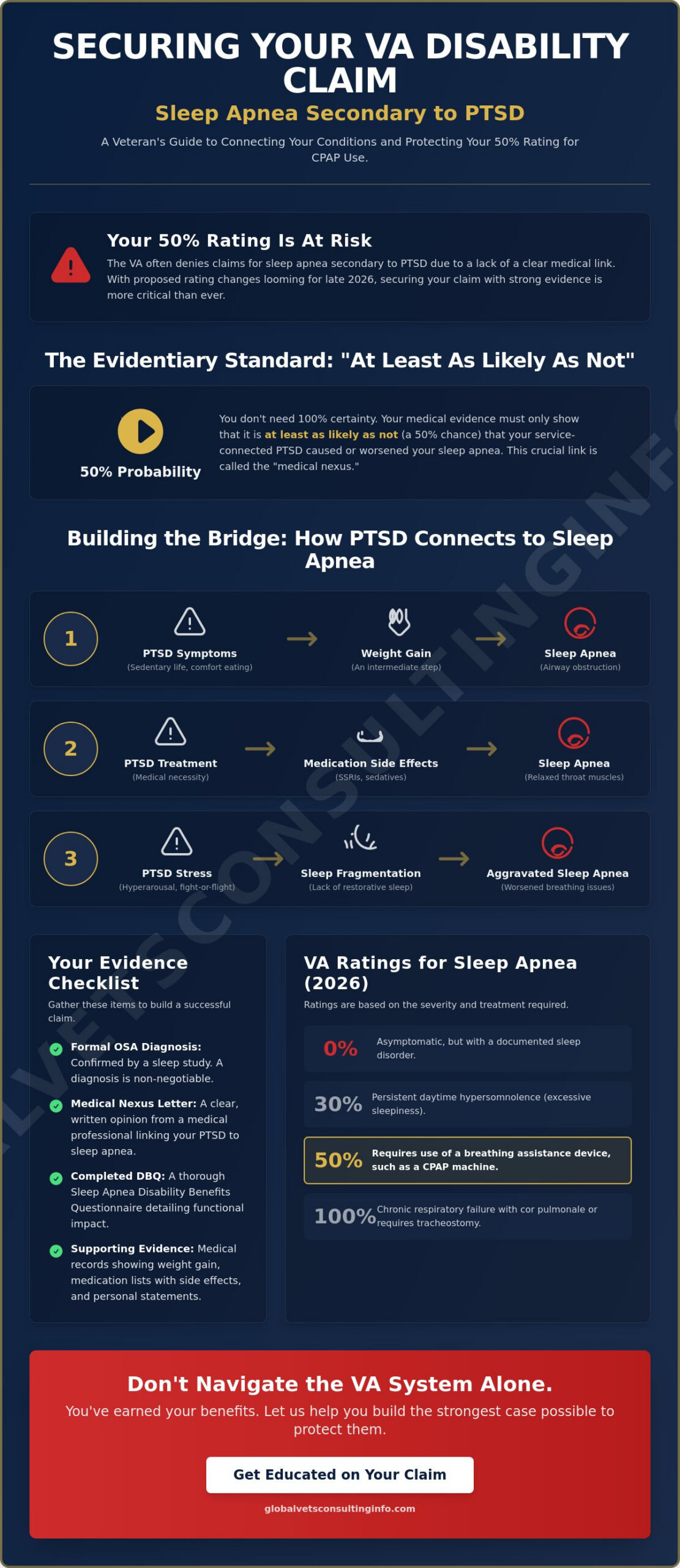
To win your claim, you must meet the “At Least As Likely As Not” standard. This is a 50% probability threshold. You don’t have to prove the link with 100% certainty. You just need to show it’s just as likely that your PTSD is the culprit as it is anything else. Many veterans face denials because their medical evidence fails to establish this “nexus” or link. Without a clear explanation of how your PTSD symptoms or treatments affect your airway, the VA rater will likely reject the claim. It’s not enough to have both conditions; you must prove one caused the other.
Before you file, you must have a current, formal diagnosis of OSA. A VA rater cannot grant service connection for a condition that hasn’t been confirmed by a sleep study. Since sleep disturbances are a common symptom of PTSD, getting that diagnostic data is your first critical step. Proper documentation is the difference between a 50% rating and a flat denial.
The Legal Basis for Secondary Claims
The framework for these claims is found in 38 CFR § 3.310. This regulation states that any disability which is the proximate result of a service-connected disease or injury shall be service-connected. It also covers “aggravation.” If your PTSD didn’t cause your sleep apnea but made it significantly worse, you are still eligible for benefits. This legal protection ensures that veterans are compensated for the full scope of how their service-connected disabilities impact their health.
The Medical Nexus: How PTSD Causes or Aggravates Sleep Apnea
Establishing a medical nexus is the most critical part of your claim. The VA requires a clear explanation of how your mental health condition directly leads to or worsens your breathing issues. Proving sleep apnea secondary to ptsd often involves looking at how your body responds to chronic trauma. The connection isn’t always a straight line; it’s often a chain of events that impacts your physical health.
Weight gain is one of the most common pathways used to bridge these two conditions. PTSD symptoms frequently lead to sedentary lifestyles or “comfort eating” as a way to cope with anxiety and depression. The “intermediate step” theory allows the VA to connect PTSD to sleep apnea by establishing that service-connected mental health symptoms caused weight gain, which then led to the development of obstructive sleep apnea. This path is scientifically sound, as excess weight is a primary cause of airway obstruction. According to VA information on PTSD and sleep, these issues are deeply intertwined and require careful documentation to prove service connection.
Physiological stress also plays a major role. Hyperarousal and sleep fragmentation caused by PTSD can exacerbate existing respiratory issues. When your body is in a constant state of “fight or flight,” your sympathetic nervous system stays active. This prevents your body from entering the deep, restorative sleep stages where your airway is most vulnerable. If you’re struggling to articulate these complex links, Independent Medical Evidence Education can provide the clarity you need to build a stronger case.
The Impact of PTSD Medications
The drugs used to treat your mental health can have unintended consequences for your breathing. Many veterans are prescribed SSRIs or sedatives to manage nightmares and anxiety. These medications often decrease the muscle tone in your throat. When these muscles relax too much during sleep, the airway collapses, causing or worsening obstructive sleep apnea. Your medical evidence must include a full list of your current medications and their documented side effects to show the VA how your treatment plan is contributing to your sleep disorder.
Proving Your Claim: The Role of DBQs and Medical Evidence
Submitting a claim for sleep apnea secondary to ptsd requires more than just a diagnosis. You need a structured presentation of medical facts that a VA rater cannot easily dismiss. While the VA often relies on Compensation and Pension (C&P) exams, these are frequently rushed. A private Disability Benefits Questionnaire (DBQ) offers a more thorough alternative. It allows a medical professional to spend the necessary time documenting how your mental health symptoms directly impact your respiratory system. To understand the specific layout of these forms, you can review our guide on what is a dbq for va claims.
A successful Sleep Apnea DBQ must contain several essential elements to be considered actionable. It needs to clearly state your sleep study results, your specific CPAP or breathing assistance device requirements, and the functional impact the condition has on your ability to work. Global Vets Consulting assists in streamlining this evidence-gathering process, ensuring your documentation is precise and comprehensive before it reaches a rater’s desk. We focus on providing Independent Medical Evidence Education so you can approach your claim with confidence.
The Necessity of an Independent Medical Opinion (IMO)
A Nexus Letter, or Independent Medical Opinion, is the professional statement that bridges your two conditions. For this letter to hold weight, your doctor must state they have reviewed your entire C-File. This ensures the VA that the opinion is based on your complete medical history, including the “intermediate steps” like weight gain or medication side effects we discussed earlier. Without this formal link, the VA may claim your sleep apnea is a standalone issue unrelated to your service.
Using DBQs for Rating Increases
If your condition has worsened over time, you can use a dbq for va disability rating increase to capture your current level of impairment. This is vital for documenting persistent daytime hypersomnolence, which is a key factor in determining your rating. Ensuring your DBQ accurately reflects your daily struggle with exhaustion can be the difference between a 30% and a 50% rating under the current 2026 schedule.
VA Ratings for Sleep Apnea in 2026: What to Expect
Understanding the current rating criteria is vital for any veteran filing for sleep apnea secondary to ptsd. As of June 2026, the VA still primarily bases its ratings on the type of treatment required rather than just the diagnosis. If your condition requires the use of a breathing assistance device, such as a CPAP or BiPAP machine, you typically qualify for a 50% disability rating. This is the most common rating for veterans who successfully link their sleep disorder to their mental health through strong medical evidence.
Lower ratings are assigned when the condition is less severe or requires less intensive intervention. A 30% rating is given for persistent daytime sleepiness, also known as hypersomnolence, even if a CPAP isn’t required. At the highest end, a 100% rating is reserved for cases involving chronic respiratory failure, carbon dioxide retention, or the necessity of a tracheostomy. The landscape is shifting toward a focus on functionality. The VA has proposed new standards that emphasize the effectiveness of treatment. Under these potential rules, if a CPAP successfully manages your symptoms, your rating could be lower than the current 50% standard. This creates a sense of urgency for veterans to file now and secure their ratings under the existing criteria.
VA Math and Combined Ratings
It’s a common misconception that adding a 50% rating for sleep apnea to a 50% rating for PTSD results in a 100% total rating. The VA uses a “combined rating” table, often called VA Math. In this system, the VA looks at how much of a “whole person” is left after each disability is accounted for. For example, a veteran with two 50% ratings would actually result in a 75% combined rating, which the VA rounds up to 80%. This highlights the importance of pursuing every service-connected condition to maximize your total monthly compensation.
If you’re ready to move forward, understanding the va disability claims process step by step will help you stay organized and meet critical deadlines. Navigating sleep apnea secondary to ptsd claims requires a methodical approach to evidence and filing. By staying informed on these 2026 updates, you can better protect your health and your hard-earned benefits.
Secure Your Rating and Protect Your Future 🇺🇸
Navigating the complexities of a sleep apnea secondary to ptsd claim requires a methodical approach to medical evidence. You’ve learned that proving the nexus through “intermediate steps” like weight gain or medication side effects is often the key to overcoming common VA denials. With the 2026 rating schedule changes prioritizing treatment effectiveness over simple device usage, submitting a thorough and professionally completed DBQ is more important than ever. Our veteran-owned and operated team understands the intricacies of the system and is dedicated to simplifying the process for you. We provide the specialized education and resources needed to ensure your medical documentation accurately reflects your service-connected conditions.
If you’re ready to take the next step toward the benefits you’ve earned, we’re here to help. 📞 Contact our 24/7 National Client Services Hotline for help with your DBQ and connect with our 24/7 AI Veteran Intake Specialist. We specialize in Disability Benefits Questionnaires and are committed to serving as your steady guide through the administrative process. You don’t have to face the bureaucracy alone. Let’s work together to secure the 50% rating you deserve and achieve the peace of mind you’ve earned through your service.
Frequently Asked Questions
Can I get VA disability for sleep apnea secondary to PTSD?
Yes, you can receive disability benefits for this connection. The VA recognizes that service-connected mental health conditions can cause or aggravate respiratory issues through various physiological and behavioral pathways. You must establish a medical nexus that links the two, often by documenting intermediate steps such as weight gain or the side effects of psychiatric medications. This path allows you to receive compensation for a condition that developed after your service because of your primary disability.
What medical evidence do I need for a secondary sleep apnea claim?
You need three specific pieces of evidence for a successful claim. First, you must have a formal diagnosis of Obstructive Sleep Apnea (OSA) confirmed by a sleep study. Second, you need a medical nexus letter from a professional explaining how your PTSD caused or worsened the apnea. Finally, a completed Disability Benefits Questionnaire (DBQ) that details the severity of your symptoms and any requirement for a CPAP machine is essential for an accurate rating.
Is a 50% rating for sleep apnea secondary to PTSD common?
A 50% rating is common for veterans who require a breathing assistance device like a CPAP machine. Under the current June 2026 rating schedule, the requirement for a device is the primary trigger for the 50% level. As long as you successfully establish the link for sleep apnea secondary to ptsd and provide evidence of your CPAP prescription, you meet the criteria for this specific compensation amount. This rating is currently worth over $1,000 a month in tax-free benefits.
What happens if the VA denies my sleep apnea secondary claim?
You have several options for appeal if your initial claim is denied. You can file a Higher-Level Review (HLR) if you believe the rater missed existing evidence or made a legal error. Alternatively, a Supplemental Claim allows you to submit new and relevant evidence, such as a more detailed nexus letter or a private DBQ. Many veterans find success by addressing the specific reasons for denial listed in their decision letter and providing the missing clinical links.
Does the VA still require a sleep study for secondary sleep apnea?
Yes, a formal sleep study is a mandatory requirement for any sleep apnea claim. The VA won’t grant service connection for sleep apnea secondary to ptsd based on symptoms like snoring or exhaustion alone. You must provide a diagnostic report that shows your Apnea-Hypopnea Index (AHI) scores. This study can be conducted at a VA facility or through a private provider, but the results must be included in your medical evidence to confirm the diagnosis.

Article by
Willie Daniel
Willie Daniel is the Founder and Chief Executive Officer (CEO) of Global Vets Consulting (GVC) – National Veterans Disability Services, a veteran-led educational and medical evidence support organization dedicated to helping veterans better understand VA disability rating increases, DBQ medical evidence, secondary claims education, and C&P examination preparation.
He is a retired U.S. Army Medical Service Corps Officer with more than 27 years of honorable military service, a decorated Iraq combat veteran, and a retired federal official with the U.S. Department of Veterans Affairs. Throughout his military and federal career, Willie Daniel served in leadership, healthcare administration, operational, and veteran-support roles focused on improving services and support systems for servicemembers, veterans, and their families.
Drawing from decades of military leadership, healthcare administration, veteran advocacy, and federal government experience, Willie Daniel brings a practical, veteran-centered perspective to Global Vets Consulting’s educational articles, AI-powered veteran resources, video education initiatives, and outreach programs. His experience navigating military systems, medical documentation processes, and veteran-related administrative operations provides valuable insight into many of the challenges veterans face when seeking to better understand VA disability rating criteria, medical evidence, documentation strategies, and secondary condition education.
Through GVC’s “Veterans Helping Veterans” mission, his focus is on delivering clear, educational, and easy-to-understand information designed to empower veterans with knowledge, resources, and educational tools that may help them make more informed decisions regarding their individual VA disability journeys.
The information provided through GVC is intended for educational and informational purposes only and should not be considered legal or medical advice.
Disclaimer
Disclaimer: Global Vets Consulting, LLC (“GVC”) is a veteran-led educational and medical evidence support organization. GVC is not a law firm, is not a Veterans Service Organization (VSO), and is not affiliated with the U.S. Department of Veterans Affairs (VA) or any government agency.
Global Vets Consulting does not provide legal advice, medical advice, medical treatment, or healthcare services. GVC does not prepare, file, or submit VA disability claims on behalf of veterans. All information provided through this website, blog articles, videos, educational materials, AI tools, dashboards, templates, and communications is intended solely for general educational and informational purposes.
Veterans are encouraged to consult with accredited representatives, licensed attorneys, qualified medical providers, or Veterans Service Organizations regarding their specific legal, medical, or VA-related matters. VA disability decisions, ratings, and outcomes are determined solely by the U.S. Department of Veterans Affairs based on applicable laws, regulations, medical evidence, and individual circumstances. Past results do not guarantee future outcomes.