
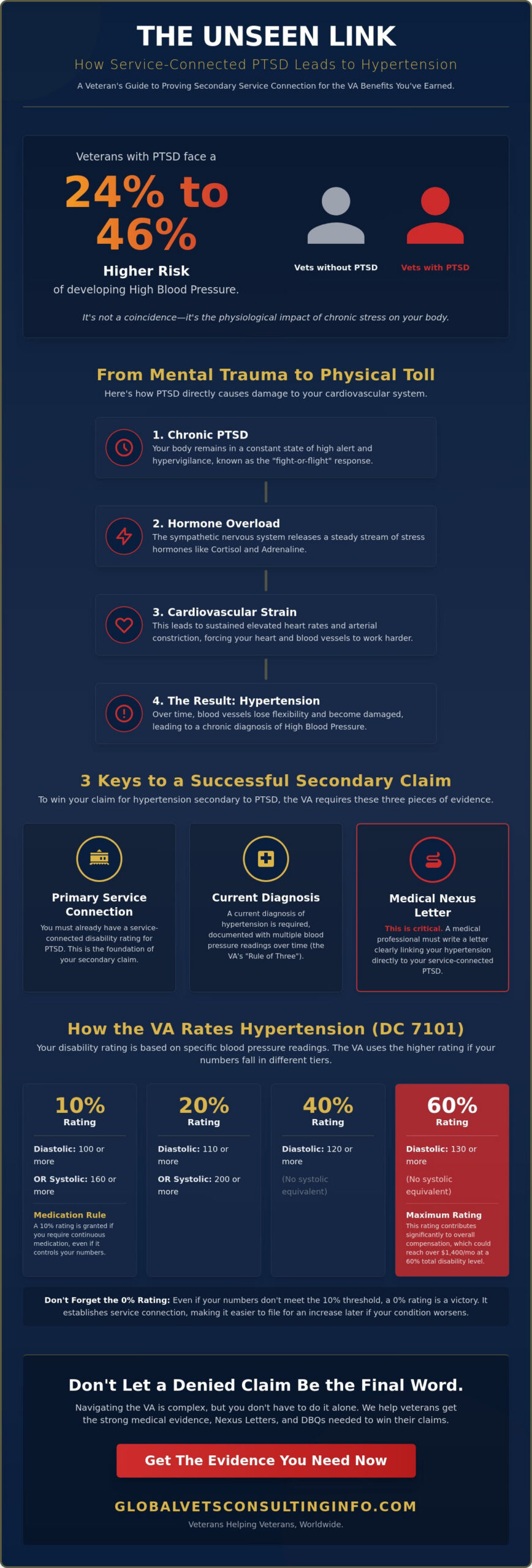
Did you know that veterans with untreated PTSD face a 24% to 46% higher risk of developing high blood pressure compared to those without it? This isn’t just a coincidence; it is the physiological impact of chronic stress on your body. You’ve likely felt the physical toll of your service long after your time in uniform ended. It’s frustrating to deal with a denied claim for hypertension secondary to ptsd when you know your heart health is directly linked to your service-connected mental health. You aren’t alone in feeling like the system is a complex maze designed to keep you from the benefits you deserve.
We are here to help you find a clear path forward. This guide will show you exactly how to link these conditions, ensuring you secure the medical evidence and DBQs required for the VA disability rating you’ve earned. We will walk through the 2026 rating criteria, the critical role of a medical nexus letter, and how accurate documentation can lead to a successful claim and increased monthly compensation, which can reach $1,435.02 for a 60% rating. By understanding the process, you can move from confusion to a successful secondary service connection with confidence.
Key Takeaways
- Discover how chronic stress and prolonged cortisol production from PTSD can trigger the physiological changes that lead to high blood pressure.
- Identify the three essential elements needed for a successful claim for hypertension secondary to ptsd, including the critical role of the medical nexus letter.
- Review the 2026 VA rating criteria for hypertension to determine where your blood pressure measurements fall within the 10% to 60% disability tiers.
- Learn why using a private Disability Benefits Questionnaire (DBQ) can provide the thorough documentation necessary to avoid the pitfalls of a rushed C&P exam.
The Physiological Link: How Chronic PTSD Triggers Hypertension
Medical research confirms that high blood pressure isn’t always about diet or genetics. For many veterans, it is the direct physical manifestation of psychological trauma. When you live with Post-traumatic stress disorder (PTSD), your body remains in a state of high alert. This constant “on” switch triggers the sympathetic nervous system to release a steady stream of cortisol and adrenaline. These hormones are meant for short-term survival; however, when they stay in your system for years, they damage your arteries. Clinical data shows that veterans with PTSD are 24% to 46% more likely to develop high blood pressure than their peers. This sustained biological pressure makes hypertension secondary to ptsd a scientifically grounded reality for those who served.
Secondary Service Connection Explained
A secondary service connection is a VA term for a disability that is caused or aggravated by a primary service-connected condition. PTSD acts as a gateway condition because the chronic stress it generates affects your entire cardiovascular system. If you already have a rating for mental health, you can link your high blood pressure to it. Proving hypertension secondary to ptsd allows you to receive compensation for the physical toll your mental health has taken on your heart. It’s about ensuring your total disability rating reflects the full impact of your service.
The Fight-or-Flight Response and Your Heart
Hypervigilance is a hallmark of PTSD that forces your heart to work harder than it should. This constant state of readiness leads to sustained elevated heart rates and arterial constriction. Over time, your blood vessels lose their flexibility, leading to permanent vascular changes and internal damage. Many veterans mistakenly believe they can’t claim this if they weren’t diagnosed while in uniform. That isn’t true. The VA recognizes that the physiological damage from service-connected stress often takes years to manifest as a formal hypertension diagnosis. You’ve earned the right to have these long-term effects recognized and rated accurately.
VA Rating Criteria for Hypertension in 2026
The VA evaluates high blood pressure under Diagnostic Code 7101. To establish a rating for hypertension secondary to ptsd, you must provide medical evidence that meets specific numerical thresholds. The VA follows a strict “Rule of Three,” requiring blood pressure readings taken on three different days. Each of these sessions must include at least two separate readings. This methodical approach ensures your diagnosis isn’t just a temporary reaction to stress but a chronic condition. It’s vital to have these readings documented accurately in your medical record before submitting your claim.
According to the VA on PTSD and Cardiovascular Health, the link between mental health and physical heart issues is well-documented and medically recognized. Even if your blood pressure is currently controlled by medication, you can still qualify for a rating. The “Medication Rule” states that if you require continuous medication for control, you are eligible for at least a 10% rating, provided your readings met the initial criteria. Don’t assume that because your numbers look “normal” on a prescription, you aren’t eligible for compensation.
Understanding the Numbers: Systolic vs. Diastolic
The VA uses your systolic (top number) and diastolic (bottom number) to determine your percentage. They will grant the higher rating if your numbers fall into different tiers. For example, if your systolic is 165 (10% tier) but your diastolic is 115 (20% tier), you should receive the 20% rating.
- 10% Rating: Diastolic of 100 or more, systolic of 160 or more, or a requirement for continuous medication.
- 20% Rating: Diastolic of 110 or more, or systolic of 200 or more.
- 40% Rating: Diastolic of 120 or more.
- 60% Rating: Diastolic of 130 or more.
Potential for a 0% Non-Compensable Rating
Sometimes your readings don’t quite hit the 10% threshold. In these cases, the VA might grant a 0% non-compensable rating. While this doesn’t result in immediate monthly pay, it is a significant victory. It officially establishes the service connection for your hypertension secondary to ptsd. This makes it much easier to file for a rating increase if your condition worsens later. If you are looking to move from a 0% to a compensable rating, learning how to use a DBQ for a VA disability rating increase in 2026 is a critical next step. Our team at Global Vets Consulting can provide the educational resources you need to understand this process.
Proving the Connection: The Medical Nexus and Evidence
Winning your claim for hypertension secondary to ptsd requires more than just showing you have high blood pressure. You must satisfy three specific legal requirements. First, you need a formal diagnosis of hypertension. Second, you must have an existing service connection for PTSD. Finally, you need a medical nexus. This nexus is the most common point of failure for veterans during the review process. It acts as the professional bridge that confirms your high blood pressure is caused or aggravated by your service-connected mental health condition.
A successful nexus letter must use the specific phrase “at least as likely as not.” In VA terms, this means there is a 50% or greater probability that your PTSD is the cause of your hypertension. Without this precise terminology, a rater may dismiss your medical opinion as too speculative. You want your evidence to be undeniable so the rater can clearly see the connection between your trauma and your cardiovascular health.
Gathering Your Medical Evidence
Don’t rely solely on VA records to tell your story. Organize your private treatment history to demonstrate a long-term pattern of elevated readings. You should also include lay statements, often called “Buddy Letters,” from family members or fellow veterans. These statements provide a firsthand account of how your PTSD symptoms, such as chronic anxiety or night terrors, coincide with your physical health struggles. Combining technical medical data with personal testimony creates a comprehensive picture of your disability.
Overcoming the “Lifestyle” Objection
VA examiners often try to attribute high blood pressure to “lifestyle factors” like age, diet, or BMI. You must ensure your medical evidence explicitly links these factors back to your primary condition. For instance, PTSD-related sleep apnea or weight gain resulting from psychiatric medications further supports the physiological link to your heart health. Your goal is to keep the examiner focused on the service-connected trauma as the root cause of these secondary issues. If you need help organizing your documentation, we provide Secondary VA Claims Education to help you navigate this complex process with confidence.
The Role of the DBQ in Securing Your Benefits
The Disability Benefits Questionnaire (DBQ) is the most critical document for your claim. It translates your medical symptoms into the specific language used by VA raters to determine your compensation level. While a Compensation and Pension (C&P) exam is often the default, these appointments can feel rushed or incomplete. A private DBQ provides a more thorough assessment of your hypertension secondary to ptsd, ensuring that your blood pressure readings from three different days are properly recorded and analyzed. This document acts as your voice in the claims process, presenting the facts clearly so there is no room for misinterpretation by the reviewer.
Why Standardized Documentation Matters
Administrative delays often happen because medical evidence is disorganized or missing key data points. A properly completed DBQ ensures that every required field is addressed according to current VA standards. If you’re unfamiliar with the layout or purpose of these forms, reviewing what is a DBQ will help you understand how they categorize your symptoms. Using standardized forms makes it easier for the VA to grant your rating without requesting additional, time-consuming exams that could stall your progress.
The Global Vets Consulting Advantage
Navigating the VA disability claims process step by step requires meticulous attention to detail. At Global Vets Consulting, we take a mission-driven approach to veteran benefits education. As a veteran-owned business, we understand the high stakes of your claim for hypertension secondary to ptsd. We focus on providing the educational resources you need to secure accurate medical documentation and DBQs. Once your documentation is complete, you can submit your hypertension DBQ through the VA.gov portal or mail it directly to the Evidence Intake Center. Taking these final steps with precision ensures you receive the compensation you’ve rightfully earned for your service and the health challenges that followed.
Ready to secure your earned benefits?
🇺🇸 Global Vets Consulting
📍 Worldwide
📞 24/7 National Client Services Hotline: 1-800-484-0342
🤖 24/7 AI Veteran Intake Specialist: GlobalVetsConsultingInfo.com
Take Control of Your Heart Health and Your VA Rating
You now understand that your high blood pressure isn’t just a separate medical issue. It is a physical consequence of the trauma you’ve endured. By establishing a service connection for hypertension secondary to ptsd, you ensure the VA recognizes the full scope of your disability. Success hinges on three key components: a solid medical nexus, consistent blood pressure readings that follow the “Rule of Three,” and the use of standardized documentation like the DBQ to prevent administrative errors. These steps move you closer to the compensation you deserve.
Navigating the VA system can be overwhelming, but you don’t have to do it alone. Global Vets Consulting is a veteran-owned and operated business founded on integrity and a mission-driven focus. We specialize in meticulous DBQ preparation and independent medical evidence education to help you build the strongest case possible. It’s time to secure the benefits you’ve earned through your service. Get the Professional DBQ Documentation You Need for Your VA Claim and take the next step toward a fair and accurate rating. You’ve fought for your country; now let’s make sure your health is properly supported.
Frequently Asked Questions
Can I claim hypertension as secondary to PTSD?
Yes, you can claim hypertension as a secondary condition if your service-connected PTSD caused or aggravated your high blood pressure. This process requires a formal medical diagnosis, an existing rating for PTSD, and a clear medical nexus linking the two. Because PTSD keeps your body in a chronic state of stress, the resulting hormonal changes often lead to the permanent cardiovascular damage recognized by the VA.
What is the highest VA rating for hypertension?
The highest possible disability rating for hypertension is 60%. This tier is specifically reserved for veterans whose diastolic pressure is predominantly 130 or higher. While many veterans qualify for the 10% or 20% categories, the 60% rating reflects the most severe cases where blood pressure remains dangerously elevated despite medical intervention and continuous treatment.
Do I need a Nexus letter for hypertension secondary to PTSD?
Yes, a nexus letter is a vital piece of medical evidence for a successful secondary claim. This document must be prepared by a qualified healthcare professional and state that your condition is “at least as likely as not” caused by your PTSD. Without this professional bridge, the VA may attribute your high blood pressure to non-service factors like genetics or general lifestyle choices.
What happens if my blood pressure is normal because of medication?
You remain eligible for a VA rating even if your blood pressure readings appear normal while on medication. The VA recognizes that the requirement for continuous medication to maintain healthy levels is a disability. If your medical records confirm you need daily medication for control, you typically qualify for at least a 10% rating for hypertension secondary to ptsd.
Can the VA deny my claim because of my weight or age?
The VA often attempts to deny claims by citing “intervening causes” such as BMI, diet, or the natural aging process. You can overcome these objections by providing evidence that your PTSD directly contributes to these factors. For example, if your mental health symptoms lead to weight gain or sleep apnea, these are considered links in the service-connected chain. A strong nexus letter should explicitly address and refute these lifestyle objections.

Article by
Willie Daniel
Willie Daniel is the Founder and Chief Executive Officer (CEO) of Global Vets Consulting (GVC) – National Veterans Disability Services, a veteran-led educational and medical evidence support organization dedicated to helping veterans better understand VA disability rating increases, DBQ medical evidence, secondary claims education, and C&P examination preparation.
He is a retired U.S. Army Medical Service Corps Officer with more than 27 years of honorable military service, a decorated Iraq combat veteran, and a retired federal official with the U.S. Department of Veterans Affairs. Throughout his military and federal career, Willie Daniel served in leadership, healthcare administration, operational, and veteran-support roles focused on improving services and support systems for servicemembers, veterans, and their families.
Drawing from decades of military leadership, healthcare administration, veteran advocacy, and federal government experience, Willie Daniel brings a practical, veteran-centered perspective to Global Vets Consulting’s educational articles, AI-powered veteran resources, video education initiatives, and outreach programs. His experience navigating military systems, medical documentation processes, and veteran-related administrative operations provides valuable insight into many of the challenges veterans face when seeking to better understand VA disability rating criteria, medical evidence, documentation strategies, and secondary condition education.
Through GVC’s “Veterans Helping Veterans” mission, his focus is on delivering clear, educational, and easy-to-understand information designed to empower veterans with knowledge, resources, and educational tools that may help them make more informed decisions regarding their individual VA disability journeys.
The information provided through GVC is intended for educational and informational purposes only and should not be considered legal or medical advice.
Disclaimer
Disclaimer: Global Vets Consulting, LLC (“GVC”) is a veteran-led educational and medical evidence support organization. GVC is not a law firm, is not a Veterans Service Organization (VSO), and is not affiliated with the U.S. Department of Veterans Affairs (VA) or any government agency.
Global Vets Consulting does not provide legal advice, medical advice, medical treatment, or healthcare services. GVC does not prepare, file, or submit VA disability claims on behalf of veterans. All information provided through this website, blog articles, videos, educational materials, AI tools, dashboards, templates, and communications is intended solely for general educational and informational purposes.
Veterans are encouraged to consult with accredited representatives, licensed attorneys, qualified medical providers, or Veterans Service Organizations regarding their specific legal, medical, or VA-related matters. VA disability decisions, ratings, and outcomes are determined solely by the U.S. Department of Veterans Affairs based on applicable laws, regulations, medical evidence, and individual circumstances. Past results do not guarantee future outcomes.