
Getting paid at the 100% rate is a significant victory for any veteran, but the wrong designation could leave your family’s healthcare and your own financial freedom at risk. You’ve fought hard to document your service-connected conditions, yet the constant fear of a surprise VA re-examination or a sudden reduction in benefits remains a heavy burden. It is frustrating to navigate “VA math” only to realize that not all 100% ratings offer the same level of protection. 🇺🇸
We understand the anxiety that comes with income limits and employment restrictions. This guide clarifies the critical differences between permanent and total disability vs tdiu so you can protect your 2026 monthly compensation of $3,938.58 and secure every benefit you’ve earned. Whether you are worried about the $15,800 income threshold for TDIU or want to ensure your dependents are covered by CHAMPVA, we have the answers you need. We will compare these two paths side-by-side, detailing the medical evidence required for a successful claim and explaining how to transition to a more stable status that respects your service and your future.
Key Takeaways
- Learn the critical differences in employment freedom between these ratings, including how the 2026 income threshold affects your ability to work while receiving TDIU.
- Compare the specific eligibility requirements for permanent and total disability vs tdiu to determine which path fits your current service-connected ratings.
- Identify the ancillary benefits available to your family, such as CHAMPVA healthcare and Chapter 35 education assistance, under both 100% designations.
- Discover how submitting comprehensive medical evidence can establish your conditions as static, potentially securing a permanent status and ending the cycle of VA re-examinations.
Defining the Terms: What is 100% P&T vs. TDIU? 🇺🇸
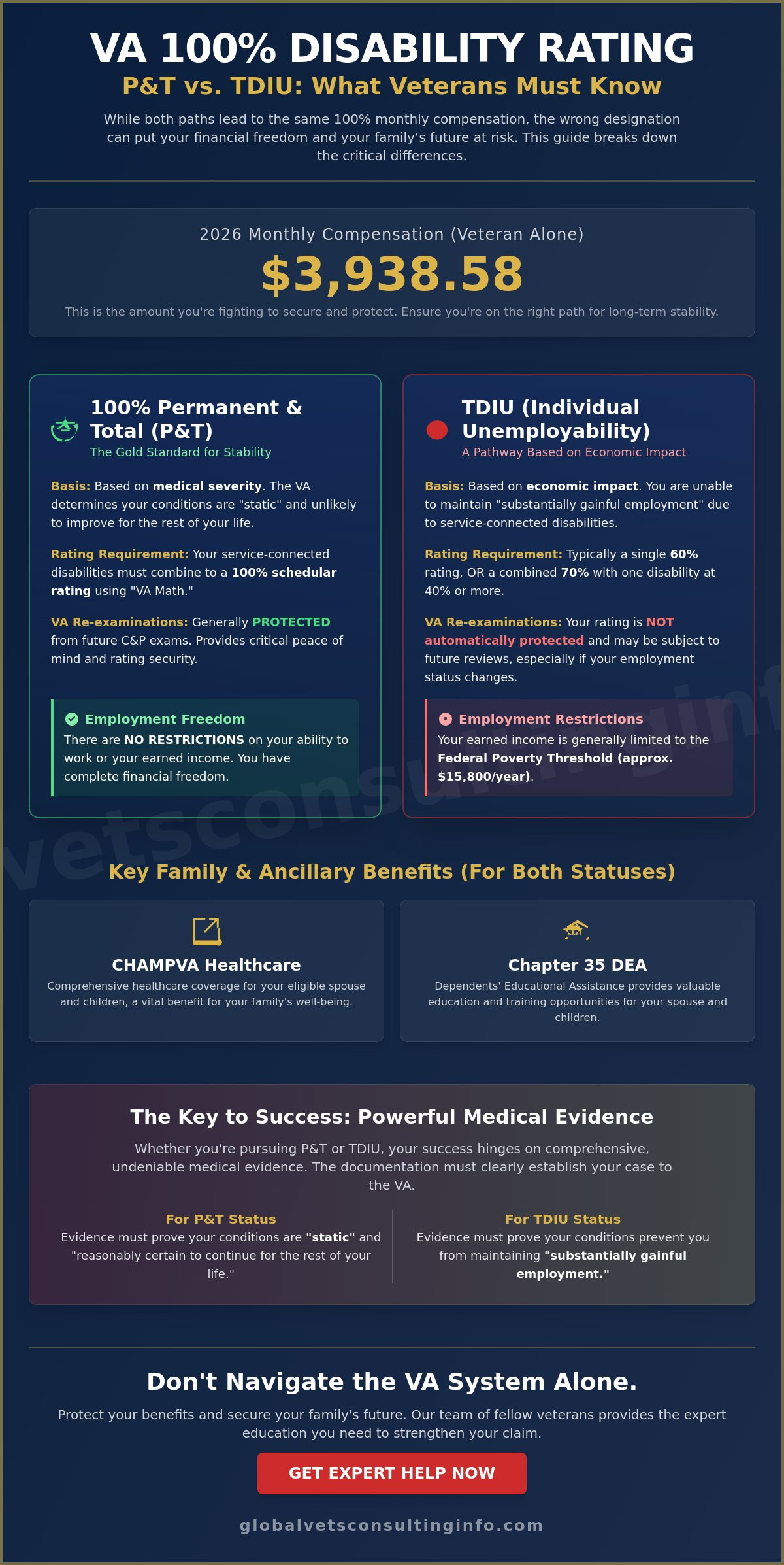
Understanding the distinction between permanent and total disability vs tdiu is vital for any veteran aiming to secure their long-term financial future. While both designations result in the same monthly compensation amount, they represent two different legal paths within the Veterans Benefits Administration (VBA) system. Permanent and Total (P&T) status is awarded when the VA concludes that your service-connected conditions are so severe that they’re unlikely to improve for the rest of your life. In contrast, Total Disability Individual Unemployability (TDIU) is an administrative benefit for veterans who cannot maintain “substantially gainful employment” due to their disabilities, even if their combined rating is less than 100%. Simply put, P&T is defined by medical severity, whereas TDIU is defined by economic impact. A 100% P&T rating is the gold standard for VA disability stability in 2026.
What Does ‘Permanent’ Actually Mean in 2026?
When the VA labels a disability as “permanent,” they’re essentially calling it “static.” This means the condition is not expected to show significant improvement over time. For you, this is a massive relief because it typically signals an end to scheduled Compensation and Pension (C&P) re-examinations. The VA determines a condition is permanent when medical evidence proves it’s “reasonably certain” to continue throughout your life. Achieving this status protects your rating from future reductions, providing a level of peace of mind that a standard 100% rating doesn’t always guarantee.
The Mechanics of TDIU: Paying at the 100% Rate
TDIU allows you to receive 100% compensation even if your combined rating is lower. To qualify for “schedular” TDIU, you generally need one disability rated at 60% or a combined rating of 70% with at least one condition at 40%. If you don’t meet these specific percentages but still can’t work, you might pursue an “extra-schedular” claim. This path focuses entirely on how your service-connected issues prevent you from holding a job. It’s a powerful tool for veterans whose physical or mental health barriers are greater than what “VA math” suggests.
Eligibility and Criteria: Permanent and Total Disability vs TDIU
Securing the maximum compensation rate requires meeting specific legal and medical thresholds. While both statuses result in the same 2026 monthly payment of $3,938.58 for a single veteran, the criteria to qualify for permanent and total disability vs tdiu differ significantly. To achieve 100% P&T, you must either have a single condition rated at 100% or multiple service-connected disabilities that reach a combined 100% through “VA math.” This path is strictly based on the severity of your medical documentation. If your ratings aren’t quite there yet, understanding the VA disability claims process step by step can help you identify which path is most attainable for your specific situation.
TDIU offers an alternative route for those who cannot work but have ratings below the 100% mark. To meet the schedular requirements for TDIU in 2026, you must have at least one service-connected disability rated at 60% or higher. Alternatively, a combined rating of 70% is sufficient if at least one of those individual conditions is rated at 40% or more. Both designations grant you access to the highest tier of VA compensation, but the evidence you provide must clearly align with either medical permanence or economic unemployability.
Medical Permanence Requirements for P&T
A P&T designation requires your disabilities to be “static,” meaning they aren’t expected to improve. The VA often applies the “Age 55 Rule,” where they generally stop scheduling routine future exams for veterans over 55 unless there’s evidence of fraud. You must prove permanence through detailed medical evidence that shows your condition is reasonably certain to continue for the rest of your life. Interestingly, having a 100% P&T rating also impacts your Interaction with Social Security Benefits, as the SSA offers expedited processing for veterans with this specific VA status.
The Unemployability Standard for TDIU
TDIU hinges on your inability to maintain “substantially gainful employment.” For 2026, the VA considers any earned income above the federal poverty threshold, approximately $15,800 to $15,960, as gainful employment. However, you might still qualify if you work in a “protected work environment” or “marginal employment” where your employer makes significant accommodations for your disabilities. If you’re struggling to gather the right documentation to prove these limitations, seeking expert education on medical evidence can be the difference between a denial and a successful claim.
The Critical Differences: Work Limits and Ancillary Benefits
While both statuses provide the same financial baseline, the day-to-day reality of living with permanent and total disability vs tdiu looks very different. The most significant distinction lies in your freedom to work. If you have a 100% P&T rating, you can earn as much as you want without the VA looking over your shoulder. P&T is the only status that truly decouples your pay from your paycheck. On the other hand, TDIU is specifically designed for those who can’t work, meaning the VA monitors your income closely to ensure you remain eligible under the VA eligibility criteria for disability. This difference is often the deciding factor for veterans who still want to pursue a career or start a business.
Despite these differences in employment, both statuses unlock a suite of life-changing ancillary benefits. Your dependents gain access to CHAMPVA health insurance and Chapter 35 Dependents’ Educational Assistance, which provides 35 months of education benefits. These are the same “extra” benefits that often make the 100% rate so desirable for families. However, P&T status is generally more shielded from the VA’s routine re-evaluation process because the conditions are already deemed static. This provides a level of long-term security that standard TDIU doesn’t always offer, especially if your medical evidence isn’t fully developed.
Income Restrictions You Must Know
The income limit is the primary hurdle for TDIU recipients. In 2026, the federal poverty threshold for a single person is approximately $15,800 to $15,960. If you earn more than this amount in a standard job, the VA can revoke your TDIU status. Veterans with a 100% P&T rating face no such restriction. You could earn a six-figure salary and still receive your full VA compensation every month. This makes P&T the ideal goal for veterans who have the capacity to work but still suffer from severe, permanent service-connected conditions.
Stability and Protection from Rating Reductions
The VA uses specific timelines, often called the 5, 10, and 20-year rules, to protect your ratings. The 5-year rule prevents the VA from reducing a rating that’s been in place for five years unless the condition shows sustained improvement. The 20-year rule makes the rating permanent and nearly impossible to reduce. While TDIU recipients can eventually reach these milestones, their status remains vulnerable if they return to work and earn above the poverty limit. If you want to move from TDIU to a more secure P&T status, you can explore our educational resources on VA rating increases to learn how to strengthen your medical file.
Securing Your 100% Rating: The Power of Medical Evidence 🌎
The difference between winning a claim and receiving a denial usually comes down to the quality of your Disability Benefits Questionnaires (DBQs). When comparing permanent and total disability vs tdiu, your medical evidence must be tailored to the specific legal standard you’re trying to meet. For a P&T designation, a private DBQ is a powerful tool for establishing that your condition is static and unlikely to improve. If you’re pursuing a dbq for mental health conditions, the documentation must go beyond a simple list of symptoms. It needs to demonstrate the long-term, permanent impact on your social and industrial life to trigger that P&T finding.
For TDIU claims, the medical evidence must explicitly state why your service-connected conditions prevent you from maintaining any form of substantially gainful employment. This requires a precise connection between your medical limitations and the functional requirements of a workplace. Without this specific link, the VA may conclude that you’re still capable of marginal employment, even if you’re struggling. High-quality evidence bridges the gap between a medical diagnosis and the economic reality of your unemployability.
Why Professional DBQ Preparation Matters
Many veterans fall into the “lack of evidence” trap by relying solely on standard VA records that may not fully capture the severity of their daily struggles. This often leads to immediate claim denials or lower-than-deserved ratings. Global Vets Consulting provides essential education on independent medical evidence to ensure your paperwork accurately reflects your true disability level. We help you understand how to document the severity and permanence of your conditions so the VA has a clear, undeniable path to awarding your benefits.
Taking the Next Step Toward Your 100% Rating
You’ve earned these benefits through your service and sacrifice. Don’t let incomplete documentation or “VA math” stand in the way of your financial security. Our 24/7 AI Veteran Intake Specialist is available right now to help you start the evidence-gathering process. Reach out to Global Vets Consulting today to ensure your medical evidence is thorough, accurate, and ready to secure the 100% rating you deserve. 🇺🇸
Global Vets Consulting
24/7 National Client Services Hotline 📞
24/7 AI Veteran Intake Specialist 🤖
Worldwide 🌎
GlobalVetsConsultingInfo.com
Take Control of Your VA Rating Future 🇺🇸
Choosing the right path between permanent and total disability vs tdiu is one of the most important decisions you’ll make for your financial security. You now understand that while both designations offer the same monthly compensation, P&T provides a unique level of employment freedom and long-term protection from re-evaluations. TDIU remains a powerful alternative if your service-connected conditions prevent you from working, even if your combined rating hasn’t reached the 100% mark yet. The success of either path relies heavily on the quality of your medical documentation and the clarity of your DBQs.
Global Vets Consulting has been veteran-owned and operated since 2021, specializing in high-impact DBQ documentation that accurately reflects your disability level. We’re dedicated to helping you move past the confusion of the VA system with steady confidence. Our 24/7 National Client Services Hotline is always available to help you secure the evidence needed for a predictable future. Contact Global Vets Consulting today for professional DBQ support and secure the maximum benefits you’ve earned. You’ve served our country with honor; now it’s time to ensure your future is stable.
Frequently Asked Questions
Can I have 100% P&T and TDIU at the same time?
No, you cannot hold both statuses simultaneously because they serve different administrative purposes. If your service-connected disabilities reach a 100% schedular rating and are deemed unlikely to improve, the VA grants you P&T status. Since you are already receiving the maximum compensation without any work restrictions, the unemployability benefit of TDIU no longer applies to your specific claim.
Does TDIU automatically become Permanent and Total after a certain number of years?
TDIU does not automatically convert to P&T status based on time alone. To achieve a permanent designation, your medical evidence must demonstrate that your disabilities are static and unlikely to improve for the rest of your life. While many veterans eventually reach this status through long-term documentation, it requires a specific finding from the VA rather than just waiting for a certain number of years to pass.
Can the VA reduce a 100% Permanent and Total rating?
The VA rarely reduces a 100% P&T rating, although it is technically possible under very specific circumstances. Reductions typically only occur if the VA discovers evidence of fraud or if a clear and unmistakable error was made during the original rating decision. Because P&T status indicates that your conditions are static, you are generally shielded from the routine future examinations that other veterans must undergo.
What is the income limit for TDIU in 2026?
The income limit for TDIU in 2026 is approximately $15,800 to $15,960 for a single veteran, which aligns with the federal poverty threshold. If your earned income from a standard job exceeds this amount, the VA may initiate a review of your benefits. This income cap is a major factor when comparing permanent and total disability vs tdiu, as P&T status has no such restrictions on your earnings.
Do I need a new DBQ to request a P&T increase?
You typically need a new DBQ to provide the updated medical evidence required for a P&T designation. This documentation must explicitly state that your conditions are static and not expected to show improvement over time. Submitting a thorough, private DBQ can help you move from a temporary 100% rating to the more secure P&T status by clearly documenting the long-term severity of your disabilities.

Article by
Willie Daniel
Willie Daniel is the Founder and Chief Executive Officer (CEO) of Global Vets Consulting (GVC) – National Veterans Disability Services, a veteran-led educational and medical evidence support organization dedicated to helping veterans better understand VA disability rating increases, DBQ medical evidence, secondary claims education, and C&P examination preparation.
He is a retired U.S. Army Medical Service Corps Officer with more than 27 years of honorable military service, a decorated Iraq combat veteran, and a retired federal official with the U.S. Department of Veterans Affairs. Throughout his military and federal career, Willie Daniel served in leadership, healthcare administration, operational, and veteran-support roles focused on improving services and support systems for servicemembers, veterans, and their families.
Drawing from decades of military leadership, healthcare administration, veteran advocacy, and federal government experience, Willie Daniel brings a practical, veteran-centered perspective to Global Vets Consulting’s educational articles, AI-powered veteran resources, video education initiatives, and outreach programs. His experience navigating military systems, medical documentation processes, and veteran-related administrative operations provides valuable insight into many of the challenges veterans face when seeking to better understand VA disability rating criteria, medical evidence, documentation strategies, and secondary condition education.
Through GVC’s “Veterans Helping Veterans” mission, his focus is on delivering clear, educational, and easy-to-understand information designed to empower veterans with knowledge, resources, and educational tools that may help them make more informed decisions regarding their individual VA disability journeys.
The information provided through GVC is intended for educational and informational purposes only and should not be considered legal or medical advice.
Disclaimer
Disclaimer: Global Vets Consulting, LLC (“GVC”) is a veteran-led educational and medical evidence support organization. GVC is not a law firm, is not a Veterans Service Organization (VSO), and is not affiliated with the U.S. Department of Veterans Affairs (VA) or any government agency.
Global Vets Consulting does not provide legal advice, medical advice, medical treatment, or healthcare services. GVC does not prepare, file, or submit VA disability claims on behalf of veterans. All information provided through this website, blog articles, videos, educational materials, AI tools, dashboards, templates, and communications is intended solely for general educational and informational purposes.
Veterans are encouraged to consult with accredited representatives, licensed attorneys, qualified medical providers, or Veterans Service Organizations regarding their specific legal, medical, or VA-related matters. VA disability decisions, ratings, and outcomes are determined solely by the U.S. Department of Veterans Affairs based on applicable laws, regulations, medical evidence, and individual circumstances. Past results do not guarantee future outcomes.