
What if the shooting pain in your legs isn’t just a side effect of your back injury, but a distinct disability that deserves its own monthly check? Many veterans assume their nerve pain is “baked into” their spinal rating, but that’s a mistake that often costs thousands in earned benefits. If you’re dealing with radiculopathy secondary to back condition, you’re looking at a neurological impairment that the VA can rate separately for every limb involved. 🇺🇸
It’s frustrating when a C&P examiner dismisses your numbness as “just part of the back,” especially when you’re trying to figure out how VA Math will affect your 2026 COLA adjusted rates. We’re here to help you bridge that gap. In this guide, you’ll learn how to establish a rock-solid nexus between your nerves and your spine, what specific medical evidence you need, and how to talk to your doctor about a secondary diagnosis. We will break down the 2026 rating schedules so you can move forward with steady confidence. You’ll gain the tools to secure the higher combined disability rating you’ve earned through your service.
Key Takeaways
- Identify radiculopathy as a distinct neurological condition that qualifies for a separate disability rating from your primary spinal injury.
- Recognize how cervical or lumbar back conditions trigger nerve symptoms in your limbs, such as shooting pain, weakness, or numbness.
- Master the process of linking radiculopathy secondary to back condition by using high-quality medical evidence like DBQs and Nexus Letters.
- Learn how the VA uses the bilateral factor to provide an extra 10% boost to your combined rating when nerve pain affects both sides of your body.
- Understand the 2026 COLA adjustments and how maximizing your secondary claims can significantly increase your monthly disability compensation.
What is Radiculopathy Secondary to a Back Condition? 🇺🇸
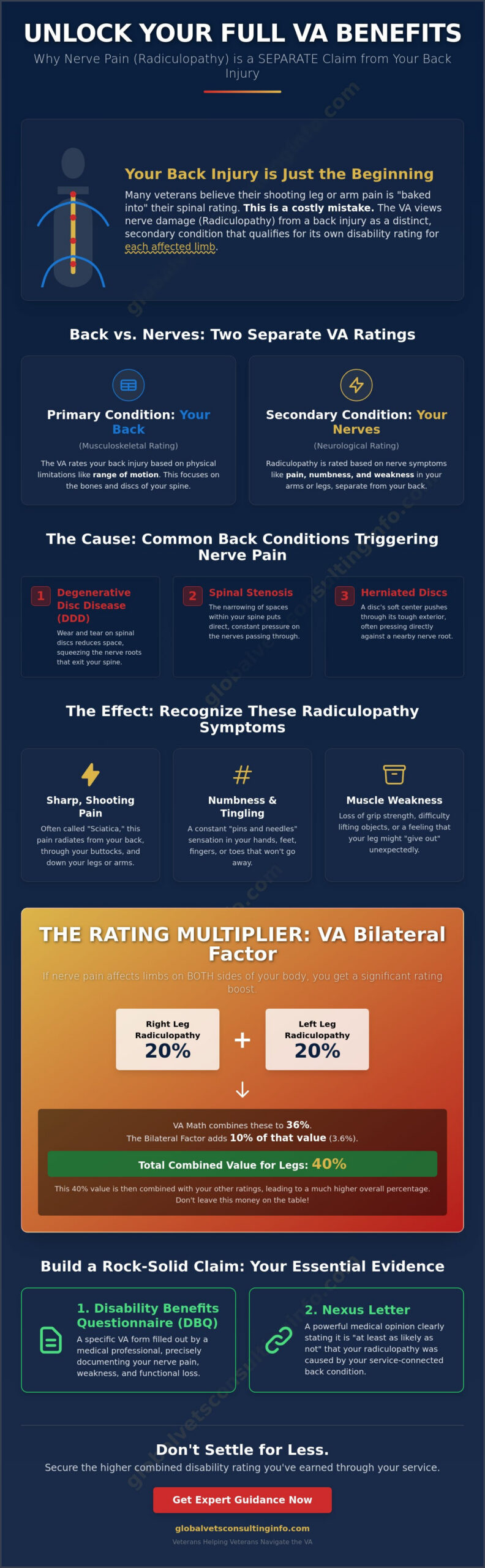
Radiculopathy occurs when a nerve root in your spinal column becomes compressed or “pinched.” While your back pain might feel like a single problem, the VA views the damage to your spine and the damage to your nerves as two separate issues. Developing radiculopathy secondary to back condition means your service-connected spinal injury has directly caused a new neurological impairment. It’s a common progression for many veterans who find that their initial back injury has worsened over time.
Establishing a secondary service connection is a powerful tool for your VA disability claim. It applies when a primary condition, like a herniated disc, causes or aggravates a new medical problem. Since your spine houses the central nervous system, physical damage to your vertebrae often leads to nerve irritation. The VA treats your back under musculoskeletal ratings, which focus mostly on your range of motion. Radiculopathy, however, falls under neurological ratings. This distinction is critical; it allows you to receive a combined rating that reflects the full scope of your physical limitations rather than just a single, capped number.
Several common primary back conditions lead to these nerve issues:
- Degenerative Disc Disease (DDD): Wear and tear on spinal discs can reduce the space between vertebrae, squeezing nearby nerves.
- Spinal Stenosis: The narrowing of the spaces within your spine puts direct pressure on the nerves traveling through the column.
- Herniated Discs: When the soft center of a spinal disc pushes through a crack in the exterior, it often presses against a nerve root.
Common Symptoms Veterans Should Recognize
Identifying your symptoms accurately is the first step toward a successful VA rating increase. You should look for these specific indicators during your daily activities:
- Sharp, shooting pain: Often referred to as sciatica, this pain typically travels from the lower back through the buttocks and down the legs.
- Numbness and tingling: You might feel a constant “pins and needles” sensation in your feet, calves, or hands.
- Muscle weakness: Nerve compression can lead to a loss of reflex function or visible weakness in your extremities, making it difficult to stand or grip objects.
Real-World Examples: How Back Injuries Trigger Radiculopathy
Understanding how your spinal anatomy affects your limbs is the key to a successful VA rating increase. When you have a service-connected back injury, the physical structures of your spine can shift or deteriorate, putting pressure on the nerves that exit the spinal cord. This is the physiological bridge for radiculopathy secondary to back condition. It’s not just “more back pain,” it’s a separate neurological impairment that requires its own medical evidence.
Case Study: Lumbar Spine and the Sciatic Nerve
Consider a veteran service-connected for Degenerative Disc Disease at the L5-S1 level. As the disc space narrows, the sciatic nerve becomes compressed. The Problem is persistent shooting pain and tingling in the right foot. The Action is obtaining a Nexus Letter that explains how the L5-S1 degradation is “at least as likely as not” the cause of the nerve pain. The Result is a secondary service connection for the sciatic nerve, which adds to the veteran’s total disability percentage. For those seeking clarity on these connections, educational resources on musculoskeletal claims can help simplify the process.
Case Study: Cervical Spine and Upper Extremity Weakness
Neck injuries often manifest as problems in the hands and arms. A veteran with a service-connected neck strain may begin to notice a loss of grip strength or numbness in their fingers. This is cervical radiculopathy. In these cases, documenting “functional loss” is essential. You must show the VA how the numbness prevents you from performing daily tasks, such as typing or holding tools. This documentation proves the condition is more than a subjective feeling; it’s a measurable disability.
One of the most overlooked aspects of these claims is Bilaterality. If your lower back condition causes nerve pain in both your left and right legs, the VA should provide two separate radiculopathy ratings. Because both sides are affected, the VA applies the “Bilateral Factor.” This adds an extra 10% to the combined rating of those specific disabilities before calculating your final score. This ensures your compensation reflects the increased burden of living with nerve damage in multiple limbs.
Building Your Evidence: DBQs and Nexus for Secondary Claims
Winning a claim for radiculopathy secondary to back condition requires more than just describing your pain to an examiner. You need a structured paper trail that connects the dots for the VA. The Disability Benefits Questionnaire (DBQ) serves as the primary tool the VA uses to evaluate the severity of your symptoms. If you’re unfamiliar with how these forms work, understanding what is a DBQ for VA claims is essential before you begin building your secondary service connection case. However, a DBQ alone often isn’t enough to prove service connection. You also need a Nexus Letter or Independent Medical Opinion (IMO) to bridge the gap between your primary back injury and your new nerve symptoms. For a deeper dive into these requirements, review our guide on medical evidence for VA disability claim.
The most critical phrase in your medical documentation is “at least as likely as not.” This is the legal standard of proof for VA claims. Your medical provider must state that your radiculopathy is at least as likely as not caused or aggravated by your service-connected back condition. Without this specific language, the VA may conclude that your nerve pain is an unrelated issue or simply a normal part of aging. Clear, professional documentation removes the guesswork for the rater and forces them to consider the neurological impact as a separate entity.
What Your Doctor Must Document on the Radiculopathy DBQ
A successful DBQ must be precise. Your doctor needs to identify the specific nerve roots involved, such as the sciatic, femoral, or median nerves. They must also categorize the severity of your sensory and motor loss as mild, moderate, or severe. Vague descriptions won’t result in an accurate rating. Instead, the evidence should focus on functional impairment and objective testing. Following Independent Medical Opinion (IMO) for VA Claims standards ensures your documentation meets the VA’s rigorous criteria for secondary conditions.
If you need help understanding how to organize your medical records or what to ask your doctor, you can explore our Secondary VA Claims Education resources to ensure your filing is thorough and accurate. Taking these steps now prevents the common “denial and appeal” cycle that many veterans face.
Maximizing Your VA Rating: The Power of Secondary Service Connection
Many veterans hesitate to file for nerve pain because they fear “pyramiding.” This is a common misconception. Pyramiding refers to being rated twice for the same symptom, but the VA treats the spine and the nerves as distinct systems. Your back rating is primarily based on range of motion, while radiculopathy secondary to back condition is rated based on neurological impairment. Because these are separate diagnostic codes, you can legally and successfully maintain both ratings simultaneously. This allows your total compensation to reflect the true level of your disability.
The Bilateral Factor is one of the most effective ways to increase your combined rating. If your back condition causes radiculopathy in both your left and right legs, the VA doesn’t just add those numbers together. They apply a 10% “boost” to the combined value of those bilateral disabilities before merging them with your primary back rating. This recognizes the exponential impact that losing sensation or strength in both limbs has on your daily life. It’s a critical component of VA Math that many veterans overlook during the filing process.
The Path to a VA Rating Increase
Even a 10% or 20% radiculopathy rating for a single limb can push a veteran into a higher compensation bracket. When you factor in multiple limbs and the bilateral factor, the impact on your monthly compensation is substantial. To ensure your symptoms are captured accurately, it’s vital to use a professional DBQ for va disability rating increase. This documentation provides the specific clinical evidence required to justify a higher tier of compensation and reduces the chance of a lowballed rating.
Next Steps: Professional DBQ Preparation
Relying solely on a C&P exam can be risky. These exams are often rushed, and examiners may overlook the nuances of nerve paralysis or sensory loss. Private medical evidence education often carries more weight because it’s thorough and reflects your long-term medical history. At Global Vets Consulting, we specialize in streamlining the questionnaire process for veterans worldwide. 🌎 We help you understand the requirements for VA rating increases so you can submit a claim that is ready for a favorable decision. Review your current ratings today; you may be leaving earned benefits on the table.
Take Control of Your VA Disability Rating Today 🇺🇸
Your journey doesn’t have to end with a single rating for back pain. Recognizing that radiculopathy secondary to back condition is a distinct neurological impairment is the first step toward getting the compensation you’ve earned. By documenting the specific nerve roots involved and leveraging the Bilateral Factor, you can ensure the VA accounts for every limb impacted by your service-connected injury. High-quality medical evidence remains the bridge between your current symptoms and a successful rating increase.
Don’t leave your financial future to a rushed C&P exam. As a veteran-owned and operated consulting firm, we specialize in helping you navigate the complex 2026 standards for DBQ documentation. Our 24/7 AI Veteran Intake Specialist is ready to assist you in organizing your medical evidence education so you can move forward with steady confidence. We focus on providing the meticulous support you need to simplify a complex bureaucratic system.
Get Expert Help with Your Radiculopathy DBQ Today! 🇺🇸
You served with honor; now it’s time to ensure the system works for you. Take the next step toward a more accurate combined rating and the peace of mind you deserve. We’re ready to stand by you as a reliable ally in your pursuit of earned benefits.
Frequently Asked Questions
Can radiculopathy be a primary VA disability claim?
Yes, you can file radiculopathy as a primary claim if the nerve damage was caused by a specific event or injury during your military service. However, most veterans find it more effective to claim radiculopathy secondary to back condition if their nerve pain developed as a result of a service-connected spinal injury. This path allows you to use your existing back diagnosis as the foundation for your new neurological claim.
What is the maximum VA rating for radiculopathy secondary to back pain?
The maximum rating depends on the specific nerve affected and the severity of the paralysis. For the sciatic nerve, ratings can reach 80% for complete paralysis, while other nerves like the femoral nerve cap at lower percentages. Most veterans receive ratings of 10% or 20% per limb for mild to moderate symptoms. The VA evaluates functional loss and sensory impairment rather than pain alone to determine these levels.
Do I need a new C&P exam for a secondary radiculopathy claim?
The VA usually schedules a Compensation and Pension (C&P) exam to verify the link and severity of your secondary symptoms. You can strengthen your case by submitting a private Disability Benefits Questionnaire (DBQ) and a Nexus Letter before your appointment. Providing this independent medical evidence helps ensure the VA examiner doesn’t overlook critical details regarding your numbness, tingling, or muscle weakness.
What is the difference between sciatica and radiculopathy in VA claims?
Sciatica is simply a specific form of radiculopathy that impacts the sciatic nerve. While sciatica only refers to the lower back and legs, radiculopathy is the broader medical term for any pinched nerve in the spine. When filing for radiculopathy secondary to back condition, you’ll use different diagnostic codes depending on whether the symptoms are in your arms, legs, or even your midsection.
Can I claim radiculopathy for both legs if I only have one back injury?
You are absolutely entitled to claim nerve damage in both legs even if you have a single back injury. If your spinal condition compresses nerve roots on both the left and right sides, you should receive two separate ratings. This triggers the bilateral factor, which adds a 10% boost to the combined value of those ratings. It’s a key strategy for ensuring your compensation reflects the full scope of your physical limitations.

Article by
Willie Daniel
Willie Daniel is the Founder and Chief Executive Officer (CEO) of Global Vets Consulting (GVC) – National Veterans Disability Services, a veteran-led educational and medical evidence support organization dedicated to helping veterans better understand VA disability rating increases, DBQ medical evidence, secondary claims education, and C&P examination preparation.
He is a retired U.S. Army Medical Service Corps Officer with more than 27 years of honorable military service, a decorated Iraq combat veteran, and a retired federal official with the U.S. Department of Veterans Affairs. Throughout his military and federal career, Willie Daniel served in leadership, healthcare administration, operational, and veteran-support roles focused on improving services and support systems for servicemembers, veterans, and their families.
Drawing from decades of military leadership, healthcare administration, veteran advocacy, and federal government experience, Willie Daniel brings a practical, veteran-centered perspective to Global Vets Consulting’s educational articles, AI-powered veteran resources, video education initiatives, and outreach programs. His experience navigating military systems, medical documentation processes, and veteran-related administrative operations provides valuable insight into many of the challenges veterans face when seeking to better understand VA disability rating criteria, medical evidence, documentation strategies, and secondary condition education.
Through GVC’s “Veterans Helping Veterans” mission, his focus is on delivering clear, educational, and easy-to-understand information designed to empower veterans with knowledge, resources, and educational tools that may help them make more informed decisions regarding their individual VA disability journeys.
The information provided through GVC is intended for educational and informational purposes only and should not be considered legal or medical advice.
Disclaimer
Disclaimer: Global Vets Consulting, LLC (“GVC”) is a veteran-led educational and medical evidence support organization. GVC is not a law firm, is not a Veterans Service Organization (VSO), and is not affiliated with the U.S. Department of Veterans Affairs (VA) or any government agency.
Global Vets Consulting does not provide legal advice, medical advice, medical treatment, or healthcare services. GVC does not prepare, file, or submit VA disability claims on behalf of veterans. All information provided through this website, blog articles, videos, educational materials, AI tools, dashboards, templates, and communications is intended solely for general educational and informational purposes.
Veterans are encouraged to consult with accredited representatives, licensed attorneys, qualified medical providers, or Veterans Service Organizations regarding their specific legal, medical, or VA-related matters. VA disability decisions, ratings, and outcomes are determined solely by the U.S. Department of Veterans Affairs based on applicable laws, regulations, medical evidence, and individual circumstances. Past results do not guarantee future outcomes.

