
For TBI Secondary Claims, the key is not simply naming another health problem. It is clearly explaining how the condition relates to your service-connected brain injury. It can be difficult to tell whether symptoms are TBI residuals or part of a separate condition, especially when they overlap or change over time.
A clear claim distinguishes the condition you’re experiencing from the medical relationship you’re asking the VA to consider. This guide explains that distinction, how medical opinions and other records may help clarify it, and how to organize medical and personal evidence. Global Vets Consulting provides VA Disability Documentation Services, including Disability Benefits Questionnaires (DBQs), to support clear medical documentation. Veterans remain responsible for filing their claims.
Key Takeaways
- Learn how to distinguish a separate diagnosed condition from symptoms that may be considered TBI residuals.
- For TBI Secondary Claims, focus on making the medical relationship clear rather than assuming it will be understood.
- Build a useful evidence timeline by organizing relevant records, symptom history, and questions for a clinician.
- Understand how independent medical documentation may support your claim while leaving claim filing in your hands.
What Does a TBI Secondary Claim Mean for Your VA Disability Benefits?
A secondary claim asks the VA to recognize a separate condition as connected to a disability that’s already service-connected. The claimed condition may be linked because the service-connected condition caused it or made it worse. For TBI Secondary Claims, that means explaining the relationship between the established TBI and the other diagnosed condition, rather than relying on the fact that both exist. A Traumatic Brain Injury (TBI) Overview can provide general background on TBI’s causes and effects, but it can’t establish an individual medical connection.
Migraines, depression, sleep apnea, and tinnitus are examples a veteran might discuss in relation to TBI. These conditions are not automatic approvals. The condition’s presence alone does not establish its relationship to TBI. Make clear which condition you’re claiming and what medical evidence supports a connection to the service-connected injury.
Is a TBI symptom always a separate secondary condition?
No. A symptom, such as trouble concentrating or headaches, may be described as a TBI residual, while a separate diagnosis identifies a distinct health condition. The distinction can be difficult when symptoms overlap or appear in more than one diagnosis. Records that identify the diagnosis, describe the symptoms, and explain how they relate to TBI can make the evidence easier to understand. They do not determine in advance how the VA will classify the condition.
When reviewing your records, note whether a provider documented a diagnosis or described a symptom without assigning one. Keep the wording accurate, and don’t treat a symptom as a separate condition unless it has been diagnosed. This gives you a clearer starting point for identifying what the evidence shows and what questions may need clarification.
How Can Medical Evidence Explain a Condition’s Link to TBI?
Useful medical evidence tells a connected story: it identifies the service-connected TBI, names the separate condition being claimed, and explains the medical reasoning behind the proposed relationship. For example, records might document when a condition was diagnosed, how symptoms developed, and what a clinician considers relevant to its connection with TBI. A conclusion without an explanation may leave questions unanswered. The clinician’s reasoning helps show how the relationship was assessed.
Treatment records and clinical observations can add context, including changes over time, reported symptoms, and effects on daily functioning. For individuals assessing long-term functional impacts and rehabilitation requirements, resources like Injury Consulting LLC specialize in life care planning and physical therapy evaluations. There isn’t one fixed set of documents that fits every case. A Disability Benefits Questionnaire (DBQ) records findings about a particular condition, but completing one doesn’t by itself establish service connection or guarantee a specific rating.
What should medical documentation make clear?
Accurate documentation distinguishes what you experience from what a clinician has diagnosed and concluded. It can describe the condition, relevant history, symptoms, and functional effects, while explaining the medical basis for any connection to TBI. Your account can provide context, but it is not a substitute for a clinician’s independent assessment. The opinion should reflect the clinician’s own review and judgment, not simply repeat a requested conclusion.
Keep records relevant to the question at hand. A treatment note may establish when symptoms were discussed, while an examination may clarify findings or limitations. Together, records can show how the clinician reached an opinion. VA forms and submission instructions can change, so verify specific documentation requirements against current VA guidance before filing.
If independent medical documentation could help clarify your evidence, Global Vets Consulting provides VA Disability Documentation Services. The service supports documentation, not claim filing. Veterans remain responsible for filing their claims and submitting their materials.
How Can You Organize Evidence for a TBI Secondary Claim?
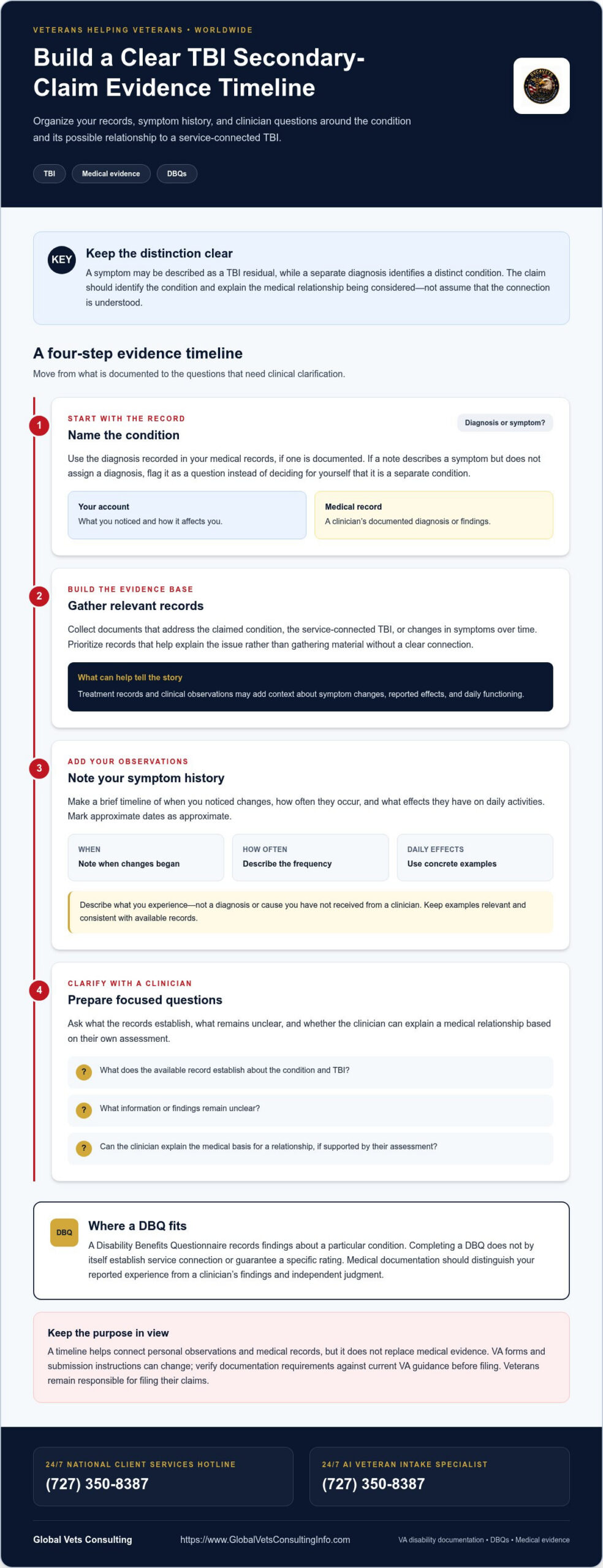
A simple structure can keep your records focused on the condition and its possible relationship to TBI. Start with these steps, and keep your observations distinct from medical findings:
- Name the condition. Use the diagnosis recorded in your medical records, if one is documented. If you’re unsure whether a note describes a symptom or a diagnosis, flag it as a question rather than making your own determination.
- Gather relevant records. Collect documents that address the claimed condition, the TBI, or changes in symptoms over time. Prioritize records that help explain the issue rather than gathering material without a clear connection.
- Note your symptom history. Make a brief timeline of when you noticed changes, how often they occur, and what effects they have on daily activities. Mark approximate dates as approximate.
- Prepare questions for a clinician. Ask what the records establish, what remains unclear, and whether the clinician can explain a medical relationship based on their assessment.
This preparation can make TBI Secondary Claims easier to discuss without treating a personal account as medical proof. For a broader overview of the filing sequence, the existing guide “VA Disability Claims Process Step by Step: A 2026 Veteran’s Guide” can provide additional context.
How should you describe symptoms without overstating them?
Use concrete examples you can describe consistently. For instance, explain that headaches interrupt a particular daily task, or note when concentration difficulties tend to occur. Keep examples relevant to the claimed condition and consistent with available records. Describe what you experience, not a diagnosis or cause you haven’t received from a clinician.
Keep the categories clear: your statement can record what you noticed and how it affects you; medical records can document diagnoses, examination findings, and a clinician’s opinion. A timeline helps connect those pieces, but it doesn’t replace medical evidence. This distinction gives a clinician clearer questions to address and helps keep your claim narrative accurate.
What Are the Next Steps for TBI Secondary-Claim Documentation?
You don’t need to obtain a doctor’s opinion just to file a VA claim. Still, independent medical documentation may help explain a condition and its relationship to a service-connected TBI. The decision to file remains yours, and no DBQ or medical opinion can guarantee service connection, a rating, or any other VA outcome.
Global Vets Consulting provides VA Disability Documentation Services, including Increase Claims (DBQ). The service connects veterans with independent physicians for medical documentation; it doesn’t file claims or provide legal advice. Veterans remain responsible for submitting their own claim and supporting materials.
What can veterans expect from a documentation consultation?
The initial consultation is free before you pay anything. It helps clarify documentation needs, not predict eligibility or a rating. The process follows three steps:
- Free Consultation: Discuss the condition and the documentation questions you want to address.
- Access Your Physician: Connect with an independent physician for documentation support.
- Evidence for Your Claim: Receive medical documentation that may help present your condition clearly as you prepare your claim.
Before the consultation, identify the diagnosed condition at issue, gather relevant records, and write down what you hope the documentation will clarify. Ask how the documentation relates to your records and what questions remain. The physician’s assessment must be independent, and the VA makes its own decision based on the claim and evidence.
If you’re considering documentation support for TBI Secondary Claims, discuss your documentation needs with Global Vets Consulting. The consultation is free before you pay anything.
Planning note: opening, takeaways, and conclusion
It can be difficult to tell whether a health problem belongs among TBI residuals or should be described as a separate condition connected to an established service-connected injury. Overlapping symptoms and unfamiliar medical terminology can make the evidence hard to organize. Start by identifying the diagnosed condition, then look for documentation that explains its history and any medical relationship to TBI. Personal observations can add context, but they are not the same as a clinician’s diagnosis or opinion. The distinction matters when preparing a secondary claim: records and clinical reasoning may help explain the relationship, while a symptom timeline can support a focused discussion. The aim is clarity, not a promise about how the VA will decide a claim.
Key Takeaways
- Separate symptoms from diagnoses.
- Organize relevant records.
- Describe a clear timeline.
- Keep claim filing in your hands.
A practical next step is to review the records you already have and write down what they say about the condition, its symptoms, and when it was discussed with a clinician. Note any gaps or questions without trying to supply a medical explanation yourself. You can then discuss those questions with a clinician or consider whether independent medical documentation could clarify the evidence. A doctor isn’t required just to file a claim, and documentation support does not determine the VA’s decision. Global Vets Consulting offers a free initial consultation before you pay anything to discuss documentation needs. Accurate records and a clear account can help present your situation, while the VA determines the outcome.
Take a Clear Next Step
You don’t have to resolve every question about your medical history before deciding what to do next. Choose one practical step: identify what you want clarified, gather the records you already have, and consider whether independent documentation could help present the information clearly. For TBI Secondary Claims, move forward carefully by focusing on an accurate account, not trying to predict the VA’s decision.
Global Vets Consulting offers documentation support through a network of 850+ DBQ doctors. Its flat-rate pricing means no commissions, no percentages, no surprises. A consultation can help you discuss documentation needs, but it can’t guarantee a claim outcome, and you remain responsible for submitting your claim.
Start with a free consultation before you pay anything to discuss your documentation needs. Clear questions and a steady approach can help you move forward with greater confidence.
Frequently Asked Questions
Can migraines be claimed as secondary to a traumatic brain injury?
Yes, migraines may be claimed as secondary to a service-connected TBI when evidence supports a medical connection. For TBI Secondary Claims, migraine symptoms alone don’t establish that link. Records describing diagnosis, onset, frequency, and impact can provide context, while a clinician’s medical reasoning may address whether TBI caused or worsened the condition. Each claim is considered on its own evidence, so approval isn’t automatic.
Do I need a doctor to file a VA secondary claim?
No, you don’t need to hire a doctor simply to submit a secondary claim. Filing and obtaining medical documentation are separate matters. A clinician’s records or opinion may help explain a diagnosis and its possible relationship to TBI, but they don’t guarantee a VA decision. If you file without an independent opinion, identify what evidence you have and what questions remain unanswered.
Can I claim a condition secondary to TBI if symptoms overlap?
Overlapping symptoms don’t automatically prevent you from raising a separate condition. For example, difficulty concentrating might appear in records discussing TBI and another diagnosis. Keep diagnoses and symptom descriptions distinct where the records do, and note which provider documented each finding. The VA determines how to evaluate overlapping impairment, so avoid assuming one symptom will receive separate consideration under multiple conditions.
Does a TBI secondary claim require a separate diagnosis?
If you’re claiming a distinct condition, documentation identifying it can help distinguish it from a symptom recorded as part of TBI. A headache, for example, may be described as a symptom, while a clinician may diagnose a specific headache disorder. How the evidence is classified depends on the medical record and claim. Don’t assign yourself a diagnosis; ask a clinician what the records establish.
Can I submit a TBI secondary claim if my evidence is incomplete?
You may be able to submit a claim while some supporting evidence is still missing, but gaps can make it harder to assess the diagnosis or its relationship to TBI. Write down what you have, what you’re still seeking, and which records may address those gaps. Review current VA instructions for submitting evidence, and keep copies of anything you provide. Incomplete evidence doesn’t predict the outcome.

Article by
Willie Daniel
Willie Daniel is the Founder and Chief Executive Officer (CEO) of Global Vets Consulting (GVC4Vets) – National Veterans Disability Services, a veteran-led educational and medical evidence support organization dedicated to helping veterans better understand VA disability rating increases, DBQ medical evidence, secondary claims education, and C&P examination preparation.
He is a retired U.S. Army Medical Service Corps Officer with more than 27 years of honorable military service, a decorated Iraq combat veteran, and a retired federal official with the U.S. Department of Veterans Affairs. Throughout his military and federal career, Willie Daniel served in leadership, healthcare administration, operational, and veteran-support roles focused on improving services and support systems for servicemembers, veterans, and their families.
Drawing from decades of military leadership, healthcare administration, veteran advocacy, and federal government experience, Willie Daniel brings a practical, veteran-centered perspective to Global Vets Consulting’s educational articles, AI-powered veteran resources, video education initiatives, and outreach programs. His experience navigating military systems, medical documentation processes, and veteran-related administrative operations provides valuable insight into many of the challenges veterans face when seeking to better understand VA disability rating criteria, medical evidence, documentation strategies, and secondary condition education.
Through GVC’s “Veterans Helping Veterans” mission, his focus is on delivering clear, educational, and easy-to-understand information designed to empower veterans with knowledge, resources, and educational tools that may help them make more informed decisions regarding their individual VA disability journeys.
The information provided through GVC is intended for educational and informational purposes only and should not be considered legal or medical advice.
Disclaimer
Disclaimer: Global Vets Consulting, LLC (“GVC”) is a veteran-led educational and medical evidence support organization. GVC is not a law firm, is not a Veterans Service Organization (VSO), and is not affiliated with the U.S. Department of Veterans Affairs (VA) or any government agency.
Global Vets Consulting does not provide legal advice, medical advice, medical treatment, or healthcare services. GVC does not prepare, file, or submit VA disability claims on behalf of veterans. All information provided through this website, blog articles, videos, educational materials, AI tools, dashboards, templates, and communications is intended solely for general educational and informational purposes.
Veterans are encouraged to consult with accredited representatives, licensed attorneys, qualified medical providers, or Veterans Service Organizations regarding their specific legal, medical, or VA-related matters. VA disability decisions, ratings, and outcomes are determined solely by the U.S. Department of Veterans Affairs based on applicable laws, regulations, medical evidence, and individual circumstances. Past results do not guarantee future outcomes.