
A 30% rating for Meniere’s disease is often a sign that the VA missed the true severity of your vertigo attacks. Most veterans filing a va claim for meniere’s disease find themselves stuck at this lower level, even when their symptoms make it impossible to maintain steady employment. It’s incredibly frustrating to try and explain the reality of “cerebellar gait” to an examiner who doesn’t see you on your worst days, and you’re right to worry about being lowballed by a system that frequently prioritizes speed over accuracy.
This guide will show you how to move beyond the 30% floor by effectively documenting the frequency of your attacks and leveraging medical evidence to secure the 100% rating you’ve earned. We’ll explore the 2026 rating criteria, the role of a private DBQ in providing a clear rationale for your symptoms, and how to ensure your tinnitus is properly factored into your claim under the latest VA proposals. By the end of this article, you’ll have a methodical path forward to prove your symptoms and achieve a successful service connection.
Key Takeaways
- Identify the specific frequency of vertigo attacks and balance issues required to qualify for a 60% or 100% rating under Diagnostic Code 6205.
- Learn the step-by-step process for building a va claim for meniere’s disease by documenting your symptoms through a consistent vertigo log.
- Discover the criteria for establishing secondary service connection, linking Meniere’s to existing conditions like TBI or anxiety for a more comprehensive claim.
- Understand how to use a private Disability Benefits Questionnaire (DBQ) to ensure the intermittent nature of your symptoms is captured with clinical accuracy.
- Gain clarity on how to prepare for your C&P examination to avoid the common pitfalls that lead to being lowballed at a 30% rating.
VA Rating Criteria for Meniere’s Disease: Understanding the Percentages
The VA evaluates Meniere’s disease under Diagnostic Code 6205. This code focuses on three primary symptoms: vertigo, hearing impairment, and tinnitus. To understand how your symptoms translate into a specific disability percentage, you must track the frequency of your attacks with precision. For a comprehensive Meniere’s disease overview, medical literature describes this condition as a chronic inner ear disorder that triggers sudden episodes of spinning and balance loss.
To better understand this concept, watch this helpful video:
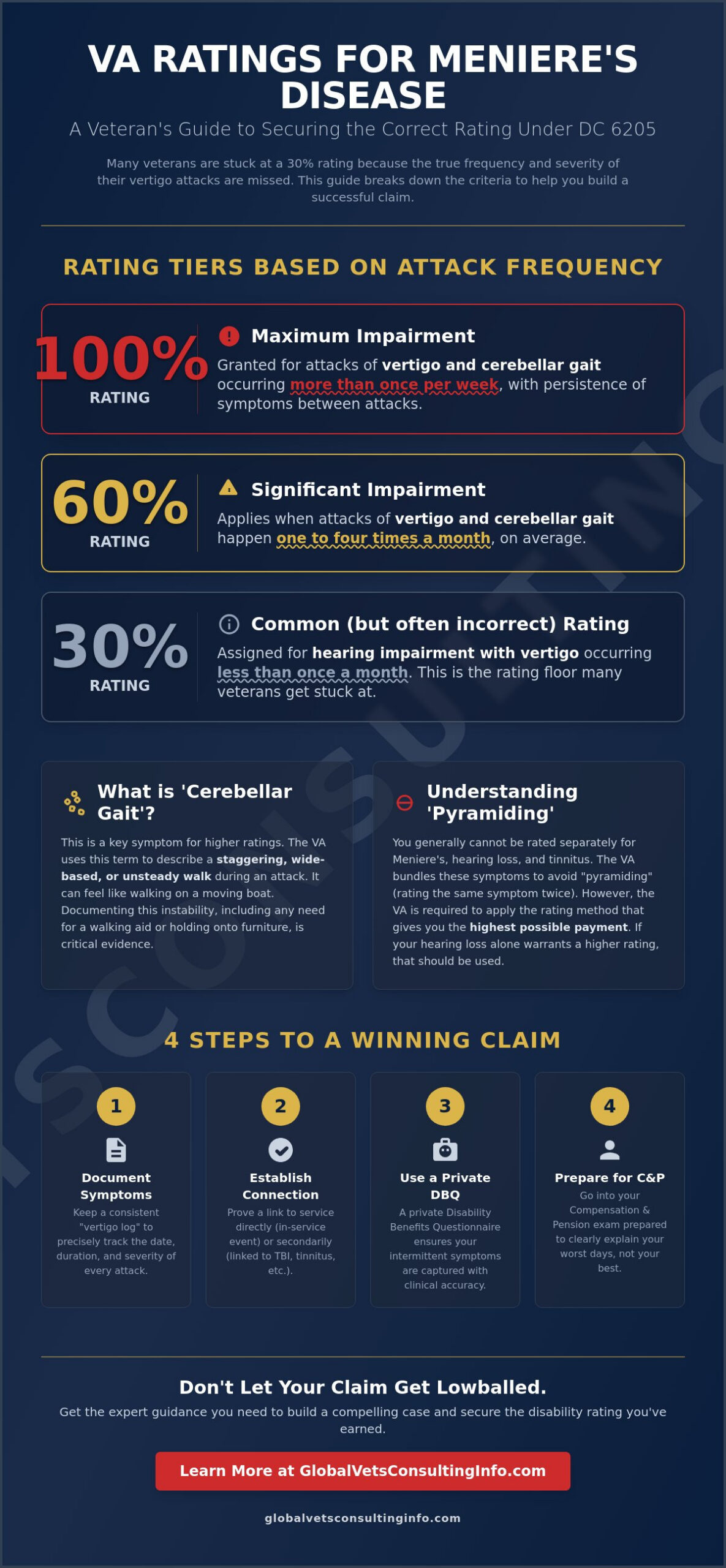
The rating tiers follow a strict progression based on the frequency of your episodes. A 30% rating applies if you have hearing impairment and vertigo that occurs less than once per month. If your attacks of vertigo and cerebellar gait happen one to four times monthly, you qualify for a 60% rating. The maximum 100% rating is only granted when these attacks occur more than once a week. Because these gaps are significant, meticulous documentation is the only way to secure the correct level for your va claim for meniere’s disease.
What the VA Means by ‘Cerebellar Gait’
Gait instability is a cornerstone of the higher rating tiers. The VA uses the term “cerebellar gait” to describe a staggering, wide-based, or unsteady walk. You might feel like you are walking on a moving boat or struggling to maintain a straight line. Documenting these balance issues is just as critical as documenting the vertigo itself. If you require a walking aid or often reach for furniture to stay upright during an episode, ensure these details are included in your medical evidence. This physical manifestation of the disease is often what separates a 30% rating from a 60% or 100% evaluation.
The Role of Hearing Impairment in Your Rating
The VA bundles hearing loss and tinnitus within the Meniere’s diagnostic code. You should know that you generally cannot be rated for Meniere’s disease, hearing loss, and tinnitus separately. This practice is called pyramiding. It occurs when the VA evaluates the same symptom under two different codes. The VA is required to apply the rating method that results in the highest payment for the veteran. If your hearing loss alone warrants a higher rating than your Meniere’s symptoms, the VA should technically use that higher evaluation. Understanding this nuance helps you advocate for the maximum benefit during your va claim for meniere’s disease.
Establishing Service Connection: Direct and Secondary Paths
Establishing service connection is the foundation of any successful va claim for meniere’s disease. You can pursue this through two primary avenues: direct or secondary connection. A direct connection requires evidence of an in-service event, injury, or a formal diagnosis while you were still on active duty. If you began experiencing vertigo or hearing loss during your service, your military medical records are your most powerful tool. You can review the VA disability claims process step by step to ensure you meet the basic filing requirements before diving into medical specifics.
The VA often grants service connection based on the VA’s Schedule of Ratings for the ear, but the burden of proof rests on your ability to provide a “Nexus.” In 2026, a high-quality Nexus letter is more critical than ever. The VA is using more rigorous screening for medical opinions; therefore, your doctor’s statement must clearly link your current condition to your service with a rationale that stands up to scrutiny. If you need help understanding how to present this evidence, exploring secondary VA claims education can provide the clarity you need to move forward.
Meniere’s Secondary to Tinnitus or Hearing Loss
Many veterans find that their Meniere’s disease is actually a secondary result of existing ear damage. If you already have a service connection for tinnitus or hearing loss, you can argue that these conditions have progressed or aggravated the inner ear to the point of Meniere’s. The standard of proof is “at least as likely as not,” meaning there is a 50% or greater chance your service-connected ear issues caused the disease. Under the proposed 2026 rating changes, tinnitus is increasingly viewed as a symptom of an underlying condition, making this secondary path a strategic choice for many.
Presumptive Conditions and Toxic Exposure
While Meniere’s disease is not currently listed as a presumptive condition under the PACT Act as of May 2026, toxic exposure remains a viable link. Exposure to jet fuel or high-decibel environments can cause profound inner ear damage. If your medical records from service are thin, lay evidence becomes vital. Buddy letters from fellow service members who witnessed your balance issues or vertigo attacks can help establish a timeline that connects your current diagnosis to your time in uniform. This documentation helps bridge the gap between your service and your current va claim for meniere’s disease.
Step-by-Step: How to Build a Winning Meniere’s Claim
Securing a successful va claim for meniere’s disease requires more than just a doctor’s note. You need a structured evidence trail that mirrors the requirements found in 38 CFR § 4.87, Schedule of Ratings – Ear. Your first step is to obtain a formal diagnosis from an Ear, Nose, and Throat (ENT) specialist or a qualified audiologist. General practitioners often lack the specialized equipment, such as caloric testing or vestibular exams, needed to confirm Meniere’s with the level of detail the VA demands.
Once you have a diagnosis, you must build a bridge between your medical records and your daily reality. Start tracking your symptoms immediately using a “Vertigo Log” for at least 3 to 6 months before you file. This log provides the frequency data the VA uses to assign a rating above the 30% floor. You should also consider obtaining a private Disability Benefits Questionnaire (DBQ) to ensure your symptoms are recorded with clinical accuracy. Finally, draft a Statement in Support of Claim that focuses on the functional impact of the disease, explaining exactly how the attacks limit your ability to work or care for yourself.
How to Keep an Effective Vertigo Log
Your log isn’t just a personal diary; it’s a critical piece of medical evidence. For every attack, record the date, the exact duration, and the severity of the spinning. Explicitly note if you experienced “cerebellar gait” or staggering during the episode. It’s vital to document “prostrating” attacks. These are episodes so severe that they require you to stop all activity, seek a dark room, or remain in bed. If an attack lasts for hours and leaves you unable to function, the VA needs to see that frequency reflected in your log to justify a higher rating.
Gathering Functional Impact Evidence
The VA evaluates how Meniere’s affects your “social and industrial capacity.” While your medical records show the disease exists, functional impact evidence shows how it disables you. Employer statements are particularly effective for this. If a supervisor can describe how your staggering or sudden vertigo makes your job duties unsafe, or if they can document the number of shifts you’ve missed due to balance issues, it carries significant weight. This type of lay evidence provides a real-world context that a standard clinical exam might miss.
The Strategic Advantage of a Private DBQ for Meniere’s
A standard C&P exam is often nothing more than a brief snapshot of your health. Because Meniere’s disease is episodic, you might arrive at your appointment on a “good day” when your balance is stable and your hearing feels relatively clear. This leads many examiners to miss the intermittent but devastating nature of your attacks. A private Disability Benefits Questionnaire (DBQ) serves as a strategic countermeasure. It allows a medical professional who has reviewed your entire history to document the long-term frequency of your vertigo and gait issues. This level of detail is a critical asset when seeking a VA disability rating increase, as it ensures every clinical box is checked with accuracy before the VA even schedules an exam.
Providing a private DBQ also helps you avoid the common “lowball” ratings that result from incomplete evidence. When you submit a claim with comprehensive medical documentation already in place, you move closer to a “Fully Developed Claim” status. This reduces the VA’s reliance on a single, potentially flawed C&P exam and forces the rater to consider the longitudinal evidence of your prostrating attacks. It’s a proactive way to manage your va claim for meniere’s disease and ensure the final decision reflects your true level of impairment.
Preempting the C&P Exam with Global Vets Consulting
Our educational resources are designed to help you walk into a C&P exam with a position of strength. Understanding what is a DBQ and how it functions within the rating schedule is the first step in taking control of your outcome. We provide the independent medical evidence education you need to ensure your documentation is “VA-ready.” By focusing on clinical accuracy and the specific terminology the VA raters look for, you can bridge the gap between your lived experience and the administrative requirements of the system.
Final Checklist for Your Meniere’s Submission
Before you hit submit, you must ensure your evidence package is airtight. Consistency is the primary factor the VA uses to verify the credibility of your claim. Review your submission for the following points:
- Does the “frequency of attacks” listed in your private DBQ match the entries in your 3 to 6 month vertigo log?
- Is there a formal diagnosis from an ENT or audiologist that explicitly mentions Meniere’s disease?
- Have you clearly documented “cerebellar gait” or staggering to justify a rating of 60% or higher?
- Does your Statement in Support of Claim focus on the prostrating nature of the attacks and their impact on your work?
Meticulous preparation is the difference between a denied claim and a successful 100% rating. By aligning your medical records, your symptoms log, and your DBQ, you provide the VA with a clear, undeniable path to granting the benefits you’ve earned.
Take Control of Your Meniere’s Rating
Securing the maximum compensation for your va claim for meniere’s disease requires you to bridge the gap between your daily struggles and the VA’s rigid rating criteria. You’ve learned that documenting the exact frequency of prostrating attacks and the presence of gait instability is the only way to move past a 30% lowball. By maintaining a detailed symptom log and ensuring your medical evidence reflects your worst days rather than just a “good day” snapshot, you provide the rater with the clinical clarity they need to grant your benefits.
Don’t leave your future to a brief C&P exam that might overlook the intermittent nature of your symptoms. As a veteran-owned and operated team, we specialize in streamlined evidence-gathering and DBQ education designed to make your documentation VA-ready. Secure the medical evidence you need with a professional DBQ from Global Vets Consulting. We’re dedicated to serving as your steady guide through this complex administrative system, ensuring you have the tools to achieve the outcome you’ve earned through your service. You have the power to change your claim’s trajectory with meticulous evidence.
Frequently Asked Questions
Can I get a 100% VA rating for Meniere’s disease?
Yes, you can receive a 100% rating if your attacks of vertigo and cerebellar gait occur more than once weekly. This evaluation recognizes the severe social and industrial impairment caused by near-constant instability. For 2026, a 100% disability rating for a veteran alone results in a monthly compensation of $3,938.58. You must provide clear medical evidence or a vertigo log to prove this frequency during your va claim for meniere’s disease.
What is the difference between Meniere’s disease and vertigo for VA claims?
Vertigo is a symptom of dizziness or spinning, while Meniere’s disease is a specific clinical diagnosis evaluated under Diagnostic Code 6205. The VA can rate vertigo on its own if no underlying cause is found, but a Meniere’s diagnosis requires a combination of vertigo, hearing impairment, and tinnitus. Because Meniere’s covers multiple symptoms, it often leads to a higher rating than a standalone vertigo claim if you document the full scope of the condition.
Do I need a Nexus letter for a Meniere’s disease claim?
While not always mandatory for an in-service diagnosis, a Nexus letter is highly recommended for a successful va claim for meniere’s disease filed years after discharge. This medical opinion provides the essential link between your current inner ear issues and your military service. In 2026, the VA is increasing its scrutiny of private evidence, so your Nexus must include a strong rationale based on your service treatment records and current clinical findings.
How many vertigo attacks do I need to qualify for 60% disability?
To qualify for a 60% disability rating, you must document attacks of vertigo and cerebellar gait occurring one to four times per month. The VA specifically looks for “cerebellar gait,” which refers to a staggering or unsteady walk during these episodes. If you experience these symptoms at this frequency but lack documentation, the VA may default to a 30% rating. Keeping a consistent log of your balance issues for several months is the best way to prove you meet this threshold.
Can I be rated for both tinnitus and Meniere’s disease at the same time?
You generally cannot receive separate ratings for both tinnitus and Meniere’s disease because this is considered pyramiding. Diagnostic Code 6205 already incorporates tinnitus and hearing loss into the overall evaluation for Meniere’s. The VA is required to assign the rating that results in the highest compensation for the veteran. If your Meniere’s symptoms are severe, the combined rating under one code is usually more beneficial than receiving a standalone 10% rating for tinnitus.

Article by
Willie Daniel
Willie Daniel is the Founder and Chief Executive Officer (CEO) of Global Vets Consulting (GVC) – National Veterans Disability Services, a veteran-led educational and medical evidence support organization dedicated to helping veterans better understand VA disability rating increases, DBQ medical evidence, secondary claims education, and C&P examination preparation.
He is a retired U.S. Army Medical Service Corps Officer with more than 27 years of honorable military service, a decorated Iraq combat veteran, and a retired federal official with the U.S. Department of Veterans Affairs. Throughout his military and federal career, Willie Daniel served in leadership, healthcare administration, operational, and veteran-support roles focused on improving services and support systems for servicemembers, veterans, and their families.
Drawing from decades of military leadership, healthcare administration, veteran advocacy, and federal government experience, Willie Daniel brings a practical, veteran-centered perspective to Global Vets Consulting’s educational articles, AI-powered veteran resources, video education initiatives, and outreach programs. His experience navigating military systems, medical documentation processes, and veteran-related administrative operations provides valuable insight into many of the challenges veterans face when seeking to better understand VA disability rating criteria, medical evidence, documentation strategies, and secondary condition education.
Through GVC’s “Veterans Helping Veterans” mission, his focus is on delivering clear, educational, and easy-to-understand information designed to empower veterans with knowledge, resources, and educational tools that may help them make more informed decisions regarding their individual VA disability journeys.
The information provided through GVC is intended for educational and informational purposes only and should not be considered legal or medical advice.
Disclaimer
Disclaimer: Global Vets Consulting, LLC (“GVC”) is a veteran-led educational and medical evidence support organization. GVC is not a law firm, is not a Veterans Service Organization (VSO), and is not affiliated with the U.S. Department of Veterans Affairs (VA) or any government agency.
Global Vets Consulting does not provide legal advice, medical advice, medical treatment, or healthcare services. GVC does not prepare, file, or submit VA disability claims on behalf of veterans. All information provided through this website, blog articles, videos, educational materials, AI tools, dashboards, templates, and communications is intended solely for general educational and informational purposes.
Veterans are encouraged to consult with accredited representatives, licensed attorneys, qualified medical providers, or Veterans Service Organizations regarding their specific legal, medical, or VA-related matters. VA disability decisions, ratings, and outcomes are determined solely by the U.S. Department of Veterans Affairs based on applicable laws, regulations, medical evidence, and individual circumstances. Past results do not guarantee future outcomes.