

Why does the VA insist that 70% plus 50% equals 85% instead of 120%? If you feel like you need a PhD in advanced calculus just to understand your benefits letter, you aren’t alone. It’s incredibly frustrating to see multiple service-connected conditions on your paperwork and realize the math doesn’t add up the way you were taught in school. This guide provides va math for combined ratings explained so you can stop guessing and start planning for your future with confidence.
We’re here to help you master the “whole person” theory and see exactly how the 2026 combined rating table dictates your monthly compensation. With the 2.8% COLA increase now in effect, a 100% rating provides $3,938.58 per month for a veteran alone. You’ll learn how the VA’s rounding rules can either help or hurt your claim and discover the specific path to reaching 100% P&T. We’ll break down the 2026 system step by step, ensuring you have the medical evidence education needed to move from a lower bracket to the higher compensation you’ve earned. By the end of this article, the mystery of the combined rating table will be replaced by a clear, actionable strategy for your benefits.
Key Takeaways
- Understand the “Whole Person” theory and how the VA calculates disabilities as percentages of your remaining non-disabled portion rather than using simple addition.
- Learn how to navigate the 2026 grid to find the exact intersection point when va math for combined ratings explained is applied to multiple service-connected conditions.
- Discover the critical rounding rules that determine if your final percentage moves up or down, which can significantly impact your monthly compensation bracket.
- Identify how professional Disability Benefits Questionnaires (DBQs) and medical evidence education help you secure the maximum possible rating for each individual condition.
- Get clarity on the 2026 COLA updates to accurately predict your monthly benefits and plan your path toward a 100% P&T rating.
Why VA Math Isn’t Simple Addition: The Whole Person Concept 🌐
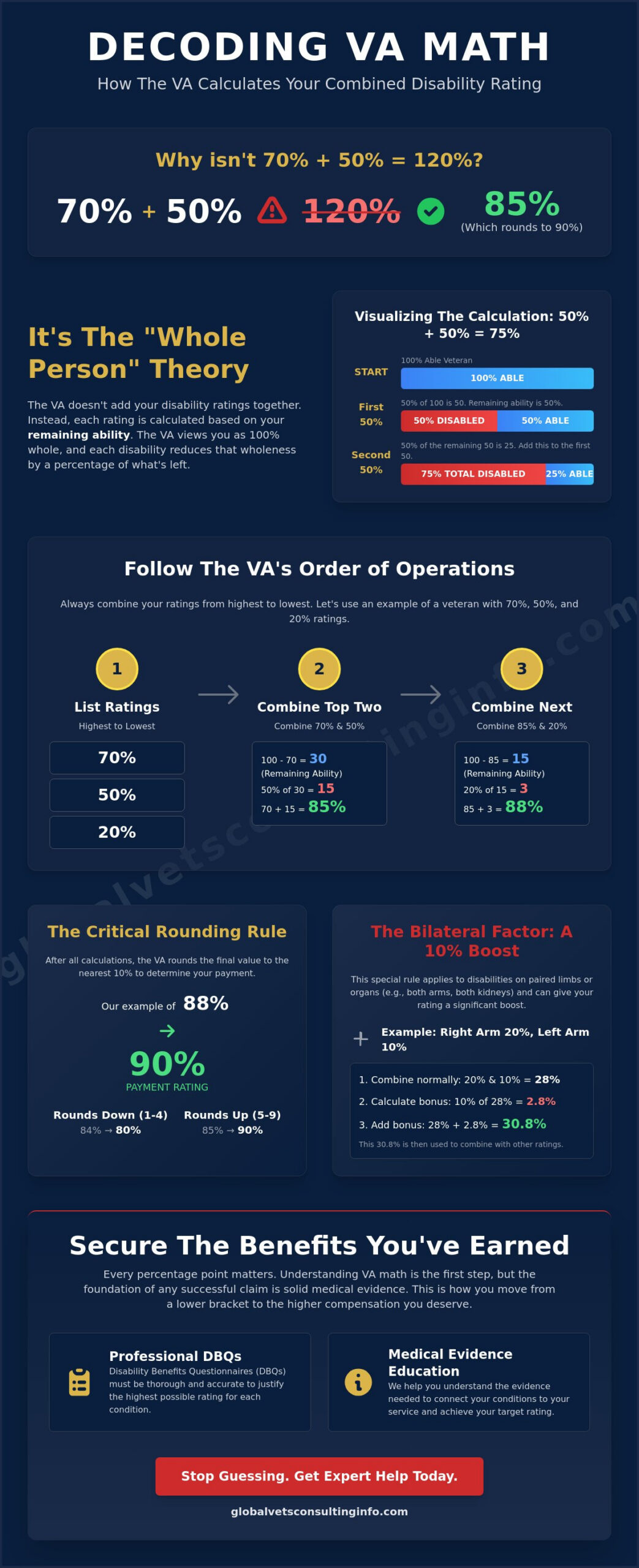
If you’ve ever looked at your benefits letter and wondered why two 50% ratings don’t equal a 100% total, you’ve encountered the “Whole Person” theory. The Department of Veterans Affairs assumes every veteran is 100% efficient before service-connected injuries occur. When you receive a disability rating, the VA isn’t just assigning a number; they’re determining how much of your total efficiency has been lost. Under this system, va math for combined ratings explained is a method of calculating the cumulative effect of multiple disabilities on a veteran’s remaining efficiency.
Each new disability rating subtracts from what’s left of your healthy, non-disabled self. For example, if you have a 50% rating for a respiratory condition, the VA considers you 50% disabled and 50% efficient. If you then receive a second 50% rating for a musculoskeletal condition, the VA doesn’t take 50% from the original 100%. Instead, they take 50% of the remaining 50% efficiency, which equals 25%. Adding that 25% to your initial 50% gives you a combined rating of 75%.
The Subtraction Logic vs. Basic Arithmetic
The logic is designed with a “diminishing returns” effect. While 50% plus 50% equals 75%, which rounds up to 80% for pay purposes, reaching the 100% threshold becomes exponentially more difficult as your combined rating climbs. This happens because each new condition only applies to a smaller and smaller slice of your remaining efficiency. This structure is grounded in the VA Schedule for Rating Disabilities, which provides the legal framework for how these percentages are assigned based on the severity of your medical evidence.
Direct Service Connection and the Rating Baseline
To calculate your total, the VA always starts with your highest-rated condition. This serves as your baseline. If you have ratings of 70%, 30%, and 10%, the calculation begins with the 70% and works downward through the remaining percentage of efficiency. Understanding this starting point is a vital part of the VA disability claims process step by step. By prioritizing your most severe conditions, you can better understand how secondary claims might impact your final combined rating and your 2026 monthly compensation.
Navigating the 2026 VA Combined Rating Table 🇺🇸
The Combined Rating Table is the official grid used by the VA to find the intersection of multiple percentages. It serves as the master key for deciphering your monthly compensation. To get an accurate result, you must follow a specific sequence. This process ensures that your VA’s Combined Disability Rating is consistent with federal regulations and reflects the true extent of your service-connected conditions.
- Step 1: List all your service-connected disabilities from highest percentage to lowest.
- Step 2: Locate your highest rating in the left-hand column of the table.
- Step 3: Locate your second-highest rating in the top row.
- Step 4: Find the intersecting number where these two values meet. This is your new “combined” baseline.
If you have a third disability, you repeat the process. You take your new baseline from the left column and find the third rating in the top row. Mastering this grid is the only way to get va math for combined ratings explained in a way that matches the VA’s own internal calculators.
Step-by-Step Calculation for Three or More Disabilities
When dealing with three or more conditions, the order of operations is non-negotiable. You must always start with the largest percentage and work your way down. If you skip around or start with a 10% rating, your final calculation won’t be accurate. This repetitive process continues until every condition is accounted for. If the complexity of the grid feels daunting, seeking VA rating increase education can help you visualize how each additional condition impacts your total.
The Bilateral Factor: A 10% Boost You Might Be Missing
The bilateral factor is a unique rule that can push your rating into a higher pay bracket. It applies when you have disabilities affecting both arms or both legs. The VA combines these bilateral disabilities first using the standard table and then adds a 10% boost of that value to the total. This “bonus” is calculated before these conditions are factored into the rest of your disabilities. It’s a critical detail because even a small boost can be the difference between a 70% and 80% final rating. Understanding va math for combined ratings explained requires looking for these specific advantages that reflect the cumulative impact on your mobility.
The Rounding Rule: How the VA Decides Your Final Pay
Once you’ve navigated the grid and found your raw combined percentage, the final step in va math for combined ratings explained is the rounding rule. This is where your theoretical percentage becomes a concrete monthly check. The VA doesn’t pay at specific digits like 63% or 87%. Instead, they round your final number to the nearest 10% increment to determine your compensation level. The VA rounding rule dictates that a combined rating of 64% results in a 60% compensation level, while 65% results in a 70% level.
This “rounding to the nearest ten” creates a high-stakes environment for veterans sitting on the edge of a bracket. The .5 Rule is your best ally in this process. Any combined rating ending in 5% or higher automatically rounds up to the next 10% increment. If your raw math totals 85%, you’re paid at the 90% rate. However, if that math drops to 84%, you’re rounded down to 80%. Understanding these razor-thin margins is essential for managing your expectations regarding your 2026 benefit amounts.
You can find the legal basis for this process in The official VA Combined Rating Table within the federal regulations. This document confirms that the VA must follow these specific mathematical steps before issuing a final decision on your claim.
The ‘Dead Zone’ in VA Math
Many veterans fall into the “Rounding Trap” where a new service-connected disability doesn’t actually increase their pay. Consider a situation where you’re at a raw 81%, which rounds down to 80%. If you’re granted a new 10% rating, the math adds 10% of your remaining 19% efficiency, which is only 1.9%. Your new raw total is 82.9%. Because this still rounds down to 80%, your monthly check stays exactly the same. Strategic planning involves focusing on a dbq for va disability rating increase for conditions that carry enough weight to actually push you over the next rounding threshold.
Total Disability Individual Unemployability (TDIU) as an Alternative
If the complexities of va math for combined ratings explained make reaching 100% feel impossible, TDIU may be a more direct path. This benefit pays you at the 100% rate even if your combined math is lower, provided your conditions prevent you from maintaining gainful employment. To qualify, you generally need a combined rating of at least 70% with at least one single condition rated at 40% or higher. This bypasses the diminishing returns of standard VA math and focuses on the real-world impact of your disabilities.
If you’re stuck in a rounding trap and need to understand your options for a higher bracket, explore our resources for a VA rating increase today.
Maximizing Your Combined Rating with Professional DBQs 📞
Winning the numbers game starts with the quality of your inputs. While understanding va math for combined ratings explained is vital, the calculation is only as strong as the percentages the VA assigns to your individual conditions. If your medical evidence is vague or incomplete, the VA will likely assign a lower rating, which makes your climb to 100% significantly steeper. A professional Disability Benefits Questionnaire (DBQ) serves as the bridge between your physical or mental symptoms and the specific legal criteria the VA uses to determine your rating.
Global Vets Consulting specializes in delivering the meticulous documentation required to support accurate evaluations. By providing clear, objective medical evidence, you ensure that the VA’s math works in your favor from the start. To understand the full role of these forms in your claim, you should read our pillar guide on what is a dbq. High-quality evidence removes the guesswork from the process and forces the VA to acknowledge the true severity of your service-connected conditions.
Why Better Evidence Trumps ‘Fuzzy Math’
Many veterans spend years trying to add multiple 10% conditions, only to stay stuck in a rounding trap. Because of the diminishing returns in the whole person theory, moving a single existing condition from 30% to 50% via a private DBQ often has a much larger impact than adding a new 10% condition. Strengthening the evidence for your primary conditions or identifying secondary service connections allows you to maximize the “Whole Person” subtraction logic. This strategic approach ensures every piece of evidence moves the needle toward your desired outcome rather than getting lost in the rounding rules of va math for combined ratings explained.
Partner with Global Vets Consulting for a Clearer Path Forward
Our “Veterans Helping Veterans” approach ensures your medical status is accurately reflected in your paperwork. We understand the complexities of the 2026 system and are dedicated to providing the educational resources you need for a successful VA rating increase. If you’re ready to stop guessing and start building a stronger claim, we’re here to help.
🇺🇸 Global Vets Consulting
📞 24/7 National Client Services Hotline: 800-484-1424
🌐 Website: GlobalVetsConsultingInfo.com
Take Control of Your VA Disability Rating in 2026
Mastering the “Whole Person” theory is the first step toward securing the benefits you deserve. You’ve seen how the VA rounding rule can make or break your monthly compensation; it’s the difference between staying stuck in a rounding trap or moving into a higher bracket. By having va math for combined ratings explained, you can now focus your energy on the medical evidence that actually moves the needle. Quality documentation is the only way to ensure the VA’s math reflects your true physical and mental health status.
Global Vets Consulting is veteran-owned and operated, and we’re dedicated to helping you navigate these complex administrative hurdles. We specialize in DBQ documentation education for rating increases, providing the technical precision your claim requires. Our 24/7 AI Veteran Intake Specialist is available to help you start the process whenever you’re ready.
Get the medical evidence you need to maximize your VA rating; contact Global Vets Consulting today!
Don’t let the complexity of the system discourage you. You’ve served your country with honor, and now it’s time to ensure the system works for you. Stay focused, stay informed, and keep moving forward toward the 100% P&T rating you’ve earned.
Frequently Asked Questions
Is 95% rounded up to 100% in VA math?
Yes, a combined rating of 95% is rounded up to 100% for compensation purposes. According to the standard rounding rules, any combined value ending in 5% or higher moves to the next 10% increment. This means once your raw math reaches 95.0%, you’ve hit the 100% threshold. It is one of the few instances where the rounding system works heavily in the veteran’s favor.
How much does a 10% increase in a single condition affect my total rating?
A 10% increase in a single condition often results in a smaller change to your total rating than you might expect. Because of the whole person theory, that 10% only applies to your remaining healthy efficiency. If you’re already at 80%, a 10% increase for one condition only adds 2% to your raw total. This is why understanding va math for combined ratings explained is essential for strategic claim planning.
What is the VA bilateral factor and how is it calculated?
The bilateral factor is a 10% boost applied when you have service connected disabilities in both arms or both legs. The VA combines the ratings for those specific limbs first using the standard table. They then calculate 10% of that subtotal and add it back to the bilateral combined rating. This final boosted number is then factored into the rest of your disabilities to determine your final compensation level.
Can I have a combined rating higher than 100%?
No, you cannot have a combined rating higher than 100%. The VA system is based on the idea that a person cannot be more than 100% disabled. However, veterans with severe disabilities may qualify for Special Monthly Compensation (SMC). This is an additional benefit paid on top of the 100% rate for specific circumstances, such as the loss of use of a limb or needing regular aid and attendance.
How does the VA calculate ratings for mental health conditions?
The VA uses a pyramiding rule for mental health, meaning you can only receive one rating for all mental health conditions regardless of how many diagnoses you have. If you have PTSD and depression, the VA evaluates the symptoms of both together to assign a single percentage. They choose the rating that most accurately reflects your overall social and occupational impairment rather than adding separate percentages for each diagnosis.
What happens if my combined rating is exactly 64.5%?
If your combined rating is exactly 64.5%, it is rounded up to 65% and then further rounded up to 70% for pay purposes. These decimal points typically occur when the bilateral factor is applied to your ratings. The VA rounding rule is consistent; any fraction of .5% or greater is rounded up to the nearest whole number. Once that whole number ends in a 5, the second rounding rule pushes your final pay to the next 10% bracket.

Article by
Willie Daniel
Willie Daniel is the Founder and Chief Executive Officer (CEO) of Global Vets Consulting (GVC) – National Veterans Disability Services, a veteran-led educational and medical evidence support organization dedicated to helping veterans better understand VA disability rating increases, DBQ medical evidence, secondary claims education, and C&P examination preparation.
He is a retired U.S. Army Medical Service Corps Officer with more than 27 years of honorable military service, a decorated Iraq combat veteran, and a retired federal official with the U.S. Department of Veterans Affairs. Throughout his military and federal career, Willie Daniel served in leadership, healthcare administration, operational, and veteran-support roles focused on improving services and support systems for servicemembers, veterans, and their families.
Drawing from decades of military leadership, healthcare administration, veteran advocacy, and federal government experience, Willie Daniel brings a practical, veteran-centered perspective to Global Vets Consulting’s educational articles, AI-powered veteran resources, video education initiatives, and outreach programs. His experience navigating military systems, medical documentation processes, and veteran-related administrative operations provides valuable insight into many of the challenges veterans face when seeking to better understand VA disability rating criteria, medical evidence, documentation strategies, and secondary condition education.
Through GVC’s “Veterans Helping Veterans” mission, his focus is on delivering clear, educational, and easy-to-understand information designed to empower veterans with knowledge, resources, and educational tools that may help them make more informed decisions regarding their individual VA disability journeys.
The information provided through GVC is intended for educational and informational purposes only and should not be considered legal or medical advice.
Disclaimer
Disclaimer: Global Vets Consulting, LLC (“GVC”) is a veteran-led educational and medical evidence support organization. GVC is not a law firm, is not a Veterans Service Organization (VSO), and is not affiliated with the U.S. Department of Veterans Affairs (VA) or any government agency.
Global Vets Consulting does not provide legal advice, medical advice, medical treatment, or healthcare services. GVC does not prepare, file, or submit VA disability claims on behalf of veterans. All information provided through this website, blog articles, videos, educational materials, AI tools, dashboards, templates, and communications is intended solely for general educational and informational purposes.
Veterans are encouraged to consult with accredited representatives, licensed attorneys, qualified medical providers, or Veterans Service Organizations regarding their specific legal, medical, or VA-related matters. VA disability decisions, ratings, and outcomes are determined solely by the U.S. Department of Veterans Affairs based on applicable laws, regulations, medical evidence, and individual circumstances. Past results do not guarantee future outcomes.

