
In 2026, simply proving you stood near a smoke plume is no longer the primary hurdle; the real battle is gathering the right evidence for burn pit exposure va claim to prove medical severity. You’ve likely spent years dealing with shortness of breath or chronic fatigue while feeling like the VA was speaking a different language. It’s frustrating to know your condition is service-connected but still face a denial because your paperwork didn’t hit the right marks. We understand that anxiety, especially with the December 31, 2026 deadline approaching for many Gulf War veterans to claim undiagnosed illnesses under presumptive rules. 🇺🇸
This guide will show you how to master your documentation by focusing on the precise medical evidence required under the PACT Act. You’ll learn which Disability Benefits Questionnaires (DBQs) are essential for your symptoms and how to prepare for a C&P exam with steady confidence. We provide a clear roadmap to help you navigate the system and secure the updated 2026 disability ratings you earned through your service. Let’s get to work on the rating increase you deserve. 🇺🇸
Key Takeaways
- Verify your eligibility for PACT Act presumptive conditions by matching your deployment locations and dates with the latest 2026 VA criteria.
- Learn how to gather the specific medical evidence for burn pit exposure va claim that shifts the focus from proving exposure to documenting the clinical severity of your symptoms.
- Discover the strategic importance of submitting an “Intent to File” to preserve your effective date and protect your potential backpay.
- Understand how to utilize Disability Benefits Questionnaires (DBQs) to ensure your medical records provide the technical accuracy needed for a successful rating increase.
- Identify how to link secondary medical conditions to your primary respiratory illness to maximize your overall compensation through “VA Math” awareness.
Understanding Burn Pit Presumptive Conditions and PACT Act Eligibility in 2026
The PACT Act fundamentally changed how the VA handles toxic exposure. If you served in Iraq, Afghanistan, or the wider Southwest Asia theater, the VA now operates under a presumptive service connection model. This means the VA assumes your military environment caused your illness without requiring you to prove a specific event triggered it. It simplifies the process, but you must remember that burn pit exposure is not a disability rating in itself. The VA grants compensation for the chronic conditions resulting from that exposure. For a detailed history of how these sites operated, you can review Wikipedia’s overview of military burn pits to see the scope of the toxins involved.
The 2026 List of Presumptive Cancers and Respiratory Illnesses
The current list of presumptive conditions is extensive. It includes respiratory illnesses like asthma, COPD, chronic rhinitis, and chronic sinusitis. It also covers a wide range of cancers, including reproductive cancers and those affecting the head, neck, or respiratory system. While the VA assumes the service connection, you still need a formal diagnosis from a medical professional. Simply having trouble breathing isn’t enough. Your medical records must show a confirmed condition to serve as the necessary evidence for burn pit exposure va claim. Without a diagnosis, the VA cannot assign a rating, regardless of your exposure history.
Qualifying Service Locations and Dates
Eligibility depends on where and when you served. Most veterans who served in the Southwest Asia theater of operations starting in 1990, or in Afghanistan after September 11, 2001, are covered. One critical timeline to watch is December 31, 2026. This date marks the deadline for Gulf War veterans to have certain undiagnosed illnesses or chronic multisystem illnesses considered under presumptive rules. Since the special window for retroactive pay backdated to 2022 has closed, your effective date for benefits in 2026 will generally be the date the VA receives your claim. Filing an “Intent to File” immediately is the best way to protect your effective date while you gather your medical records. 🇺🇸
Gathering the Critical Medical Evidence for Your Burn Pit Claim
Winning your case in 2026 requires a tactical shift in how you view your paperwork. While your DD-214 confirms your boots were on the ground in a qualifying zone, it doesn’t describe the damage to your lungs or skin. The most vital evidence for burn pit exposure va claim is no longer service records alone but rather the clinical documentation of your current health. You can find Official VA PACT Act Information that confirms your eligibility, but the rating itself depends on the severity of your diagnosis. Without a current, formal diagnosis from a qualified professional, the VA has no baseline to assign a percentage. 🇺🇸
The Role of Disability Benefits Questionnaires (DBQs)
A DBQ is a standardized form that speaks the VA rater’s language. It ensures your symptoms are categorized exactly how the law requires for a specific rating. To better understand these forms, you should read our guide on what is a dbq and how it impacts your claim. For veterans with breathing issues, a respiratory DBQ provides a detailed breakdown of your functional impact, such as forced expiratory volume (FEV-1) or the need for daily medications. These forms translate your daily struggle into a numerical value the VA can’t easily ignore.
Why Private Medical Evidence Often Beats a Standard C&P Exam
Many veterans rely solely on the VA’s Compensation and Pension (C&P) exam. This is often a mistake. These exams are frequently rushed, and the examiner may only spend 15 minutes reviewing a decade of health issues. Private medical evidence allows you to work with professionals who take the time to capture every symptom thoroughly. This proactive approach ensures that your evidence for burn pit exposure va claim is complete before it ever reaches a rater’s desk. If you’re tired of inaccurate exam results, exploring medical evidence education can help you take control of your claim’s outcome. 🇺🇸
Step-by-Step Guide: Filing Your Toxic Exposure Claim Successfully
Filing a claim in 2026 requires a disciplined approach to ensure you don’t leave money on the table. The process is more than just filling out forms; it’s about building a case that the VA rater cannot easily dismiss. Follow these steps to organize your evidence for burn pit exposure va claim and move toward a successful outcome. 🇺🇸
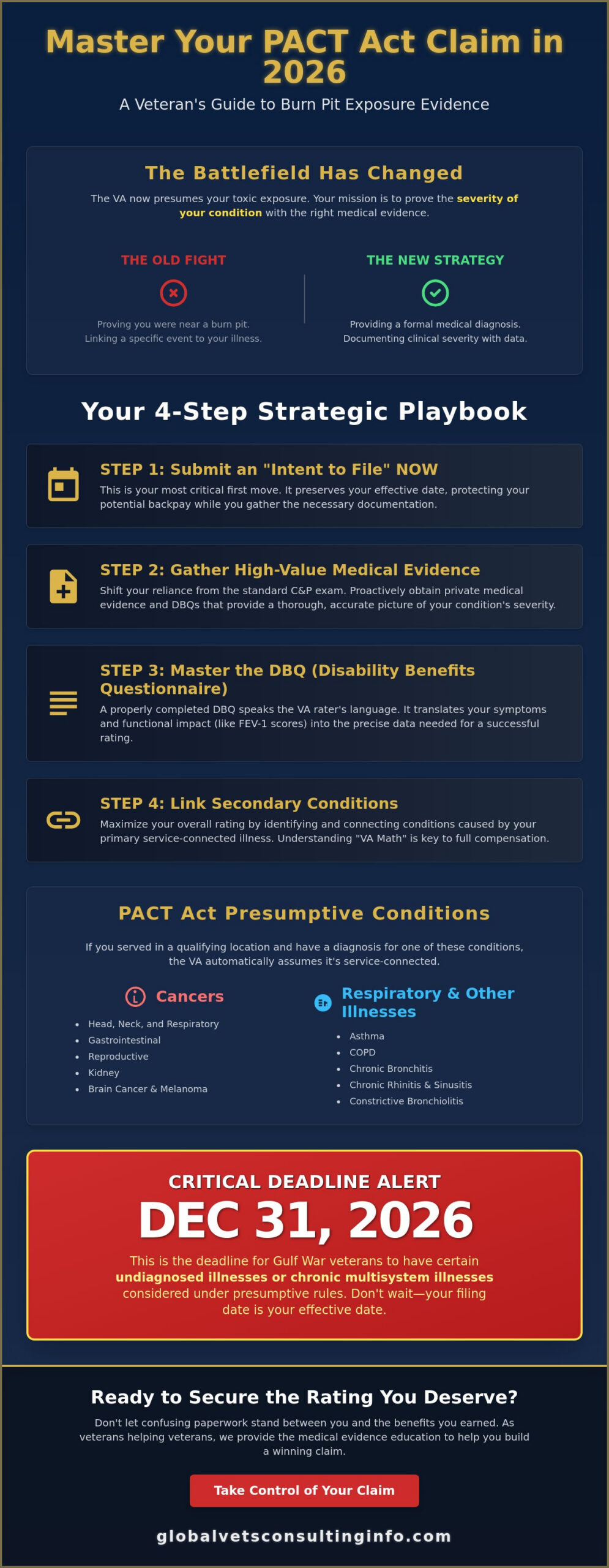
- Step 1: Submit an Intent to File. This simple action preserves your effective date for backpay. Since the 2023 retroactive window has closed, your benefits usually start from the date you notify the VA of your intent, giving you up to one year to gather your medical evidence.
- Step 2: Review Service Records. Verify your deployment to qualifying toxic exposure zones. You can find the PACT Act Explained to see how your specific service locations and dates align with current presumptive rules.
- Step 3: Secure Professional DBQs. Obtain a Disability Benefits Questionnaire for each diagnosed condition. This documentation provides the specific evidence for burn pit exposure va claim that raters need to see to assign an accurate percentage.
- Step 4: Submit a Fully Developed Claim (FDC). By providing all your medical evidence upfront, you signal to the VA that no further development is needed. This often results in a faster decision compared to standard claims.
Navigating the C&P Exam for Toxic Exposure
The Compensation and Pension (C&P) exam is a high-stakes moment. When the examiner asks how you’re doing, don’t focus on your “good days.” Describe your worst days and how your respiratory or skin issues limit your daily life. It’s helpful to bring copies of your private medical evidence to the appointment to ensure the examiner sees the full scope of your diagnosis. For a deeper look at the timeline, check out our guide on the va disability claims process step by step. If you want to ensure your paperwork is bulletproof before your exam, consider exploring our medical evidence education resources today. 🇺🇸
Maximizing Your VA Rating and Overcoming Past Denials
If the VA previously denied your claim for a respiratory condition or cancer, the PACT Act offers a vital opportunity to reopen that case. You don’t have to accept a past “no” as the final word. By filing a supplemental claim, you can provide new evidence for burn pit exposure va claim that aligns with current presumptive standards. This is a game-changer for veterans who struggled to prove service connection before the law changed. Since the VA now assumes exposure for those in qualifying theaters, your focus should shift toward using a dbq for va disability rating increase to show how your condition has progressed. 🇺🇸
Understanding “VA Math” is also essential for maximizing your compensation. The VA doesn’t simply add percentages together; instead, they use a combined rating table that calculates your remaining “whole person” efficiency. For example, two 10% ratings often result in a 19% score, which rounds down to a 20% total rating. Every point counts. With the 2026 cost-of-living adjustment (COLA) of 2.8%, a 100% disability rating for a veteran alone now sits at $3,938.57 per month. Precision in your documentation is what secures these higher tiers. 🇺🇸
Common Secondary Conditions: Sleep Apnea and GERD
Many veterans don’t realize that their primary burn pit condition can lead to other service-connected issues. Chronic sinusitis or rhinitis often causes or aggravates sleep apnea, which can carry a significant rating on its own. To succeed here, you need a medical nexus. A nexus is the clinical bridge that connects your secondary condition to your primary service-connected illness. Without this link, the VA may view these as unrelated health problems.
How Global Vets Consulting Streamlines Your Documentation
We take a “Veterans Helping Veterans” approach to ensure your medical evidence is meticulous and VA-compliant. Our team specializes in education regarding DBQ preparation and independent medical evidence to help you present a clear, undeniable case to the rater. We focus on technical accuracy to reduce the risk of further denials. If you’re ready to secure the rating you earned, reach out to our 24/7 AI Veteran Intake Specialist at GlobalVetsConsultingInfo.com for immediate assistance. 🌎
Take Command of Your Toxic Exposure Benefits
The window to secure your earned benefits is open, but it requires a meticulous approach to documentation. We’ve explored how the PACT Act has shifted the burden of proof, making your current medical diagnosis the most critical piece of evidence for burn pit exposure va claim. Success in 2026 depends on translating your daily physical limitations into the specific clinical language the VA requires. By focusing on professional DBQs and identifying secondary conditions like sleep apnea, you can move toward the rating that reflects the true impact of your service. 🇺🇸
Our team is veteran-owned and operated, bringing firsthand understanding to every consultation. We offer specialized expertise in respiratory and toxic exposure DBQs to ensure your medical evidence is accurate and VA-compliant from the start. You don’t have to navigate this complex bureaucratic system alone. Our 24/7 National Client Services Hotline 📞 is available to provide the support you need when you need it most. 🌎
Reach out today to Secure Your Professional DBQ Documentation Today and take the next step in your journey. We are ready to serve as your steady guide through the claims process. You’ve done the hard work of serving our country; now let us help you secure the future you earned. 🇺🇸
Frequently Asked Questions
Can I file a VA claim for burn pit exposure if I was already denied?
Yes, you can reopen a previously denied claim by filing a supplemental claim under the PACT Act. This allows you to submit new evidence for burn pit exposure va claim that wasn’t available or considered during your initial application. Since many conditions are now considered presumptive, the VA will re-evaluate your case based on current laws rather than the stricter standards used in previous years.
How much backpay can I get for a burn pit presumptive condition?
Your backpay amount is primarily determined by your “Intent to File” date or the date the VA received your supplemental claim. While the special window for backdating benefits to August 2022 closed in August 2023, you can still receive significant retroactive pay if you have a pending intent to file. The 2026 100% disability rate for a single veteran is $3,938.57 per month, which serves as a baseline for calculating potential backpay totals.
Do I need a Nexus Letter if my condition is considered presumptive?
You generally don’t need a formal nexus letter to prove service connection for conditions on the presumptive list. However, you still need strong medical evidence for burn pit exposure va claim to establish the severity of your condition for rating purposes. While the VA assumes the cause, they don’t assume the disability percentage. Detailed DBQs and current medical records remain essential for securing the rating you deserve.
What happens if I served in a location not listed on the PACT Act?
If your service location isn’t on the presumptive list, you must pursue direct service connection through a medical nexus. This requires you to provide evidence that your specific environment caused your illness, often through independent medical evidence or buddy statements. It’s a more complex path, but it remains a viable option for veterans who were exposed to toxins outside of the standard PACT Act theaters.
How long does the VA take to process a burn pit disability claim in 2026?
The VA has made significant progress in reducing wait times, with the backlog for claims pending over 125 days dropping below 100,000 as of April 2026. While individual cases vary, most veterans can expect a decision within four to six months for fully developed claims. Providing meticulous documentation upfront, such as completed DBQs, is the most effective way to ensure your claim moves through the system without unnecessary delays.

Article by
Willie Daniel
Willie Daniel is the Founder and Chief Executive Officer (CEO) of Global Vets Consulting (GVC) – National Veterans Disability Services, a veteran-led educational and medical evidence support organization dedicated to helping veterans better understand VA disability rating increases, DBQ medical evidence, secondary claims education, and C&P examination preparation.
He is a retired U.S. Army Medical Service Corps Officer with more than 27 years of honorable military service, a decorated Iraq combat veteran, and a retired federal official with the U.S. Department of Veterans Affairs. Throughout his military and federal career, Willie Daniel served in leadership, healthcare administration, operational, and veteran-support roles focused on improving services and support systems for servicemembers, veterans, and their families.
Drawing from decades of military leadership, healthcare administration, veteran advocacy, and federal government experience, Willie Daniel brings a practical, veteran-centered perspective to Global Vets Consulting’s educational articles, AI-powered veteran resources, video education initiatives, and outreach programs. His experience navigating military systems, medical documentation processes, and veteran-related administrative operations provides valuable insight into many of the challenges veterans face when seeking to better understand VA disability rating criteria, medical evidence, documentation strategies, and secondary condition education.
Through GVC’s “Veterans Helping Veterans” mission, his focus is on delivering clear, educational, and easy-to-understand information designed to empower veterans with knowledge, resources, and educational tools that may help them make more informed decisions regarding their individual VA disability journeys.
The information provided through GVC is intended for educational and informational purposes only and should not be considered legal or medical advice.
Disclaimer
Disclaimer: Global Vets Consulting, LLC (“GVC”) is a veteran-led educational and medical evidence support organization. GVC is not a law firm, is not a Veterans Service Organization (VSO), and is not affiliated with the U.S. Department of Veterans Affairs (VA) or any government agency.
Global Vets Consulting does not provide legal advice, medical advice, medical treatment, or healthcare services. GVC does not prepare, file, or submit VA disability claims on behalf of veterans. All information provided through this website, blog articles, videos, educational materials, AI tools, dashboards, templates, and communications is intended solely for general educational and informational purposes.
Veterans are encouraged to consult with accredited representatives, licensed attorneys, qualified medical providers, or Veterans Service Organizations regarding their specific legal, medical, or VA-related matters. VA disability decisions, ratings, and outcomes are determined solely by the U.S. Department of Veterans Affairs based on applicable laws, regulations, medical evidence, and individual circumstances. Past results do not guarantee future outcomes.