

What if the difference between a 0% and a 50% rating isn’t the intensity of your pain, but the specific way your medical evidence defines a “prostrating” attack? It’s incredibly frustrating when a VA examiner downplays the frequency of your migraines or fails to account for the days you’ve missed work and the income you’ve lost. You know the toll these headaches take on your life, yet the current documentation often fails to reflect that reality. This guide will show you exactly how to secure a Migraine Rating Increase by aligning your evidence with the VA’s 2026 criteria and using professional medical documentation to bridge the gap. We’ll break down the “prostrating” frequency requirements and explain how a properly completed Disability Benefits Questionnaire (DBQ) can finally secure the 50% rating you’ve earned. At Global Vets Consulting, we provide 24/7 support to veterans worldwide via our hotline at (727) 350-8387 and at https://www.GlobalVetsConsultingInfo.com to ensure your medical evidence reflects the true severity of your condition. 🇺🇸
Key Takeaways
- Gain clarity on the specific frequency requirements for each level of the VA rating scale, from non-compensable status to the maximum 50% rating.
- Learn why the VA prioritizes documented “prostrating” symptoms over pain intensity and how to prove the need for total isolation during an attack.
- Discover how professional medical documentation and a thoroughly completed DBQ act as the vital link to securing your Migraine Rating Increase.
- Follow a logical process to gather medical evidence and leverage 24/7 expert support to strengthen your claim for higher compensation.
Understanding the VA Migraine Rating Scale (0% to 50%)
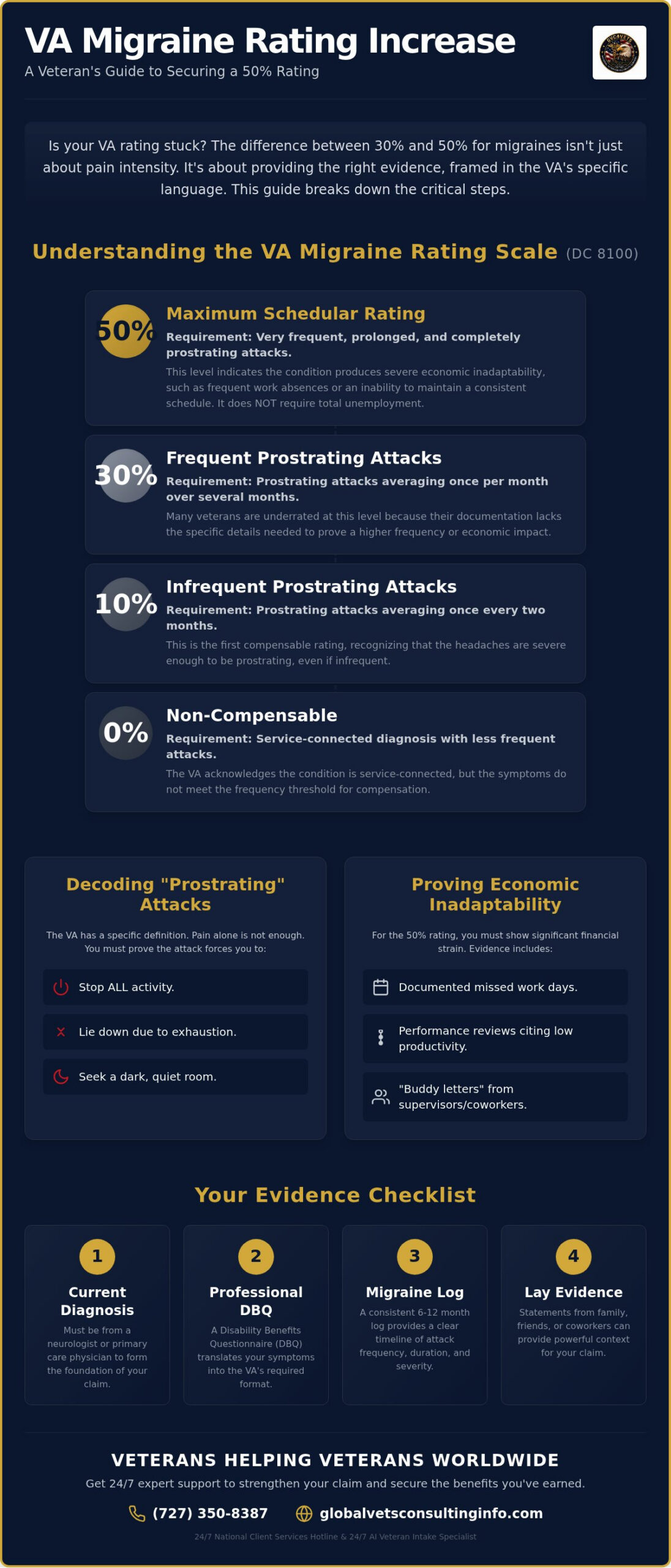
Securing a Migraine Rating Increase begins with a clear understanding of the 38 CFR § 4.124a criteria. The Veterans Benefits Administration (VBA) uses Diagnostic Code 8100 to categorize your symptoms based on frequency and severity. A 0% rating is non-compensable, meaning you have a service-connected diagnosis but your attacks are infrequent. To reach 10%, you must experience prostrating attacks averaging once every two months. The 30% tier requires these episodes to occur on average once a month over several months.
The 50% rating represents the highest schedular level for headaches. This requires very frequent, prolonged, and completely prostrating attacks that produce severe economic inadaptability. It’s a common misconception that you must be unemployed to qualify for this level. Economic inadaptability actually refers to the migraines’ capacity to cause significant financial strain, such as frequent absences from your job or the inability to maintain a consistent work schedule due to sudden, debilitating pain.
Why Most Veterans are Underrated for Migraines
Many veterans find themselves stuck at a 30% rating because their medical records lack specific descriptors. The gap between 30% and 50% often comes down to how your symptoms are documented. If your records only mention “severe headaches” without describing the need for total isolation in a dark room, the VA may not recognize the prostrating nature of the condition. Precision in your medical terminology is the key to moving beyond a lower rating.
The Importance of Service Connection
Establishing a clear link between your military service and your condition is the first step toward a successful claim. Whether your headaches are a direct result of service or secondary to another condition like TBI or PTSD, the evidence must be undeniable. You can review how to use a DBQ for a VA disability rating increase in 2026 to see how professional documentation strengthens this connection and supports a Migraine Rating Increase.
The Critical Role of ‘Prostrating’ Attacks in Your Increase 🇺🇸
To achieve a Migraine Rating Increase, you must prove your attacks are “prostrating.” The VA defines a prostrating attack as one so severe it forces you to stop all activities and lie down in a dark, quiet room until the symptoms subside. Many veterans assume reporting “severe pain” is sufficient, but pain alone doesn’t meet the legal standard found in the VA Schedule of Ratings for Neurological Conditions. You must explicitly document the state of powerlessness and exhaustion that follows.
If your attacks are prolonged, meaning they last 24 hours or longer, your evidence should reflect this duration. Additionally, don’t overlook the side effects of your migraine medications. Dizziness, nausea, and “brain fog” from prescribed treatments can be just as debilitating as the headache itself, further impacting your daily functioning and ability to work. If you find yourself struggling to articulate these impacts, our team offers 24/7 educational support to help you prepare your documentation.
Documenting Economic Inadaptability
For a 50% rating, you must show that your migraines cause “severe economic inadaptability.” This isn’t just about being unemployed. You can use evidence like missed work days, late arrivals, or performance reviews that mention decreased productivity. Buddy letters from supervisors or coworkers can also provide powerful “lay evidence” regarding how your attacks interfere with your job responsibilities and financial stability.
Using a Migraine Log as Evidence
Consistency is your best ally when filing for an increase. Maintaining a detailed migraine log for 6 to 12 months provides a clear timeline of the frequency and duration of your attacks. A well-maintained digital log can easily be converted into a supporting document for your professional DBQ, ensuring your medical provider has the data needed to advocate for your earned benefits.
How to Gather Evidence for a Migraine Rating Increase in 2026
Gathering the right evidence is a strategic process that moves your claim from a simple assertion to a documented fact. First, ensure you have a current diagnosis from a neurologist or primary care physician. Without this foundation, the VA won’t consider an increase. Next, request a Disability Benefits Questionnaire (DBQ) from a professional who specializes in veteran disability education. This document serves as the primary tool for translating your symptoms into the language used in the VA’s Official Migraine Rating Criteria.
You should also gather 12 months of pharmacy records. These records prove you’re actively seeking treatment and demonstrate the frequency of your attacks through your refill history. If your migraines are secondary to another service-connected disability, secure a Medical Nexus Letter to establish that “at least as likely as not” connection. If you’re ready to start this process, contact us today for expert guidance on your Migraine Rating Increase.
The Power of the Private DBQ
A private DBQ often offers a more thorough assessment than a government-contracted C&P exam. While a standard exam might only last 15 minutes, a private evaluation allows for a deeper dive into your history of prostrating attacks. Understanding what is a DBQ for VA claims helps you see why this document is the “missing link” in a successful claim for higher compensation.
Preparing for the C&P Exam
Many veterans make the mistake of describing an “average” day during their exam. When the examiner asks how you’re doing, don’t say “fine.” Instead, describe your worst day. Detail the light sensitivity, the nausea, and the hours spent in total darkness. This ensures the record reflects the full severity of your condition rather than a temporary moment of relief. Precise communication during this exam is vital for securing your earned benefits.
Professional DBQ Preparation: The Global Vets Advantage 🇺🇸
Global Vets Consulting streamlines the evidence-gathering process, ensuring your Migraine Rating Increase claim is built on a solid foundation. Our “Veterans Helping Veterans” model provides peer-to-peer support that understands the specific challenges of military service. Since 2021, we’ve focused on providing professional medical documentation that accurately reflects your limitations. Standardized, professional documentation is the key to successful 2026 claims, as it bridges the gap between your lived experience and the VA’s administrative requirements.
We ensure your medical status is not just listed but thoroughly explained. This meticulousness prevents the VA from overlooking critical details like the frequency of prostrating attacks or the resulting economic impact. By choosing a partner that values integrity and mission-driven focus, you gain a reliable ally dedicated to your well-being. We understand the system’s intricacies and work to simplify them for you.
24/7 Accessibility for Worldwide Veterans
Accessibility is a priority for our worldwide mission. We operate a 24/7 National Client Services Hotline at (727) 350-8387, providing constant support regardless of your time zone. Additionally, our AI Veteran Intake Specialist is available around the clock to begin your journey immediately. This 24/7 availability reduces anxiety by offering a clear, predictable path forward at any moment, ensuring you’re never alone in this process.
Next Steps for Your Increase
Getting started is a straightforward process designed to empower you. Your earned benefits shouldn’t be left to chance or incomplete records. Take the next step toward the compensation you deserve by securing professional support for your documentation. Our team is ready to help you accurately document your condition and its impact on your life. Secure your DBQ and fight for the rating you earned today.
Take Control of Your VA Migraine Claim Today
Securing a Migraine Rating Increase requires more than just describing your pain; it demands precise documentation of how “prostrating” attacks impact your life and financial stability. You’ve learned that the gap between a 30% and 50% rating often depends on having a thoroughly prepared DBQ that translates your symptoms into the VA’s required terminology. By maintaining a detailed log and gathering a year’s worth of medical evidence, you provide the clear proof the VBA needs to grant your earned benefits. 🇺🇸
Global Vets Consulting is veteran-owned and operated, offering specialized educational resources and 24/7 worldwide support to help you navigate this complex process. Our team is ready to stand by you as a knowledgeable advocate and guide. Contact Global Vets Consulting Today or call our 24/7 National Client Services Hotline at (727) 350-8387 to speak with our AI Veteran Intake Specialist. Your service and sacrifices deserve to be accurately recognized with the correct rating level.
Frequently Asked Questions
Can I get a 50% migraine rating if I am still employed?
Yes, you can achieve a 50% rating while remaining employed. The VA standard for “severe economic inadaptability” focuses on the condition’s capacity to disrupt your financial stability, not just your employment status. This includes frequent missed shifts, the need for workplace accommodations, or a pattern of leaving early due to prostrating attacks. Proper documentation must show that your migraines are severe enough to potentially cause significant financial hardship.
How many prostrating attacks do I need for a 30% vs 50% rating?
The 30% rating requires characteristic prostrating attacks occurring on average once every month. For a 50% Migraine Rating Increase, the VA looks for “very frequent” attacks, which typically means more than once per month. These episodes must also be prolonged and completely prostrating. Providing a detailed 12 month log is the most effective way to prove that your attack frequency meets these higher schedular requirements.
What is the difference between a VA DBQ and a private DBQ for migraines?
A private DBQ is often more comprehensive than the standard form used during a government-contracted C&P exam. While VA examiners may only spend a few minutes reviewing your history, a private professional can document your symptoms with the specific terminology required by Diagnostic Code 8100. This ensures your prostrating episodes and economic limitations are fully captured, bridging the evidence gap that often leads to lower ratings.
Can migraines be rated secondary to other service-connected conditions like PTSD or Tinnitus?
Yes, migraines are frequently rated as secondary to service-connected conditions such as PTSD, TBI, or Tinnitus. If your primary condition aggravates or causes your headaches, you can file for a Migraine Rating Increase under secondary service connection. You’ll need a Medical Nexus Letter to establish the link between the two conditions, demonstrating that your migraines are “at least as likely as not” caused by your primary disability.
How long does it take for the VA to process a migraine rating increase in 2026?
Most veterans find that a claim for a rating increase takes between 120 and 150 days to process in 2026. This timeline can vary depending on the complexity of your evidence and the current backlog at the VBA. Submitting a fully developed claim with a professional DBQ can sometimes lead to faster decisions, as it provides the examiner with all the necessary information in a standardized format.

Article by
Willie Daniel
Willie Daniel is the Founder and Chief Executive Officer (CEO) of Global Vets Consulting (GVC4Vets) – National Veterans Disability Services, a veteran-led educational and medical evidence support organization dedicated to helping veterans better understand VA disability rating increases, DBQ medical evidence, secondary claims education, and C&P examination preparation.
He is a retired U.S. Army Medical Service Corps Officer with more than 27 years of honorable military service, a decorated Iraq combat veteran, and a retired federal official with the U.S. Department of Veterans Affairs. Throughout his military and federal career, Willie Daniel served in leadership, healthcare administration, operational, and veteran-support roles focused on improving services and support systems for servicemembers, veterans, and their families.
Drawing from decades of military leadership, healthcare administration, veteran advocacy, and federal government experience, Willie Daniel brings a practical, veteran-centered perspective to Global Vets Consulting’s educational articles, AI-powered veteran resources, video education initiatives, and outreach programs. His experience navigating military systems, medical documentation processes, and veteran-related administrative operations provides valuable insight into many of the challenges veterans face when seeking to better understand VA disability rating criteria, medical evidence, documentation strategies, and secondary condition education.
Through GVC’s “Veterans Helping Veterans” mission, his focus is on delivering clear, educational, and easy-to-understand information designed to empower veterans with knowledge, resources, and educational tools that may help them make more informed decisions regarding their individual VA disability journeys.
The information provided through GVC is intended for educational and informational purposes only and should not be considered legal or medical advice.
Disclaimer
Disclaimer: Global Vets Consulting, LLC (“GVC”) is a veteran-led educational and medical evidence support organization. GVC is not a law firm, is not a Veterans Service Organization (VSO), and is not affiliated with the U.S. Department of Veterans Affairs (VA) or any government agency.
Global Vets Consulting does not provide legal advice, medical advice, medical treatment, or healthcare services. GVC does not prepare, file, or submit VA disability claims on behalf of veterans. All information provided through this website, blog articles, videos, educational materials, AI tools, dashboards, templates, and communications is intended solely for general educational and informational purposes.
Veterans are encouraged to consult with accredited representatives, licensed attorneys, qualified medical providers, or Veterans Service Organizations regarding their specific legal, medical, or VA-related matters. VA disability decisions, ratings, and outcomes are determined solely by the U.S. Department of Veterans Affairs based on applicable laws, regulations, medical evidence, and individual circumstances. Past results do not guarantee future outcomes.

