

Having a diagnosis on the official list of presumptive conditions for vietnam veterans doesn’t guarantee a monthly benefit check. While the PACT Act has opened doors for thousands of heroes, many still face denials or low ratings because they lack the specific medical evidence required to prove the severity of their symptoms. 🇺🇸
You’ve likely spent years dealing with the frustration of shifting rules and the anxiety of a looming C&P exam. It’s exhausting to feel like you’re fighting a second war just to get the benefits you earned decades ago. This guide provides the clarity you need by detailing the 2026 list of qualifying conditions, including recent additions like hypertension and MGUS. We will show you how to move from a presumptive label to a successful rating increase by leveraging medical evidence education and accurate DBQs. We’ll also cover the updated 2.8% COLA pay rates for 2026 to ensure you know exactly what you’re entitled to receive. 🇺🇸
Key Takeaways
- Understand how presumptive status removes the burden of proving a “nexus,” simplifying your path to service connection.
- Identify the latest 2026 additions to the list of presumptive conditions for vietnam veterans, including hypertension and MGUS.
- Learn why a Disability Benefits Questionnaire (DBQ) is essential for documenting the specific data points the VA requires for a maximum rating.
- Discover how to leverage medical evidence education to prepare for your C&P exam and avoid common claim pitfalls.
- Follow a clear, two-step process to verify your service location and obtain the diagnosis needed for a successful VA rating increase.
What are Presumptive Conditions for Vietnam Veterans? 🌐
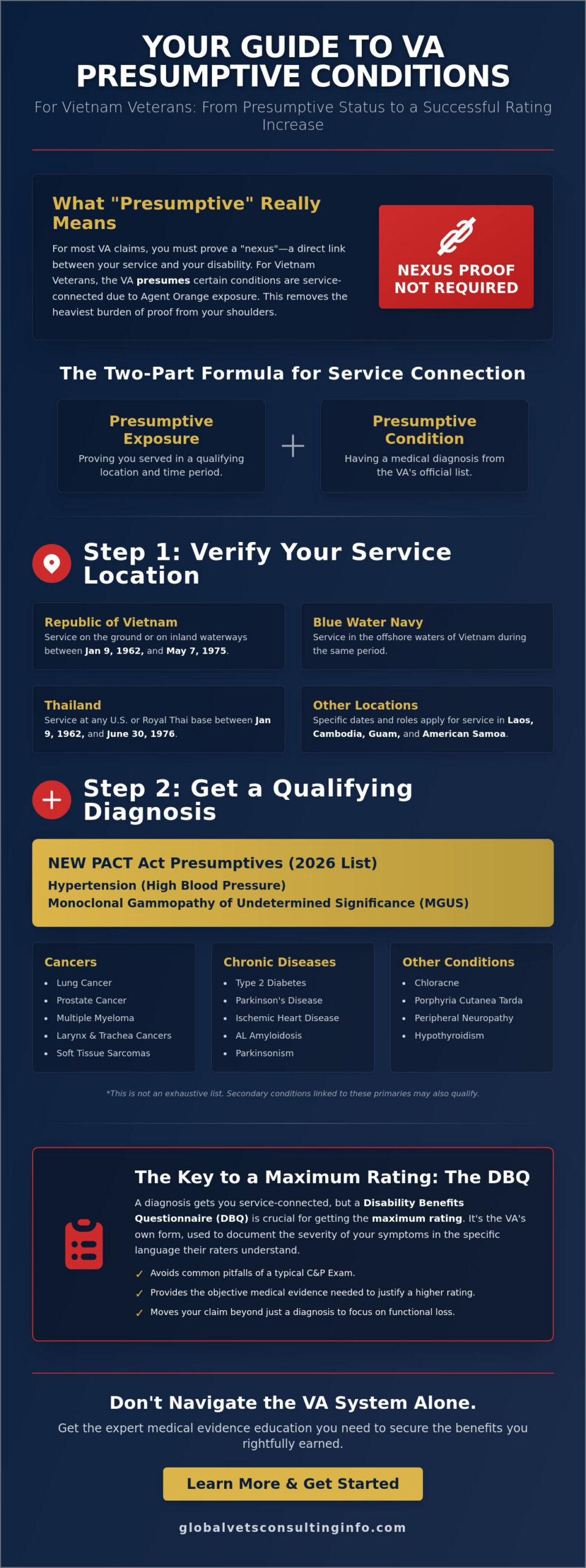
Establishing a service connection is often the most difficult part of a VA disability claim. For most veterans, this requires proving a direct “nexus” or medical link between a specific military event and a current diagnosis. However, the system works differently for those who served during the Vietnam era. The VA recognizes a specific list of presumptive conditions for vietnam veterans, which means they concede that your military service caused your illness without requiring you to prove the connection. This shortcut exists because the government acknowledges that exposure to tactical herbicides like Agent Orange was widespread and devastating.
It’s vital to distinguish between presumptive exposure and a presumptive condition. These are two separate parts of the same requirement. Presumptive exposure refers to where and when you served; the VA assumes you were exposed to toxins based on your location. A presumptive condition is the actual medical diagnosis, such as Type 2 Diabetes or Parkinson’s Disease. To secure a successful VA rating increase, you must satisfy both requirements. You need to show you were in a qualifying location and provide medical evidence of a condition on the approved list.
The Legal Power of ‘Presumption’
The concept of presumption removes the heavy burden of proof from your shoulders. This legal framework began with the Agent Orange Act of 1991, which established that certain diseases are linked to herbicidal exposure. The PACT Act of 2022 expanded these protections even further. These laws ensure that if you have a qualifying diagnosis and the correct service record, the VA cannot deny the service connection based on a lack of medical “nexus” evidence. It levels the playing field for veterans who’ve spent decades fighting for recognition.
Qualifying Service Locations for Presumptive Exposure
The PACT Act significantly widened the map for veterans. While service in the Republic of Vietnam remains the primary qualifier, the list now includes several other regions. You meet the exposure criteria if you served in these locations during specified windows:
- Vietnam: Service on the ground or on inland waterways between January 9, 1962, and May 7, 1975.
- Blue Water Navy: Service in the offshore waters of Vietnam.
- Thailand: Service at any U.S. or Royal Thai base between January 9, 1962, and June 30, 1976.
- Laos and Cambodia: Specific dates apply for those serving in these regions or at certain locations in Guam and American Samoa.
If your records show service in these areas, your next step is ensuring your medical documentation accurately reflects the severity of your condition.
The 2026 List of Presumptive Conditions for Agent Orange 📞
The list of presumptive conditions for vietnam veterans has evolved significantly following the full implementation of the PACT Act. As of 2026, the VA recognizes a broad range of illnesses, from aggressive cancers to chronic metabolic disorders. You can find the complete VA list of Agent Orange presumptive conditions on their official site, but understanding how they apply to your specific claim is what matters most. These laws exist to simplify your path to compensation, yet the burden remains on you to document the severity of your symptoms accurately.
Cancers on the list include lung, bronchus, larynx, and trachea cancers, along with prostate cancer and multiple myeloma. Chronic diseases are equally prevalent, covering Type 2 Diabetes, Parkinson’s Disease, and Ischemic Heart Disease. These presumptive conditions for vietnam veterans are assumed to be service-connected, allowing you to focus on documenting your functional loss to ensure you receive the 2.8% COLA increase for 2026. Respiratory and skin disorders, such as chloracne, also remain key components of the presumptive framework.
New PACT Act Presumptives: Hypertension and Beyond
The addition of hypertension (high blood pressure) and Monoclonal Gammopathy of Undetermined Significance (MGUS) changed the landscape for thousands of veterans. Hypertension is particularly impactful because it’s a common diagnosis that can now lead to a direct rating without a complex nexus letter. For those who served at any U.S. or Royal Thai base between January 9, 1962, and June 30, 1976, these new rules provide a clear path to benefits that were previously out of reach.
Secondary Conditions Linked to Presumptives
A successful claim often extends beyond the primary diagnosis. For example, Type 2 Diabetes frequently causes secondary issues like peripheral neuropathy or diabetic retinopathy. If your primary condition is presumptive, any illness it causes is also eligible for compensation. You might explore how to link radiculopathy secondary to back condition as a model for how these medical connections work. Understanding these links is vital for a comprehensive VA rating increase strategy that reflects the full scope of your disability.
Using a DBQ to Document Your Presumptive Condition 🇺🇸
Service connection is only the first step. While the VA assumes your illness is related to your service, they don’t assume how much it affects your daily life. To receive the correct monthly compensation, you must provide clear evidence of your disability’s level. A Disability Benefits Questionnaire (DBQ) is the high-quality evidence you need. It captures specific data points the VA uses to assign a rating, including:
- Severity: How much the condition limits your physical or mental function.
- Frequency: How often you experience flare-ups or debilitating symptoms.
- Duration: How long your symptoms last when they occur.
Without this detailed snapshot, you’re at the mercy of a C&P examiner who might only spend ten minutes reviewing your case. Documentation is the language of the VA. When dealing with presumptive conditions for vietnam veterans, many heroes assume the “presumption” covers everything. It doesn’t. You still need to prove the extent of your functional loss. A private DBQ ensures that your medical reality is translated into the technical terms the VA rating specialists require.
Why Private Medical Evidence is the Key to Success
Diagnosis alone isn’t a rating. You might have a diagnosis for one of the many Diseases Related to Agent Orange Exposure, but that doesn’t tell the VA if you’re 10% or 100% disabled. Private medical evidence education helps you bridge this gap. It ensures that your symptoms are documented according to the VA rating schedule criteria, leaving no room for interpretation or error by a busy government reviewer.
Preparing for the C&P Examination with a DBQ
Walking into a C&P exam without a plan is a mistake. A completed DBQ acts as a roadmap for your conversation with the examiner. It helps you remember to mention every symptom and limitation, preventing the “low-ball” ratings that plague many presumptive conditions for vietnam veterans. Proper preparation ensures your claim stands on a foundation of solid facts. If you need assistance documenting your symptoms, learn how to secure a professional Disability Benefits Questionnaire today.
How to File for a VA Rating Increase for Presumptive Illnesses
Moving from a service connection to an accurate compensation level requires a methodical approach. You’ve already established that your illness falls under the presumptive conditions for vietnam veterans; now you must prove how that illness limits your life. Following a structured process ensures the VA has everything they need to make a fast, favorable decision. 🇺🇸
- Step 1: Verify service records. Cross-reference your deployment dates and locations against the expanded PACT Act standards discussed in the first section of this guide.
- Step 2: Get a current diagnosis. Ensure a licensed professional has recently confirmed your condition to show it’s a chronic, ongoing issue.
- Step 3: Secure a professional DBQ. Use a DBQ for your specific condition to document the severity of your symptoms according to VA rating schedule criteria.
- Step 4: Submit a Fully Developed Claim (FDC). By providing all medical evidence upfront, you bypass the lengthy evidence-gathering phase the VA usually performs, which often speeds up the decision process.
What to Do if Your Presumptive Claim was Previously Denied
Many veterans faced denials in the past because their illness wasn’t on the presumptive list yet or their service location wasn’t recognized. The PACT Act changed these rules. If you were denied for a condition like hypertension or MGUS before these laws passed, you can file a Supplemental Claim. This allows the VA to re-evaluate your case using the new legal standards and any fresh medical evidence you provide. It’s a vital second chance to secure the benefits you were previously denied. 🌐
Getting the Rating You Earned
The path to a 100% Permanent and Total (P&T) rating often involves combining multiple presumptive conditions for vietnam veterans with secondary claims. For instance, linking Type 2 Diabetes with secondary neuropathy can significantly increase your combined rating. With the 2.8% COLA increase taking effect for 2026, a 100% rating now provides $3,938.57 per month for a single veteran. Documentation is the only way to ensure your rating matches your disability.
Don’t leave your financial future to chance or a rushed C&P exam. If you need assistance with medical evidence education or securing an accurate Disability Benefits Questionnaire, reach out to our team at GlobalVetsConsultingInfo.com today. 📞
Secure the Benefits You’ve Earned 🇺🇸
Navigating the list of presumptive conditions for vietnam veterans is a critical first step, but it’s the medical evidence that ultimately determines your monthly compensation. The 2026 PACT Act updates have provided a renewed opportunity for those who were previously denied or are currently seeking a VA rating increase. By focusing on accurate documentation and utilizing professional DBQs, you can ensure the VA understands the full impact of your service-connected health issues.
Global Vets Consulting has been veteran-owned and operated since 2021, standing as a dedicated partner in your journey through the complex VA system. We specialize in independent medical evidence education and professional DBQ preparation to help you present a clear, undeniable case. Our 24/7 National Client Services Hotline is always available to guide you toward the resources you need for a successful outcome. 📞
Get the medical evidence you need for your VA claim—Connect with Global Vets Consulting today!
You’ve served your country with honor, and now it’s time for the system to work for you. Don’t settle for a rating that doesn’t reflect your reality. Take the next step toward the security and peace of mind you deserve. 🇺🇸
Frequently Asked Questions
Is hypertension now a presumptive condition for Vietnam veterans?
Yes, hypertension is now a recognized presumptive condition for Vietnam veterans under the PACT Act. This change means you don’t need to provide a medical link between your high blood pressure and your military service to establish a connection. If you served in a qualifying location, the VA assumes the exposure occurred. You should focus on obtaining a current diagnosis and documenting the severity of your symptoms to secure an accurate VA rating increase.
What locations are covered under the PACT Act for Agent Orange exposure?
The PACT Act expanded coverage to include several new locations beyond the Republic of Vietnam and its inland waterways. Qualifying areas now include any U.S. or Royal Thai base in Thailand between 1962 and 1976, along with specific regions in Laos and Cambodia. Coverage also extends to certain locations in Guam and American Samoa. If your service records show you were stationed in these areas during the designated windows, you meet the criteria for presumptive exposure.
Can I file a claim for a presumptive condition if I was denied 10 years ago?
You can absolutely file a new claim if you were previously denied, even if that denial happened a decade ago. The PACT Act allows for the re-evaluation of claims based on the updated list of presumptive conditions for vietnam veterans. You should file a Supplemental Claim and provide new medical evidence, such as a private DBQ, to show your condition now meets the current legal standards for service connection and compensation.
Do I need a Nexus Letter for a presumptive condition?
You don’t need a Nexus Letter to establish a service connection for a condition that is on the presumptive list. The VA legally assumes the connection exists based on your service location and dates. However, you still need strong medical evidence to prove the severity of your illness. Using a Disability Benefits Questionnaire (DBQ) helps translate your symptoms into a specific rating without the need for a complex nexus statement from a doctor.
How long does it take for the VA to process a presumptive disability claim in 2026?
Processing times vary depending on the complexity of your file, but the VA aims to decide Fully Developed Claims (FDC) faster than standard claims. In 2026, submitting a complete package with all your medical evidence and a professional DBQ upfront reduces the need for the VA to gather additional records. This proactive approach helps you avoid the lengthy evidence-gathering phase and moves your claim toward a decision more efficiently, ensuring you receive your 2.8% COLA increase sooner.

Article by
Willie Daniel
Willie Daniel is the Founder and Chief Executive Officer (CEO) of Global Vets Consulting (GVC) – National Veterans Disability Services, a veteran-led educational and medical evidence support organization dedicated to helping veterans better understand VA disability rating increases, DBQ medical evidence, secondary claims education, and C&P examination preparation.
He is a retired U.S. Army Medical Service Corps Officer with more than 27 years of honorable military service, a decorated Iraq combat veteran, and a retired federal official with the U.S. Department of Veterans Affairs. Throughout his military and federal career, Willie Daniel served in leadership, healthcare administration, operational, and veteran-support roles focused on improving services and support systems for servicemembers, veterans, and their families.
Drawing from decades of military leadership, healthcare administration, veteran advocacy, and federal government experience, Willie Daniel brings a practical, veteran-centered perspective to Global Vets Consulting’s educational articles, AI-powered veteran resources, video education initiatives, and outreach programs. His experience navigating military systems, medical documentation processes, and veteran-related administrative operations provides valuable insight into many of the challenges veterans face when seeking to better understand VA disability rating criteria, medical evidence, documentation strategies, and secondary condition education.
Through GVC’s “Veterans Helping Veterans” mission, his focus is on delivering clear, educational, and easy-to-understand information designed to empower veterans with knowledge, resources, and educational tools that may help them make more informed decisions regarding their individual VA disability journeys.
The information provided through GVC is intended for educational and informational purposes only and should not be considered legal or medical advice.
Disclaimer
Disclaimer: Global Vets Consulting, LLC (“GVC”) is a veteran-led educational and medical evidence support organization. GVC is not a law firm, is not a Veterans Service Organization (VSO), and is not affiliated with the U.S. Department of Veterans Affairs (VA) or any government agency.
Global Vets Consulting does not provide legal advice, medical advice, medical treatment, or healthcare services. GVC does not prepare, file, or submit VA disability claims on behalf of veterans. All information provided through this website, blog articles, videos, educational materials, AI tools, dashboards, templates, and communications is intended solely for general educational and informational purposes.
Veterans are encouraged to consult with accredited representatives, licensed attorneys, qualified medical providers, or Veterans Service Organizations regarding their specific legal, medical, or VA-related matters. VA disability decisions, ratings, and outcomes are determined solely by the U.S. Department of Veterans Affairs based on applicable laws, regulations, medical evidence, and individual circumstances. Past results do not guarantee future outcomes.

