

Your current VA disability rating is likely missing a critical piece of the puzzle because you are only looking at the injuries that happened on active duty. Many veterans struggle for years with a low rating, feeling frustrated that the system doesn’t account for how one service-connected injury has caused a cascade of other health problems. It’s common to feel anxious about filing for Secondary VA Claims, especially when you’re unsure how to prove a medical link or fear another denial at a C&P exam.
We understand that frustration, and we know that the path to a higher combined rating isn’t about luck; it’s about evidence. You’ll learn exactly how to identify, document, and successfully link secondary conditions to your existing rating using high-quality medical evidence. We’ll explain the May 1, 2026, “but-for” causation standard and how it simplifies the path to service connection when your primary condition makes another health issue worse or prevents proper treatment.
This guide provides a clear look at the medical nexus requirement and how professional DBQ documentation can turn a confusing process into a predictable result. By the end of this article, you’ll have a step-by-step framework to maximize your benefits and secure the compensation you’ve earned through your service.
Key Takeaways
- Understand how the “but-for” causation standard allows you to link new medical issues to your existing service-connected disabilities for a higher rating.
- Identify common overlooked conditions like depression or joint pain that often qualify as Secondary VA Claims when they stem from your primary injuries.
- Learn why a high-quality Disability Benefits Questionnaire (DBQ) is the most critical piece of medical evidence to prove a clinical nexus.
- Follow a structured, step-by-step approach to audit your medical history and secure the professional documentation required for a successful claim in 2026.
What are Secondary VA Claims and Why Do They Matter? 🇺🇸
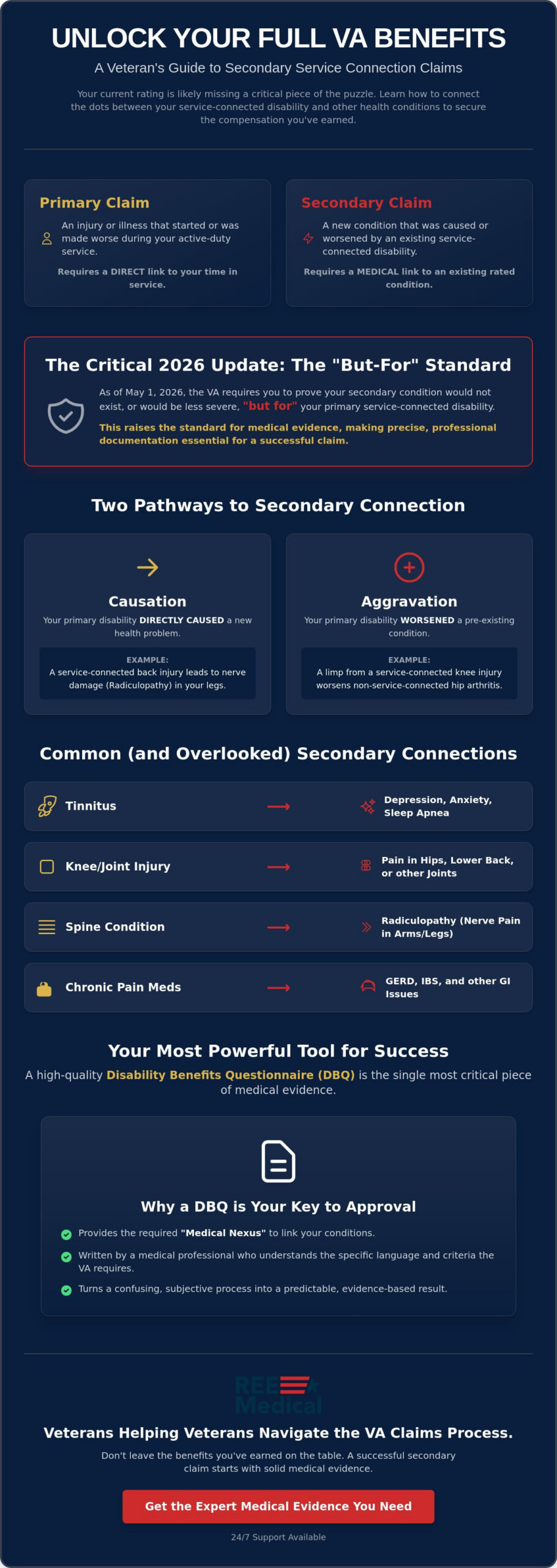
A secondary VA claim is a specific type of application for a condition that was either caused or made worse by an existing service-connected disability. While a primary claim focuses on injuries sustained during your time in uniform, Secondary VA Claims look at the long-term ripple effects those injuries have on your body and mind. For instance, if a service-connected back injury eventually leads to nerve damage in your legs, that nerve damage is a secondary condition. It’s a recognition that your health doesn’t exist in a vacuum; one injury often triggers another.
The core of a successful claim is the medical link, often called the “Nexus.” As of the May 1, 2026, update to the M21-1 manual, the VA now emphasizes a “but-for” causation standard. This means you must demonstrate that the secondary condition wouldn’t exist, or would be significantly less severe, but for the presence of your primary disability. This standard is a high bar for medical evidence, making precise clinical documentation essential for anyone filing Secondary VA Claims to secure VA disability benefits.
Strategically, these claims are vital because of how VA math works. Instead of struggling to increase a single 10% rating, adding secondary conditions can help you bridge the gap toward the 100% P&T threshold. It’s often the most logical path to ensure your total compensation reflects the true impact of your service on your daily life.
Direct vs. Secondary Service Connection
Direct connection requires an “in-service” event documented in your military records. Secondary connection is different; it only requires a medical link to a condition you’re already rated for. This shift in focus makes secondary claims one of the most effective paths to a VA rating increase because you aren’t searching for lost records from decades ago. You’re documenting your health as it exists today and explaining how your current symptoms are tied to your previous service-connected award.
The “Aggravation” Rule
You don’t always need to prove that your service-connected disability caused a new problem from scratch. Under the “aggravation” rule, you can claim a condition that existed before or developed independently if your primary rating made it worse. If your service-connected knee injury causes you to walk with a limp that worsens a non-service-connected hip issue, that is aggravation. Proving this requires meticulous clinical evidence that shows a clear increase in severity beyond the natural progression of the disease.
Common Secondary Conditions Veterans Often Overlook 🌎
Many veterans focus only on the physical trauma from their service, missing the indirect ways that trauma impacts their overall health. When filing Secondary VA Claims, you must look at how your primary conditions interact with other body systems. For example, the constant ringing of tinnitus isn’t just an ear issue; it often leads to sleep disturbances and severe irritability. This is why conditions like depression and anxiety are frequently secondary to tinnitus.
There are several other connections that the VA recognizes but rarely highlights to veterans. These include:
- Orthopedic Chains: A service-connected knee injury that causes you to limp, eventually damaging your hips or lower back.
- Neurological Connections: Lumbar or cervical spine conditions that pinch nerves, leading to radiculopathy in your arms or legs.
- Medication Side Effects: Developing GERD or IBS because of long-term NSAID use for chronic service-connected pain.
Your body naturally tries to compensate for pain. If you have a service-connected knee injury, your gait changes to protect that joint. This shift puts unnatural stress on your hips and lower back, often leading to new diagnoses years later. These connections are well-documented in the VA’s own Secondary Service Connection factsheet. Securing expert guidance on your medical evidence is often the best way to ensure your claim is built on a solid foundation.
Sleep Apnea Secondary to Respiratory or Mental Health
Proving a link for sleep apnea requires more than just a diagnosis. You must show how a service-connected condition like asthma or PTSD-related weight gain was the proximate cause of the sleep disorder. A sleep study is mandatory to confirm the condition, but the “nexus” is what wins the claim. You need a medical opinion that explains the physiological link between your primary rating and your breathing issues at night.
The “Pyramiding” Trap
The VA will deny claims if they believe you are trying to get paid twice for the same functional impairment. Pyramiding is the VA practice of not rating the same symptom under two different codes. To avoid a denial, your Secondary VA Claims must document distinct symptoms that aren’t already covered by your primary rating’s diagnostic code. Clear clinical evidence is the only way to prove that your secondary condition is a separate, compensable disability.
The Critical Role of DBQs in Establishing a Medical Nexus
You can’t rely on the VA to “connect the dots” between your medical conditions during a standard review. Winning Secondary VA Claims requires speaking the rater’s language through precise, standardized documentation. A Disability Benefits Questionnaire (DBQ) is the specific tool the VA uses to evaluate the severity and connection of your disabilities. For a deeper look at how these forms function, review A Veteran’s Guide to Disability Benefits Questionnaires to see how they structure medical evidence for 2026.
While a standard doctor’s note might describe your pain, it often lacks the clinical specificity required to grant a secondary rating. DBQs are more effective because they follow the VA’s Schedule for Rating Disabilities exactly. By using a private medical provider who understands these forms, you ensure the documentation is thorough and focused on the nexus between your primary and secondary conditions. Private medical opinions provide a level of independence and detail that a rushed C&P exam often misses, giving the rater a clear clinical path to an approval.
Front-Loading Your Claim
The most effective strategy for a fast decision is submitting a Fully Developed Claim (FDC). By including completed DBQs when you first file, you “front-load” your evidence and reduce the need for the VA to request additional exams. This proactive approach is your best defense against a VA claim denied for lack of evidence. It presents the rater with a complete medical picture from day one, which can significantly shorten the wait time for your rating increase.
What Makes a Strong Nexus Statement?
A strong nexus requires three elements: a current medical diagnosis, a service-connected primary condition, and a clear medical link between them. Your provider must use specific language to satisfy the VA’s requirements. The phrase “at least as likely as not” is the standard of proof for VA claims, meaning there is at least a 50% probability that your secondary condition was caused or aggravated by your service-connected disability. If you’re ready to secure high-quality medical evidence for your claim, you can access professional DBQ documentation here to ensure your link is clearly established.
Step-by-Step Guide to Filing a Secondary Claim in 2026 📞
Moving from a diagnosis to a successful award requires a methodical approach. You’ve already learned why these links matter and which conditions are most common. Now, it’s time to put that knowledge into action. Filing Secondary VA Claims in 2026 is a digital-first process that rewards veterans who submit complete, evidence-heavy packages from the start.
- Identify the Link: Audit your current award letter. Compare your rated disabilities against new symptoms or diagnoses you’ve received since your last claim.
- Secure the Evidence: Don’t wait for a C&P examiner to find the connection for you. Obtain a professional DBQ that explicitly addresses the secondary link using the “but-for” causation standard.
- File via VA.gov: Submit your application as a Fully Developed Claim (FDC). You can navigate the VA disability claims process step by step using the VA’s online portal to ensure your documentation is uploaded correctly.
- Track the Decision: Processing times in 2026 remain steady, but claims with private medical evidence often move through the system faster because they require less internal development by the VA.
Reviewing Your Medical Records
Success is often hidden in the fine print of your treatment notes. Look for “clues” where a doctor might have noted that your back pain is affecting your gait or that your medication is causing digestive distress. Organize these notes chronologically. When you present a clear timeline to the VA rater, you make it much easier for them to verify the medical nexus and grant your increase.
Partnering with Global Vets Consulting
Our “Veterans Helping Veterans” ethos means we don’t just see a file; we see a fellow service member. We understand the high stakes of Secondary VA Claims and provide the educational resources you need to secure accurate DBQs. Our team is available through our 24/7 National Client Services Hotline and our 24/7 AI Veteran Intake Specialist to ensure you never have to navigate this complex system alone. We prioritize transparency and meticulousness to give you peace of mind throughout the process. Ready to link your conditions and get the rating you deserve? Contact Global Vets Consulting today.
Take Control of Your Disability Rating Increase
Securing the compensation you deserve for Secondary VA Claims requires more than just submitting a list of symptoms. It demands a precise medical link and high-quality clinical evidence that meets the 2026 “but-for” causation standard. By focusing on overlooked conditions and providing the VA with completed DBQs from the start, you eliminate the guesswork for the rater and speed up your decision timeline.
Global Vets Consulting has been veteran-owned and operated since 2021; we specialize in the complex medical documentation needed to prove these critical links. Whether you’re dealing with joint pain that has migrated or mental health struggles stemming from chronic injury, you don’t have to navigate this system alone. Our 24/7 AI Veteran Intake Specialist is ready to help you begin the process of documenting your health accurately and thoroughly.
📞 Get Professional DBQ Support for Your Secondary Claim Now
You’ve already done the hard work of serving your country. Now, it’s time to ensure your VA records reflect the full reality of your service-connected health. Your path to a higher combined rating starts with the right evidence.
Secondary VA Claims FAQs
What is the most common secondary VA claim?
Radiculopathy is widely considered the most common secondary claim, often stemming from service-connected lumbar or cervical spine conditions. This condition involves nerve pain, numbness, or weakness in the arms or legs caused by spinal issues. Many veterans also find success filing for gastrointestinal issues secondary to the medications used for their primary injuries. These Secondary VA Claims are successful because the medical community recognizes these direct physiological progressions as standard complications of chronic physical trauma.
Do I need a new nexus letter for every secondary condition?
Yes, you must provide a distinct medical link for every secondary condition you include in your claim. The VA treats each diagnosis as an individual request for compensation, so a single nexus statement cannot cover multiple unrelated health issues. You need specific clinical documentation, such as a DBQ, for each condition to prove it was caused or aggravated by your primary disability. This level of meticulousness prevents administrative denials and ensures each symptom is rated fairly.
Can a secondary condition be rated higher than the primary condition?
Absolutely, a secondary condition can carry a higher disability rating than the primary service-connected disability. The VA evaluates the severity of your symptoms and their functional impact on your daily life, regardless of which condition developed first. For instance, a veteran with a 10% rating for a knee injury might receive a 50% rating for secondary sleep apnea if the symptoms are more debilitating. Your total compensation is based on the combined effect of all your disabilities.
What happens if the VA denies my secondary claim but keeps my primary rating?
Your primary service-connected rating remains protected and unchanged even if the VA denies your secondary claim. A denial only means the rater found insufficient evidence to establish a medical nexus or that the symptoms didn’t meet the rating criteria. It doesn’t mean your original rating was incorrect. You can respond by providing more thorough medical evidence or a private DBQ to address the specific gaps identified in the decision letter to move your claim forward.
How does “VA math” affect my total rating when adding secondary conditions?
VA math uses a combined rating table where each new disability percentage is applied to your remaining healthy percentage rather than being added directly. If you have a 50% rating and add a 30% secondary condition, the 30% is taken from the remaining 50%, adding 15% to your total. This results in a 65% rating, which the VA then rounds to 70%. Filing Secondary VA Claims is the most effective way to reach higher rating tiers.

Article by
Willie Daniel
Willie Daniel is the Founder and Chief Executive Officer (CEO) of Global Vets Consulting (GVC) – National Veterans Disability Services, a veteran-led educational and medical evidence support organization dedicated to helping veterans better understand VA disability rating increases, DBQ medical evidence, secondary claims education, and C&P examination preparation.
He is a retired U.S. Army Medical Service Corps Officer with more than 27 years of honorable military service, a decorated Iraq combat veteran, and a retired federal official with the U.S. Department of Veterans Affairs. Throughout his military and federal career, Willie Daniel served in leadership, healthcare administration, operational, and veteran-support roles focused on improving services and support systems for servicemembers, veterans, and their families.
Drawing from decades of military leadership, healthcare administration, veteran advocacy, and federal government experience, Willie Daniel brings a practical, veteran-centered perspective to Global Vets Consulting’s educational articles, AI-powered veteran resources, video education initiatives, and outreach programs. His experience navigating military systems, medical documentation processes, and veteran-related administrative operations provides valuable insight into many of the challenges veterans face when seeking to better understand VA disability rating criteria, medical evidence, documentation strategies, and secondary condition education.
Through GVC’s “Veterans Helping Veterans” mission, his focus is on delivering clear, educational, and easy-to-understand information designed to empower veterans with knowledge, resources, and educational tools that may help them make more informed decisions regarding their individual VA disability journeys.
The information provided through GVC is intended for educational and informational purposes only and should not be considered legal or medical advice.
Disclaimer
Disclaimer: Global Vets Consulting, LLC (“GVC”) is a veteran-led educational and medical evidence support organization. GVC is not a law firm, is not a Veterans Service Organization (VSO), and is not affiliated with the U.S. Department of Veterans Affairs (VA) or any government agency.
Global Vets Consulting does not provide legal advice, medical advice, medical treatment, or healthcare services. GVC does not prepare, file, or submit VA disability claims on behalf of veterans. All information provided through this website, blog articles, videos, educational materials, AI tools, dashboards, templates, and communications is intended solely for general educational and informational purposes.
Veterans are encouraged to consult with accredited representatives, licensed attorneys, qualified medical providers, or Veterans Service Organizations regarding their specific legal, medical, or VA-related matters. VA disability decisions, ratings, and outcomes are determined solely by the U.S. Department of Veterans Affairs based on applicable laws, regulations, medical evidence, and individual circumstances. Past results do not guarantee future outcomes.

