
What if the difference between a 0% and 50% disability rating came down to a single word in your medical records? For many veterans, the daily reality of chronic sinus pressure and painful infections is ignored because their evidence doesn’t meet the VA’s specific legal definitions. We understand the frustration of having a C&P examiner downplay your symptoms when you’re struggling to breathe or function. At Global Vets Consulting (GVC4Vets), we’re a mission-driven team of veterans helping veterans worldwide secure the disability benefits they’ve earned. This guide breaks down the exact criteria the VA uses to determine your Sinusitis VA Rating under the 38 CFR. You’ll learn how to document incapacitating episodes and use medical evidence to move toward a rating increase. For 24/7 support, our National Client Services Hotline and AI Intake Specialist are available at (727) 350-8387. You can also access educational resources at https://www.GlobalVetsConsultingInfo.com to help you navigate the claims process with confidence.
Key Takeaways 🇺🇸
- Master the 38 CFR § 4.97 diagnostic codes to understand how the VA evaluates specific sinus cavities and conditions.
- Discover the critical difference between non-incapacitating symptoms and the bed rest requirements that lead to a higher Sinusitis VA Rating.
- Learn how to build a robust medical file using a sinusitis journal and pharmacy records to track your antibiotic frequency.
- Access 24/7 support through our National Client Services Hotline and 24/7 AI Veteran Intake Specialist at (727) 350-8387 or visit https://www.GlobalVetsConsultingInfo.com.
2026 VA Rating Criteria for Chronic Sinusitis (38 CFR § 4.97) 🇺🇸
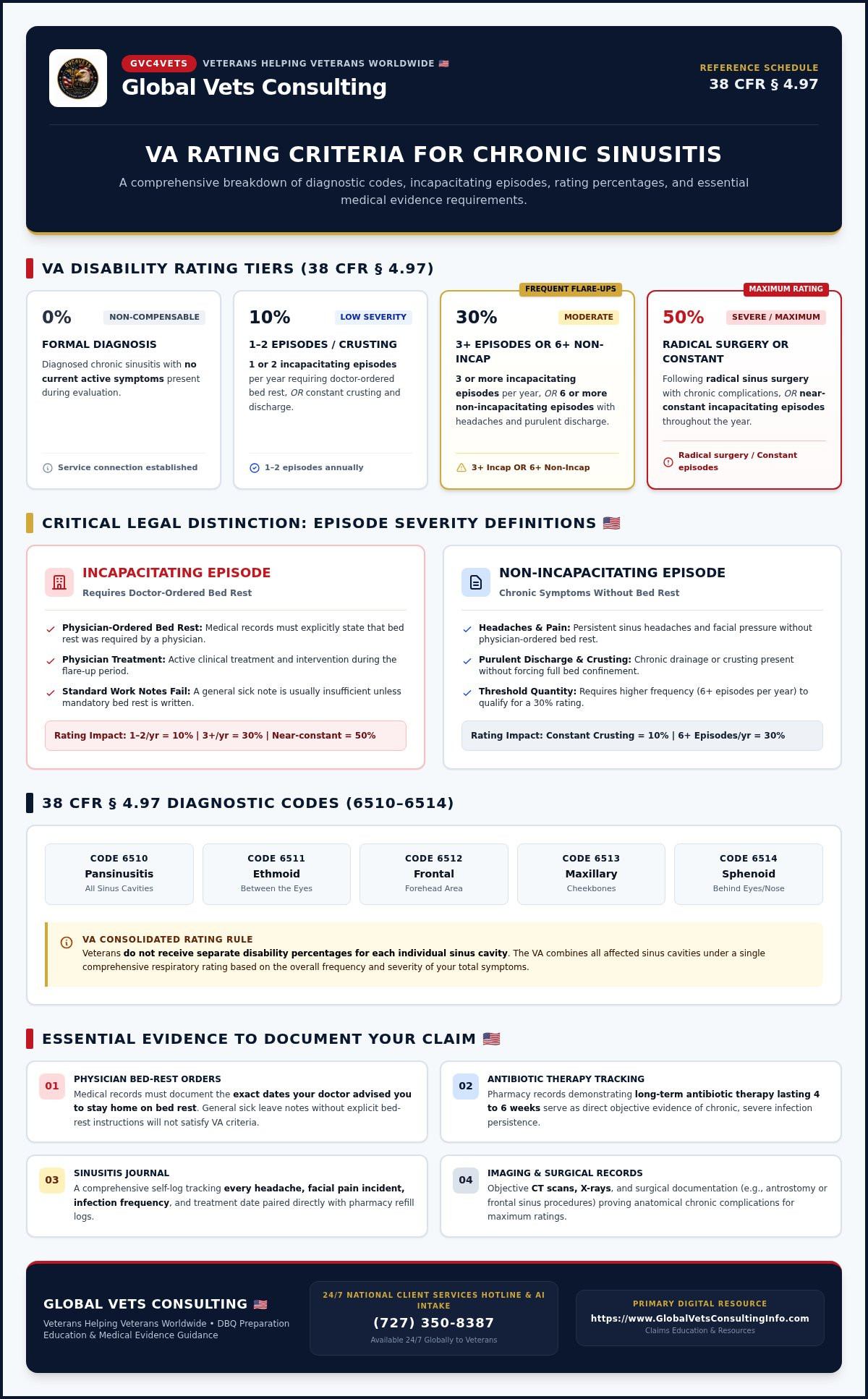
The VA evaluates your service-connected respiratory conditions using a specific schedule found in 38 CFR § 4.97. To secure an accurate Sinusitis VA Rating, you must understand how the VA defines the severity of your symptoms. A 0% non-compensable rating is assigned if you have a formal diagnosis but don’t currently experience symptoms. As your condition worsens, the ratings increase based on frequency. A 10% rating requires one or two incapacitating episodes per year or constant crusting and discharge. If you experience three or more incapacitating episodes annually, or six or more non-incapacitating episodes characterized by headaches and purulent discharge, you may qualify for a 30% rating.
Understanding Diagnostic Codes 6510-6514
The VA uses specific codes to identify which sinus cavities are affected. These include 6510 (pansinusitis), 6511 (ethmoid), 6512 (frontal), 6513 (maxillary), and 6514 (sphenoid). While chronic sinusitis can impact any of these areas, the VA typically combines these under a single rating for the respiratory system. You won’t receive separate ratings for each cavity. Instead, the overall frequency of your symptoms across all affected areas determines your final percentage. This consolidated approach ensures that your total disability is captured under one comprehensive rating.
The 50% Maximum Rating Criteria
Achieving the 50% maximum rating is challenging and requires precise medical documentation. This level is reserved for veterans who have undergone radical sinus surgery with chronic complications or those who suffer from near-constant incapacitating episodes throughout the year. Because this rating is difficult to secure, high-quality DBQ preparation education is essential to ensure your symptoms are reported accurately. If you need help understanding these criteria for your Sinusitis VA Rating, our team at Global Vets Consulting (GVC4Vets) provides support worldwide.
Connect with Global Vets Consulting (GVC4Vets) 24/7:
- 24/7 National Client Services Hotline: (727) 350-8387
- 24/7 AI Veteran Intake Specialist: (727) 350-8387
- Primary Digital Resource: https://www.GlobalVetsConsultingInfo.com
Defining “Incapacitating Episodes” vs. Non-Incapacitating 🇺🇸
The VA uses specific language to distinguish between the severity of your sinus flare-ups. An incapacitating episode is defined as a period of symptoms severe enough to require bed rest and treatment by a physician. In contrast, non-incapacitating episodes involve persistent headaches, purulent discharge, or crusting, but don’t force you into bed rest. These distinctions are vital because they directly determine your Sinusitis VA Rating. Even without frequent infections, constant crusting and discharge can trigger a 10% rating. The VA also looks at how often you require antibiotics, as frequent prescriptions serve as objective evidence of severity. Understanding these VA disability compensation rates helps you see why precise definitions matter for your Sinusitis VA Rating and monthly benefits.
The Importance of Physician-Ordered Bed Rest
When you visit a doctor for a sinus infection, the terminology used in your medical records is critical. To qualify for a higher rating, the documentation must explicitly mention bed rest ordered by a physician. Bed rest is mandatory. A standard sick note for work might not satisfy a C&P examiner unless it specifies that bed rest was medically required. We recommend documenting the exact dates your doctor advised you to stay home. This level of detail is exactly what we focus on during our respiratory system claims education sessions.
Tracking Antibiotic and Surgical History
The duration of your treatment also plays a role in your claim. Long-term antibiotic therapy lasting four to six weeks is often viewed as evidence of a more severe, persistent infection. If your condition has required radical surgery, such as an antrostomy or frontal sinus procedure, you may reach the 50% rating threshold. Our team supports veterans worldwide by providing DBQ preparation education to ensure these medical facts aren’t overlooked during a C&P exam. If you have questions about your evidence, call our 24/7 National Client Services Hotline or our 24/7 AI Veteran Intake Specialist at (727) 350-8387. You can also visit our primary digital resource at https://www.GlobalVetsConsultingInfo.com for further guidance.
Essential Evidence: How to Document Your Sinusitis Symptoms 🇺🇸
Securing a higher Sinusitis VA Rating depends on the quality of your evidence file. We recommend maintaining a detailed Sinusitis Journal to track every headache, facial pain incident, and infection frequency. This log should be paired with pharmacy records that prove how often you require antibiotics. Objective data like CT scans or X-rays are also vital as they confirm the presence of chronic inflammation or polyps. The VA schedule for these ratings is found in the 38 CFR § 4.97 Schedule of Ratings for the Respiratory System. By providing this level of detail, you leave less room for a C&P examiner to downplay your symptoms. Consistent documentation shows the chronic nature of your condition.
Secondary Service Connection Strategies
Many veterans find success by linking sinusitis as a secondary condition to allergic rhinitis or sleep apnea. Under the PACT Act, sinusitis is now a presumptive condition for those exposed to burn pits during service. The logic used in establishing a radiculopathy secondary to back condition claim applies here too. If one service-connected issue causes or worsens another, it’s compensable. We provide secondary VA claims education to help you map these connections correctly. This approach often leads to a more accurate overall disability rating for your Sinusitis VA Rating.
Using a Private DBQ to Tell Your Full Story
A private DBQ often tells a more complete story than a standard C&P exam because it allows for a thorough review of your longitudinal history. It ensures your daily limitations and incapacitating episodes are fully recorded without the time constraints of a government-contracted exam. If you’re ready to strengthen your medical evidence, visit Global Vets Consulting (GVC4Vets) for expert resources. Our mission is to support our community worldwide. Call our 24/7 National Client Services Hotline or our 24/7 AI Veteran Intake Specialist at (727) 350-8387 to get started today.
How Global Vets Consulting (GVC4Vets) Supports Your Sinusitis Claim 🇺🇸
Global Vets Consulting (GVC4Vets) stands as a steady guide for veterans worldwide who are tired of the confusion surrounding the disability system. We focus on empowering you through education on the VA disability claims process step by step. Our mission-driven team understands the specific evidence needed to justify a higher Sinusitis VA Rating. We provide high-quality DBQ preparation education to ensure your symptoms are reported with the meticulous detail the VA requires. By leveraging our veteran-led network, you gain access to a partnership that values your service and your well-being. This isn’t a cold transaction; it’s a peer-to-peer support model designed to give you peace of mind.
Expert Guidance on Rating Increases
If your condition has worsened since your last evaluation, you need a clear strategy for a rating increase. We educate you on how to use a dbq for va disability rating increase for sinusitis. This documentation acts as a shield during a C&P exam, preventing examiners from downplaying the frequency of your infections or the duration of your required bed rest. Proper preparation ensures that your Sinusitis VA Rating accurately reflects your daily medical reality and functional limitations.
Get Started with Global Vets Consulting (GVC4Vets) Today
Taking the next step shouldn’t be a stressful or lonely experience. Our 24/7 National Client Services Hotline and 24/7 AI Veteran Intake Specialist are ready to assist you at (727) 350-8387. We offer constant accessibility because we know your symptoms and flare-ups don’t stop after business hours. You can also explore our full range of respiratory system claims education by visiting our primary digital resource at GlobalVetsConsultingInfo.com. We’re dedicated to helping you secure the earned outcomes you deserve through thorough and accurate documentation.
Take Control of Your Sinusitis Disability Claim 🇺🇸
Securing a fair Sinusitis VA Rating requires more than just a medical diagnosis. It demands a thorough record of your incapacitating episodes and a consistent treatment history. By documenting every flare-up in a journal and tracking your antibiotic use, you build a case that reflects your daily medical reality. We’re a veteran-owned and operated team dedicated to helping you navigate these complexities with confidence. Whether you’re filing for a rating increase or educating yourself on the 38 CFR criteria, we provide the steady guidance you need. Our worldwide support network is built on the principle of veterans helping veterans. You don’t have to face the bureaucracy alone. Ready to secure the rating you deserve? Call our 24/7 National Client Services Hotline or speak with our 24/7 AI Veteran Intake Specialist at (727) 350-8387. You can also visit GlobalVetsConsultingInfo.com to start your intake today. We’re here to help you achieve the accurate outcome your service earned.
Frequently Asked Questions 🇺🇸
Can I get a 100% rating for sinusitis?
The maximum rating for chronic sinusitis is 50% under 38 CFR § 4.97, meaning you cannot get a 100% rating for this condition alone. To reach a 100% total disability status, you must combine this with other service-connected ratings. The 50% level requires radical surgery or near-constant incapacitating episodes. Understanding these limits is a key step in setting realistic goals for your disability claim.
Is sinusitis a presumptive condition under the PACT Act?
Yes, chronic sinusitis is a presumptive condition under the PACT Act for veterans exposed to burn pits or other toxins. This means the VA presumes your service caused the condition, removing the need for a specific in-service event. You still need a current diagnosis and evidence of symptoms to qualify for a Sinusitis VA Rating. This presumptive status significantly simplifies the evidence gathering process for many eligible veterans.
What counts as an incapacitating episode for the VA?
The VA defines an incapacitating episode as a flare-up severe enough to require bed rest and treatment by a physician. Simple headaches or nasal discharge that don’t force you into bed rest are considered non-incapacitating. To secure a higher rating, your medical records must explicitly document doctor-ordered bed rest. We provide education on how to ensure your medical evidence accurately reflects these specific requirements during your claim evaluation.
How do I prove my sinusitis is service-connected?
Proving service connection requires a formal diagnosis, evidence of an in-service incident, and a medical nexus. High-quality DBQ preparation education is essential for documenting how your military service led to your current respiratory issues. For immediate support with your evidence, contact our 24/7 National Client Services Hotline or our 24/7 AI Veteran Intake Specialist at (727) 350-8387. You can also find resources at https://www.GlobalVetsConsultingInfo.com.
Can sinusitis be rated secondary to allergic rhinitis?
Sinusitis can be rated secondary to allergic rhinitis if your service-connected nasal condition causes or worsens your sinus inflammation. This link is common because chronic nasal congestion frequently leads to secondary infections. Establishing this connection can help you achieve a Sinusitis VA Rating increase. Our team at Global Vets Consulting (GVC4Vets) provides the education needed to help you map these respiratory links effectively for your claim.

Article by
Willie Daniel
Willie Daniel is the Founder and Chief Executive Officer (CEO) of Global Vets Consulting (GVC4Vets) – National Veterans Disability Services, a veteran-led educational and medical evidence support organization dedicated to helping veterans better understand VA disability rating increases, DBQ medical evidence, secondary claims education, and C&P examination preparation.
He is a retired U.S. Army Medical Service Corps Officer with more than 27 years of honorable military service, a decorated Iraq combat veteran, and a retired federal official with the U.S. Department of Veterans Affairs. Throughout his military and federal career, Willie Daniel served in leadership, healthcare administration, operational, and veteran-support roles focused on improving services and support systems for servicemembers, veterans, and their families.
Drawing from decades of military leadership, healthcare administration, veteran advocacy, and federal government experience, Willie Daniel brings a practical, veteran-centered perspective to Global Vets Consulting’s educational articles, AI-powered veteran resources, video education initiatives, and outreach programs. His experience navigating military systems, medical documentation processes, and veteran-related administrative operations provides valuable insight into many of the challenges veterans face when seeking to better understand VA disability rating criteria, medical evidence, documentation strategies, and secondary condition education.
Through GVC’s “Veterans Helping Veterans” mission, his focus is on delivering clear, educational, and easy-to-understand information designed to empower veterans with knowledge, resources, and educational tools that may help them make more informed decisions regarding their individual VA disability journeys.
The information provided through GVC is intended for educational and informational purposes only and should not be considered legal or medical advice.
Disclaimer
Disclaimer: Global Vets Consulting, LLC (“GVC”) is a veteran-led educational and medical evidence support organization. GVC is not a law firm, is not a Veterans Service Organization (VSO), and is not affiliated with the U.S. Department of Veterans Affairs (VA) or any government agency.
Global Vets Consulting does not provide legal advice, medical advice, medical treatment, or healthcare services. GVC does not prepare, file, or submit VA disability claims on behalf of veterans. All information provided through this website, blog articles, videos, educational materials, AI tools, dashboards, templates, and communications is intended solely for general educational and informational purposes.
Veterans are encouraged to consult with accredited representatives, licensed attorneys, qualified medical providers, or Veterans Service Organizations regarding their specific legal, medical, or VA-related matters. VA disability decisions, ratings, and outcomes are determined solely by the U.S. Department of Veterans Affairs based on applicable laws, regulations, medical evidence, and individual circumstances. Past results do not guarantee future outcomes.