
Skin conditions are among the top five most common service-connected disabilities for new VA compensation recipients, yet the rating process often feels remarkably arbitrary. When you’re filing a va claim for skin conditions, the difference between a 10% and a 60% rating frequently hinges on how your medical evidence defines systemic therapy versus topical treatment. It’s frustrating to deal with complex criteria that don’t seem to account for the daily reality of your symptoms or the difficulty of proving a service connection for non-presumptive conditions.
You deserve a rating that reflects the true severity of your condition and the actual impact it has on your life. This guide will help you navigate the 38 CFR rating criteria and explain how to secure a DBQ that accurately captures your symptoms for the VA. We’ll provide a clear path through the 2026 COLA updates and the specific documentation required to move beyond a simple diagnosis toward a fair and earned disability rating.
Key Takeaways
- Understand how the VA applies the “Pyramiding” rule to skin conditions and why most veterans receive a single rating for multiple dermatological issues.
- Learn to navigate the 38 CFR § 4.118 criteria to ensure your va claim for skin conditions accurately documents the body surface area affected and the frequency of your treatments.
- Discover why a Disability Benefits Questionnaire (DBQ) serves as the most critical piece of medical evidence to support your symptoms and secure a fair disability rating.
- Identify the essential differences between topical and systemic therapies to avoid common errors that lead to underrated claims.
- Gain a clear, step-by-step understanding of how professional education and private medical evidence can provide a more predictable path forward during the VA claims process.
Understanding VA Disability for Skin Conditions
Securing a successful va claim for skin conditions requires a clear grasp of how the VA views dermatological health. Under federal law, the VA recognizes various conditions ranging from chronic eczema, which affects approximately 556,000 veterans, to psoriasis and severe acne vulgaris. To gain a broader perspective on how these benefits fit into the larger veterans’ support system, it’s helpful to start with Understanding VA Disability for Skin Conditions.
One of the biggest hurdles veterans face is the “Pyramiding” rule. The VA generally assigns only one disability rating for all skin issues, even if you have multiple diagnoses like dermatitis and scarring. Understanding this is a key part of the VA disability claims process step by step, as the VA will choose the single diagnostic code that provides the highest evaluation for your combined symptoms.
Documenting the frequency of flares and “incapacitating episodes” is vital for a strong claim. A flare is an acute worsening of your symptoms. An incapacitating episode involves a period of extreme severity that requires bed rest or specific medical treatment ordered by a physician. Having a clear record of these events can significantly influence your final rating.
Direct vs. Secondary Service Connection
Direct service connection occurs when you can prove your skin condition began during your time in uniform. However, many veterans find success through secondary service connection for their va claim for skin conditions. This involves linking a skin condition to an existing service-connected disability, such as psoriasis triggered by the stress of a mental health condition or a rash caused by medications for another service-connected illness. Per 38 CFR terminology, a service-connected skin condition is any chronic dermatological disease that was incurred in or aggravated by active military service and results in a measurable disability.
Presumptive Conditions and Environmental Exposure
Certain conditions are automatically presumed to be service-connected based on where and when you served. Vietnam veterans exposed to Agent Orange may qualify for chloracne or porphyria cutanea tarda if these conditions manifested within one year of exposure. For modern veterans, the PACT Act has opened new pathways for claims related to burn pits and particulate matter exposure. These exposures often lead to chronic dermatitis, eczema, or other inflammatory skin disorders that the VA now recognizes as presumptive for many Gulf War and post-9/11 veterans.
How the VA Rates Skin Conditions: The 2026 Criteria
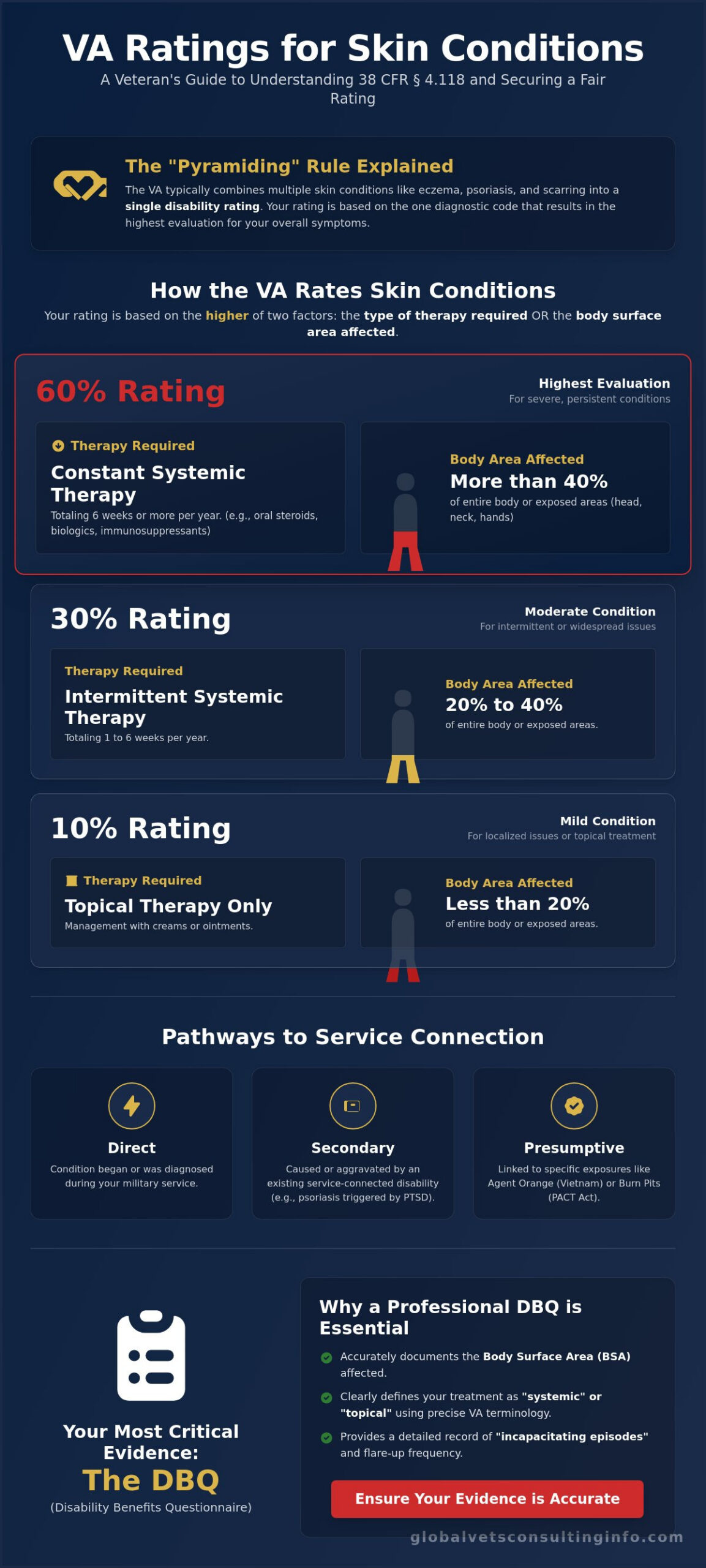
The VA evaluates a va claim for skin conditions using the General Rating Formula for the Skin found in 38 CFR § 4.118. This formula is unique because it offers two different paths to a rating. The VA looks at either the total Body Surface Area (BSA) affected or the type of therapy required to control the condition. It’s a “whichever is higher” rule, meaning if your medicine is intense but the rash is small, you can still qualify for a significant rating.
Body Surface Area is measured by looking at “exposed areas,” which include the head, face, neck, and hands, or the “whole body.” However, for many veterans, the type of treatment is the deciding factor. Systemic therapy, such as oral steroids, biologics, or immunosuppressants, carries much more weight than topical therapy like creams or ointments. Understanding these nuances is part of gathering the Essential Evidence for a Successful Skin Condition Claim to ensure your medical records reflect the true severity of your situation.
The 10% to 60% Rating Breakdown
- 60% Rating: This requires constant systemic therapy (six weeks or more total duration per year) or more than 40% of the entire body or exposed areas affected.
- 30% Rating: This is assigned for intermittent systemic therapy (used for a total of at least one week but less than six weeks per year) or if 20% to 40% of the body or exposed areas are affected.
- 10% Rating: This applies if you only require topical therapy or if the condition affects less than 20% of the body or exposed areas.
If your current rating doesn’t align with the frequency of your flare-ups or the intensity of your medication, seeking skin conditions and dermatological claims education can help you identify exactly what evidence is missing from your file.
Rating Scars and Disfigurement
Scars are evaluated based on two primary factors: instability and pain. An “unstable” scar is one where the skin frequently breaks down or ulcerates. A “painful” scar is one that causes documented discomfort during a physical exam. If a scar is both painful and unstable, it may qualify for separate ratings. The VA rates scars on the head, face, and neck differently by focusing on “disfigurement,” which accounts for tissue loss, skin color changes, or the distortion of facial features.
Essential Evidence for a Successful Skin Condition Claim
Building a strong va claim for skin conditions requires more than just showing a rash to a physician. You must provide objective data that aligns perfectly with the VA’s Schedule of Ratings for Skin Conditions. This is especially true for claims involving toxic exposure under the PACT Act, where the connection between your service and your current symptoms must be clearly established through medical documentation. A Disability Benefits Questionnaire (DBQ) is the most critical piece of evidence you can provide. It serves as the primary tool for the VA Rater to determine your disability percentage by translating your physical symptoms into the specific administrative language of systemic therapy and body surface area.
Beyond the DBQ, a Nexus Letter is often necessary to bridge the gap between your military service and your diagnosis. This is particularly vital for non-presumptive conditions. Additionally, photographic evidence is non-negotiable. Flares frequently subside by the time you attend a C&P exam. High-quality, dated photographs prove the severity of your condition at its worst, ensuring the Rater sees the full extent of your disability rather than just a clear-skin day.
Maintaining a Treatment Log
Consistency is key when documenting your medical history. You should maintain a detailed log that tracks every instance of systemic therapy, such as doses of prednisone or methotrexate. Because the VA evaluates ratings based on how many weeks of treatment you require annually, having a precise record of your prescriptions and flare-ups can be the difference between a 30% and 60% rating. If you need assistance documenting these complex details, consider investing in skin conditions and dermatological claims education to ensure no detail is overlooked.
Supporting Statements (Lay Evidence)
While medical reports provide the “what,” buddy statements and personal statements provide the “how.” These documents describe the daily reality of living with a chronic skin condition. Use buddy statements to corroborate the severity of itching, physical pain, and the sleep loss you experience. Your personal statement should clearly describe the social and economic impact of your condition, such as the need to miss work during an incapacitating episode or the emotional toll of visible disfigurement.
If you are ready to secure medical evidence that accurately reflects your symptoms, explore our Disability Benefits Questionnaire (DBQ) resources to get started on the right path.
Navigating Your Claim with Professional DBQ Support
Successfully completing a va claim for skin conditions requires a proactive approach to medical evidence. While the VA often schedules a Compensation and Pension (C&P) examination, these appointments can be brief and may not occur during a flare-up. This is where the advantage of a private Disability Benefits Questionnaire (DBQ) becomes clear. By working with a medical professional who understands the specific nuances of the General Rating Formula, you ensure your documentation accurately reflects your symptoms and treatment history before the VA makes a decision.
Global Vets Consulting helps streamline the VA disability claims process step by step, focusing on educational resources that empower you to present a complete medical picture. This preparation is vital for ensuring that the intensity of your systemic therapy or the exact percentage of body surface area affected is clearly communicated to the Rater. If your condition has progressed over time, you can also learn how to use a DBQ for a VA disability rating increase to reflect your current level of impairment.
Why Meticulous Documentation Matters
Many veterans face “lack of evidence” denials because their records don’t explicitly mention the frequency of systemic treatments or the specific areas of disfigurement. Meticulous documentation removes the guesswork for the VA Rater and reduces the anxiety that often accompanies the claims process. Professional medical education support provides a predictable path forward, helping you gather the precise documentation required by 38 CFR § 4.118 without the stress of navigating the bureaucracy alone.
Your Next Steps Toward a Fair Rating
The first step toward a successful va claim for skin conditions is a thorough review of your existing medical records. Look for gaps in your treatment history, such as periods where you used systemic medications but didn’t have a follow-up appointment. Once you identify these gaps, you can take action to fill them. Contact Global Vets Consulting today to access expert DBQ preparation and skin conditions and dermatological claims education. We are dedicated to helping you secure the fair disability rating you’ve earned through your service.
Take Control of Your Dermatological Claim
Securing a fair outcome for your va claim for skin conditions requires moving beyond a simple diagnosis. You must ensure your medical records explicitly detail the frequency of your systemic treatments and the exact percentage of body surface area affected. The VA’s 2026 criteria prioritize objective data over subjective descriptions. A Disability Benefits Questionnaire (DBQ) provides the precise administrative language needed to bridge the gap between your physical symptoms and a successful rating decision.
Global Vets Consulting is veteran-owned and operated since 2021. We specialize in 38 CFR compliance for DBQs and focus on accurate medical evidence education to help you navigate this complex system with confidence. By prioritizing thoroughness and accuracy today, you create a predictable path toward the benefits you earned through your service. Accuracy in your initial documentation is the most effective way to reduce anxiety and ensure your claim is processed correctly the first time.
Secure your professional DBQ documentation with Global Vets Consulting today. You don’t have to face the bureaucracy alone; we’re here to provide the steady guidance you need for a successful result.
Frequently Asked Questions
What is the maximum VA disability rating for skin conditions?
The maximum rating for most skin conditions under the general rating formula is 60%. This evaluation is typically assigned when a veteran requires constant systemic therapy for six weeks or more in a 12-month period. It can also be achieved if more than 40% of the entire body or exposed areas are affected by the condition. While some specific conditions like skin cancer have different rules, the 60% threshold is the standard ceiling for chronic inflammatory issues.
Can I get a VA rating for scars secondary to surgery?
You can receive a disability rating for scars that result from a surgery performed to treat a service-connected condition. These are filed as secondary claims. The VA evaluates these scars based on their size, location, and whether they’re painful or unstable. If the original surgery was for a service-connected musculoskeletal or internal issue, any resulting disfigurement or functional limitation from the scar is compensable under the current rating schedule.
How does the VA define “systemic therapy” for skin conditions?
Systemic therapy refers to treatments that are ingested, injected, or otherwise introduced into the body to treat the skin from the inside out. This includes oral corticosteroids, biologics, and immunosuppressive medications like methotrexate. When filing a va claim for skin conditions, it’s vital to distinguish these from topical therapies like creams or ointments. Systemic treatments generally result in higher ratings because they indicate a more severe condition requiring aggressive medical intervention.
Is eczema a presumptive condition under the PACT Act?
Eczema is considered a presumptive condition for Gulf War veterans and those exposed to toxic substances under the PACT Act. The VA recognizes chronic dermatitis, which includes eczema and psoriasis, as linked to environmental exposures in specific theaters of operation. This means you don’t need to prove a specific event caused the condition; you only need a current diagnosis and proof of service in a qualifying location during the recognized timeframes.
What happens if my skin condition is in remission during my C&P exam?
If your condition is in remission during an exam, the VA Rater must rely on the medical evidence and lay statements you’ve already provided. This is why submitting a va claim for skin conditions with a private DBQ and a detailed treatment log is so important. You should present clear, dated photographs of your skin during a flare-up. This ensures the examiner understands the peak severity of your symptoms rather than just your appearance on that specific day.

Article by
Willie Daniel
Willie Daniel is the Founder and Chief Executive Officer (CEO) of Global Vets Consulting (GVC) – National Veterans Disability Services, a veteran-led educational and medical evidence support organization dedicated to helping veterans better understand VA disability rating increases, DBQ medical evidence, secondary claims education, and C&P examination preparation.
He is a retired U.S. Army Medical Service Corps Officer with more than 27 years of honorable military service, a decorated Iraq combat veteran, and a retired federal official with the U.S. Department of Veterans Affairs. Throughout his military and federal career, Willie Daniel served in leadership, healthcare administration, operational, and veteran-support roles focused on improving services and support systems for servicemembers, veterans, and their families.
Drawing from decades of military leadership, healthcare administration, veteran advocacy, and federal government experience, Willie Daniel brings a practical, veteran-centered perspective to Global Vets Consulting’s educational articles, AI-powered veteran resources, video education initiatives, and outreach programs. His experience navigating military systems, medical documentation processes, and veteran-related administrative operations provides valuable insight into many of the challenges veterans face when seeking to better understand VA disability rating criteria, medical evidence, documentation strategies, and secondary condition education.
Through GVC’s “Veterans Helping Veterans” mission, his focus is on delivering clear, educational, and easy-to-understand information designed to empower veterans with knowledge, resources, and educational tools that may help them make more informed decisions regarding their individual VA disability journeys.
The information provided through GVC is intended for educational and informational purposes only and should not be considered legal or medical advice.
Disclaimer
Disclaimer: Global Vets Consulting, LLC (“GVC”) is a veteran-led educational and medical evidence support organization. GVC is not a law firm, is not a Veterans Service Organization (VSO), and is not affiliated with the U.S. Department of Veterans Affairs (VA) or any government agency.
Global Vets Consulting does not provide legal advice, medical advice, medical treatment, or healthcare services. GVC does not prepare, file, or submit VA disability claims on behalf of veterans. All information provided through this website, blog articles, videos, educational materials, AI tools, dashboards, templates, and communications is intended solely for general educational and informational purposes.
Veterans are encouraged to consult with accredited representatives, licensed attorneys, qualified medical providers, or Veterans Service Organizations regarding their specific legal, medical, or VA-related matters. VA disability decisions, ratings, and outcomes are determined solely by the U.S. Department of Veterans Affairs based on applicable laws, regulations, medical evidence, and individual circumstances. Past results do not guarantee future outcomes.