
Burn scar VA claims can result in ratings from 0% to 80%, depending on the scar’s location, size, depth, pain, instability, and effects on function. The VA evaluates scars under 38 CFR §4.118, and service connection to military service is needed for compensation. A denial doesn’t always end the process; the decision’s reasons can point to what evidence or issue needs attention.
If you’re trying to understand why a burn scar received a particular rating, or why the VA denied the claim, the criteria can be hard to piece together. This guide explains how scar ratings work, when a scar may be linked secondarily to another service-connected condition, and what to consider after a denial. You’ll also learn how medical evidence and a Disability Benefits Questionnaire (DBQ) can document scar features relevant to the VA’s evaluation. Understanding the criteria and possible next steps can help you see what evidence your claim may need.
Key Takeaways
- Learn which scar characteristics the VA considers when evaluating disfigurement, including how location and visible changes matter.
- Understand how evidence connecting a scar to military service, including through another service-connected condition, can support a claim.
- See how scar location, depth, pain, instability, and functional effects can influence the disability evaluation.
- After a denial, review the decision’s reasons to identify what evidence or issue may need attention. For DBQ and medical evidence education, contact Global Vets Consulting (GVC4Vets) at its 24/7 National Client Services Hotline and 24/7 AI Veteran Intake Specialist: (727) 350-8387, or visit GlobalVetsConsultingInfo.com.
What Are the Eight Characteristics of Disfigurement?
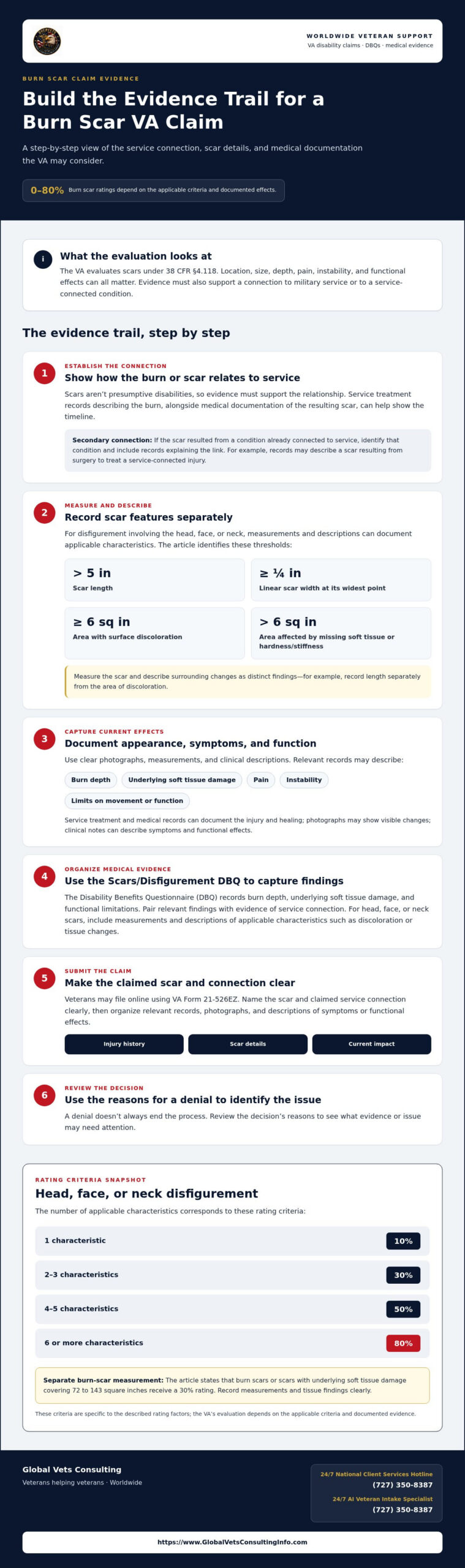
The VA considers eight characteristics when assessing disfigurement from scars on the head, face, or neck. These criteria distinguish a scar’s dimensions and tissue effects from its location alone. Documenting each affected area can clarify how the scar may relate to compensation. The measurements below describe several of the specific characteristics.
Measure the scar itself and describe changes to the surrounding surface. A scar longer than 5 inches is one characteristic; a linear scar at least one-quarter inch wide at its widest point is another. Discoloration covering at least six square inches also counts. These measurements concern different features, so record each separately rather than treating length and width as one finding.
- Missing tissue: More than six inches of missing soft tissue beneath a scar is a characteristic.
- Hardness or stiffness: This counts when it affects an area of more than six inches.
- Surface discoloration: Note the affected area when color change covers at least six square inches.
- Scar length: Record the full length when it exceeds 5 inches.
- Linear scar width: Measure the widest point against the one-quarter-inch threshold.
For head, face, and neck scars, the number of characteristics affects the rating criteria. One characteristic corresponds to 10%; two or three correspond to 30%; four or five correspond to 50%; and six or more correspond to 80%. Tissue loss or changes to facial features can also matter. The Office of the Federal Register describes the criteria for these ratings. An attorney reviewing a claim may examine whether the evidence documents each applicable characteristic.
Use clear photographs along with measurements and clinical descriptions to show the scar’s location and appearance. For example, record a measured scar’s length separately from the area affected by broad discoloration. This gives the VA examiner specific characteristics to assess instead of relying on a general description such as “visible burn scar.”
Can I Earn Secondary Service Connection for Scars?
Yes, a scar linked to a service-connected condition may qualify for a VA scar evaluation when evidence supports the connection. Veterans pursuing Burn Scar VA Claims may file online using VA Form 21-526EZ and submit records explaining the burn’s origin and resulting scar.
Evidence for Scar Claims
Evidence for a scar claim should describe its cause, appearance, and effects, and show how it relates to service or a service-connected condition. Service treatment and medical records can document the injury and healing. Photographs may show visible changes, while clinical notes can describe pain, instability, tissue loss, or limits on movement. Together, these records explain the scar’s history and current effects.
The VA Scars/Disfigurement Disability Benefits Questionnaire records burn depth, underlying soft tissue damage, and functional limitations. Use it to organize relevant findings alongside evidence of service connection. For head, face, or neck scars, measurements and descriptions can document applicable characteristics of disfigurement, including discoloration or tissue changes.
Service Connection for Burn Injuries
Service connection means showing that a burn injury or resulting scar is related to military service. Scars aren’t presumptive disabilities, so evidence must support that relationship. An in-service record describing a burn, together with medical documentation of the resulting scar, can establish the timeline and help connect the injury to the current condition.
A secondary connection may apply when a scar developed from a condition already connected to service. Identify that condition and include records explaining how the scar resulted. For example, if surgery treated a service-connected injury, records describing the procedure and resulting scar can help show the link.
Filing a Burn Scar Claim
Filing means submitting a disability application and supporting evidence for VA review. Veterans may use VA Form 21-526EZ online. Name the scar and claimed service connection clearly, then organize relevant records, photographs, and descriptions of symptoms or functional effects. This helps distinguish evidence about the original injury from details about the scar’s current impact.
For veterans assembling Burn Scar VA Claims, keep evidence focused on the injury, scar development, and present effects. For guidance organizing secondary-claim evidence, contact the 24/7 National Client Services Hotline or the 24/7 AI Veteran Intake Specialist at (727) 350-8387, or visit learn more.
Can I Get VA Disability Compensation for Scars and Burns?
Yes, a burn scar may qualify if service connection is established and its effects meet VA criteria. Separate disfigurement or functional ratings may apply, and distinct scar effects may be evaluated alongside related conditions.
Qualifying Burn Scars
A qualifying burn scar is evaluated by its location, area, depth, symptoms, and documented connection to service. These details matter because the VA’s criteria distinguish scars with underlying soft tissue damage from superficial scars. The Office of the Federal Register states that burn scars or scars with underlying soft tissue damage covering 72 to 143 square inches receive a 30% rating. Record measurements and tissue findings clearly.
Scar Rating Factors
Scar ratings consider size, depth, pain, instability, and effects on function. Under Diagnostic Code 7804, the Office of the Federal Register says one or two painful or unstable scars warrant a 10 percent rating. An unstable scar involves frequent loss of skin covering. The VA Scars/Disfigurement Disability Benefits Questionnaire also records burn depth, soft tissue damage, and limitations, helping connect examination findings with the rating criteria.
Head, Face, and Neck Ratings
Head, face, and neck ratings account for disfigurement characteristics and changes to facial features. According to the Office of the Federal Register, one characteristic qualifies for a 10% disability rating. A 50% rating may apply for tissue loss or changes to two or more features or paired sets, or four or five characteristics. An 80% rating may apply for changes to three or more features or paired sets, or six or more characteristics.
Ratings for Multiple Scars
Multiple scars may receive separate evaluations when they produce distinct, nonoverlapping effects. Under Esteban v. Brown, separate ratings may apply to different manifestations of the same condition; VA combines separate evaluations under 38 CFR § 4.25. Compare each scar’s pain, instability, disfigurement, and movement limits. If a decision overlooks documented effects, review its stated reasons and identify evidence addressing the specific rating criteria or functional impact.
Appeals after a scar claim denial
Claim timing depends on whether the VA needs additional records or an examination, and on the review route. To challenge a denial, read the decision notice, identify its stated reasons, and address each with relevant evidence. A focused response can clarify whether the disagreement concerns service connection, scar measurements, symptoms, or the assigned diagnostic code.
Start by comparing the decision with the evidence already submitted. If the VA overlooked photographs, treatment records, or documented tissue loss, identify the specific omission. If the rating appears inconsistent with scar measurements, show how the recorded area relates to the applicable criteria. For example, Diagnostic Code 7801 addresses qualifying deep, nonlinear scars outside the head, face, and neck.
- Check the measurement: Under the criteria, 12 to less than 72 square inches meets the 20% rating criteria.
- Review the area: 72 to less than 144 square inches corresponds to 30% for qualifying scars.
- Compare larger scars: At least 144 square inches can meet the 40% criteria for qualifying scars.
These thresholds can help identify a disagreement, but area alone may not settle it. Check whether the record addresses underlying soft tissue damage, pain, instability, and functional limits. If a scar feels inflexible or shows tissue loss, clinical descriptions can explain those effects. For a head, face, or neck scar, compare the decision’s findings with the applicable disfigurement characteristics.
Keep your appeal focused on the decision’s specific reasoning. A new photograph may clarify appearance, while a medical record may document depth or movement limits. If the denial concerns service connection, organize evidence showing how the burn injury or resulting scar relates to service. Note any response deadline in the VA decision notice.
For help understanding how medical evidence and examination documentation relate to a scar decision, explore VA claim evidence education.
Timing varies depending on whether additional records or an examination are needed and which review route applies. To appeal a denial, address the decision’s reasons with relevant evidence and observe the response deadline in the notice.
Global Vets Consulting (GVC4Vets): Disability Benefits Questionnaires (DBQ)
Global Vets Consulting (GVC4Vets) offers Disability Benefits Questionnaires (DBQ) and education on independent medical evidence. If you’re preparing documentation for a burn scar claim, a DBQ can help organize details about a service-connected condition’s severity. GVC4Vets also provides Secondary VA Claims Education and C&P Examination Preparation Education, which may help you understand evidence and examination documentation relevant to your claim.
Use these educational resources to better understand what medical evidence can describe and how to prepare for a Compensation and Pension examination. They can help you understand the process but do not replace medical care or legal advice.
For veteran-to-veteran guidance, contact Global Vets Consulting (GVC4Vets) through its 24/7 National Client Services Hotline or 24/7 AI Veteran Intake Specialist at (727) 350-8387, or visit GlobalVetsConsultingInfo.com.
Take the Next Step With Clear Documentation
As you move forward with burn scar VA claims, tie your next step to the issue in your decision or application. Organize records so the scar’s service connection, current effects, and supporting medical evidence are clear. If the VA’s decision leaves a specific point unresolved, focus your preparation on that issue rather than resubmitting unrelated information.
Global Vets Consulting (GVC4Vets) offers education to help veterans understand DBQs, independent medical evidence, and secondary claims. Use those resources to strengthen your understanding of the documentation involved and prepare informed questions about your claim.
Explore VA claim education from Global Vets Consulting (GVC4Vets) and choose a practical next step for your situation. Careful preparation can help you move forward with greater clarity and confidence.
Frequently Asked Questions
Does VA Make Mistakes When Evaluating Scars?
Yes, an evaluation can overlook or misstate evidence in the claim record. Compare the decision’s findings with examination notes, photographs, and medical descriptions. For example, if the examiner recorded limited movement but the decision discusses appearance only, identify that gap and the supporting record. Also check whether the decision addresses each claimed scar and its documented symptoms.
Does VA Pyramiding Apply to Scars?
Yes, pyramiding matters when the same scar symptom is counted under multiple ratings. Separate evaluations may apply to distinct, nonoverlapping effects, as recognized in Esteban v. Brown. For example, disfigurement and painful scarring may represent different effects when each is independently supported. Review the decision to see whether it treated separate symptoms as one or counted the same effect twice.
Does the Location of the Scarring Matter?
Yes, location affects which scar criteria apply. Scars on the head, face, or neck are evaluated using criteria that consider disfigurement and changes to facial features. Scars elsewhere may be assessed by area, depth, pain, instability, or functional effects. For certain burn scars, the VA may evaluate affected body zones separately, so document each scar’s location rather than describing only the overall affected area.
How Does the VA Rate Scars?
The VA evaluates scars by applying the diagnostic criteria that match their location and characteristics. Under 38 CFR §4.118, diagnostic codes 7800-7805 address features such as disfigurement, scar area, pain, instability, and effects on function. A practical way to understand a decision is to match each finding in the examination report with the criterion used in the rating explanation.
How Much Disability Compensation Will Scarring Qualify For?
The scar rating alone doesn’t establish an exact monthly payment. VA compensation depends on the resulting disability evaluation and how it combines with other service-connected conditions. For instance, if you have a scar rating and other service-connected evaluations, review the combined evaluation in the decision rather than adding percentages together. The rating percentage and payment amount are related, but they aren’t interchangeable.
What Is the VA Rating for Scars?
There isn’t one rating for every scar. The VA applies criteria based on the scar’s location, symptoms, and effects. Start by identifying whether the decision evaluates disfigurement, painful or unstable scars, tissue damage, or functional limits. Then compare the assigned diagnostic code with the examination report to understand how the evaluation was reached.

Article by
Willie Daniel
Willie Daniel is the Founder and Chief Executive Officer (CEO) of Global Vets Consulting (GVC4Vets) – National Veterans Disability Services, a veteran-led educational and medical evidence support organization dedicated to helping veterans better understand VA disability rating increases, DBQ medical evidence, secondary claims education, and C&P examination preparation.
He is a retired U.S. Army Medical Service Corps Officer with more than 27 years of honorable military service, a decorated Iraq combat veteran, and a retired federal official with the U.S. Department of Veterans Affairs. Throughout his military and federal career, Willie Daniel served in leadership, healthcare administration, operational, and veteran-support roles focused on improving services and support systems for servicemembers, veterans, and their families.
Drawing from decades of military leadership, healthcare administration, veteran advocacy, and federal government experience, Willie Daniel brings a practical, veteran-centered perspective to Global Vets Consulting’s educational articles, AI-powered veteran resources, video education initiatives, and outreach programs. His experience navigating military systems, medical documentation processes, and veteran-related administrative operations provides valuable insight into many of the challenges veterans face when seeking to better understand VA disability rating criteria, medical evidence, documentation strategies, and secondary condition education.
Through GVC’s “Veterans Helping Veterans” mission, his focus is on delivering clear, educational, and easy-to-understand information designed to empower veterans with knowledge, resources, and educational tools that may help them make more informed decisions regarding their individual VA disability journeys.
The information provided through GVC is intended for educational and informational purposes only and should not be considered legal or medical advice.
Disclaimer
Disclaimer: Global Vets Consulting, LLC (“GVC”) is a veteran-led educational and medical evidence support organization. GVC is not a law firm, is not a Veterans Service Organization (VSO), and is not affiliated with the U.S. Department of Veterans Affairs (VA) or any government agency.
Global Vets Consulting does not provide legal advice, medical advice, medical treatment, or healthcare services. GVC does not prepare, file, or submit VA disability claims on behalf of veterans. All information provided through this website, blog articles, videos, educational materials, AI tools, dashboards, templates, and communications is intended solely for general educational and informational purposes.
Veterans are encouraged to consult with accredited representatives, licensed attorneys, qualified medical providers, or Veterans Service Organizations regarding their specific legal, medical, or VA-related matters. VA disability decisions, ratings, and outcomes are determined solely by the U.S. Department of Veterans Affairs based on applicable laws, regulations, medical evidence, and individual circumstances. Past results do not guarantee future outcomes.