
Your medical records provide the clinical “what” of your disability, but they rarely capture the “how” it actually impacts your daily life. It’s a common frustration to feel like the VA doesn’t understand the true severity of your symptoms just by looking at a chart. You are likely wondering, what is va form 21-4138 statement in support of claim and how can it change your outcome? This document is your primary opportunity to take control of the narrative and humanize the cold data found in your files.
We understand the anxiety that comes with administrative paperwork, especially when you’re worried about “screwing up” or confusing personal statements with buddy statements. This guide provides a clear path forward by teaching you how to use VA Form 21-4138 to bridge the gap between your medical history and a successful disability rating. We’ll walk through a proven framework for writing an effective statement; this ensures your personal story provides the necessary context to support your DBQ evidence with steady confidence.
Key Takeaways
- Learn what is va form 21-4138 statement in support of claim and how it serves as the essential narrative to humanize your clinical medical records.
- Discover the three critical pillars every successful statement must include to effectively link your service history to your current symptoms.
- Master the ideal length for your personal statement and learn how to describe your worst days with honesty and clarity.
- Understand how to pair your personal statement with a Disability Benefits Questionnaire (DBQ) to prevent common claim denials.
Understanding VA Form 21-4138: The Voice of Your Disability Claim
VA Form 21-4138, officially titled “Statement in Support of Claim,” serves as a flexible document designed to provide evidence in your own words. While medical records from the Veterans Benefits Administration are clinical and objective, they often lack the personal context of your daily struggles. This form allows you to describe the “how” and “when” of your condition’s impact, ensuring your voice is heard. It becomes a permanent part of your C-File, serving as a formal declaration of your experience. In 2026, understanding what is va form 21-4138 statement in support of claim is vital for submitting fully developed claims that speed up decision times.
When Should a Veteran Use Form 21-4138?
You should use this form whenever your service treatment records don’t clearly document a specific event or injury. It’s also the best place to explain the frequency and severity of “flare-ups” that a doctor might miss during a ten-minute exam. If you’re seeking a VA rating increase, use this document to detail how your symptoms have worsened over time. It bridges the gap between technical data and your lived reality, providing the rater with a clear picture of your functional limitations.
Form 21-4138 vs. 21-10210: Know the Difference
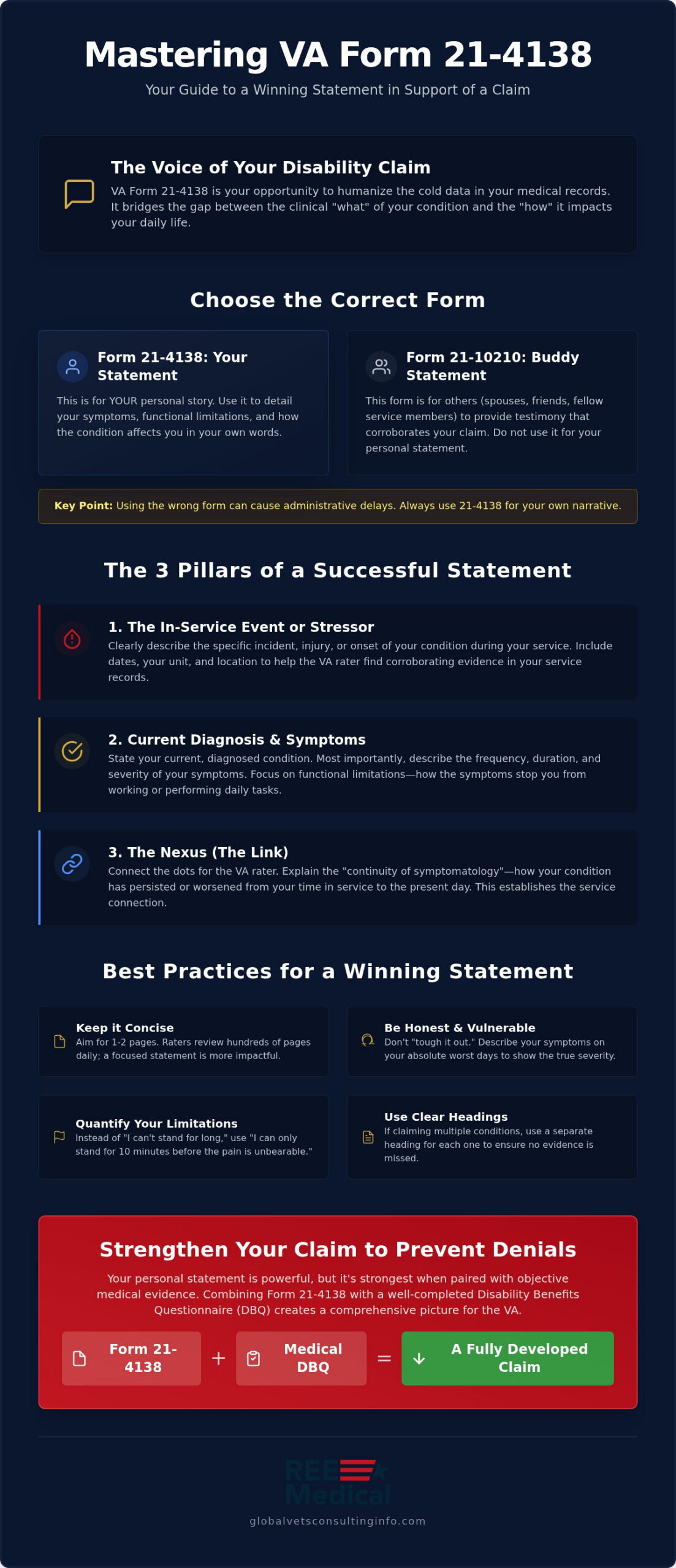
Many veterans confuse these two documents, but they serve distinct roles. Form 21-4138 is strictly for your personal statement. Conversely, Form 21-10210 is the “Buddy Statement” form intended for spouses, friends, or fellow service members to corroborate your claim. Filing your personal story on a buddy form can lead to administrative delays during the evidence-gathering phase. Using the correct paperwork ensures the rater sees your narrative exactly where it belongs, which maintains the integrity of your submission.
What to Include in a Statement in Support of Claim
A successful statement focuses on three pillars: the service-connected incident, your current diagnosis, and the “Nexus” linking them together. When considering what is va form 21-4138 statement in support of claim, remember that the VA isn’t looking for a self-diagnosis or complex medical jargon. Instead, they need your subjective experience of the symptoms. Be specific about functional limitations and always reference specific dates or locations to help the rater find corroborating evidence. You can download the official VA Form 21-4138 Statement in Support of Claim to get started on your draft.
The Chronological Timeline of Symptoms
Your narrative should flow logically from your time in service to the present. Start with the “In-Service Stressor” or injury by describing the date, unit, and the immediate aftermath of the event. From there, detail the “Continuity of Symptomatology,” which explains how the condition has persisted since your discharge. It’s helpful to write a single, punchy sentence defining your “worst day.” This illustrates the ceiling of your disability for the rater, helping them understand the true severity of your condition.
Documenting Functional Limitations
Focus heavily on “Social and Industrial Impairment.” This means explaining how your condition stops you from working or performing daily tasks with your family. Use quantitative measures for clarity; stating “I can only stand for 10 minutes” is far more effective than saying “I can’t stand for long.” Ensure these limitations connect back to the specific DBQ for mental health or physical conditions you’re claiming. If you feel overwhelmed by the technical requirements, our team at Global Vets Consulting is ready to provide the education you need to succeed.
Best Practices: How to Write a Personal Statement That Wins
VA raters often review hundreds of pages daily, so your statement must be concise and impactful. A length of one to two pages is typically the “sweet spot” for maintaining their attention while providing sufficient detail. When drafting, be honest but vulnerable. Many veterans have a habit of “toughing it out,” but this is the time to describe your symptoms as they appear on your absolute worst days. If you’re claiming multiple conditions, use clear headings for each. This organization ensures the rater doesn’t miss key evidence. Most importantly, verify that your story matches the information you provided during your C&P Examination, as contradictions can lead to denials.
The “Dos and Don’ts” of Form 21-4138
When asking what is va form 21-4138 statement in support of claim, focus on evidence over emotion. Use the “Problem-Action-Result” framework to describe service incidents: explain the problem that occurred, the action you took or that happened to you, and the resulting long-term disability. Always reference specific medical records, such as “See Page 12 of my 2014 records,” to make the rater’s job easier. Avoid using this space to rant about the military or the VA; anger is not evidence and often distracts from the merits of your claim. You can access the official VA Form 21-4138, Statement in Support of Claim online to begin your draft.
Digital Submission vs. Paper Filing in 2026
In 2026, speed is essential. Use the VA’s QuickSubmit portal for faster evidence processing rather than traditional mail. Ensure your PDF is “machine-readable” so the VA’s automated optical character recognition (OCR) systems can scan it accurately. Always keep a time-stamped copy of your submission for your own records. If you need help structuring your narrative to meet these standards, contact Global Vets Consulting for expert education on claim preparation.
Strengthening Your Claim: Combining Form 21-4138 with Medical DBQs
While understanding what is va form 21-4138 statement in support of claim is your first step, knowing how it interacts with clinical data is what ultimately wins claims. Think of your personal statement as the “lay evidence” that humanizes your file. However, a Disability Benefits Questionnaire (DBQ) provides the “medical evidence” required to close the case. A VA claim denied for lack of evidence often occurs when these two documents fail to tell a consistent story. At Global Vets Consulting, we educate veterans on securing high-quality DBQs that give your personal narrative the clinical weight it deserves.
Why a Private DBQ is the Perfect Partner for Your Statement
Private doctors often have significantly more time than a standard C&P examiner to review your full 21-4138 statement. This extra attention ensures your DBQ captures the specific symptoms and frequency of flare-ups you’ve highlighted. By using professional medical documentation to validate your subjective experiences, you transform a personal story into a structured evidence package. This alignment is the connective tissue that helps a rater see the full scope of your service-connected disability. Knowing what is va form 21-4138 statement in support of claim is vital, but it’s the medical evidence that anchors your story.
Final Checklist Before You Submit
Administrative errors are the easiest way to delay your benefits. Before you submit your packet, ensure you’ve covered these basics:
- Signature: Did you sign and date the form? An unsigned 21-4138 is not considered valid evidence by the VA.
- Contact Info: Is your contact information up to date? Administrative confusion often stems from old addresses.
- Consistency: Does your narrative match your medical history? Consistency is the hallmark of a credible claim.
📞 Need help with your medical evidence? Contact our 24/7 National Client Services Hotline today at GlobalVetsConsultingInfo.com for immediate intake assistance. 🇺🇸
Taking Control of Your VA Disability Narrative
Your personal story is the most powerful tool you have to humanize the clinical data in your medical records. By understanding what is va form 21-4138 statement in support of claim, you can effectively bridge the gap between technical findings and your daily lived reality. Focus on specific functional limitations and ensure your narrative remains consistent across all documentation. This methodical approach reduces administrative anxiety and provides a clear, predictable path toward the rating you earned through your service.
Pairing your personal statement with high-quality medical evidence is the final step to a successful outcome. As a veteran-owned and operated team specializing in Disability Benefits Questionnaires (DBQ), we’re dedicated to your mission. Our 24/7 AI Veteran Intake Specialist is available now to help you organize your evidence. 🇺🇸 Get the Medical Evidence You Need—Contact Global Vets Consulting Today. You’ve served our country with honor; now let’s secure the benefits you deserve with steady confidence.
Frequently Asked Questions
Can I use VA Form 21-4138 for a buddy statement?
No, you should use VA Form 21-10210 for buddy statements from spouses, friends, or fellow service members. While veterans previously used the 4138 for many purposes, the VA now prefers the specific buddy form for third-party testimony. Using the correct document prevents administrative delays during the evidence gathering phase. It ensures the rater identifies the source of the testimony immediately, which helps keep your disability claim moving through the system efficiently.
How long should my statement in support of a claim be?
You should aim for a length of one to two pages. VA raters manage heavy caseloads, so keeping your narrative concise ensures they read every word. Focus on your functional limitations and your “worst days” rather than writing an overly long history. If you have multiple conditions, use clear headings to stay organized. This structured approach helps the rater quickly identify how your symptoms impact your daily life and your ability to work.
Do I need a doctor to sign my VA Form 21-4138?
No, a doctor does not need to sign this form. Since it’s a personal statement, only your signature is required to certify that the information is true and correct. While a doctor provides medical evidence through a DBQ, you provide the lay evidence through this form. Both documents work together to support your VA rating increase. Ensure you sign and date the document, as an unsigned form is considered invalid evidence by the rater.
What happens after I submit my personal statement to the VA?
Once submitted, your statement becomes a permanent part of your Claims File. A rater reviews it alongside your medical evidence and C&P exam results to determine your disability rating. They specifically look for consistency between your narrative and the clinical findings. If you’ve clearly explained what is va form 21-4138 statement in support of claim in your packet, it helps the rater bridge the gap between technical data and your daily reality.
Can I submit multiple 21-4138 forms for one claim?
Yes, you can submit multiple forms if you’re claiming several different conditions. It’s often more effective to use separate forms for distinct issues like PTSD and Tinnitus to keep your evidence organized. You can also submit a new form to provide an update if your symptoms worsen during the waiting period. This ensures the VA has the most current information regarding what is va form 21-4138 statement in support of claim for your specific disability case.

Article by
Willie Daniel
Willie Daniel is the Founder and Chief Executive Officer (CEO) of Global Vets Consulting (GVC) – National Veterans Disability Services, a veteran-led educational and medical evidence support organization dedicated to helping veterans better understand VA disability rating increases, DBQ medical evidence, secondary claims education, and C&P examination preparation.
He is a retired U.S. Army Medical Service Corps Officer with more than 27 years of honorable military service, a decorated Iraq combat veteran, and a retired federal official with the U.S. Department of Veterans Affairs. Throughout his military and federal career, Willie Daniel served in leadership, healthcare administration, operational, and veteran-support roles focused on improving services and support systems for servicemembers, veterans, and their families.
Drawing from decades of military leadership, healthcare administration, veteran advocacy, and federal government experience, Willie Daniel brings a practical, veteran-centered perspective to Global Vets Consulting’s educational articles, AI-powered veteran resources, video education initiatives, and outreach programs. His experience navigating military systems, medical documentation processes, and veteran-related administrative operations provides valuable insight into many of the challenges veterans face when seeking to better understand VA disability rating criteria, medical evidence, documentation strategies, and secondary condition education.
Through GVC’s “Veterans Helping Veterans” mission, his focus is on delivering clear, educational, and easy-to-understand information designed to empower veterans with knowledge, resources, and educational tools that may help them make more informed decisions regarding their individual VA disability journeys.
The information provided through GVC is intended for educational and informational purposes only and should not be considered legal or medical advice.
Disclaimer
Disclaimer: Global Vets Consulting, LLC (“GVC”) is a veteran-led educational and medical evidence support organization. GVC is not a law firm, is not a Veterans Service Organization (VSO), and is not affiliated with the U.S. Department of Veterans Affairs (VA) or any government agency.
Global Vets Consulting does not provide legal advice, medical advice, medical treatment, or healthcare services. GVC does not prepare, file, or submit VA disability claims on behalf of veterans. All information provided through this website, blog articles, videos, educational materials, AI tools, dashboards, templates, and communications is intended solely for general educational and informational purposes.
Veterans are encouraged to consult with accredited representatives, licensed attorneys, qualified medical providers, or Veterans Service Organizations regarding their specific legal, medical, or VA-related matters. VA disability decisions, ratings, and outcomes are determined solely by the U.S. Department of Veterans Affairs based on applicable laws, regulations, medical evidence, and individual circumstances. Past results do not guarantee future outcomes.