
A Disability Benefits Questionnaire is more than just a piece of paperwork; it’s a clinical translation of your worsening daily reality into the VA’s specific legal language. You probably feel that your current rating is a “lowball” figure that fails to reflect the true impact of your service-connected conditions, especially as symptoms evolve over time. It’s frustrating to watch your physical or mental health decline while your compensation stays stuck in the past, leaving you to manage rising costs with outdated support.
You deserve a rating that accurately reflects your struggle, and using a dbq for va disability rating increase is the most direct way to prove your condition has progressed. This guide will show you how to leverage these forms to secure the higher rating you’ve earned, providing a clear path toward financial stability. We will cover how to use current medical evidence to address the latest 2026 COLA adjustments and proposed rating schedule changes for conditions like tinnitus and sleep apnea so you can submit your claim with confidence and minimize the risk of a denial.
Key Takeaways
- Understand how a DBQ functions as the primary tool to translate your worsening physical or mental symptoms into the VA’s specific legal language.
- Learn why using a dbq for va disability rating increase is essential for capturing precise measurements like Range of Motion that determine your compensation level.
- Discover the strategic differences between private medical evidence and standard C&P exams to ensure your claim isn’t undermined by a rushed evaluation.
- Follow a clear, step-by-step process for gathering 12 months of medical records and comparing your symptoms against the VA Schedule for Rating Disabilities.
- Identify how professional guidance in medical documentation can streamline your submission and help you secure the financial stability you’ve earned.
Understanding the Role of DBQs in the VA Rating Increase Process
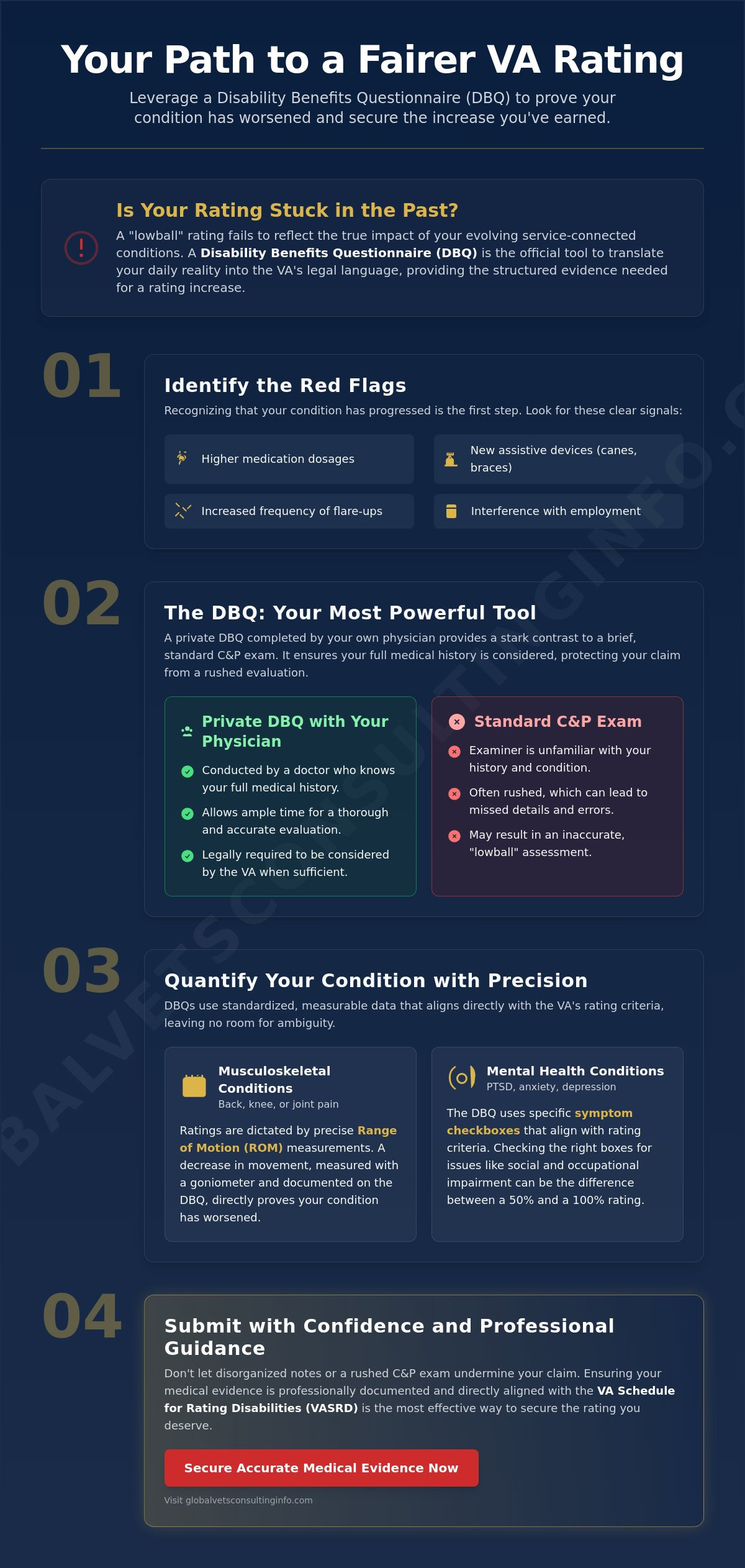
A Disability Benefits Questionnaire (DBQ) is the primary tool the VA uses to evaluate the severity of your service-connected conditions. When you file a dbq for va disability rating increase, the focus shifts from proving that your injury happened in service to demonstrating how much it has worsened since your last exam. This distinction is vital. You aren’t fighting to establish a connection, but rather to ensure your compensation matches your current clinical reality. The DBQ acts as a bridge, translating your daily physical or mental pain into the technical language of the VA rating schedule.
Recent legislative updates have made this process more transparent and efficient for veterans. The Elizabeth Dole 21st Century Veterans Healthcare and Benefits Improvement Act of 2025 now requires medical examiners to provide completed DBQs in a standardized PDF format. This change facilitates faster electronic sharing and ensures that the evidence you provide is accessible to the raters immediately. Legally, the VA is required to consider private DBQs that meet their sufficiency standards. This means your private physician’s professional opinion carries significant weight if it’s documented correctly. This is particularly relevant for complex claims, such as VA Disability Benefits for PTSD, where specific symptom checkboxes can make the difference between a 50% and 100% rating.
When is it Time to File for a VA Disability Rating Increase?
Recognizing when your condition has progressed is the first step toward securing fair compensation. You should look for specific red flags in your daily life. These might include a need for higher medication dosages, the introduction of new assistive devices like braces or canes, or a higher frequency of painful flare-ups. While some disabilities are labeled as static, many conditions are expected to worsen over time. If your symptoms have begun to interfere with your ability to maintain substantial gainful employment, it’s a clear signal that your current rating no longer reflects your situation.
The Evidence Gap: Why Your Current Rating Might Be Outdated
Rating stagnation occurs when a veteran relies solely on standard VA treatment records. These notes often lack the specific language needed for a rating increase. The VA Schedule for Rating Disabilities (VASRD) is frequently updated, including proposed 2026 changes to mental health and sleep apnea evaluations. A dedicated DBQ is more effective than years of disorganized clinical notes because it uses the exact checkboxes and terminology the VA raters use to assign percentages. Without this structured evidence, a rater might overlook the very symptoms that qualify you for a higher tier of support. Proactively capturing this data prevents your claim from being stuck in a cycle of “lowball” ratings that don’t match your needs.
How the VA Uses DBQs to Measure Symptom Progression
The VA processes thousands of claims every month, making standardized data essential for their decision-makers. When you submit a dbq for va disability rating increase, you’re providing a structured set of answers that ensures no symptom is overlooked by a busy rater. These forms use specific checkboxes that align directly with the legal criteria for different disability percentages. By following this format, your physician provides the exact information needed to move your claim forward without the ambiguity often found in standard clinical notes. You can find more details on how these forms are structured through the Official VA DBQ Information portal.
For musculoskeletal conditions, such as back or knee injuries, the VA relies heavily on Range of Motion (ROM) measurements. If your condition has worsened, the DBQ must document a decrease in your ability to move the affected joint. Examiners use a tool called a goniometer to get precise angles, and these numbers dictate whether you qualify for a higher percentage. It’s not just about the pain you feel. It’s about the physical limitations that pain creates during movement. If you’re struggling to document these physical changes, you might consider professional assistance with your medical evidence to ensure every detail is captured.
Mental health claims operate on a different set of metrics. Instead of physical angles, the VA looks at the frequency, severity, and duration of your symptoms. A mental health DBQ tracks how often you experience social or occupational impairment. If your “bad days” have become more frequent or your symptoms more intense since your last evaluation, the DBQ captures that progression through specific behavioral markers. This structured approach helps the VA understand how your mental health affects your daily life in a way that simple treatment notes cannot.
Older veterans should also be aware of the “Rule of 55.” Generally, the VA does not require routine re-evaluations for veterans over age 55 unless there’s a specific reason to do so or the condition is expected to improve. This rule provides a level of protection for veterans whose conditions have stabilized. However, if you’re seeking an increase after 55, a private DBQ remains the most effective way to prove that your condition has indeed progressed and warrants a higher compensation level. For veterans whose documentation efforts are ultimately aimed at reaching the highest tier, understanding the full scope of 100 percent p&t va disability benefits and protections can help you plan your long-term claims strategy with confidence.
The VASRD: The Blueprint for Your Rating Increase
The VA Schedule for Rating Disabilities (VASRD), found in 38 CFR Part 4, is the legal framework that dictates your percentage. Each condition has a diagnostic code with specific criteria for each rating level. The DBQ acts as a bridge between your medical reality and these legal requirements. In many cases, “Functional Loss” is the most critical metric. This refers to your inability to perform tasks without pain, fatigue, or lack of coordination. It often justifies a higher rating even if your range of motion hasn’t completely disappeared.
Objective vs. Subjective Evidence in a DBQ
A strong claim balances objective data with your subjective experience. Objective evidence includes diagnostic testing like MRIs, X-rays, or blood work that provides undeniable proof of physical decline. However, your subjective symptoms like chronic pain, “brain fog,” or fatigue are equally important. A private provider has the time to listen and document these daily struggles in a way that a rushed C&P examiner might not. Sufficiency is the clinical standard the VA uses to determine if a private DBQ contains enough data to be accepted without requiring a new exam.
Private DBQs vs. C&P Exams: Protecting Your Claim for Increase
Choosing between a standard Compensation and Pension (C&P) exam and a private provider is one of the most critical decisions you’ll make. Most veterans are familiar with the typical 15-minute C&P appointment where a contract examiner might barely look up from their screen. In contrast, a private medical evaluation allows for a thorough discussion of how your symptoms have progressed since your last rating. When you use a dbq for va disability rating increase from a private source, you’re submitting evidence that represents a comprehensive clinical review rather than a rushed snapshot. This distinction is vital because a private doctor has the time to document the full scope of your daily struggle.
A common concern is whether the VA will still schedule a C&P exam if you provide your own documentation. While the VA reserves the right to order its own exam, submitting a “sufficient” private DBQ can often trigger a Fully Developed Claim (FDC). This process streamlines the timeline and puts the burden on the VA to explain why your private evidence isn’t enough before they can force you into another appointment. Under their “Duty to Assist,” the VA must consider your private evidence. A well-documented DBQ from a physician who understands the veteran experience can significantly reduce the need for redundant testing and provide a clearer path to the compensation you’ve earned. If you want a broader understanding of how this fits into the overall system, reviewing the va disability claims process step by step can help you see exactly where your DBQ evidence fits within the 8-stage journey from intent to file through final decision.
The Advantage of a Private Medical Opinion
Private doctors often provide a deeper level of continuity of care. They can review your entire medical history, identifying patterns of worsening symptoms that a one-time contractor might miss. For your dbq for va disability rating increase to be accepted, it must be “sufficient for rating purposes.” This means it contains all the clinical findings, diagnostic results, and medical reasoning necessary for a rater to make a decision without needing further clarification. This level of meticulousness is what protects your claim from being delayed by unnecessary administrative hurdles.
Common Pitfalls of the C&P Exam Process
The “Good Day” phenomenon is a major risk during C&P exams. If you happen to have a low-pain day during your appointment, a contract examiner from VES, QTC, or Optum might document that your condition has improved, even if you spent the previous week in significant distress. Many contract examiners fail to perform a comprehensive record review, leading to inadequate reports that don’t reflect your reality. If you receive a negative C&P result, your private DBQ serves as a powerful rebuttal tool. It provides a clinical counter-argument that challenges the examiner’s findings and keeps your claim for an increase on the right track.
Step-by-Step: Preparing Your Evidence for a VA Rating Increase
Securing a higher rating requires a shift from reactive treatment to proactive documentation. The process of using a dbq for va disability rating increase involves more than just filling out a form; it’s about building a chronological narrative of your health’s decline. By following a structured approach, you can ensure that the VA sees the full picture of your disability rather than just a snapshot of a single day. This methodical preparation reduces the likelihood of administrative delays and positions your claim for a favorable outcome.
- Step 1: Conduct a self-assessment. Compare your current symptoms against the VA Schedule for Rating Disabilities (VASRD) for your specific condition. This helps you identify exactly which criteria you meet for a higher percentage.
- Step 2: Gather 12 months of records. Collect every private and VA medical record from the last year. This timeframe is the critical window the VA uses to determine if a condition has actually progressed.
- Step 3: Partner with a professional service. Accuracy is paramount. Working with a professional DBQ preparation service ensures your medical evidence is formatted correctly and uses the precise clinical language required by raters.
- Step 4: File an Intent to File. This simple action preserves your effective date while you gather your evidence. An effective date is usually the date you filed your Intent to File.
- Step 5: Submit as a Fully Developed Claim (FDC). When you provide all necessary evidence upfront, including your private DBQ, you can bypass much of the VA’s standard evidence-gathering phase for faster processing.
To ensure your documentation meets these rigorous standards, you can get started with a professional DBQ review today.
Mapping Your Symptoms to the Correct Rating Tier
Success often depends on knowing the “next level” requirements for your condition. For example, moving from a 30% to a 50% rating for migraines requires proving that your attacks are “prostrating” and occur at a specific frequency. The VA looks for key clinical terms like “severe social impairment” or “prostrating” to justify a higher tier. If your doctor doesn’t use these specific keywords in the dbq for va disability rating increase, the rater may not have the legal authority to grant the increase even if your pain is evident. Beyond documenting your primary condition, many veterans discover that using secondary conditions to increase va rating is one of the most powerful strategies available, particularly when a knee injury leads to back pain or tinnitus triggers mental health challenges.
Reviewing Your DBQ for Accuracy Before Submission
Before you hit submit, you must verify the “Three Pillars” of a claim: a current diagnosis, an in-service event, and the nexus connecting them. Since your service connection is already established, your DBQ must explicitly focus on “Worsening” or “Progression.” Under the Elizabeth Dole Act of 2025, examiners must provide these forms in a PDF format, which makes it easier for you to review for clerical errors. Common mistakes, such as missing checkboxes or inconsistent dates, often trigger “Development Letters” that can stall your claim for months. Meticulous review at this stage is your best defense against rating stagnation.
Securing Accurate Medical Evidence with Global Vets Consulting
Global Vets Consulting operates with a mission-driven focus because we are veterans ourselves. We understand that your medical documentation is the most powerful tool you have in a system that often feels indifferent to your daily struggle. When you seek a dbq for va disability rating increase, you’re looking for a way to communicate your clinical reality to a rater who requires technical precision. We streamline the preparation process by focusing on the meticulous details that VA raters demand. This approach saves you time and significantly reduces the anxiety associated with the claims process. It’s a partnership designed to provide you with a clear, predictable path forward.
Why Veterans Trust Global Vets Consulting for Increases
Trust is built on transparency and results. Our team stays at the forefront of the 2026 VA landscape, monitoring the implementation of the Elizabeth Dole Act and the recent 2.8% COLA adjustments. We ensure that every dbq for va disability rating increase we prepare reflects the most current versions of the forms and aligns with the newest rating criteria for conditions like mental health, back injuries, and sleep apnea. We’ve experienced the same “lowball” ratings and rushed exams that you have. This shared history drives us to provide documentation that supports your truth with steady confidence. You don’t have to guess how to translate your pain into a percentage. We act as your knowledgeable guide throughout the complex bureaucratic journey, ensuring no symptom is overlooked.
Take the Next Step Toward the Rating You Deserve
You shouldn’t have to settle for a rating that fails to cover your medical needs or reflect your service. If your condition has worsened, the evidence must show it clearly and without ambiguity. A professional medical evidence review ensures that your claim is grounded in reliability and meticulousness. By choosing to work with an ally who values your well-being, you’re taking a concrete step toward financial stability. The path forward is manageable when you have the right documentation in hand. We prioritize clarity and earned outcomes for every veteran we serve. It’s time to secure the higher rating that matches your current reality and provides the support you’ve earned through your sacrifice.
Secure your completed DBQ today with Global Vets Consulting and move your claim forward with the confidence of having an expert advocate on your side.
Take Control of Your VA Rating Journey
You now have a clear roadmap for documenting the progression of your service-connected conditions. By understanding how the VA uses specific clinical metrics, you can move beyond the frustration of an outdated rating. Utilizing a dbq for va disability rating increase ensures your evidence is sufficient and accurately reflects your daily reality. This proactive approach protects you from the risks of a rushed C&P exam and aligns your claim with the latest 2026 standards.
Global Vets Consulting has been veteran-owned and operated since 2021. We specialize in standardized DBQ preparation that streamlines the evidence-gathering phase for Fully Developed Claims. Our commitment to meticulous documentation helps ensure that no symptom is overlooked during the evaluation process. You’ve already done the hard work of serving; now it’s time to ensure the system provides the support you’ve earned through your sacrifice.
Get the Medical Evidence You Need for Your VA Increase
Your journey toward a fair rating doesn’t have to be a solo mission. With the right evidence and a steady guide, you can achieve the financial stability and peace of mind you deserve.
Frequently Asked Questions
Can I submit a private DBQ for a rating increase?
Yes, you can submit a private medical evaluation to the VA. Using a dbq for va disability rating increase allows your own healthcare provider to document the progression of your symptoms. The VA is legally required to consider this evidence as long as it meets their sufficiency standards. This approach gives you more control over the narrative of your claim and ensures your doctor captures your symptoms accurately.
Will the VA automatically lower my rating if I ask for an increase?
Requesting an increase doesn’t trigger an automatic reduction. However, filing a claim for an increase does reopen that specific condition for a full review. If the medical evidence shows significant improvement, a reduction is possible. This is why meticulous documentation is vital to prove that your condition has actually worsened or remained the same since your last evaluation.
What is the “Fully Developed Claim” (FDC) program?
The Fully Developed Claim program is an optional way to have your claim processed faster. You submit all your evidence, including your private DBQ and medical records, at the same time you file your claim. You must also certify that there’s no more evidence for the VA to gather. This streamlined path often results in a quicker decision from the rater because the evidence folder is complete upon arrival.
How much does it cost to get a private DBQ filled out?
The VA doesn’t pay for or reimburse the cost of DBQs completed by private healthcare providers. Costs vary depending on the provider and the complexity of the medical review required. While C&P exams are free, many veterans find the investment in a private evaluation worthwhile to ensure their symptoms are documented thoroughly by a provider who understands their history and clinical needs.
How long does the VA take to process a claim for increase in 2026?
Processing times in 2026 continue to vary based on the complexity of the claim and the volume of submissions. Generally, a Fully Developed Claim moves through the system faster than a standard claim. Most veterans can expect a decision within several months, especially if the submitted dbq for va disability rating increase is sufficient for rating purposes and requires no further development or clarification from the examiner.
What happens if the VA schedules a C&P exam after I submit my DBQ?
You should attend any scheduled C&P exam even if you’ve already submitted a private DBQ. Failing to show up can lead to an immediate denial of your claim. Your private documentation serves as a critical part of your evidence folder. It can be used to challenge the findings of the C&P examiner if their report contradicts your primary doctor’s clinical observations or overlooks key symptoms.
Do I need a new Nexus Letter for a rating increase?
You typically don’t need a new Nexus Letter when filing for a rating increase. Since the VA has already granted service connection for the condition, the focus is now on the severity of your symptoms rather than their cause. The DBQ serves as the primary tool to show the VA that your condition meets the criteria for a higher percentage tier based on your current health status.
Can a DBQ be used for secondary service connection increases?
Yes, DBQs are frequently used for conditions that are secondary to an already service-connected disability. If a secondary condition like depression or radiculopathy has worsened, the DBQ captures those clinical changes. This ensures that the combined rating accurately reflects the total impact of your service-related health issues on your daily life and your ability to maintain substantial employment. If your documentation efforts are ultimately building toward the highest possible compensation tier, learning about the full range of protections available through 100 percent p&t va disability status can help you understand what’s at stake and why securing a permanent designation matters for your family’s long-term security. Veterans who want to maximize their combined rating should also explore how identifying the right secondary conditions to increase va rating can reveal hidden compensation potential that many veterans overlook when focusing solely on their primary disabilities.

Article by
Willie Daniel
Willie Daniel is the Founder and Chief Executive Officer (CEO) of Global Vets Consulting (GVC) – National Veterans Disability Services, a veteran-led educational and medical evidence support organization dedicated to helping veterans better understand VA disability rating increases, DBQ medical evidence, secondary claims education, and C&P examination preparation.
He is a retired U.S. Army Medical Service Corps Officer with more than 27 years of honorable military service, a decorated Iraq combat veteran, and a retired federal official with the U.S. Department of Veterans Affairs. Throughout his military and federal career, Willie Daniel served in leadership, healthcare administration, operational, and veteran-support roles focused on improving services and support systems for servicemembers, veterans, and their families.
Drawing from decades of military leadership, healthcare administration, veteran advocacy, and federal government experience, Willie Daniel brings a practical, veteran-centered perspective to Global Vets Consulting’s educational articles, AI-powered veteran resources, video education initiatives, and outreach programs. His experience navigating military systems, medical documentation processes, and veteran-related administrative operations provides valuable insight into many of the challenges veterans face when seeking to better understand VA disability rating criteria, medical evidence, documentation strategies, and secondary condition education.
Through GVC’s “Veterans Helping Veterans” mission, his focus is on delivering clear, educational, and easy-to-understand information designed to empower veterans with knowledge, resources, and educational tools that may help them make more informed decisions regarding their individual VA disability journeys.
The information provided through GVC is intended for educational and informational purposes only and should not be considered legal or medical advice.
Disclaimer
Disclaimer: Global Vets Consulting, LLC (“GVC”) is a veteran-led educational and medical evidence support organization. GVC is not a law firm, is not a Veterans Service Organization (VSO), and is not affiliated with the U.S. Department of Veterans Affairs (VA) or any government agency.
Global Vets Consulting does not provide legal advice, medical advice, medical treatment, or healthcare services. GVC does not prepare, file, or submit VA disability claims on behalf of veterans. All information provided through this website, blog articles, videos, educational materials, AI tools, dashboards, templates, and communications is intended solely for general educational and informational purposes.
Veterans are encouraged to consult with accredited representatives, licensed attorneys, qualified medical providers, or Veterans Service Organizations regarding their specific legal, medical, or VA-related matters. VA disability decisions, ratings, and outcomes are determined solely by the U.S. Department of Veterans Affairs based on applicable laws, regulations, medical evidence, and individual circumstances. Past results do not guarantee future outcomes.