

The VA claims process isn’t just a series of forms; it’s a documentation battle where the veteran who presents the most thorough medical evidence first is the one who wins. You’ve likely felt the frustration of staring at complex terminology or worrying that a single missing piece of paperwork will lead to a denial. It’s exhausting to wait 120 to 150 days for an initial decision while wondering if you’ve done enough to secure the rating you deserve. You’ve earned these benefits through your service, and the bureaucracy shouldn’t stand in your way.
This guide provides a clear, methodical roadmap to help you understand the va disability claims process step by step, ensuring you move through the system with confidence rather than confusion. Our goal is to replace your anxiety with a predictable path forward. We’ll break down the 8-stage journey from your initial intent to file to the final decision notification. You’ll learn how to leverage precise evidence, including Disability Benefits Questionnaires (DBQs), to potentially speed up your timeline and secure a rating that accurately reflects your health and your history.
Key Takeaways
- Identify the three essential pillars—service connection, a current diagnosis, and a medical nexus—to ensure your claim stands on solid ground from the start.
- Learn how to navigate the va disability claims process step by step by transitioning from a reactive approach to a proactive strategy using Fully Developed Claims.
- Gain a clear understanding of the VA’s 8-stage lifecycle to track your progress and manage expectations during the review and decision phases.
- Discover how completing precise medical documentation, such as Disability Benefits Questionnaires (DBQs), can provide the objective evidence needed for a more accurate rating.
- Develop a post-decision strategy to interpret your rating letter and select the most effective appeal lane, such as a Supplemental Claim or Higher-Level Review.
Understanding the VA Disability Claims Process: The 2026 Framework
A VA disability claim is far more than just paperwork; it’s a formal request for tax-free monthly compensation that recognizes the physical or mental toll of your service. The Veterans Benefits Administration (VBA) manages this complex system to ensure veterans receive the financial support they’ve earned. As we move through 2026, mastering the va disability claims process step by step is more vital than ever. This year remains a critical window for PACT Act-related claims, as expanded eligibility continues to provide a path for veterans exposed to toxic substances to finally secure their benefits.
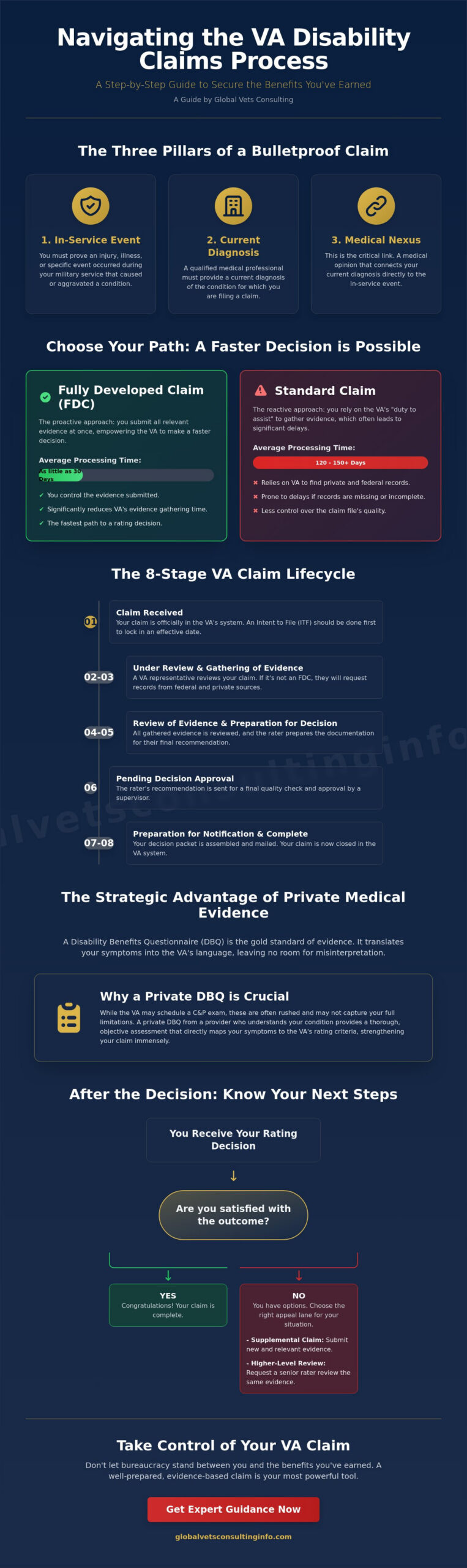
Success in this system isn’t random. It’s built on three essential pillars. First, you must identify an in-service event, injury, or aggravation. Second, you need a current medical diagnosis from a healthcare professional. Finally, you must establish a medical nexus, which is the evidence that links your current condition to your time in uniform. By following the va disability claims process step by step, you can ensure these pillars are clearly documented before the VA even opens your file.
Step 0: The Intent to File (ITF)
Before you submit your formal application, you should submit an Intent to File. This simple but powerful action preserves your effective date, which can result in thousands of dollars in back pay if your claim is eventually approved. Once you’ve submitted an ITF, you have a one-year window to gather your medical evidence and build a bulletproof file. This timeframe is your opportunity to be proactive rather than waiting for the VA to request more information.
Eligibility and Service Connection Basics
Service connection is the bridge between your military duty and your current health status. It isn’t a one-size-fits-all concept. Direct service connection covers injuries that happened during active duty, while secondary service connection applies when a service-connected condition causes a new health issue. There’s also presumptive service connection, where the VA assumes your condition was caused by service based on where or when you served. Understanding these categories allows you to frame your evidence with the precision the VA requires.
Evidence Gathering: How to Build a Bulletproof Claim File
Navigating the va disability claims process step by step requires a fundamental shift in mindset. You shouldn’t wait for the VA to gather evidence on your behalf. While the official VA claims process includes a duty to assist, relying solely on the government to find your records is a common pitfall. The VA often misses private medical records or fails to capture the specific functional limitations that dictate your rating. Taking a proactive approach by collecting your Service Treatment Records (STRs), private clinical notes, and buddy statements ensures your file is complete before it reaches a rater’s desk.
The goal of evidence collection is to eliminate any ambiguity. A successful claim file acts as a silent advocate, speaking for you when you aren’t in the room. By providing clear, objective data, you reduce the chances of a denial based on “insufficient evidence.” This meticulousness is the difference between a claim that drags on for months and one that moves efficiently through the system. Understanding the va disability claim mistakes to avoid during evidence gathering can be just as important as knowing what to include in your file.
Standard vs. Fully Developed Claims (FDC)
Standard claims are the default option where the VA takes the lead in gathering your records. This often leads to longer wait times. In contrast, Fully Developed Claims (FDCs) are typically processed much faster. As of early 2026, average initial claim times range from 120 to 150 days; however, an FDC can receive a decision in as little as 30 days because it requires no additional evidence gathering by the VA. A complete FDC package should include your 21-526EZ form, all relevant medical records, a nexus letter, and any necessary Disability Benefits Questionnaires. To ensure your records are organized and presented with maximum clarity, review our detailed guide on medical evidence for va disability claim preparation so your file is decision-ready from day one.
The Strategic Advantage of Private DBQs
A Disability Benefits Questionnaire (DBQ) is the gold standard of medical evidence. These documents directly map your symptoms to the VA Schedule for Rating Disabilities, leaving little room for interpretation. While the VA may schedule a Compensation and Pension (C&P) exam, these appointments are often rushed and may not fully capture your daily struggles. A private DBQ provides a more thorough assessment from a provider who takes the time to document every limitation. This is especially critical for veterans filing psychiatric or emotional health claims, where a professional dbq for mental health conditions can ensure your symptoms are accurately captured and mapped to the correct rating criteria. If you need help obtaining these records, Global Vets Consulting specializes in helping veterans secure these critical medical documents to strengthen their va disability claims process step by step.
The 8 Stages of the VA Claim Lifecycle
Once you submit your application, your file enters the official VA disability claim process. This lifecycle is divided into eight specific stages. Understanding these stages helps manage the anxiety that often accompanies long wait times. The va disability claims process step by step begins with Step 1, Claim Received, which is simply the VA’s acknowledgment that they have your file. Step 2, Initial Review, follows as the VA confirms you meet basic eligibility requirements and have submitted the correct forms.
Step 3, Evidence Gathering, Review, and Decision, is typically the longest phase. This is when the VA requests records and schedules exams. Following this is Step 4, Preparation for Decision (PFD). Many veterans call this the “black hole” phase because the file is waiting in a queue for a rater to review the completed evidence. It’s during these middle stages that having a complete file is most beneficial, as it reduces the back-and-forth between the VA and your doctors.
The Rating and Notification Phases
After the PFD phase, the process moves into Step 5 (Rating), where a rater determines your disability percentage. Step 6 (Preparing Decision Letter) and Step 7 (Final Review) are internal administrative steps. The most significant shift occurs in Step 8, Preparation for Notification (PFN). When your status changes to PFN, your claim is complete. You’ll soon receive a decision package in the mail, though you can often check your updated rating online before the letter arrives.
C&P Exams: What to Expect
The Compensation & Pension (C&P) exam is a medical evaluation used to confirm your diagnosis and assess symptom severity. You should prepare by reviewing your history and being ready to describe your “worst days” with total honesty. If an examiner ignores your private medical records, don’t stay silent. You can strengthen your va disability claims process step by step by ensuring your symptoms are documented accurately before the exam. To ensure your evidence is presented clearly, consider obtaining a professional Disability Benefits Questionnaire (DBQ) to provide the rater with a thorough medical assessment.
Post-Decision Strategy: Appeals, Increases, and Next Steps
Receiving your Rating Decision letter is a major milestone, but it isn’t always the end of your journey. You must look past the initial “granted” or “denied” status and carefully read the “Reasons for Decision” section. This area acts as a roadmap; it tells you exactly what evidence the rater felt was missing or unconvincing. If you’ve been granted a 10% rating ($180.42) but your symptoms align with a higher percentage, don’t settle. Understanding the va disability claims process step by step empowers you to treat a denial as a request for more specific evidence rather than a final rejection.
You have three primary lanes to contest a decision if the outcome isn’t what you earned. A Higher-Level Review (HLR) is a strong choice if you believe the rater made an error based on existing evidence; these currently take about 4 months to complete. If you have new proof to submit, a Supplemental Claim is your best path, with average processing times between 150 and 180 days in 2026. For more complex legal issues, a Board Appeal allows a judge to review your file, though this can take 12 to 24 months depending on the specific lane you select. Before pursuing any appeal, reviewing the most common va disability claim mistakes to avoid can help you identify and correct any gaps in your evidence before resubmitting.
Mastering the va disability claims process step by step also means knowing when to ask for more. You should file for an increase if a service-connected condition worsens over time. If that original injury causes a new health problem, you should file for a secondary condition. Keeping your rating updated ensures you receive the full 2.8% COLA increase and the maximum compensation you deserve, which can reach $3,938.58 monthly for a single veteran at the 100% level.
Winning an Appeal with New Evidence
A Supplemental Claim is often the fastest way to reverse a denial. By providing a fresh Disability Benefits Questionnaire (DBQ), you give the VA the objective clinical data they need to approve your claim. For veterans appealing PTSD, depression, or anxiety denials, submitting a detailed dbq for mental health conditions as new evidence can be the decisive factor that reverses a prior denial. You’ll also need a clear Nexus. A Nexus is the expert medical opinion that establishes the bridge between your current health condition and your military service.
Maintaining and Increasing Your Rating
Ratings aren’t always permanent, so you must understand your protections. The VA uses the 5-year rule to protect ratings that haven’t improved, while the 20-year rule makes a rating nearly impossible to reduce. You should monitor your symptoms and keep seeking treatment. If your limitations grow, filing for an increase ensures your benefits stay aligned with your actual level of impairment.
Take Command of Your VA Benefits Journey
Securing the rating you deserve requires a shift from passive waiting to proactive documentation. You now have a clear understanding of the va disability claims process step by step, from the initial intent to file to the final notification phase. By focusing on the three pillars of service connection and utilizing high-quality medical evidence, you can navigate the bureaucracy with far more certainty. A well-prepared file doesn’t just speed up the decision timeline; it provides the rater with the objective data needed to make an accurate decision the first time.
If you’re ready to strengthen your claim, professional medical documentation is your strongest asset. Global Vets Consulting has been veteran-owned and operated since 2021, specializing in high-accuracy DBQ preparation for veterans across the United States. We understand the nuances of the rating schedule and provide the meticulous support you need to win your documentation battle. Secure the medical evidence you need with a professional DBQ from Global Vets Consulting and move forward with the confidence that your health history is fully represented. Your dedication to your country was absolute, and your benefits should be too.
Frequently Asked Questions
How long does the VA disability claims process take in 2026?
Initial claims typically take between 120 and 150 days as of early 2026. This timeline varies based on the complexity of your medical evidence and the current workload at your regional office. Supplemental claims often take longer, averaging between 150 and 180 days. You can track your specific progress through the VA’s digital portal to stay informed during each phase of the review, ensuring you remain updated on any requests for additional information.
Can I speed up my VA claim?
You can potentially speed up your claim by filing a Fully Developed Claim (FDC) instead of a standard one. By submitting all your medical records and Disability Benefits Questionnaires (DBQs) upfront, you eliminate the time the VA spends searching for evidence. This proactive approach allows raters to move directly to the decision phase, sometimes resulting in a decision in as little as 30 days. It’s the most effective way to navigate the va disability claims process step by step.
What is the most common reason for a VA claim denial?
The most common reason for a denial is a lack of sufficient medical evidence linking your condition to your service. Many veterans fail to provide a clear medical nexus or a current, formal diagnosis for the symptoms they are claiming. Addressing these gaps early by securing detailed clinical documentation is vital. This ensures your file explicitly bridges your military history with your current health status, leaving no room for the rater to question the connection.
Do I need a lawyer to file a VA disability claim?
You aren’t required to hire a lawyer to file an initial claim. Many veterans successfully navigate the system on their own or with the help of a Veterans Service Officer (VSO). Legal representation is more common during complex appeals at the Board of Veterans’ Appeals level. Your priority should always be gathering high-quality medical evidence for va disability claim approval, which provides the objective data raters need to approve your benefits regardless of whether you have professional legal counsel.
What happens if I miss my C&P exam?
Missing a Compensation and Pension (C&P) exam without a valid reason often leads to an immediate claim denial. If you can’t attend, you must notify the VA or the third-party contractor as soon as possible to reschedule. Providing “good cause” for the absence is essential to keep your claim active. Otherwise, the rater will likely decide your case based solely on the limited evidence currently available in your file.

Article by
Willie Daniel
Willie Daniel is the Founder and Chief Executive Officer (CEO) of Global Vets Consulting (GVC) – National Veterans Disability Services, a veteran-led educational and medical evidence support organization dedicated to helping veterans better understand VA disability rating increases, DBQ medical evidence, secondary claims education, and C&P examination preparation.
He is a retired U.S. Army Medical Service Corps Officer with more than 27 years of honorable military service, a decorated Iraq combat veteran, and a retired federal official with the U.S. Department of Veterans Affairs. Throughout his military and federal career, Willie Daniel served in leadership, healthcare administration, operational, and veteran-support roles focused on improving services and support systems for servicemembers, veterans, and their families.
Drawing from decades of military leadership, healthcare administration, veteran advocacy, and federal government experience, Willie Daniel brings a practical, veteran-centered perspective to Global Vets Consulting’s educational articles, AI-powered veteran resources, video education initiatives, and outreach programs. His experience navigating military systems, medical documentation processes, and veteran-related administrative operations provides valuable insight into many of the challenges veterans face when seeking to better understand VA disability rating criteria, medical evidence, documentation strategies, and secondary condition education.
Through GVC’s “Veterans Helping Veterans” mission, his focus is on delivering clear, educational, and easy-to-understand information designed to empower veterans with knowledge, resources, and educational tools that may help them make more informed decisions regarding their individual VA disability journeys.
The information provided through GVC is intended for educational and informational purposes only and should not be considered legal or medical advice.
Disclaimer
Disclaimer: Global Vets Consulting, LLC (“GVC”) is a veteran-led educational and medical evidence support organization. GVC is not a law firm, is not a Veterans Service Organization (VSO), and is not affiliated with the U.S. Department of Veterans Affairs (VA) or any government agency.
Global Vets Consulting does not provide legal advice, medical advice, medical treatment, or healthcare services. GVC does not prepare, file, or submit VA disability claims on behalf of veterans. All information provided through this website, blog articles, videos, educational materials, AI tools, dashboards, templates, and communications is intended solely for general educational and informational purposes.
Veterans are encouraged to consult with accredited representatives, licensed attorneys, qualified medical providers, or Veterans Service Organizations regarding their specific legal, medical, or VA-related matters. VA disability decisions, ratings, and outcomes are determined solely by the U.S. Department of Veterans Affairs based on applicable laws, regulations, medical evidence, and individual circumstances. Past results do not guarantee future outcomes.

