
Did you know that veterans who file for sleep apnea as a secondary condition have a 73% higher success rate than those filing it as a primary condition? If you’ve struggled with high denial rates or feel lost in the maze of “VA Math,” you aren’t alone. It’s frustrating to know your service caused your condition only to face a wall of bureaucracy years later. This guide provides the Sleep Apnea VA Claim Help you need to navigate these complexities with confidence. We’ll show you how professional medical documentation can bridge the gap between a denial and the benefits you earned.
You’ll discover the specific 50% rating criteria for 2026 and a clear strategy for secondary service connections. We also examine why using a private Disability Benefits Questionnaire (DBQ) is the most effective way to document your need for a CPAP machine. By the end of this article, you’ll have a step-by-step path to secure your rating before proposed schedule changes take effect. Our goal is to ensure you feel empowered and informed throughout every stage of the process.
Key Takeaways
- Master the 2026 rating schedule to understand exactly how the VA evaluates your symptoms and why a breathing device is the key to a 50% rating.
- Explore the strategic advantages of secondary service connections, which can link your sleep apnea to conditions like PTSD or sinusitis for a higher success rate.
- See how professional medical documentation through a private DBQ provides the Sleep Apnea VA Claim Help necessary to bypass common administrative hurdles.
- Develop a clear plan for handling claim denials by using the Supplemental Claim lane to submit the “new and relevant” evidence needed for a successful appeal.
Understanding the Sleep Apnea VA Rating Criteria in 2026 🇺🇸
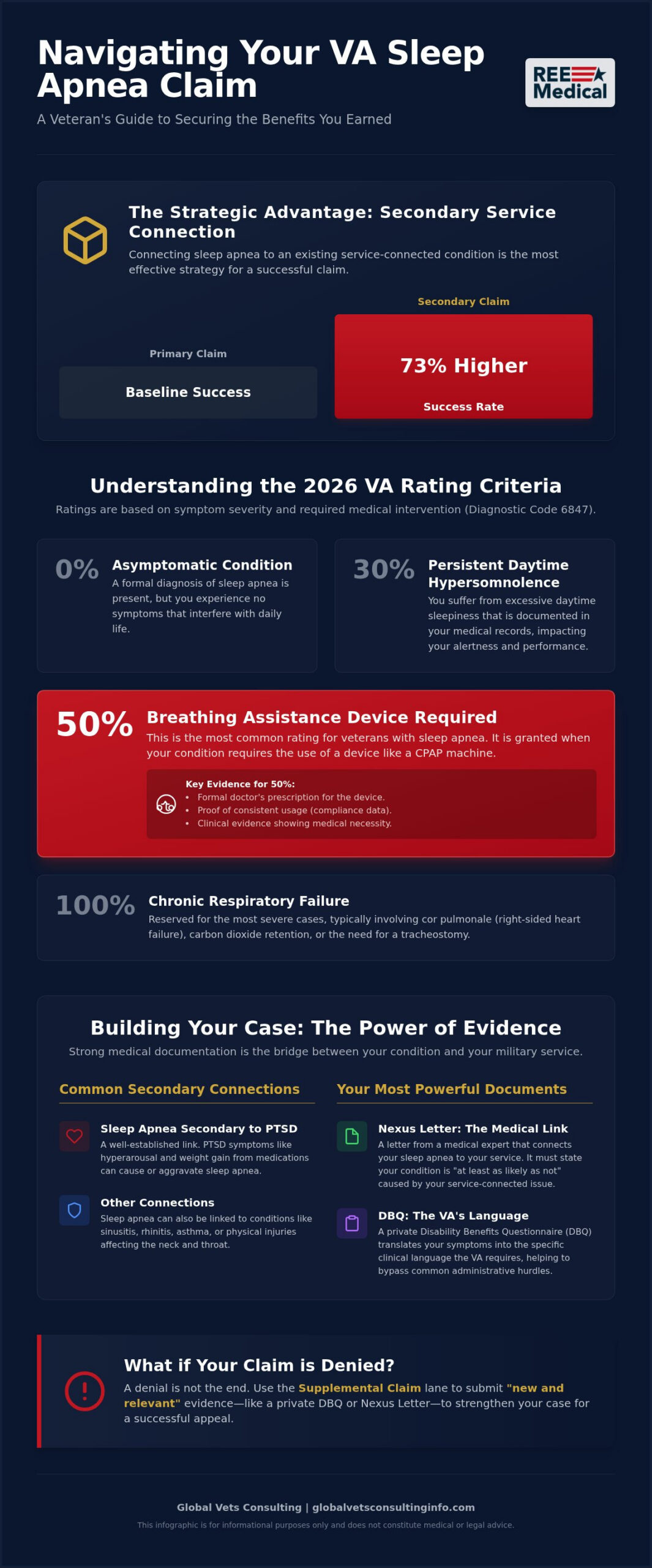
The VA evaluates sleep apnea under Diagnostic Code 6847. Navigating the 2026 criteria requires expert Sleep Apnea VA Claim Help to ensure your medical evidence matches specific VA standards. The VA assigns ratings based on the level of medical intervention you require and the severity of your daytime symptoms.
- 0% Rating: You have a formal diagnosis but don’t experience symptoms.
- 30% Rating: You suffer from persistent daytime hypersomnolence (excessive sleepiness).
- 50% Rating: Your condition requires the use of a breathing assistance device.
- 100% Rating: You experience chronic respiratory failure or carbon dioxide retention.
Understanding Sleep Apnea types is the first step in building your case. The VA recognizes three primary forms:
- Obstructive (OSA): Physical airway blockages during sleep.
- Central (CSA): Neurological issues where the brain skips breathing signals.
- Complex: A combination of both obstructive and central symptoms.
The Importance of the CPAP Requirement
The “50% Rule” is a cornerstone of sleep apnea claims. Simply having a CPAP machine isn’t enough; you must demonstrate medical necessity. For VA rating purposes, medical necessity is defined as the clinical requirement for a device to maintain airway patency or prevent respiratory failure during sleep. In 2026, the VA still prioritizes the following evidence:
- A documented prescription from a qualified physician.
- Proof of consistent device usage through compliance data.
- Clinical evidence that the device is required to treat your specific apnea type.
When Does Sleep Apnea Reach 100%?
A 100% rating is reserved for the most severe cases. The VA looks for specific medical markers that indicate total disability:
- Evidence of cor pulmonale (right-sided heart failure).
- Chronic respiratory failure requiring a tracheostomy.
- TDIU Option: If your 50% rating makes you unable to maintain gainful employment, you may be eligible for maximum compensation through Total Disability Individual Unemployability.
Proving Service Connection: Direct vs. Secondary Claims 🇺🇸
Establishing service connection is the foundation of your claim. Most veterans find it difficult to prove a direct connection without a sleep study in their military records. If you’ve been out of service for years, Sleep Apnea VA Claim Help is essential for identifying secondary pathways. These connections allow you to link sleep apnea to a condition you’ve already established.
- Direct Connection: Requires a diagnosis or documented symptoms during active duty.
- Secondary Connection: Proves your apnea was caused or aggravated by another service-connected issue.
- Success Rates: Secondary claims currently show a 73% higher success rate than primary filings.
- Legal Standards: Ratings are governed by the VA’s Schedule of Ratings for the Respiratory System.
Sleep Apnea Secondary to PTSD
The link between mental health and sleep disorders is well-established. Veterans often win these claims by proving how PTSD symptoms or treatments impact their respiratory health. Key factors include:
- Chronic hyperarousal causing fragmented sleep and airway collapse.
- Weight gain caused by side effects of psychiatric medications.
- The physiological stress that mental health conditions place on the body.
The Role of the Nexus Letter
A Nexus Letter is the medical link that bridges your condition to your service. It’s a vital part of Sleep Apnea VA Claim Help because it provides the clinical proof raters require. To be effective, this document must contain:
- The critical phrase “at least as likely as not” regarding the service link.
- A detailed medical rationale based on your specific health history.
- Citations of peer-reviewed medical research to support the connection.
Reviewing professional educational resources can help you understand how to gather this critical evidence effectively.
The Strategic Role of the DBQ in Your VA Claim 🇺🇸
A Disability Benefits Questionnaire (DBQ) is a high-impact document. It translates your medical symptoms into the specific clinical language the VA uses to grant a rating increase. Global Vets Consulting focuses on educating veterans about how this form acts as the primary evidence tool for your Sleep Apnea VA Claim Help strategy.
- Standardization: DBQs ensure your medical evidence follows the VA’s exact diagnostic criteria.
- Evidence Chain: This form acts as the “missing link” between your diagnosis and your compensation.
- Clarity: It forces a structured review of your condition, leaving no room for rater guesswork.
Private DBQ vs. C&P Exam
Relying on a VA-contracted examiner is often a gamble. These appointments are typically brief and may overlook years of your medical history. A private DBQ gives you more control over your medical narrative and helps you avoid common exam pitfalls.
- Clinical Depth: Private providers often spend more time reviewing your total medical history than a contract examiner.
- Fully Developed Claims: Submitting a private DBQ allows your claim to move through the faster “Fully Developed Claim” lane.
- Comprehensive Review: Private documentation ensures that nuances like your frequency of nighttime awakenings are formally recorded.
Accuracy in Documentation
Precision is vital to avoid deferred decisions. Your documentation must clearly demonstrate “functional loss,” which is the inability of a body part or system to perform its normal function. Accuracy in these forms is the best way to bypass administrative hurdles.
- Apneic Events: Your DBQ must document the specific frequency and severity of your breathing pauses.
- Safety Impact: Documentation should include how daytime exhaustion affects your work productivity or driving safety.
- Clinical Language: Using the VA’s specific terminology ensures your evidence is easily understood by the rating specialist.
To ensure your documentation is accurate and thorough, explore our educational resources for Sleep Apnea DBQs. We help you understand exactly what medical evidence is required to support your claim effectively.
What to Do if Your Sleep Apnea Claim is Denied 🇺🇸
Receiving a denial letter is discouraging, but it’s often just the first step in a longer journey toward your benefits. Sleep apnea is one of the most frequently denied conditions, yet it’s also one of the most commonly won upon appeal. If you’ve been turned down, you need Sleep Apnea VA Claim Help to determine which appeal lane fits your situation. You can choose a Supplemental Claim if you have new evidence, or a Higher-Level Review (HLR) if you believe the rater made an error based on the existing record. An HLR is best when you don’t have new records but want a senior rater to re-examine your file.
The Supplemental Claim lane is particularly effective when you can provide “new and relevant” evidence. This is where a fresh Disability Benefits Questionnaire (DBQ) becomes invaluable. It addresses the specific reasons for denial cited in your decision letter. If your condition has worsened since your last exam, you can also file for a VA rating increase to reflect your current level of impairment. This ensures your compensation matches the actual severity of your symptoms.
Gathering Stronger Medical Evidence
Bolstering your file requires more than just a diagnosis. Buddy letters from spouses or roommates provide eyewitness accounts of your snoring, gasping, or daytime exhaustion. A recent sleep study is also critical for establishing current severity. A private medical opinion serves as a powerful rebuttal to a negative C&P exam by providing a detailed, clinical alternative to the VA examiner’s findings. These documents bridge the gap between your symptoms and the legal requirements for service connection.
Next Steps for Your Claim
You don’t have to face this bureaucratic system alone. Our 24/7 AI Veteran Intake Specialist and National Client Services Hotline are available to help you begin the documentation process immediately. We’re dedicated to providing the education you need to secure the benefits you earned through your service. Visit GlobalVetsConsultingInfo.com to access our resources and start your intake today. We’re ready to provide the veteran-to-veteran support you deserve. 📞
Secure Your Earned Sleep Apnea Benefits Today 🇺🇸
Navigating the VA system requires a strategic approach grounded in precise medical evidence. You now understand that a 50% rating is often tied to the medical necessity of a breathing device and that secondary service connections offer a high success rate for many veterans. By utilizing a private Disability Benefits Questionnaire, you can ensure your documentation speaks the VA’s language of functional loss. If you’re ready to move forward, getting expert guidance is the next logical step in your journey toward a successful outcome.
At Global Vets Consulting, we are proud to be Veteran-Owned & Operated. We provide specialized secondary claim education and offer a 24/7 AI Veteran Intake Specialist to help you start your process at any time. Don’t let a complex system stand between you and the compensation you deserve. Contact Global Vets Consulting for Sleep Apnea Claim Help 🇺🇸 and take the first step toward securing your future. You’ve served your country; now let us help you navigate the path to the benefits you’ve earned.
Frequently Asked Questions
Is sleep apnea a presumptive condition for VA disability in 2026?
No, sleep apnea is not currently a presumptive condition for VA disability in 2026. This means you must provide medical evidence of a direct or secondary service connection. While some respiratory conditions are presumptive under the PACT Act, sleep apnea requires a specific diagnosis and a nexus to your military service or an existing service-connected disability to be approved for benefits.
Can I get a VA rating for sleep apnea without a CPAP machine?
Yes, you can receive a VA rating for sleep apnea without a CPAP machine, though it’ll likely be at the 0% or 30% level. A 30% rating is typically awarded for persistent daytime hypersomnolence. However, to reach the 50% threshold under the current 2026 criteria, the VA requires proof of medical necessity for a breathing assistance device like a CPAP or BiPAP machine.
How do I link my sleep apnea to my service-connected PTSD?
Linking sleep apnea to service-connected PTSD requires a medical nexus letter that explains the physiological connection between the two. Your doctor should document how PTSD symptoms, such as hyperarousal or weight gain from psychiatric medications, have caused or aggravated your sleep apnea. Providing Sleep Apnea VA Claim Help through specialized education ensures your medical documentation uses the specific clinical language required for a successful secondary connection.
What is the average VA disability rating for obstructive sleep apnea?
The most common VA disability rating for obstructive sleep apnea is 50%, primarily because many veterans require a CPAP machine for treatment. While ratings can range from 0% to 100%, the vast majority of successful claimants fall into the 50% category. Utilizing Sleep Apnea VA Claim Help ensures your medical evidence accurately reflects the severity of your condition and satisfies current VA rating requirements.
Will the VA pay for my sleep study if I think I have sleep apnea?
If you’re enrolled in VA healthcare, the VA will typically cover the cost of a sleep study to diagnose sleep apnea. You should speak with your VA primary care provider about your symptoms, such as chronic fatigue or gasping for air at night. They can then order a facility-based or home sleep study. This diagnostic report is a vital piece of medical evidence for your claim.

Article by
Willie Daniel
Willie Daniel is the Founder and Chief Executive Officer (CEO) of Global Vets Consulting (GVC) – National Veterans Disability Services, a veteran-led educational and medical evidence support organization dedicated to helping veterans better understand VA disability rating increases, DBQ medical evidence, secondary claims education, and C&P examination preparation.
He is a retired U.S. Army Medical Service Corps Officer with more than 27 years of honorable military service, a decorated Iraq combat veteran, and a retired federal official with the U.S. Department of Veterans Affairs. Throughout his military and federal career, Willie Daniel served in leadership, healthcare administration, operational, and veteran-support roles focused on improving services and support systems for servicemembers, veterans, and their families.
Drawing from decades of military leadership, healthcare administration, veteran advocacy, and federal government experience, Willie Daniel brings a practical, veteran-centered perspective to Global Vets Consulting’s educational articles, AI-powered veteran resources, video education initiatives, and outreach programs. His experience navigating military systems, medical documentation processes, and veteran-related administrative operations provides valuable insight into many of the challenges veterans face when seeking to better understand VA disability rating criteria, medical evidence, documentation strategies, and secondary condition education.
Through GVC’s “Veterans Helping Veterans” mission, his focus is on delivering clear, educational, and easy-to-understand information designed to empower veterans with knowledge, resources, and educational tools that may help them make more informed decisions regarding their individual VA disability journeys.
The information provided through GVC is intended for educational and informational purposes only and should not be considered legal or medical advice.
Disclaimer
Disclaimer: Global Vets Consulting, LLC (“GVC”) is a veteran-led educational and medical evidence support organization. GVC is not a law firm, is not a Veterans Service Organization (VSO), and is not affiliated with the U.S. Department of Veterans Affairs (VA) or any government agency.
Global Vets Consulting does not provide legal advice, medical advice, medical treatment, or healthcare services. GVC does not prepare, file, or submit VA disability claims on behalf of veterans. All information provided through this website, blog articles, videos, educational materials, AI tools, dashboards, templates, and communications is intended solely for general educational and informational purposes.
Veterans are encouraged to consult with accredited representatives, licensed attorneys, qualified medical providers, or Veterans Service Organizations regarding their specific legal, medical, or VA-related matters. VA disability decisions, ratings, and outcomes are determined solely by the U.S. Department of Veterans Affairs based on applicable laws, regulations, medical evidence, and individual circumstances. Past results do not guarantee future outcomes.