
What if the reason your VA claim for flat feet keeps getting denied isn’t because your pain isn’t real, but because your medical evidence is speaking the wrong language? When you’re preparing a dbq for flat feet (pes planus), the difference between a 10% and a 50% rating often comes down to how well your doctor documents specific anatomical deformities like marked pronation or inward bowing of the Achilles tendon. You likely already know the frustration of a rushed C&P exam that fails to capture your daily struggle with mobility and the complex “VA math” used for bilateral conditions.
We’re here to help you bridge the gap between your physical reality and the VA’s strict documentation requirements. This guide provides a clear path to understanding Diagnostic Code 5276 and ensures you know how to present an actionable and sufficient DBQ to the rater. We’ll explore how to document “painful motion” and functional loss so you can secure the highest possible rating based on your actual symptoms. By the end of this article, you’ll have a step-by-step strategy to turn your medical records into a powerful tool for your disability claim.
Key Takeaways
- Understand how a dbq for flat feet (pes planus) acts as the primary tool for translating your physical pain into a specific VA disability rating.
- Learn the specific clinical markers, such as calcaneal eversion and callosities, that raters look for when assigning percentages under Diagnostic Code 5276.
- Discover the criteria required to move from a 0% non-compensable rating to the maximum 50% bilateral rating based on your functional limitations.
- Identify the necessary steps to secure an actionable private DBQ, including how to track daily flare-ups and mobility restrictions for your doctor.
- Explore how to strengthen your claim by linking flat feet to secondary conditions like knee, hip, or lower back strain.
The Role of the DBQ for Flat Feet in Your VA Claim
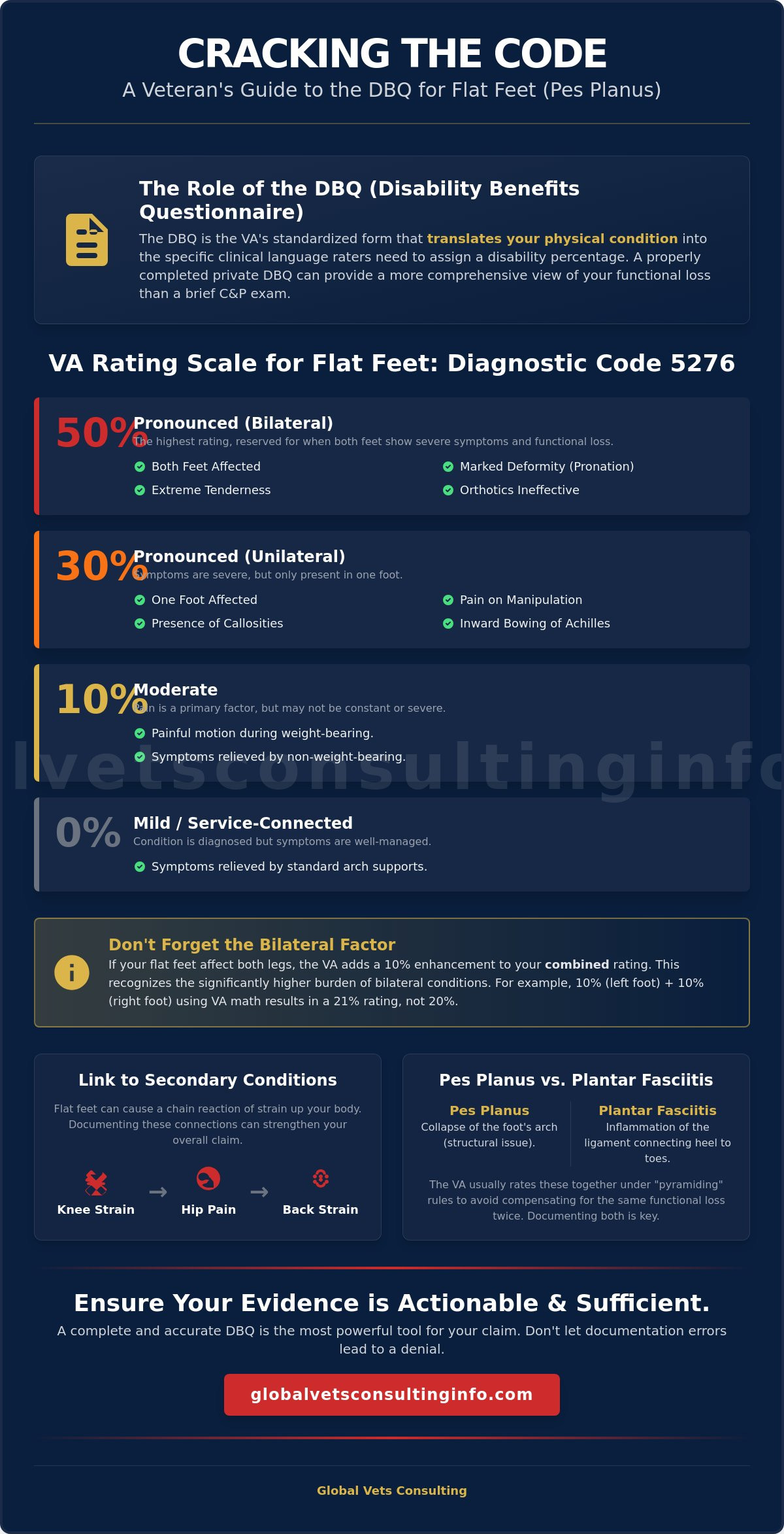
A Disability Benefits Questionnaire (DBQ) serves as a standardized clinical tool designed to guide medical providers in documenting the specific severity of your condition. For veterans, submitting a dbq for flat feet (pes planus) is a critical step in ensuring the VA has the exact data points required to make a rating decision. Instead of relying on vague notes in a general medical file, this form prompts your doctor to address the clinical markers the VA uses to determine compensation levels. It acts as a translation layer between your physical pain and the legal requirements of the benefits system.
The VA evaluates these findings under Diagnostic Code 5276. This specific code translates your physical limitations into a rating between 0% and 50%. Without a properly completed DBQ, a rater might miss the specific nuances of your gait or the degree of your arch collapse. While the VA often schedules Compensation and Pension (C&P) exams, these appointments can sometimes feel rushed or incomplete. A private DBQ allows you to work with a provider who takes the time to capture your daily reality, providing a more comprehensive view of your functional loss than a ten-minute government exam might offer.
To be accepted, your evidence must meet the “actionable and sufficient” standard. This means the form must be entirely complete, signed by a qualified provider, and supported by objective clinical findings. These findings often include X-rays or physical observations made during an exam. If a document is missing a signature or fails to address a required field, the VA may disregard it. Accuracy is your best defense against a denied claim. You can review the medical definition of pes planus to better understand the anatomical changes your doctor needs to document on the dbq for flat feet (pes planus).
Pes Planus vs. Plantar Fasciitis: Clearing the Confusion
Many veterans confuse these two conditions, but they involve different structures. Pes planus refers to the collapse of the foot’s arch, while plantar fasciitis is the inflammation of the thick ligament connecting your heel to your toes. Because these issues affect the same body part, the VA often rates them together under “pyramiding” rules to prevent double-counting. However, documenting both on your form ensures the rater sees the full scope of your disability and assigns the highest possible rating permitted by law.
Interpreting Diagnostic Code 5276: Clinical Evidence Requirements
To secure a fair rating, you must understand how the VA rater interprets Diagnostic Code 5276. This specific code acts as the blueprint for your dbq for flat feet (pes planus). It provides a spectrum of ratings based on the objective severity of your condition rather than just your level of discomfort. A 0% rating is typically assigned for mild cases that are easily relieved by standard arch supports. However, as the structural integrity of the foot worsens, the VA looks for specific clinical markers to justify higher compensation levels.
Your medical provider should look for and document findings such as calcaneal eversion, where the heel bone turns outward, and a visible bulging of the inner border of the foot. The presence of callosities, or thick skin patches caused by abnormal pressure, provides objective proof of an altered gait. You can see how these specific fields are laid out on the official VA DBQ for Foot Conditions. If you’re struggling to find a provider who understands these clinical nuances, it’s often helpful to review professional documentation options to ensure no detail is overlooked.
Functional loss is another critical component of the rating math. The VA evaluates how pain during motion or weight-bearing impacts your ability to perform daily tasks. If your condition affects both feet, the “Bilateral Factor” comes into play. This rule adds a 10% increase to your combined disability rating before the final rounding occurs. It recognizes that bilateral injuries create a significantly higher burden on your overall mobility and health.
The ‘Pronounced’ Criteria: Reaching the 30% and 50% Ratings
Reaching the 30% or 50% tier requires evidence of “pronounced” flat feet. This involves documented marked deformity and extreme tenderness on the bottom of the foot. Crucially, your doctor must note the failure of orthotics. If “strong” arch supports or orthopedic shoes don’t improve your symptoms, it demonstrates the severity required for these higher ratings. Without this specific mention of failed treatment, the VA may default to a lower percentage.
Step-by-Step: Securing an Actionable Private DBQ
Securing a dbq for flat feet (pes planus) requires a methodical approach that prioritizes objective medical evidence over subjective complaints. The first step is obtaining a formal diagnosis through a weight-bearing X-ray or a comprehensive physical exam. A diagnosis alone isn’t enough; the VA needs to see the structural reality of your condition. Once you have a diagnosis, begin tracking your daily limitations. Document how long you can stand before the pain becomes unbearable and how far you can walk during a flare-up. This data is vital for the “Functional Impact” section of the form, which is often the most overlooked part of a claim.
Working with a provider who understands the specific language of Diagnostic Code 5276 is the third and perhaps most critical step. General practitioners may not realize that terms like “marked deformity” or “extreme tenderness” carry specific legal weight. Finally, you must review the completed document for accuracy before it reaches the VA. A single missing checkbox can lead to a multi-month delay. If you’re ready to ensure your evidence is handled correctly from the start, order your private DBQ today to begin the process with confidence.
Preparing for Your Medical Appointment
When you sit down with your doctor, describe your pain levels on your worst days. Don’t just focus on how you feel at the moment of the exam. If your feet swell after a shift at work or your gait changes significantly after walking a block, ensure these objective findings are noted. The VA values clinical observations of swelling or altered movement more than a simple statement that your feet hurt.
Avoiding Common DBQ Mistakes
Incomplete forms are a leading cause of claim deferrals. You must verify that Section I is entirely filled out and that the physician’s signature is clear and dated. Pay close attention to the “Remarks” section as well. This area should capture the full story of your service connection and how the condition has progressed over time. If this section is blank, you’re missing a key opportunity to provide context to the rater.
Strengthening Your Evidence: Secondary Connections and Final Steps
Your feet serve as the foundation for your entire skeletal system. When you submit a dbq for flat feet (pes planus), you should also consider how this condition impacts other areas of your body. The VA recognizes that an altered gait caused by collapsed arches often leads to secondary disabilities. Common connections include chronic knee pain, hip misalignment, and lower back strain. Documenting these secondary conditions can significantly increase your combined rating, provided you have a clear medical rationale linking them to your primary foot condition.
Establishing a “Nexus” is the bridge between your current diagnosis and your military service. You must prove that your flat feet either started during your service or were aggravated by the rigors of duty. Global Vets Consulting simplifies this process by ensuring your medical evidence is organized and speaks directly to the rater’s requirements. By submitting a Fully Developed Claim (FDC) with a completed DBQ, you help the VA move your file forward efficiently. As of early 2026, the average processing time for initial claims ranges from 80 to 125 days, and having precise documentation is the best way to stay on the shorter end of that window.
To ensure your submission is ready for review, follow this final checklist:
- Verify your formal diagnosis is supported by weight-bearing X-ray evidence.
- Confirm your provider has documented the failure of orthotics or “strong” arch supports.
- Ensure all secondary conditions, like plantar fasciitis or back pain, are clearly noted.
- Double-check that your DBQ is signed, dated, and includes all required clinical findings.
The Kinetic Chain: Why Your Feet Affect Your Back
The human body operates through a kinetic chain where movement in one joint directly affects the next. When your arches collapse, it causes overpronation, which forces your ankles and knees to rotate inward. This misalignment travels up to your hips and places uneven pressure on your lower spine. Because pes planus alters your natural gait and shifts the weight-bearing load on your spine, it can lead to the premature wear and tear known as secondary degenerative disc disease.
Next Steps with Global Vets Consulting
Our professional DBQ preparation ensures your medical evidence is bulletproof and meets the VA’s “actionable and sufficient” standards. We focus on the meticulous details that lead to earned outcomes, helping you avoid the common pitfalls of a rushed C&P exam. You deserve a rating that reflects your daily reality. Learn more about our DBQ services here to take the next step in your disability claim journey.
Take Control of Your Disability Claim Journey
Securing the rating you’ve earned requires moving beyond subjective pain to objective clinical evidence. You now understand how Diagnostic Code 5276 uses specific markers like arch collapse and failed orthotics to determine your compensation level. By properly documenting your dbq for flat feet (pes planus) and considering secondary impacts on your knees or back, you create a stronger, more comprehensive claim that accurately reflects your physical reality. Precision in your medical evidence is the most effective way to reduce anxiety and ensure a predictable path forward through the VA system.
Global Vets Consulting was founded in 2021 to bridge the gap between veteran experiences and the complex requirements of the VA. As a veteran-owned and operated team, we specialize in VA-compliant medical documentation that stands up to scrutiny. We understand the mission because we’ve lived it. Don’t leave your benefits to chance or a rushed examination that fails to capture your daily struggle. Our meticulous approach ensures every detail of your condition is documented with the integrity your service deserves.
Get Your Professional Flat Feet DBQ Prepared by Global Vets Consulting
You’ve served your country with honor, and now it’s time to ensure your medical records reflect the true impact of that service. Take the next step with confidence and secure the future you’ve earned.
Frequently Asked Questions
Can I get a VA rating for flat feet if I had them before joining the military?
You can receive a rating for pre-existing flat feet if your military service aggravated the condition beyond its natural progression. The VA requires medical evidence showing that your duties caused a specific worsening of your symptoms or structural deformity. This is often documented by comparing your entrance exam records with clinical findings during or after your time in service. Proving aggravation is a standard path to securing earned benefits.
What is the difference between moderate and pronounced flat feet for VA ratings?
The primary difference lies in the severity of structural deformity and functional loss. Moderate flat feet usually involve pain during use and an inward bowing of the Achilles tendon. Pronounced flat feet require documentation of marked deformity, extreme tenderness on the plantar surface, and a lack of improvement from orthopedic shoes. These specific clinical markers are essential when completing a dbq for flat feet (pes planus) to reach higher rating tiers.
Will the VA accept a DBQ from a private podiatrist?
The VA is required to accept a DBQ from a private podiatrist as long as it meets the “actionable and sufficient” standard for medical evidence. This means the form must be entirely complete and signed by a licensed provider who has reviewed your records or conducted an exam. Private evidence can often provide a more detailed account of your functional limitations than a standard C&P exam, helping to reduce claim processing anxiety.
How much does a private DBQ for flat feet cost?
Costs for a private medical evaluation and the completion of a dbq for flat feet (pes planus) vary depending on the provider’s expertise and the complexity of your medical history. You should contact private medical providers or consulting firms directly to discuss their specific fee structures. It’s best to view this as a partnership in securing accurate disability compensation that reflects the true severity of your service-connected condition.
Can flat feet be a secondary condition to another service-connected injury?
Flat feet can be claimed as a secondary condition if they were caused or worsened by another service-connected injury. For example, a veteran with a service-connected knee or hip injury may develop pes planus due to an altered walking gait that places abnormal stress on the arches. In these cases, you’ll need a medical nexus to prove the clinical link between the primary injury and your secondary foot condition.

Article by
Willie Daniel
Willie Daniel is the Founder and Chief Executive Officer (CEO) of Global Vets Consulting (GVC) – National Veterans Disability Services, a veteran-led educational and medical evidence support organization dedicated to helping veterans better understand VA disability rating increases, DBQ medical evidence, secondary claims education, and C&P examination preparation.
He is a retired U.S. Army Medical Service Corps Officer with more than 27 years of honorable military service, a decorated Iraq combat veteran, and a retired federal official with the U.S. Department of Veterans Affairs. Throughout his military and federal career, Willie Daniel served in leadership, healthcare administration, operational, and veteran-support roles focused on improving services and support systems for servicemembers, veterans, and their families.
Drawing from decades of military leadership, healthcare administration, veteran advocacy, and federal government experience, Willie Daniel brings a practical, veteran-centered perspective to Global Vets Consulting’s educational articles, AI-powered veteran resources, video education initiatives, and outreach programs. His experience navigating military systems, medical documentation processes, and veteran-related administrative operations provides valuable insight into many of the challenges veterans face when seeking to better understand VA disability rating criteria, medical evidence, documentation strategies, and secondary condition education.
Through GVC’s “Veterans Helping Veterans” mission, his focus is on delivering clear, educational, and easy-to-understand information designed to empower veterans with knowledge, resources, and educational tools that may help them make more informed decisions regarding their individual VA disability journeys.
The information provided through GVC is intended for educational and informational purposes only and should not be considered legal or medical advice.
Disclaimer
Disclaimer: Global Vets Consulting, LLC (“GVC”) is a veteran-led educational and medical evidence support organization. GVC is not a law firm, is not a Veterans Service Organization (VSO), and is not affiliated with the U.S. Department of Veterans Affairs (VA) or any government agency.
Global Vets Consulting does not provide legal advice, medical advice, medical treatment, or healthcare services. GVC does not prepare, file, or submit VA disability claims on behalf of veterans. All information provided through this website, blog articles, videos, educational materials, AI tools, dashboards, templates, and communications is intended solely for general educational and informational purposes.
Veterans are encouraged to consult with accredited representatives, licensed attorneys, qualified medical providers, or Veterans Service Organizations regarding their specific legal, medical, or VA-related matters. VA disability decisions, ratings, and outcomes are determined solely by the U.S. Department of Veterans Affairs based on applicable laws, regulations, medical evidence, and individual circumstances. Past results do not guarantee future outcomes.