
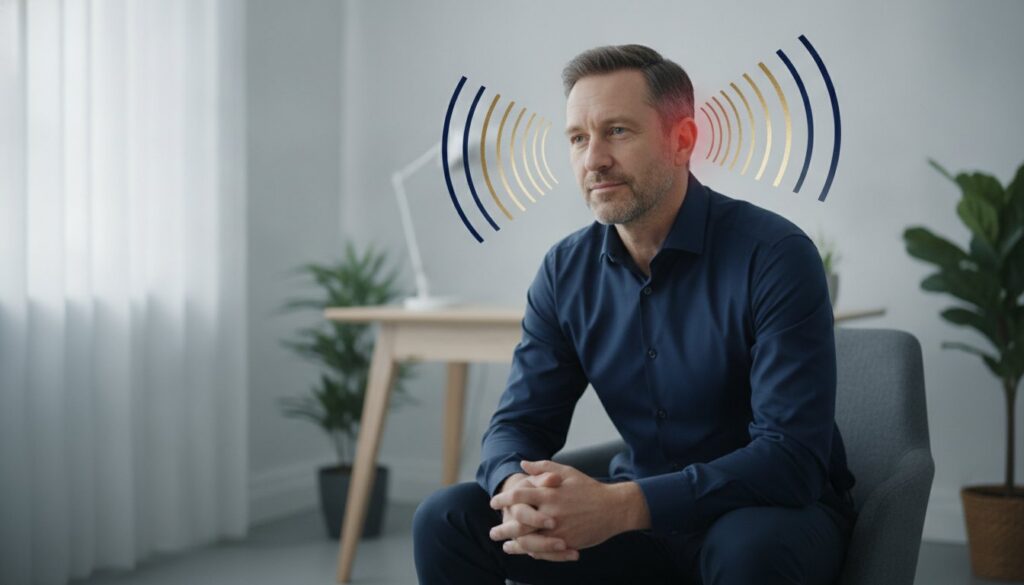
What if the persistent ringing in your ears isn’t just a nuisance, but the primary medical trigger for the debilitating headaches that keep you from work and family? It’s a common frustration for veterans who know their migraines secondary to tinnitus are linked, yet they fear the VA’s reported crackdown on secondary claims. You shouldn’t have to struggle with the anxiety of a C&P exam while also managing prostrating pain that forces you into a dark room for hours at a time.
We believe you’ve earned the right to a clear path forward without the confusion of complex bureaucracy. This guide will teach you how to successfully link your headaches to your service-connected hearing issues and secure the disability rating you deserve. We’ll break down the 2026 rating standards, the importance of independent medical evidence, and the specific documentation needed to prove your medical nexus. By the end of this article, you’ll have a step-by-step roadmap to move from a 10% tinnitus rating to the higher compensation levels your actual symptoms require.
Key Takeaways
- Understand how chronic stress and sleep deprivation from constant ringing establish the medical link for migraines secondary to tinnitus.
- Learn the specific VA definitions for “prostrating attacks” to determine if your frequency of symptoms qualifies for a 30% or 50% VA rating increase.
- Identify the critical steps for gathering medical evidence and securing a private medical opinion that clearly explains the nexus between your conditions.
- Discover how utilizing a Disability Benefits Questionnaire (DBQ) provides the standardized medical evidence required to support your secondary claim.
- Gain the tools to effectively prepare for your C&P exam and present a clear, evidence-based case to the VA.
The Medical Connection: Migraines Secondary to Tinnitus Explained
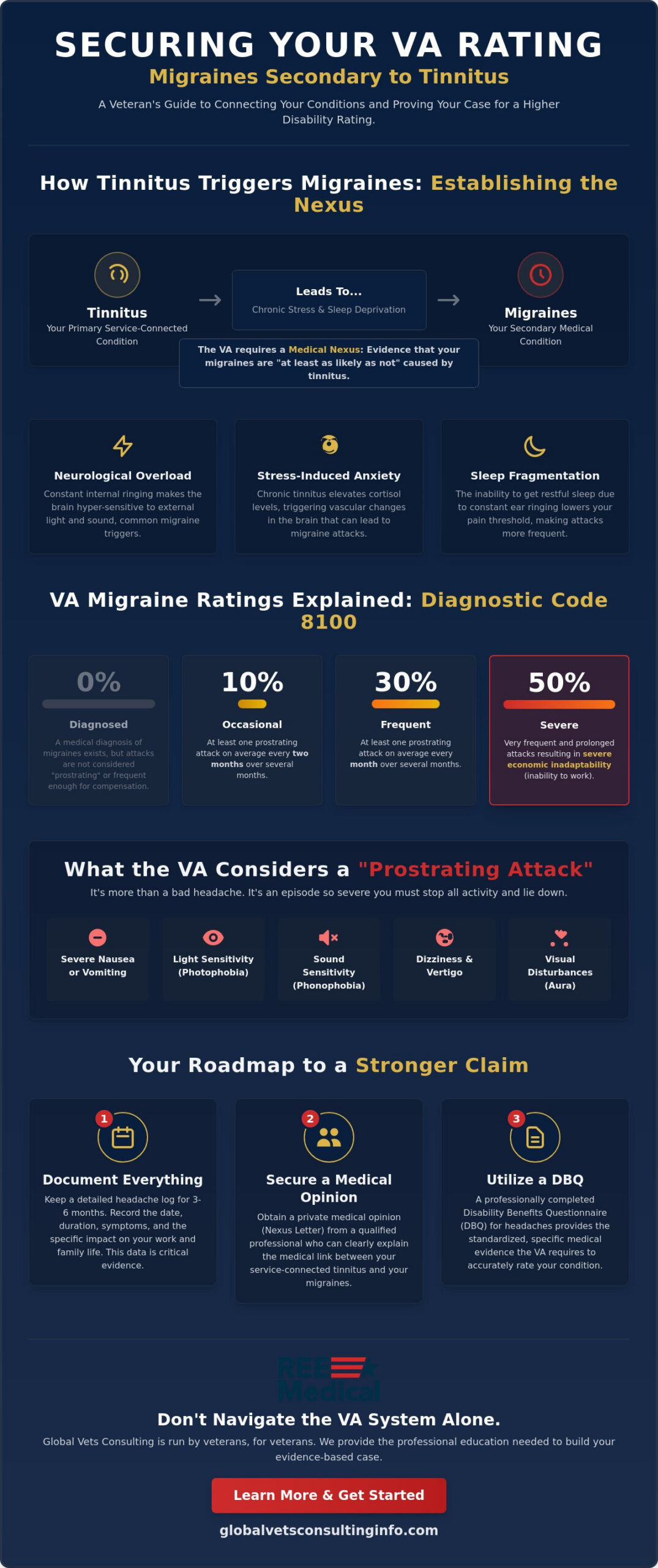
A secondary service connection occurs when a new medical condition is caused or aggravated by a disability you’ve already service-connected. In the case of migraines secondary to tinnitus, your existing ear ringing serves as the primary gateway condition. This link is well-documented in medical literature, as the two conditions often present as a complex comorbidity. According to this Tinnitus Overview, the condition involves the perception of sound when no external noise is present. This constant internal noise creates a cycle of chronic stress and sleep deprivation, both of which are high-level physiological triggers for migraine onset.
To secure a successful VA disability claim, you must establish a medical nexus. This means providing medical evidence that shows your migraines are “at least as likely as not” caused by your tinnitus. This 50% or greater probability is the legal threshold required for the VA to grant service connection. If you don’t have a clear explanation of how the stress of tinnitus aggravates your neurological system, examiners may dismiss the connection as coincidental. We focus on helping you bridge this gap with professional education on medical evidence.
How Tinnitus Triggers Migraine Attacks
The human central nervous system processes both sound and pain signals through overlapping pathways. When your tinnitus spikes, it often creates a cascade effect in your brain. This physiological catalyst often leads to the following events:
- Neurological Overload: The brain becomes hyper-sensitive to external stimuli like light and sound due to the constant internal ringing.
- Stress-Induced Anxiety: Chronic tinnitus creates a state of “fight or flight,” raising cortisol levels that trigger vascular changes in the brain.
- Sleep Fragmentation: Inability to rest due to ear noise lowers your threshold for pain, making prostrating attacks more frequent.
Tracking these trigger events is essential. If you notice that your ear ringing intensifies shortly before a headache begins, you have specific evidence to share with a medical professional. Documenting these patterns helps build a stronger case for your VA rating increase. By identifying these neurological triggers, you can better explain the severity of your condition during a VA compensation and pension examination.
VA Rating Criteria for Secondary Migraine Claims
The VA evaluates headaches under Diagnostic Code 8100 in the Schedule for Rating Disabilities. If you are pursuing migraines secondary to tinnitus, your rating depends almost entirely on the frequency and intensity of your “prostrating” attacks. The rating scale starts at 0%, which acknowledges a medical diagnosis but provides no monthly compensation. A 10% rating requires one prostrating attack every two months on average. To reach a 30% rating, you must document attacks that occur once per month. The highest schedular rating of 50% is reserved for veterans whose attacks are very frequent, prolonged, and result in severe economic inadaptability.
Economic inadaptability is a specific legal standard that means your migraines prevent you from maintaining steady, gainful employment. If you’ve missed significant time from your job, required workplace accommodations, or been forced to use FMLA because of your headaches, you need to document these impacts clearly. Frequency is the engine that drives your VA rating. Without a consistent record of how often these episodes occur, the VA may default to a lower percentage regardless of your actual pain levels.
Documenting ‘Prostrating’ Severity for Your DBQ
A prostrating attack is more than just a severe headache. It’s an episode so intense that you’re unable to perform any activity. To the VA, this usually means you must lie down in a dark, quiet room until the symptoms subside. When preparing your medical evidence, identify specific symptoms that force you into this state:
- Severe nausea or vomiting
- Extreme sensitivity to light (photophobia) and sound (phonophobia)
- Visual disturbances or “aura”
- Dizziness and inability to stand or walk safely
We recommend maintaining a detailed headache log for at least three to six months. Record the date, the duration of the attack, and how it affected your ability to work or care for your family. This data is vital for a Disability Benefits Questionnaire (DBQ), as it provides the examiner with concrete proof of your condition’s severity rather than vague estimates. Documenting the impact on your work attendance and social functioning helps paint a complete picture of your disability for the rater.
Steps to Establish a Strong Nexus for Your Claim
Securing a rating for migraines secondary to tinnitus depends on the strength of your medical evidence and the clarity of your documentation. You must first gather all existing service records and decision letters related to your primary tinnitus diagnosis. These documents establish the foundation of your claim by proving you already have a service-connected condition. Once your primary connection is verified, the next step is obtaining a private medical opinion that explicitly links your headaches to your ear ringing.
High-quality medical evidence doesn’t just state a conclusion; it explains the clinical “why” behind the connection. You should ensure your provider includes citations to peer-reviewed studies that discuss the neurological relationship between auditory distress and migraine triggers. This level of meticulousness makes it much harder for a VA rater to deny the link. Before you attend your VA compensation and pension examination, review your headache log and nexus letter thoroughly. Being able to explain your symptoms clearly during the exam ensures the examiner records the full impact of your condition. If you need help understanding how to present this evidence, our VA Rating Increase education can provide the clarity you need.
The Role of the Nexus Letter
Think of the nexus letter as the professional bridge that connects your service-connected tinnitus to your secondary migraines. For the VA to accept this link, the medical professional must use specific terminology, such as stating the condition is “more likely than not” caused or aggravated by the primary disability. This phrasing tells the rater that there is a greater than 50% probability that the two conditions are related. A nexus letter without a supporting DBQ is often insufficient for complex secondary claims because it lacks the standardized clinical data raters use to assign a specific percentage.
Establishing this link requires a methodical approach to your medical history:
- Service-Connection Proof: Confirmation of your 10% tinnitus rating.
- Current Diagnosis: A formal medical diagnosis of migraine headaches.
- Medical Logic: A detailed explanation of how tinnitus-induced stress triggers your migraine attacks.
- Clinical Support: References to medical journals or studies that support the comorbidity.
How Professional DBQs Support Your Rating Increase
A Disability Benefits Questionnaire (DBQ) serves as a standardized tool that ensures the VA receives the precise medical evidence required to rate your condition. When you file for migraines secondary to tinnitus, the DBQ translates your subjective pain into the technical data points used by VA raters. This form provides a structured framework that documents the frequency, duration, and severity of your attacks. Using a standardized format reduces the likelihood of a rater overlooking critical details that define your disability level.
A private DBQ often provides a more comprehensive evaluation than a standard C&P exam, which can sometimes feel rushed or incomplete. During a private evaluation, you have the time to explain exactly how your ear ringing aggravates your neurological health. This accuracy is vital because the VA requires clear evidence of “aggravation” to grant a secondary service connection. Professional medical documentation is your most effective defense if you have previously experienced a va claim denied for lack of evidence. It fills the gaps in your medical history and provides the clinical weight needed to overturn a prior denial.
Winning Your Claim with Global Vets Consulting
Global Vets Consulting specializes in providing veterans with high-level education on what is a dbq and how to leverage medical evidence for a successful claim. Our “Veterans Helping Veterans” mission ensures that our approach is grounded in a deep respect for your service and a commitment to accuracy 🇺🇸. We focus on meticulousness because we know that a well-documented claim is the fastest path to the benefits you earned.
We are ready to support you at any stage of your journey. Whether you are preparing for an upcoming exam or responding to a rating decision, our team provides the steady guidance you need to move forward with confidence.
- 📞 24/7 National Client Services Hotline
- 🤖 24/7 AI Veteran Intake Specialist
- 🌐 GlobalVetsConsultingInfo.com
Our global, mission-driven consulting service is available round-the-clock to help you navigate the complexities of the VA system. Reach out today to start securing the VA rating increase you deserve.
Secure Your Earned VA Disability Rating
Establishing a service connection for migraines secondary to tinnitus is a significant step toward receiving the full compensation you earned. You now understand that your rating depends on the frequency of your prostrating attacks and the strength of your medical nexus. By focusing on standardized documentation like a DBQ, you can provide the VA with the clear evidence they need to grant your increase. It’s about ensuring your records reflect the true impact of your service-connected conditions on your daily life and ability to work.
As a veteran-owned and operated consulting firm, we specialize in secondary claim medical evidence education. We understand the complexities of the system and are committed to your success. Our 24/7 AI Veteran Intake Specialist is available to guide you through the initial steps of your documentation journey. You don’t have to navigate this bureaucratic process alone or feel overwhelmed by the requirements of a C&P exam.
Get Started with Your DBQ Preparation Today
The path to a higher rating is built on accuracy and persistence. Take the next step with confidence and secure the results you deserve.
Frequently Asked Questions
Can the VA deny migraines secondary to tinnitus in 2026?
Yes, the VA can deny these claims if the medical nexus isn’t clearly established or if your records lack a formal diagnosis. Even though the 10% standalone rating for tinnitus remains in effect for 2026, the VA often scrutinizes secondary links more closely than direct connections. You must provide medical evidence that your ear ringing “at least as likely as not” triggers your headaches. Professional medical education and a detailed DBQ can help you avoid a denial for lack of evidence.
How much is a 50% migraine rating worth in 2026?
Your monthly payment for a 50% rating depends on whether you have dependents, such as a spouse or children. For 2026, the VA implemented a 2.8% cost-of-living adjustment for all disability compensation. A veteran alone at the 30% level receives $552.47 per month, while the 100% rate is $3,938.57. Securing a 50% rating for migraines secondary to tinnitus can move your overall combined rating into a much higher compensation bracket.
What is the difference between a direct and secondary service connection?
Direct service connection requires proof that a condition began during your active duty service. In contrast, a secondary service connection recognizes that one service-connected disability has caused or aggravated a new one. For example, if your service-connected tinnitus causes chronic stress that leads to headaches, those migraines are eligible for secondary connection. You don’t need to prove the headaches started in service, only that they are linked to your tinnitus now.
Do I need a new C&P exam if I submit a private DBQ?
The VA often schedules a C&P exam even when you provide a private DBQ, but your private evidence remains a critical part of the file. A private DBQ allows your doctor to document the full severity of your symptoms without the time constraints of a VA-contracted exam. This documentation acts as a baseline that the VA examiner must address. It ensures your prostrating attacks are accurately represented in your file during the decision process.
How do I prove my migraines are ‘prostrating’ to the VA?
You prove your migraines are prostrating by documenting the specific symptoms that force you to stop all work or social activity. The VA defines prostrating as an attack that requires you to lie down in a dark, quiet room until the episode passes. Keeping a detailed headache log that tracks the frequency and duration of these episodes is essential. This log provides the concrete evidence needed to support a 30% or 50% VA rating increase for migraines secondary to tinnitus.

Article by
Willie Daniel
Willie Daniel is the Founder and Chief Executive Officer (CEO) of Global Vets Consulting (GVC) – National Veterans Disability Services, a veteran-led educational and medical evidence support organization dedicated to helping veterans better understand VA disability rating increases, DBQ medical evidence, secondary claims education, and C&P examination preparation.
He is a retired U.S. Army Medical Service Corps Officer with more than 27 years of honorable military service, a decorated Iraq combat veteran, and a retired federal official with the U.S. Department of Veterans Affairs. Throughout his military and federal career, Willie Daniel served in leadership, healthcare administration, operational, and veteran-support roles focused on improving services and support systems for servicemembers, veterans, and their families.
Drawing from decades of military leadership, healthcare administration, veteran advocacy, and federal government experience, Willie Daniel brings a practical, veteran-centered perspective to Global Vets Consulting’s educational articles, AI-powered veteran resources, video education initiatives, and outreach programs. His experience navigating military systems, medical documentation processes, and veteran-related administrative operations provides valuable insight into many of the challenges veterans face when seeking to better understand VA disability rating criteria, medical evidence, documentation strategies, and secondary condition education.
Through GVC’s “Veterans Helping Veterans” mission, his focus is on delivering clear, educational, and easy-to-understand information designed to empower veterans with knowledge, resources, and educational tools that may help them make more informed decisions regarding their individual VA disability journeys.
The information provided through GVC is intended for educational and informational purposes only and should not be considered legal or medical advice.
Disclaimer
Disclaimer: Global Vets Consulting, LLC (“GVC”) is a veteran-led educational and medical evidence support organization. GVC is not a law firm, is not a Veterans Service Organization (VSO), and is not affiliated with the U.S. Department of Veterans Affairs (VA) or any government agency.
Global Vets Consulting does not provide legal advice, medical advice, medical treatment, or healthcare services. GVC does not prepare, file, or submit VA disability claims on behalf of veterans. All information provided through this website, blog articles, videos, educational materials, AI tools, dashboards, templates, and communications is intended solely for general educational and informational purposes.
Veterans are encouraged to consult with accredited representatives, licensed attorneys, qualified medical providers, or Veterans Service Organizations regarding their specific legal, medical, or VA-related matters. VA disability decisions, ratings, and outcomes are determined solely by the U.S. Department of Veterans Affairs based on applicable laws, regulations, medical evidence, and individual circumstances. Past results do not guarantee future outcomes.