

The fastest way to fix a denied disability claim isn’t always to start from scratch; it’s knowing exactly which door to walk through before you submit your paperwork. If you’ve spent years stuck in the old legacy system, you know the frustration of waiting on a decision that never seems to come. You’re likely asking, what is the va appeals modernization act, and more importantly, can it actually speed up your benefits? Since its full implementation, the AMA has shifted the landscape of veteran benefits by replacing a broken, linear process with three distinct, choice-based lanes.
We understand that choosing the wrong lane feels like a gamble with your time and your family’s financial security. This guide will show you how the AMA streamlines your claim and which review path is best for your specific medical evidence. You’ll discover the fastest route to a decision, whether you need a Higher-Level Review or a Supplemental Claim backed by a new DBQ. We’ll also look at how 2026 updates, like the 2.8% COLA increase, make securing an accurate rating more vital than ever. By the end of this article, you’ll have a clear strategy to navigate the VA’s 125-day processing goal with confidence.
Key Takeaways
- Understand how the AMA replaced the slow Legacy system to give veterans more control and faster decisions on their disability claims.
- Learn exactly what is the va appeals modernization act and how to navigate the three specific review lanes to find the fastest path to a decision.
- Discover why high-quality Disability Benefits Questionnaires (DBQs) are the critical “new and relevant” evidence needed for a successful Supplemental Claim.
- Master the strategy for analyzing your VA Rating Decision to identify evidence gaps and take the right steps toward a rating increase.
What is the VA Appeals Modernization Act (AMA)? 🇺🇸
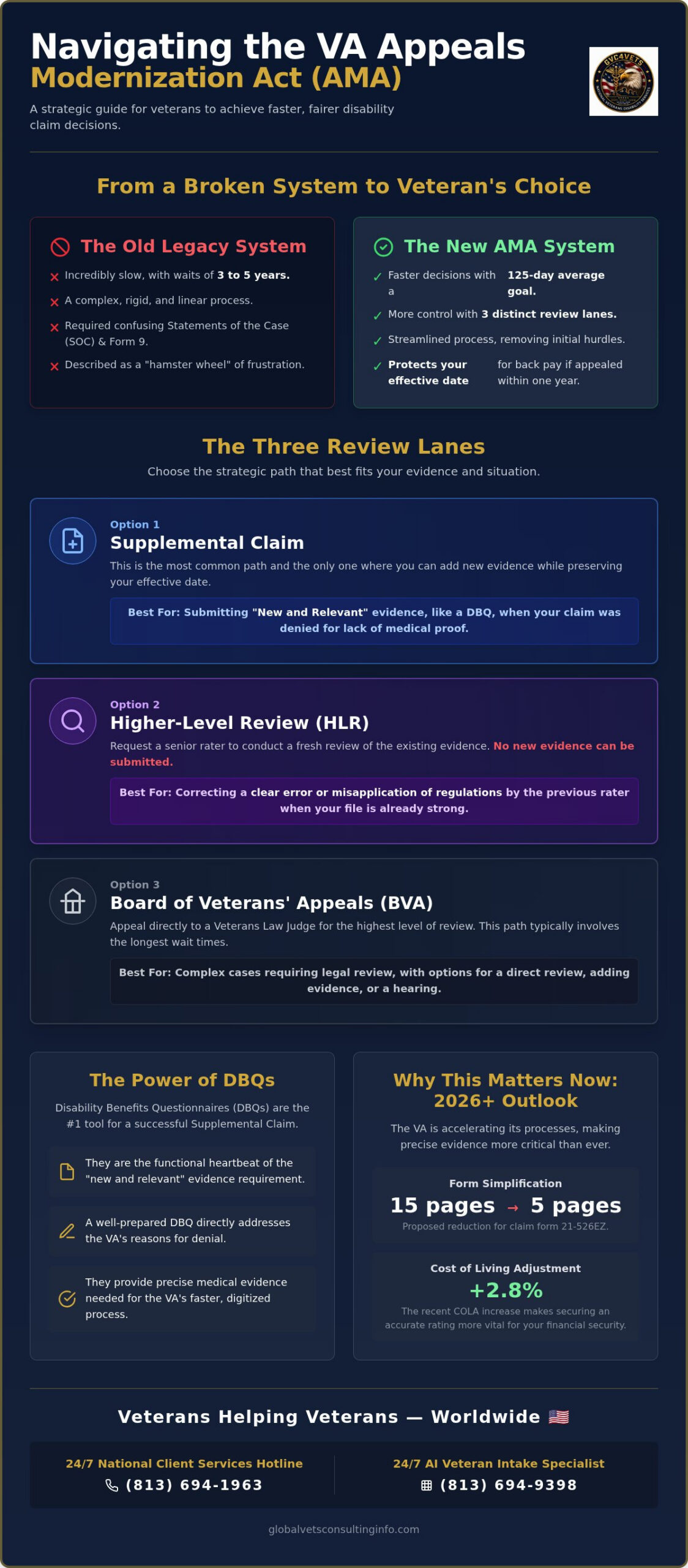
The Veterans Appeals Improvement and Modernization Act of 2017 changed everything for veterans seeking a disability rating increase. If you’ve been wondering what is the va appeals modernization act, it’s the system designed to end the “hamster wheel” of the old legacy process. Instead of a single, rigid path that often took years to resolve, the AMA gives you three distinct lanes to challenge a decision. This shift focuses on transparency and speed, aiming for an average processing time of 125 days.
One of the most valuable features of this system is the protection of your effective date. As long as you file your appeal within one year of your rating decision, you preserve your right to back pay. This creates a continuous chain of evidence and compensation, ensuring you don’t lose out on benefits while fighting for the correct rating. You now have the power to choose a path that matches the strength of your medical evidence.
Legacy Appeals vs. Appeals Modernization
The retired Legacy system was notorious for its complexity and lack of transparency. Veterans had to navigate Statements of the Case (SOC) and file a formal “Form 9” just to keep their claim alive. It wasn’t uncommon for these cases to languish for three to five years without an update. The AMA retired these hurdles. By removing the SOC and the requirement for a Form 9 in the initial stages, the VA has streamlined the path to a resolution. You now choose the lane that fits your specific situation, rather than being forced into a decade-long wait.
Why the AMA Matters for Your 2026 Claim
In 2026, the VA is pushing for even greater efficiency through digital tools and proposed form reductions. For example, the VA recently proposed shortening the disability compensation claim form (21-526EZ) from 15 pages down to five. This faster pace means your medical evidence must be precise from the start. Professional documentation, such as private DBQs, is now the primary driver for success in the Supplemental Claim lane. Because the system moves quicker, having your medical evidence organized and ready to submit is the best way to secure your earned outcomes without unnecessary delays.
The Three Review Lanes: Choosing Your Path to Success
Once you receive a rating decision that doesn’t reflect the reality of your condition, you have exactly one year to act. A central part of what is the va appeals modernization act is the empowerment of the veteran to choose between three decision review options. This choice shouldn’t be a guess. It should be a strategic move based on why the VA denied your claim in the first place. If you disagree with the result of one lane, you can often transition to another, provided you stay within the one-year window to preserve your back pay.
Option 1: The Supplemental Claim Lane
This is the most common path for veterans who need to submit “new and relevant” evidence that the VA hasn’t seen before. It’s the only lane where you can add medical documentation to bolster your case while keeping your original effective date. If your va claim denied for lack of evidence, this lane is your primary recovery strategy. It allows you to fill the gaps in your service connection or symptom severity with updated medical records. It’s an active way to address specific missing links identified by the rater.
Option 2: Higher-Level Review (HLR)
An HLR is a “de novo” review, meaning a senior rater looks at your file with fresh eyes. You can’t submit new evidence here. This lane is best when the evidence is already in your file, but the previous rater made a clear error or misapplied a regulation. It’s a powerful tool for correcting administrative mistakes without starting over. You’re essentially asking for a second opinion from a more experienced official based on the existing record.
Option 3: Board of Veterans’ Appeals (BVA)
The Board lane takes your case directly to a Veterans Law Judge. You can choose a direct review, submit more evidence, or request a hearing. While this offers the highest level of scrutiny, be prepared for longer wait times compared to the 125-day goal of the other lanes. Most veterans find that resolving issues through expert education on the appeals process in the Supplemental or HLR lanes is a much more efficient path to their earned benefits.
Evidence Strategy: The Critical Role of DBQs in the AMA
“New and relevant” evidence is the functional heartbeat of the Supplemental Claim lane. When you grasp what is the va appeals modernization act, you see a system designed to reward veterans who provide clear, structured data. The VA defines “relevant” as evidence that tends to prove or disprove a matter at issue in your claim. A private Disability Benefits Questionnaire (DBQ) is the most effective way to meet this standard. By providing the rater with a completed DBQ, you reduce their “duty to assist” workload. This often results in a faster, more accurate rating decision because you’ve already done the heavy lifting of documenting your symptoms.
Why Private DBQs are a Game Changer
C&P examinations are often rushed, sometimes lasting only minutes. This can result in a denial because the examiner didn’t capture the true severity of your symptoms or missed a key secondary connection. In contrast, what is a dbq for va claims? It is a structured document that ensures every symptom is recorded according to the VA’s Schedule for Rating Disabilities (VASRD). Learning how to use a dbq for a va disability rating increase allows you to present a “fully developed” claim. This documentation clarifies the severity of your condition in a language the VA rater understands, often bypassing the need for multiple follow-up exams.
Preparing Your Evidence Package
The AMA system moves quickly; a lack of detail is the leading cause of denials in 2026. Your documentation must project professional authority and empathetic support to show the full scope of your disability. When you look at what is the va appeals modernization act from a strategic perspective, your evidence is your most powerful tool. A checklist for a “fully developed” package includes:
- A completed DBQ from a qualified medical professional who understands your history.
- Current medical records showing a clear diagnosis of the service-connected condition.
- A clear “nexus” or medical link to your time in service or an existing disability.
- Personal statements that detail how the condition impacts your daily life and work.
Precision is your best ally when navigating the new appeals system. If you need help substantiating your claim with professional medical documentation, you can get expert DBQ education today to ensure your package is ready for a favorable decision.
How to Navigate the Appeals Process in 2026 📞
Taking action after a denial requires a methodical approach. Now that you understand what is the va appeals modernization act, you can use its structure to your advantage. Following a logical sequence ensures you don’t miss critical deadlines or submit incomplete evidence packages. In 2026, the VA’s shift toward digital processing means that electronic submissions are processed significantly faster than paper mail, so keep your login credentials for VA.gov ready.
- Step 1: Analyze your Rating Decision letter. Look specifically for the “Reasons for Decision” section. This is where the VA identifies the “missing link” in your claim, such as a lack of a medical nexus or insufficient symptom severity.
- Step 2: Gather new medical evidence. If the denial was based on medical facts, a private DBQ is your strongest tool. It provides the specific data points needed to refute the VA’s previous findings.
- Step 3: Select your lane. Match your strategy to the denial reason. If you have new evidence, choose the Supplemental Claim lane. If the error was legal or administrative, choose a Higher-Level Review.
- Step 4: Submit electronically. Use the VA.gov portal to upload your forms and evidence. This creates an immediate digital timestamp and starts the 125-day processing goal clock.
Common Mistakes to Avoid Under the AMA
The most frequent error veterans make is choosing a Higher-Level Review when they actually have new medical records to provide. A senior rater cannot look at any evidence that wasn’t in your file at the time of the original decision. If you have a new DBQ, you must use the Supplemental Claim lane. Additionally, watch your calendar closely. You have exactly one year from the date on your decision letter to file your appeal. If you miss this window, you lose your original effective date and potentially years of back pay.
Next Steps: Get Expert Guidance
You don’t have to navigate this complex system alone. Global Vets Consulting supports you by providing the medical evidence education needed to substantiate your claim and win your appeal. Our team focuses on meticulous documentation to ensure your evidence package is “fully developed” before it reaches a rater’s desk. For immediate assistance, our 24/7 AI Veteran Intake Specialist is available to help you start the process right now. You can also explore our va disability claims process step by step guide for a more detailed look at securing your rating increase.
Take Control of Your VA Appeal Strategy 🇺🇸
Understanding what is the va appeals modernization act is your first step toward overcoming a claim denial. You now have the power to select a review lane that matches your evidence; whether that’s correcting a legal error through Higher-Level Review or adding new medical facts via a Supplemental Claim. By focusing on high-quality medical documentation like private DBQs, you remove the guesswork for VA raters and move your claim toward a faster, more accurate decision. Don’t let a confusing decision letter or a one-year deadline stand between you and your earned benefits.
Global Vets Consulting is a veteran-owned and operated team dedicated to providing expert DBQ preparation education and resource awareness. We specialize in helping you substantiate your service-connected conditions with the meticulous medical evidence the VA requires. If you’re ready to strengthen your appeal, Secure Your Medical Evidence Today – Contact Global Vets Consulting. Our 24/7 National Client Services Hotline is always available to provide the steady guidance you deserve. You’ve served your country with honor; now it’s time to ensure the system recognizes the full extent of your sacrifice.
Frequently Asked Questions
What is the difference between a Supplemental Claim and a Higher-Level Review?
A Supplemental Claim is the correct path when you have new and relevant evidence to add to your file, such as a private DBQ. In contrast, a Higher-Level Review is a “de novo” look at your existing evidence by a senior rater. You use the Supplemental lane to fix gaps in medical documentation. You use HLR to correct administrative errors or legal misapplications where no new facts are required.
How long do I have to appeal a VA decision under the Appeals Modernization Act?
You have exactly one year from the date on your rating decision letter to file an appeal. This 365-day window is critical for preserving your original effective date and securing back pay. If you miss this deadline, your claim becomes final. You would then have to file a new claim, which usually results in a later effective date and a significant loss of potential compensation.
Can I submit new medical evidence (like a DBQ) during a Higher-Level Review?
No, you cannot submit any new medical evidence, including a DBQ, during a Higher-Level Review. The senior rater is legally restricted to considering only the evidence that was in your file at the time the previous decision was made. If you have obtained new medical documentation that substantiates your condition, you must choose the Supplemental Claim lane instead. This ensures your new evidence is part of the record.
What happens if my Supplemental Claim is denied again?
If your Supplemental Claim is denied, you can choose any of the three lanes again, provided you act within one year of the new denial. You might choose a Higher-Level Review if you believe the rater ignored the new evidence you just provided. Alternatively, you can file another Supplemental Claim if you gather even more “new and relevant” evidence to address the remaining gaps in your service connection or symptom severity.
Is the Board of Veterans’ Appeals lane faster than a Supplemental Claim?
No, the Board of Veterans’ Appeals (BVA) lane is generally the slowest path in the system. While the VA aims for a 125-day average for Supplemental Claims and Higher-Level Reviews, BVA cases often take significantly longer. This is due to the complexity of legal hearings and the backlog of cases awaiting a Veterans Law Judge. Most veterans find it more efficient to resolve evidence issues at the local level first.
Do I need a lawyer to file an appeal under the AMA?
You are not required to have a lawyer to file an appeal under the AMA. Many veterans successfully navigate the process by focusing on the medical evidence required for a rating increase. Understanding what is the va appeals modernization act allows you to act as your own advocate. Using professional education to prepare your DBQs and medical documentation can often be more effective than legal representation for evidence-based denials.

Article by
Willie Daniel
Willie Daniel is the Founder and Chief Executive Officer (CEO) of Global Vets Consulting (GVC4Vets) – National Veterans Disability Services, a veteran-led educational and medical evidence support organization dedicated to helping veterans better understand VA disability rating increases, DBQ medical evidence, secondary claims education, and C&P examination preparation.
He is a retired U.S. Army Medical Service Corps Officer with more than 27 years of honorable military service, a decorated Iraq combat veteran, and a retired federal official with the U.S. Department of Veterans Affairs. Throughout his military and federal career, Willie Daniel served in leadership, healthcare administration, operational, and veteran-support roles focused on improving services and support systems for servicemembers, veterans, and their families.
Drawing from decades of military leadership, healthcare administration, veteran advocacy, and federal government experience, Willie Daniel brings a practical, veteran-centered perspective to Global Vets Consulting’s educational articles, AI-powered veteran resources, video education initiatives, and outreach programs. His experience navigating military systems, medical documentation processes, and veteran-related administrative operations provides valuable insight into many of the challenges veterans face when seeking to better understand VA disability rating criteria, medical evidence, documentation strategies, and secondary condition education.
Through GVC’s “Veterans Helping Veterans” mission, his focus is on delivering clear, educational, and easy-to-understand information designed to empower veterans with knowledge, resources, and educational tools that may help them make more informed decisions regarding their individual VA disability journeys.
The information provided through GVC is intended for educational and informational purposes only and should not be considered legal or medical advice.
Disclaimer
Disclaimer: Global Vets Consulting, LLC (“GVC”) is a veteran-led educational and medical evidence support organization. GVC is not a law firm, is not a Veterans Service Organization (VSO), and is not affiliated with the U.S. Department of Veterans Affairs (VA) or any government agency.
Global Vets Consulting does not provide legal advice, medical advice, medical treatment, or healthcare services. GVC does not prepare, file, or submit VA disability claims on behalf of veterans. All information provided through this website, blog articles, videos, educational materials, AI tools, dashboards, templates, and communications is intended solely for general educational and informational purposes.
Veterans are encouraged to consult with accredited representatives, licensed attorneys, qualified medical providers, or Veterans Service Organizations regarding their specific legal, medical, or VA-related matters. VA disability decisions, ratings, and outcomes are determined solely by the U.S. Department of Veterans Affairs based on applicable laws, regulations, medical evidence, and individual circumstances. Past results do not guarantee future outcomes.

