

Your medical records are full of facts, but unless those facts are translated into the VA’s specific language, they might as well be written in code. Understanding what is a dbq is the first step toward cracking that code and securing the benefits you’ve earned through your service. These standardized forms, known as Disability Benefits Questionnaires, are designed to capture the exact severity and functional impact of your condition in a way that aligns perfectly with VA rating criteria.
It’s completely normal to feel anxious about biased C&P exams or the possibility of a claim denial because of a lack of evidence. You deserve a process that feels like a partnership rather than a cold transaction. This guide will help you understand how a DBQ functions as the critical link between your medical diagnosis and the disability rating you’ve earned. We’ll cover the 19 medical categories available, explain how to obtain a private DBQ from your own doctor, and give you the tools to submit a fully developed claim with total confidence.
Key Takeaways
- Discover how understanding what is a dbq allows you to translate your medical symptoms into the precise language the VA uses for rating decisions.
- Learn how the specific data points on these forms correlate directly to disability percentages, giving you a clearer picture of your earned benefits.
- Compare the differences between VA-controlled C&P exams and the strategic advantages of submitting a private DBQ from your own provider.
- Follow a logical, step-by-step process to identify the correct forms and gather the necessary medical evidence for a fully developed claim.
- Gain confidence by partnering with veteran advocates who focus on meticulous documentation to reduce the risk of a “lack of evidence” denial.
What is a DBQ? Defining the Disability Benefits Questionnaire
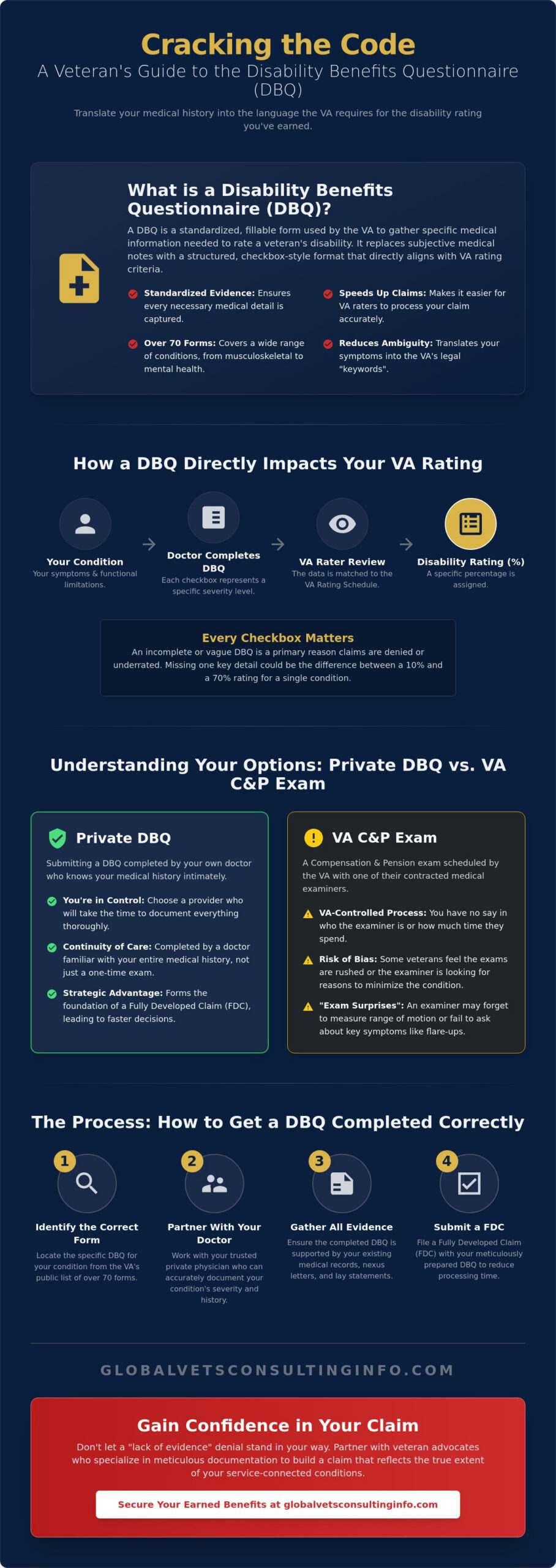
A Disability Benefits Questionnaire (DBQ) is a standardized medical form used by the Department of Veterans Affairs to evaluate the severity of a veteran’s service-connected conditions. Rather than relying on long, disorganized medical notes, these forms use a structured format to capture the exact data points required for a rating decision. Understanding what is a dbq is essential because it serves as the primary tool for communicating your physical or mental limitations to the individuals who decide your compensation level.
The VA moved away from narrative medical reports years ago to solve a growing backlog of claims. In the past, doctors wrote letters that often omitted the specific legal “keywords” needed for a rating. Today, there are more than 70 different types of DBQs available, ranging from musculoskeletal issues to complex neurological disorders. These forms use a checkbox style that aligns directly with the VA Schedule for Rating Disabilities, ensuring that the evidence you submit is easy for a rater to process quickly and accurately.
The push for modernization reached a new milestone with the Elizabeth Dole 21st Century Veterans Healthcare and Benefits Improvement Act of 2025. This legislation emphasizes the importance of streamlined, electronic evidence and veteran-centric care. By standardizing how medical information is collected, the VA aims to reduce the time you spend waiting for a decision while increasing the consistency of ratings across the board. For many, this means a more predictable path toward the benefits they’ve earned.
The Core Purpose of the DBQ in 2026
The primary goal of a DBQ is to translate your daily pain and functional limitations into the legal criteria used by VA raters. It acts as a guide for the medical professional, ensuring they check for every relevant symptom associated with your condition. When a doctor completes one of these forms, they aren’t just giving a medical opinion; they’re providing a structured framework that the VA uses to assign a percentage. For instance, in mental health evaluations, Disability Benefits Questionnaires (DBQs) help clarify the specific social and occupational impairment levels required for a fair rating.
Why Every Veteran Needs to Understand These Forms
Knowing what is a dbq empowers you to take control of your claim. It prevents “exam surprises” where a doctor might forget to measure your range of motion or fail to ask about the frequency of your flare-ups. When you understand the form, you can speak the same language as the rating board and ensure your medical evidence is complete before it ever reaches a rater’s desk. This knowledge is the foundation of a Fully Developed Claim (FDC), which can significantly speed up your processing time and reduce the risk of a denial based on a supposed lack of evidence. To see exactly how a DBQ fits into the broader submission workflow, review this complete guide to the va disability claims process step by step from intent to file through final decision.
How a DBQ Directly Impacts Your VA Disability Rating
The relationship between a medical form and your monthly compensation is direct and mathematical. When you ask what is a dbq in terms of its impact, think of it as the input for a technical calculator. Each checkbox on the form corresponds to a specific severity level defined in the VA’s rating schedule. If a doctor checks a box indicating your range of motion is restricted to a certain degree, that data point triggers a specific disability percentage.
An incomplete or vague form is the primary reason claims are underrated. If a physician fails to document the frequency of your symptoms or the severity of your functional loss, the VA rater cannot grant a higher percentage. This is true even if your condition is severe. Meticulousness is vital here. For example, the 2026 VA disability rate for a veteran at 100% is $3,938.57 per month. Missing just one checkbox could mean the difference between that 100% rating and a much lower combined score.
“VA Math” is where many veterans feel lost. The VA doesn’t simply add percentages together; it calculates how much “efficiency” you have left after each disability is subtracted. If you have a 50% rating for one condition and a 30% rating for another, the VA takes 30% of the remaining 50%, resulting in a 65% total, which rounds to 70%. Because every point matters, understanding what is a dbq and ensuring your VA’s Public DBQs are filled out with precision is the only way to maximize your combined rating. If you need assistance ensuring your medical evidence is accurately captured, you might consider professional medical evidence preparation to avoid common pitfalls.
Mapping Symptoms to the VA Schedule for Rating Disabilities (VASRD)
The VASRD is the official rulebook that dictates how every injury or illness is rated. A DBQ is essentially a mirrored version of this rulebook. It asks the doctor the exact questions the VASRD requires for a rating decision. To get an accurate rating, the form must reflect your “worst-case days” and flare-ups. If your exam happens on a day when you feel relatively well, but the form doesn’t mention that you’re bedridden three days a week, your rating will suffer.
Objective Medical Evidence vs. Subjective Pain
The VA prioritizes objective data over subjective descriptions of pain. While your pain is real, a rater looks for measurable evidence like range of motion degrees, frequency of episodes, or diagnostic test results. A correctly completed questionnaire provides this proof. It moves the conversation from “my back hurts” to “the veteran has a 15-degree limitation in flexion.” This level of detail is what turns a denied claim into an approved one.
Private DBQs vs. VA C&P Exams: Understanding Your Options
Many veterans believe the only path to a rating is through a VA-scheduled Compensation and Pension (C&P) exam. This isn’t the case. You have the legal right to choose who documents your condition. Understanding what is a dbq in the context of private medical evidence is a game-changer for your claim strategy. Under current law, the VA is required to consider private medical evidence as long as it is competent, credible, and meets the same technical standards as their own internal examinations.
The Elizabeth Dole 21st Century Veterans Healthcare and Benefits Improvement Act of 2025 has further solidified this right. This legislation was designed to improve the veteran experience by ensuring that third-party evidence is given proper weight in the adjudication process. It reduces the VA’s ability to dismiss private findings without a specific, valid medical reason. This shift gives you significantly more agency in a system that can often feel one-sided and bureaucratic.
When you provide your own evidence, you’re effectively framing the conversation. You aren’t waiting for a stranger to discover your symptoms during a brief encounter. Instead, you’re presenting a completed, professional medical opinion that uses the VA’s own criteria to prove your case. This proactive approach is a hallmark of a successful claim strategy. It transforms the process from a passive wait into an active pursuit of the benefits you’ve earned.
The Limitations of the Standard C&P Exam
C&P exams are often the source of significant anxiety for veterans. These appointments can feel incredibly rushed. It’s common for a veteran to wait months for an appointment only to have it last 15 minutes. In such a short window, complex conditions are rarely evaluated with the depth they deserve. Furthermore, contract examiners are often generalists. They might lack the specific expertise required to assess your unique injury or mental health condition accurately. Because these exams are “one-and-done” snapshots, they often fail to capture the reality of your daily struggles or the full history of your treatment.
The Strategic Advantage of a Private DBQ
A private evaluation allows for a meticulous, comprehensive review of your entire medical history. When you work with a provider who understands the veteran experience, you receive a more accurate functional assessment that reflects your life outside the exam room. One of the most significant benefits is transparency. You get to see the evidence before it’s submitted to the VA. This allows you to identify and correct factual errors or clarify points that might have been misunderstood. Ensuring the final document is a thorough reflection of your health is the best way to avoid the “lack of evidence” denials that plague so many claims. Before committing to a provider, it’s worth understanding the cost of a private DBQ in 2026 so you can evaluate your options and identify legitimate partners who deliver high-fidelity documentation. To ensure your provider follows the VA’s exact documentation requirements, review our detailed guide on how to get a DBQ from a private doctor that meets every VA standard.
The Process: How to Get a DBQ Completed Correctly
Completing the paperwork correctly is the difference between a successful claim and a year-long appeal. While downloading a PDF from the VA website is easy, ensuring it’s filled out with the technical precision required for a rating is a complex task. Following a methodical, step-by-step approach ensures your evidence is ready for a rater’s review. Understanding what is a dbq in the context of a submission workflow helps you avoid the common mistakes that lead to delays.
- Step 1: Identify the correct form for your condition. The VA organizes these into 19 distinct categories, such as Cardiovascular or Musculoskeletal.
- Step 2: Gather every relevant treatment record and diagnostic result. A doctor cannot provide a valid opinion without reviewing your full medical history.
- Step 3: Partner with a medical professional who understands the nuances of VA documentation.
- Step 4: Review the final form for accuracy and the inclusion of specific “Nexus” language.
- Step 5: Submit the completed document as part of a Fully Developed Claim (FDC) via VA.gov to reduce your waiting time.
The Elizabeth Dole Act of 2025 has streamlined this workflow by requiring the VA to accept high-quality electronic evidence from private providers more readily. This means your private documentation carries more weight than ever before. If you want to ensure your forms meet these rigorous new standards and capture the full extent of your disability, you can purchase a professionally prepared DBQ to strengthen your claim. For a broader understanding of how each of these steps fits into the overall journey from filing to decision, our detailed breakdown of the va disability claims process step by step walks you through all 8 stages with clarity.
Who Can Legally Complete a DBQ for You?
Not every medical professional is qualified to sign every form. While MDs and DOs are the standard, specialists are often required for specific claims. For example, a mental health DBQ must be completed by a board-certified or board-eligible psychologist or psychiatrist. In the 2026 landscape, Nurse Practitioners (NPs) and Physician Assistants (PAs) are increasingly recognized by the VA as competent examiners for many conditions. However, many primary care physicians remain hesitant to sign these forms. They often fear the legal complexity or simply don’t have the time to learn the VA’s specific rating language. If your doctor is one of them, our step-by-step resource on how to get a DBQ from a private doctor who meets VA requirements can help you find and work with the right provider.
Critical Elements Every DBQ Must Include
A form is only as good as the data it contains. To be effective, it must use diagnostic language that matches the VA’s internal requirements. Vague descriptions like “chronic pain” are less effective than specific clinical findings. Every form must also include a detailed functional impact statement. This explains exactly how your condition prevents you from working or performing daily tasks. Most importantly, the form needs a clear “Nexus” statement. This is the medical opinion that links your current condition to your military service, usually using the phrase “at least as likely as not.” Without this link, the VA will likely deny service connection regardless of the condition’s severity.
Global Vets Consulting: Your Partner in Evidence Preparation
Global Vets Consulting was established with a singular mission: to serve those who served. We understand the frustration of receiving a denial letter after years of sacrifice because we have been in your boots. Our team recognizes that understanding what is a dbq is only the first step. The real challenge lies in ensuring that these complex forms are completed with the meticulous accuracy the VA requires. We bridge the gap between your service history and the rating decision you deserve by focusing on high-quality medical evidence.
Our approach follows a logical “Problem-Action-Result” flow designed to reduce your anxiety. The problem for many veterans is a lack of objective evidence or a poorly conducted C&P exam. We take action by facilitating professional medical evidence preparation that addresses your specific service-connected conditions. The result is a comprehensive, fully developed claim that leaves nothing to chance. This structured process simplifies the bureaucratic maze and gives you a predictable path forward.
Integrity is the foundation of our partnership. We don’t believe in shortcuts or flashy marketing; instead, we prioritize the thoroughness and legitimacy of your documentation. By ensuring every checkbox and clinical finding aligns with the VA’s technical standards, we help you present a case that is difficult to ignore. This commitment to accuracy is our way of continuing our sense of duty to the veteran community.
A Mission-Driven Approach to Veteran Advocacy
We treat your claim with the same level of duty and respect we gave while in uniform. Our expertise allows us to identify the specific evidence gaps that typically lead to denials, such as a missing nexus or insufficient functional impact statements. Providing professional, standardized documentation gives you the peace of mind that comes from knowing your claim is built on a solid foundation. You’ve already done the hard work of serving your country. Now, we help you navigate the administrative requirements to secure your earned benefits. Understanding what is a dbq shouldn’t be a source of stress when you have an advocate who understands the system’s intricacies.
Taking the Next Step Toward Your Earned Benefits
You don’t have to leave your rating to chance or rely on a stranger during a rushed 15-minute exam. Taking a proactive stance by submitting a private DBQ is a powerful way to ensure your symptoms are documented correctly the first time. We invite you to begin a professional review of your medical evidence to see how we can strengthen your claim. Every day you wait is a day of earned compensation lost. Take control of your future and ensure your sacrifices are properly recognized by the VA. Schedule your consultation with Global Vets Consulting today to determine which medical evidence strategies are right for your situation.
Take Control of Your VA Claim Journey
Understanding what is a dbq is more than just learning a definition; it’s about gaining a strategic advantage in a complex bureaucratic system. You now have a clear roadmap for how these forms translate your daily symptoms into the specific legal criteria used by VA raters. By choosing to provide your own private medical evidence, you ensure that every functional limitation is documented with the precision and care it deserves. This proactive approach is the most effective way to secure a fully developed claim that reflects the true severity of your service connected conditions.
Global Vets Consulting has been veteran owned and operated since 2021. We maintain a meticulous focus on accurate medical documentation that adheres to the latest 2026 VA compliance standards. Our team understands the weight of your service and the importance of an accurate rating for your future. You don’t have to navigate this process alone or settle for a rushed evaluation. Secure the medical evidence your claim deserves with Global Vets Consulting today. Your dedication to duty was unwavering, and we are here to ensure you receive a result that reflects that same level of integrity.
Frequently Asked Questions
Is a DBQ required for every VA disability claim?
A DBQ is not mandatory for a claim, but it is the most efficient way to provide evidence. While the VA can review your raw medical records to find evidence, a DBQ organizes that information into the exact format a rater needs to make a decision. Submitting one reduces the risk of a rater missing a key symptom in hundreds of pages of notes.
Can I fill out my own DBQ if I have my medical records?
You cannot fill out your own form. These documents must be completed and signed by a licensed medical professional to be considered valid evidence. While you can provide your doctor with your treatment history and notes on your symptoms, the clinical findings and functional assessments must come from their professional evaluation of your health.
Do private DBQs really work as well as VA C&P exams?
Private DBQs are often more effective than standard C&P exams because they allow for a more exhaustive review of your history. Since you choose the provider, you can ensure they have the time to document every flare up and limitation. The VA is required by law to give these forms full consideration as long as they meet technical standards.
What should I do if my doctor refuses to sign a DBQ?
If your primary care doctor refuses to sign the form, you should partner with a specialist who understands VA documentation requirements. Many doctors in the private sector are unfamiliar with what is a dbq and may worry about the legal implications. Working with advocates who specialize in this field ensures your paperwork is handled by someone comfortable with the process.
How much does it cost to get a private DBQ prepared?
The cost of preparing a private DBQ depends on the complexity of your condition and the time required for a thorough medical review. Every case is unique; specialists typically base their fees on the depth of the evaluation needed. For a detailed breakdown of what drives pricing and how to evaluate whether you’re getting genuine value, review our complete guide to the cost of a private DBQ in 2026. You should view this as an investment in securing the accurate rating you’ve earned through your service.
Can the VA ignore a DBQ from a private doctor?
The VA cannot legally ignore a private DBQ if it is submitted by a competent medical professional and contains the necessary clinical findings. Under the Elizabeth Dole Act of 2025, the VA must provide a specific medical justification if they choose to weigh their own examiner’s opinion more heavily than your private evidence.
What is the difference between a DBQ and a Nexus Letter?
A DBQ documents the current severity of your symptoms, while a Nexus Letter establishes the link to your military service. You often need both for a successful claim. The DBQ tells the VA how much your condition affects you today, which determines your rating percentage. The Nexus Letter proves that the condition started or was aggravated during your time in uniform.
How long is a completed DBQ valid for submission to the VA?
Most experts recommend submitting a DBQ that has been completed within the last year. The VA wants to see evidence that reflects your current level of disability. If your form is older than 12 months, the rater may decide that your condition has changed and request a new examination to confirm your current functional limitations.

Article by
Willie Daniel
Willie Daniel is the Founder and Chief Executive Officer (CEO) of Global Vets Consulting (GVC) – National Veterans Disability Services, a veteran-led educational and medical evidence support organization dedicated to helping veterans better understand VA disability rating increases, DBQ medical evidence, secondary claims education, and C&P examination preparation.
He is a retired U.S. Army Medical Service Corps Officer with more than 27 years of honorable military service, a decorated Iraq combat veteran, and a retired federal official with the U.S. Department of Veterans Affairs. Throughout his military and federal career, Willie Daniel served in leadership, healthcare administration, operational, and veteran-support roles focused on improving services and support systems for servicemembers, veterans, and their families.
Drawing from decades of military leadership, healthcare administration, veteran advocacy, and federal government experience, Willie Daniel brings a practical, veteran-centered perspective to Global Vets Consulting’s educational articles, AI-powered veteran resources, video education initiatives, and outreach programs. His experience navigating military systems, medical documentation processes, and veteran-related administrative operations provides valuable insight into many of the challenges veterans face when seeking to better understand VA disability rating criteria, medical evidence, documentation strategies, and secondary condition education.
Through GVC’s “Veterans Helping Veterans” mission, his focus is on delivering clear, educational, and easy-to-understand information designed to empower veterans with knowledge, resources, and educational tools that may help them make more informed decisions regarding their individual VA disability journeys.
The information provided through GVC is intended for educational and informational purposes only and should not be considered legal or medical advice.
Disclaimer
Disclaimer: Global Vets Consulting, LLC (“GVC”) is a veteran-led educational and medical evidence support organization. GVC is not a law firm, is not a Veterans Service Organization (VSO), and is not affiliated with the U.S. Department of Veterans Affairs (VA) or any government agency.
Global Vets Consulting does not provide legal advice, medical advice, medical treatment, or healthcare services. GVC does not prepare, file, or submit VA disability claims on behalf of veterans. All information provided through this website, blog articles, videos, educational materials, AI tools, dashboards, templates, and communications is intended solely for general educational and informational purposes.
Veterans are encouraged to consult with accredited representatives, licensed attorneys, qualified medical providers, or Veterans Service Organizations regarding their specific legal, medical, or VA-related matters. VA disability decisions, ratings, and outcomes are determined solely by the U.S. Department of Veterans Affairs based on applicable laws, regulations, medical evidence, and individual circumstances. Past results do not guarantee future outcomes.

