

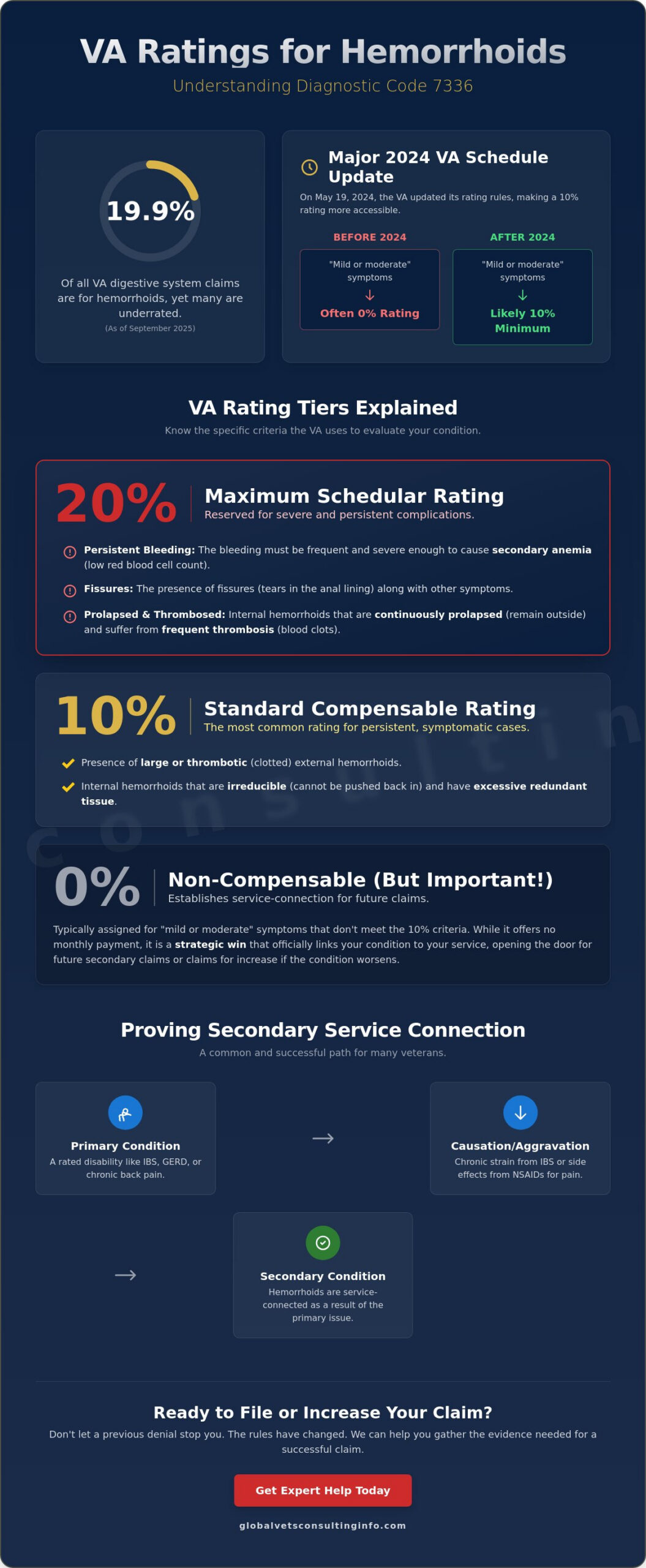
If you were denied a rating or assigned 0% for your condition before 2024, the VA’s own updated regulations now suggest you likely deserve at least 10% in monthly compensation. Filing a va claim for hemorrhoids is often a source of frustration for veterans who feel their daily pain is dismissed as a minor inconvenience during a brief examination. It is understandable to feel hesitant about discussing such a private issue, especially when past attempts resulted in a rating that does not reflect your reality. As of September 2025, hemorrhoids accounted for 19.9% of all digestive system claims, yet many veterans still struggle to move past a non-compensable evaluation despite persistent symptoms.
You deserve a rating that accurately acknowledges the impact this condition has on your quality of life. This guide will show you exactly how to document your symptoms and navigate the current rating schedule to secure the disability benefits you earned. We will provide a clear understanding of the 10% versus 20% criteria, explain how to link your condition to other service-connected issues like IBS, and help you build a plan to gather medical evidence that the VA cannot ignore.
Key Takeaways
- Understand the 2024 rating schedule changes that established a 10% minimum for most cases and the specific medical markers required for a 20% evaluation.
- Learn how to successfully file a va claim for hemorrhoids by linking it as a secondary condition to service-connected digestive issues like IBS or GERD.
- Discover why even a 0% rating is a strategic win for your long-term health and how it serves as a foundation for future secondary claims.
- Identify the specific evidence needed for a Disability Benefits Questionnaire (DBQ) to ensure your symptoms are documented with the precision the VA requires.
Understanding the VA Rating for Hemorrhoids (Diagnostic Code 7336)
The VA evaluates hemorrhoids under Diagnostic Code 7336. This code covers both internal and external Hemorrhoids, focusing on the frequency of symptoms and the presence of physical complications. While many veterans previously received a 0% rating, recent policy shifts have made it easier to secure a compensable rating. You must show that your symptoms interfere with your daily life or require specific medical interventions to move beyond a non-compensable status.
To better understand how the VA evaluates digestive conditions, watch this helpful video:
A 20% rating is the maximum schedular amount for this condition. To qualify, you must demonstrate persistent bleeding that causes secondary anemia or internal hemorrhoids that remain continuously prolapsed and suffer from frequent thrombosis. If your condition is less severe but still constant, a 10% rating is assigned for large or thrombotic tissue, or irreducible hemorrhoids with excessive redundant tissue. Understanding these thresholds is the first step in building a successful va claim for hemorrhoids.
The 2024 VASRD Update: Why Your Previous Denial Might Be Wrong
On May 19, 2024, the VA updated its rating schedule to be more favorable to veterans. Previously, “mild or moderate” symptoms often resulted in a 0% non-compensable rating. Now, these same symptoms qualify for a 10% minimum rating. If you were denied or given 0% in the past, filing a va claim for hemorrhoids as an increase is a logical next step to reflect these new standards. You don’t have to prove your condition got worse; you only need to show it meets the current criteria.
Internal vs. External: Does the VA Rate Them Differently?
The VA uses the same diagnostic code for both types, but the evidence required for each differs. Internal hemorrhoids are often evidenced by “prolapse,” which means the tissue extends outside the anal canal. External hemorrhoids are typically documented by size and the presence of blood clots, known as thrombosis. Using a what is a DBQ education resource can help you ensure your doctor documents these distinctions with the precision the VA requires.
Proving Service Connection: Direct vs. Secondary Claims
Establishing a service connection is the foundation of any successful va claim for hemorrhoids. You can achieve this through a direct link or a secondary path. Direct connection requires evidence from your Service Treatment Records (STRs) showing you sought treatment while on active duty. If you don’t have these records, you must rely on a “nexus” letter. This is a formal medical opinion where a provider states your condition is “at least as likely as not” caused by your military service. It’s a high bar, but it’s achievable with the right documentation.
A secondary service connection is a medical condition caused or aggravated by an already rated disability. This path is often more successful for veterans who didn’t seek treatment during their service but developed issues later due to other service-connected problems. Understanding the VA disability claims process is vital when navigating these complex medical links.
Hemorrhoids Secondary to IBS and Gastrointestinal Issues
Chronic digestive problems frequently lead to physical strain. If you’re rated for Irritable Bowel Syndrome (IBS) under Diagnostic Code 7319, the resulting constipation or diarrhea can directly cause or worsen hemorrhoids. The VA recognizes this physiological connection under Diagnostic Code 7336. If your GI symptoms create a “straining” effect, your hemorrhoids are a clear secondary result. You’ve earned the right to have every related symptom acknowledged by the rating schedule.
The Medication Link: NSAIDs and Iron Supplements
Many veterans take Non-Steroidal Anti-Inflammatory Drugs (NSAIDs) for service-connected back or joint pain. These medications are known to cause gastrointestinal distress, which can lead to the development of hemorrhoids. Similarly, iron supplements prescribed for service-connected anemia can cause severe constipation. You should document these side effects carefully in your medical records. If you’re unsure how to link these issues, secondary VA claims education can provide the clarity you need to move forward with confidence.
How to File a Successful VA Claim for Hemorrhoids
Filing a successful va claim for hemorrhoids requires more than just submitting a form; it demands a structured collection of evidence that speaks the VA’s language. You must move through the process methodically to ensure no detail is overlooked. First, secure a current medical diagnosis from a healthcare provider to establish the existence of the condition. Without this foundation, the VA cannot proceed with an evaluation. Next, maintain a detailed symptom log for three to six months. This log should document every instance of pain, bleeding, or prolapse, providing the “frequency” data that examiners often miss during a single appointment.
If your service treatment records are missing or incomplete, gather buddy letters from fellow service members who witnessed your struggles. These lay statements can bridge the gap in your official history. Finally, use a Disability Benefits Questionnaire (DBQ) to provide the VA with a clear roadmap of your condition. This document ensures that every relevant symptom is captured according to the VA’s specific rating criteria. If you need help understanding these requirements, our veteran benefits education resources offer a clear path forward.
Gathering Your Medical Evidence
Precision in your medical records is vital for a favorable outcome. Your healthcare provider should use specific clinical terms when describing the symptoms and treatments of hemorrhoids. Words like “persistent bleeding,” “thrombosis,” and “prolapsed” are essential triggers for higher ratings under the current schedule. If your condition has worsened over time, using a private DBQ for a VA disability rating increase can help you document the new level of severity with the accuracy required for a successful increase.
Preparing for the C&P Exam
The Compensation and Pension (C&P) exam is a common point of failure for many veterans. A significant pitfall is downplaying symptoms due to embarrassment or because the condition isn’t “flaring up” on the day of the exam. You must describe your symptoms based on your worst days, not just your current state. Having a completed DBQ before your exam is a strategic advantage. It ensures consistency between your private medical evidence and the examiner’s report, making it much harder for the VA to ignore your documented history. Our C&P examination preparation education can help you approach this meeting with steady confidence.
The Role of a Private DBQ in Your Hemorrhoid Claim
The most effective way to strengthen a va claim for hemorrhoids is through a private Disability Benefits Questionnaire (DBQ). You might wonder what is a DBQ and why it matters for your specific case. It is a standardized form designed by the VA that allows a healthcare provider to document your symptoms with surgical precision. It is considered the gold standard for medical evidence because it mirrors the exact criteria used by VA raters. When a specialist who understands veteran-specific issues completes this paperwork, they ensure every box is checked for the 20% rating criteria, such as persistent bleeding or frequent thrombosis.
Global Vets Consulting focuses on accuracy and thoroughness in every educational resource we provide. We know that many veterans are assigned a 0% non-compensable rating simply because their medical records lacked the specific terminology required by the rating schedule. By using a private DBQ, you take control of the narrative, providing a comprehensive record that leaves no room for guesswork by the VA.
Accuracy Over Speed: Why Documentation Matters
A typical C&P exam is often conducted in a rushed environment where the examiner might only spend a few minutes reviewing your history. They may miss the persistent nature of your symptoms or fail to document how your condition affects your ability to work. A detailed DBQ serves as an Independent Medical Opinion (IMO) that speaks for you when you aren’t in the room. It documents the chronic nature of your pain and the frequency of your flare-ups, ensuring your medical reality is reflected in your file. You don’t want your benefits decided by a five-minute conversation with a stranger.
Next Steps: Securing Your DBQ with Global Vets Consulting
We help veterans bridge the gap between their daily physical struggles and the rigid requirements of VA documentation. Our focus is on providing the educational resources and high-quality DBQs you need to present a fully developed claim. Before you hit the “submit” button on your application, ensure your evidence is meticulous and undeniable. You’ve earned these benefits through your service. Let us help you document your condition with the integrity and respect you deserve. Explore our Digestive System & Gastrointestinal Claims Education today to start your journey toward a fair rating.
Take Control of Your VA Rating Today
You now have a clear path to move your va claim for hemorrhoids forward with confidence. The 2024 rating schedule update means that even mild symptoms likely qualify for a compensable 10% rating, provided your documentation is accurate. By focusing on detailed symptom logs and exploring secondary service connections to digestive issues, you provide the VA with the evidence they need to grant your claim. Precise medical language and a well-prepared DBQ are your best tools to avoid a 0% non-compensable result.
Global Vets Consulting has been veteran-owned and operated since 2021, specializing in Disability Benefits Questionnaires (DBQ) and medical evidence education. We prioritize thorough, compliant documentation to ensure your medical history is presented clearly and accurately. Our mission is to help you bridge the gap between your physical reality and the VA’s administrative requirements.
Get the Accurate DBQ Evidence You Need for Your VA Claim. You’ve already done the hard work of serving your country. Now, it’s time to ensure you receive every benefit you’ve earned with the respect and integrity you deserve.
Frequently Asked Questions
Can I get VA disability for hemorrhoids if I didn’t see a doctor in service?
Yes, you can still receive benefits even if your service treatment records are silent on the issue. Many veterans establish a connection by filing a va claim for hemorrhoids as a secondary condition to a service-connected digestive issue like IBS. You can also use buddy letters from fellow service members or a medical nexus letter to bridge the gap between your service and your current diagnosis. This documentation provides the context the VA needs to link your current symptoms to your military history.
What is the maximum VA disability rating for hemorrhoids?
The maximum schedular disability rating for hemorrhoids under Diagnostic Code 7336 is 20%. To reach this level, you must demonstrate persistent bleeding that leads to secondary anemia or have internal hemorrhoids that are continuously prolapsed with frequent thrombosis. While 20% is the standard limit, the VA may consider extraschedular ratings in exceptionally severe cases that go beyond these specific criteria. Most veterans find that a 10% or 20% rating accurately reflects their condition’s impact.
How do I prove my hemorrhoids are secondary to my service-connected IBS?
You prove this link by providing a medical nexus letter that explains the physiological connection between your conditions. Chronic straining from constipation or frequent diarrhea associated with IBS often leads directly to the development of hemorrhoids. Your doctor should state that your hemorrhoids are at least as likely as not caused or aggravated by your service-connected IBS. This medical opinion links the two conditions, making your va claim for hemorrhoids much stronger in the eyes of the VA.
Is a C&P exam required if I submit a private DBQ for hemorrhoids?
The VA often requests a C&P exam even if you submit a private Disability Benefits Questionnaire (DBQ), but a well-completed private form can sometimes make the exam unnecessary. A thorough DBQ provides the rater with the evidence needed to make a decision without further evaluation. If the VA still schedules an exam, your private DBQ serves as a vital piece of evidence. It ensures the examiner’s findings remain consistent with your documented medical history and long-term symptoms.
Can hemorrhoids qualify for Total Disability Based on Individual Unemployability (TDIU)?
Hemorrhoids can contribute to a TDIU claim if they, in combination with your other service-connected disabilities, prevent you from maintaining gainful employment. While a 20% rating alone won’t meet the percentage threshold for TDIU, it can be combined with other ratings to reach the necessary requirements. Severe symptoms that require frequent medical procedures or cause significant physical limitations are important factors in proving that your service-connected conditions prevent you from working a traditional job.

Article by
Willie Daniel
Willie Daniel is the Founder and Chief Executive Officer (CEO) of Global Vets Consulting (GVC) – National Veterans Disability Services, a veteran-led educational and medical evidence support organization dedicated to helping veterans better understand VA disability rating increases, DBQ medical evidence, secondary claims education, and C&P examination preparation.
He is a retired U.S. Army Medical Service Corps Officer with more than 27 years of honorable military service, a decorated Iraq combat veteran, and a retired federal official with the U.S. Department of Veterans Affairs. Throughout his military and federal career, Willie Daniel served in leadership, healthcare administration, operational, and veteran-support roles focused on improving services and support systems for servicemembers, veterans, and their families.
Drawing from decades of military leadership, healthcare administration, veteran advocacy, and federal government experience, Willie Daniel brings a practical, veteran-centered perspective to Global Vets Consulting’s educational articles, AI-powered veteran resources, video education initiatives, and outreach programs. His experience navigating military systems, medical documentation processes, and veteran-related administrative operations provides valuable insight into many of the challenges veterans face when seeking to better understand VA disability rating criteria, medical evidence, documentation strategies, and secondary condition education.
Through GVC’s “Veterans Helping Veterans” mission, his focus is on delivering clear, educational, and easy-to-understand information designed to empower veterans with knowledge, resources, and educational tools that may help them make more informed decisions regarding their individual VA disability journeys.
The information provided through GVC is intended for educational and informational purposes only and should not be considered legal or medical advice.
Disclaimer
Disclaimer: Global Vets Consulting, LLC (“GVC”) is a veteran-led educational and medical evidence support organization. GVC is not a law firm, is not a Veterans Service Organization (VSO), and is not affiliated with the U.S. Department of Veterans Affairs (VA) or any government agency.
Global Vets Consulting does not provide legal advice, medical advice, medical treatment, or healthcare services. GVC does not prepare, file, or submit VA disability claims on behalf of veterans. All information provided through this website, blog articles, videos, educational materials, AI tools, dashboards, templates, and communications is intended solely for general educational and informational purposes.
Veterans are encouraged to consult with accredited representatives, licensed attorneys, qualified medical providers, or Veterans Service Organizations regarding their specific legal, medical, or VA-related matters. VA disability decisions, ratings, and outcomes are determined solely by the U.S. Department of Veterans Affairs based on applicable laws, regulations, medical evidence, and individual circumstances. Past results do not guarantee future outcomes.

