

Your Joint Pain VA Rating isn’t just about a diagnosis; it’s about how your body fails you during a flare-up. If you’ve ever felt like a C&P exam reduced your daily struggle to a simple range of motion test, you aren’t alone. Many veterans find that standard goniometer measurements don’t capture the functional loss they experience while working or caring for their families. It’s frustrating when the system overlooks the pain, weakness, and fatigue that define your disability.
We understand this because we are veterans helping veterans. This guide explains how the VA evaluates joint conditions under 2026 standards, including the 2.8% COLA increase that sets a 10% rating at $180.42. You’ll learn to use professional medical evidence and Disability Benefits Questionnaires (DBQs) to ensure your rating reflects your reality. We’ll break down the DeLuca criteria and the Painful Motion Rule for your next exam. Our 24/7 National Client Services Hotline and AI Veteran Intake Specialist are available at (727) 350-8387, and you can find resources at https://www.GlobalVetsConsultingInfo.com for worldwide support.
Key Takeaways
- Learn how the VA applies 38 CFR Part 4 to musculoskeletal conditions and why your Joint Pain VA Rating depends on functional loss rather than just a medical diagnosis.
- Understand the “Painful Motion Rule” and how the DeLuca criteria require examiners to document weakness, fatigue, and flare-ups during your C&P exam.
- Identify why a private Disability Benefits Questionnaire (DBQ) provides the detailed medical evidence needed to substantiate your claim’s severity in 2026.
- Access worldwide support through our 24/7 National Client Services Hotline at (727) 350-8387 or visit https://www.GlobalVetsConsultingInfo.com to start your education today.
Understanding the VA Rating System for Joint Pain 🇺🇸
The Department of Veterans Affairs evaluates your joint issues under 38 CFR Part 4, the Schedule for Rating Disabilities. Within this framework, the VA classifies joint pain as a musculoskeletal condition affecting your skeletal frame. Your Joint Pain VA Rating isn’t merely a calculation of how far you can bend; it’s a measure of how your body functions in the real world. Common joints covered under this schedule include knees, hips, shoulders, ankles, and the spine. As of 2026, updated rater instructions emphasize that your symptoms must be viewed through the lens of daily physical limitations.
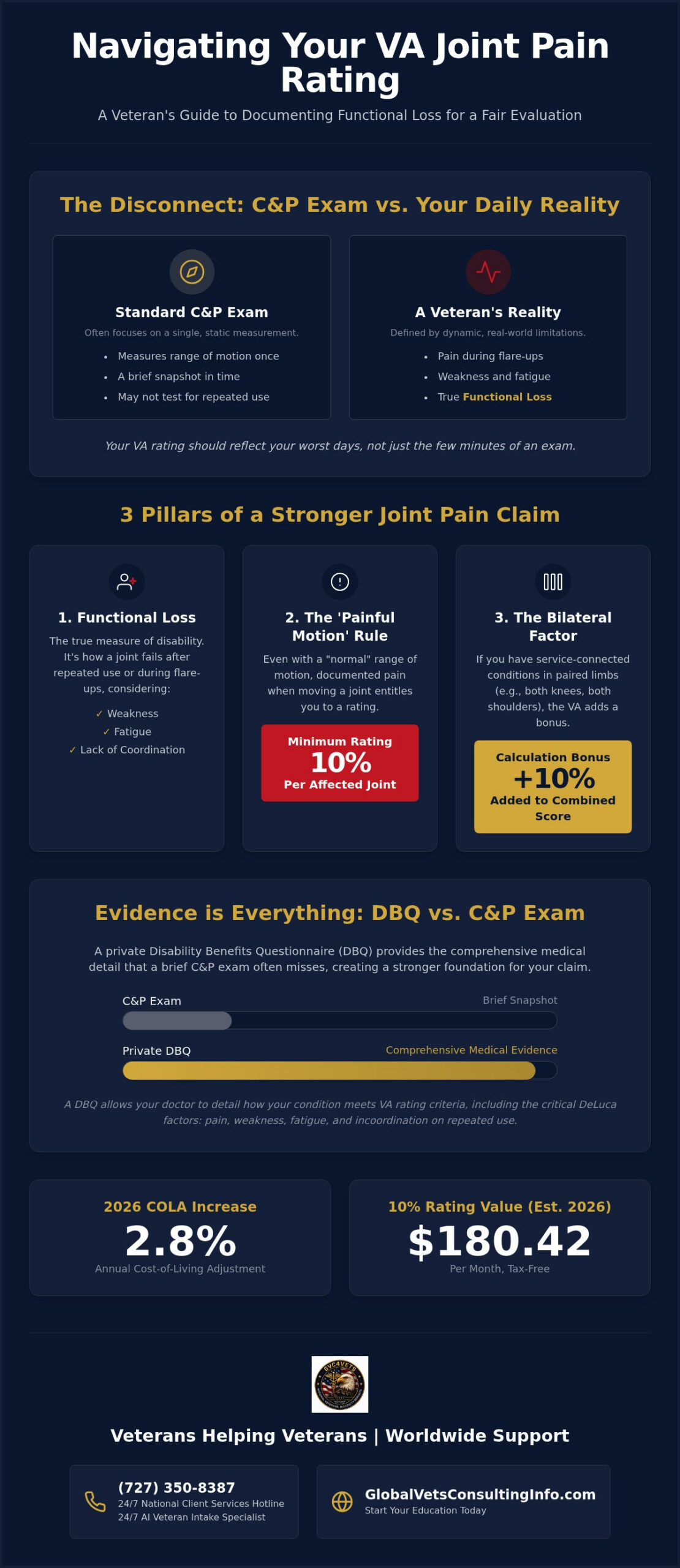
A key concept you must understand is “Functional Loss.” This refers to how a joint fails to perform during flare-ups or after repeated use. If you can bend your knee once in a quiet exam room but struggle after walking a block, that’s functional loss the VA must consider. The rater should look at factors like weakness, fatigue, and lack of coordination, ensuring your rating reflects your worst days, not just your best ones.
Direct vs. Secondary Service Connection
Establishing service connection is your first step. Direct connection applies to injuries sustained during active duty. However, many veterans suffer from secondary conditions where one injury causes another. For instance, you can use the framework of radiculopathy secondary to back condition to understand how a spinal issue leads to nerve pain or joint dysfunction elsewhere. This chain of service connection is vital for securing an accurate combined rating that accounts for all your physical limitations.
The Role of Diagnostic Testing (X-Rays and MRIs)
While imaging like X-rays and MRIs provides helpful evidence, it isn’t the final word. A “normal” X-ray doesn’t disqualify you from a rating. The VA often prioritizes your physical limitations and painful motion over picture-perfect imaging. Your subjective report of pain during movement carries significant weight when documented correctly. We focus on ensuring your medical evidence highlights these functional gaps that a simple picture cannot capture.
Range of Motion vs. Pain with Motion: The 10% Rule 🇺🇸
During a Compensation and Pension (C&P) exam, the examiner uses a tool called a goniometer to measure your degrees of movement. This measurement is often the primary factor in your Joint Pain VA Rating. But it isn’t everything. The landmark DeLuca v. Brown case established that the VA must look beyond simple degrees. The examiner is required to consider how pain, weakness, and fatigue limit your ability to function during repeated use. This is especially relevant for a VA Disability Rating for Knee Pain, where stability and endurance are critical for daily tasks.
Even if your range of motion is normal, if a joint hurts when moved, you are entitled to a minimum 10% rating per joint. This “Pain with Motion” rule ensures that your actual physical experience is compensable. Since C&P exams are snapshots in time, you must also describe your flare-ups. If your joint locks or becomes unusable three days a week, that evidence must be included in your file to avoid an underrated claim.
The Importance of the ‘Pain Point’
Many veterans make the mistake of trying to show strength during their exam. They push through the discomfort to reach a higher degree of movement. You should stop moving the moment pain begins. Pushing through pain results in lower, inaccurate ratings because the examiner records a range of motion that you cannot safely maintain. If you need help preparing for this process, our educational resources provide the guidance you need.
Bilateral Factor: Boosting Your Combined Rating
When you have service-connected pain in both knees, both shoulders, or both ankles, the VA applies the bilateral factor. This adds a 10% bonus to your combined score before rounding. Understanding this “VA math” is essential for maximizing your benefits. You can see how this affects your total compensation in our combined disability rating explained guide.
- National Client Services Hotline: (727) 350-8387
- 24/7 AI Veteran Intake Specialist: (727) 350-8387
- Digital Resource Center: www.GlobalVetsConsultingInfo.com
How to Use a DBQ to Document Joint Severity 🇺🇸
In 2026, the Disability Benefits Questionnaire (DBQ) has become the most critical piece of evidence for any veteran seeking a Joint Pain VA Rating. While many rely on the VA to complete these during a Compensation and Pension exam, a private DBQ often provides a more thorough assessment. Musculoskeletal DBQs are designed to capture specific data points that a rushed examiner might miss, such as instability, crepitus, and the exact degrees of limited motion. These details are the difference between a 0% and a compensable rating.
Global Vets Consulting specializes in providing education on what is a dbq to help you navigate this documentation process. We ensure that every form is compliant with VA standards while reflecting the true severity of your condition. Our mission is to empower you with the medical evidence education required to substantiate your claim effectively.
Step 1: Gathering Treatment Records
Your first move is to compile all service treatment records (STRs) along with any private medical history. It isn’t enough to have a diagnosis; your records must highlight “functional impairment.” Ensure your documentation mentions specific instances where your joint pain prevents you from completing tasks at work or home. This establishes the necessary link between your service and your current physical limitations.
Step 2: Professional DBQ Completion
When you move toward completing a DBQ, work with advocates who understand the “Veterans Helping Veterans” model. A professional DBQ should explicitly address “Pain with Motion” and the frequency of “Flare-ups,” which are the keys to a fair Joint Pain VA Rating. If you’re ready to secure the documentation you’ve earned, call our 24/7 National Client Services Hotline and 24/7 AI Veteran Intake Specialist at (727) 350-8387 or visit www.GlobalVetsConsultingInfo.com today.
Maximizing Your VA Rating with Global Vets 🇺🇸
You don’t have to face the complex VA bureaucracy on your own. Many veterans find that their initial attempts to secure a Joint Pain VA Rating fail simply because the paperwork doesn’t speak the VA’s language. We provide the educational resources necessary for a va disability rating increase, ensuring your file is supported by clear, clinical evidence. This partnership approach takes the guesswork out of the process and allows you to focus on your health while we guide you through the documentation requirements.
If you’ve recently received a va claim denied for lack of evidence, professional DBQ preparation is your logical next step. A denial isn’t the end of the road; it’s often a sign that your medical records didn’t clearly illustrate the functional loss we discussed earlier. By using standardized forms that detail the severity of your service-connected conditions, you present a case that the VA cannot easily ignore.
Contacting Our 24/7 National Hotline
Our commitment to the veteran community is worldwide and constant. You can reach our 24/7 National Client Services Hotline and our 24/7 AI Veteran Intake Specialist at (727) 350-8387. Whether you’re at home or stationed abroad, this line connects you to immediate assistance. We operate with a mission-driven focus to ensure no veteran feels neglected by the system they served.
Next Steps for Your 2026 Claim
Visit GlobalVetsConsultingInfo.com to begin your evidence-gathering process. Once your DBQ is complete, use it as a study guide for your C&P exam. Reviewing your documented limitations beforehand helps you communicate accurately with the examiner. This preparation ensures your Joint Pain VA Rating finally reflects the true physical cost of your service.
Secure Your Earned Benefits Today 🇺🇸
Securing an accurate Joint Pain VA Rating requires moving beyond simple range of motion tests. You must document the functional loss you experience every day. By focusing on the DeLuca criteria and utilizing a private Disability Benefits Questionnaire, you provide the VA with the specific medical evidence needed to substantiate your claim’s severity. This proactive approach ensures that pain, weakness, and flare-ups are properly accounted for in your final rating percentage.
As a veteran-owned and operated organization, we are dedicated to providing worldwide support to those who served. You don’t have to navigate these complex administrative hurdles alone. Ready to secure the rating you earned? Contact Global Vets Consulting at (727) 350-8387 or visit our website today! Our 24/7 National Client Services Hotline and AI Veteran Intake Specialist are always available. Take the next step toward the compensation you deserve. You’ve done the hard work of serving our country; let’s finish the mission together.
Frequently Asked Questions
What is the minimum VA rating for joint pain?
The minimum compensable rating for a joint that is painful during movement is 10% under 38 CFR § 4.59. This Painful Motion Rule ensures that veterans receive compensation even when their range of motion falls within normal limits. If you experience pain during flexion or extension, the VA must assign this baseline percentage. It’s a critical component of securing an accurate Joint Pain VA Rating for your musculoskeletal conditions.
Can I get a VA rating for joint pain if my X-ray is normal?
You can definitely receive a disability rating even if your X-rays or MRIs show no structural damage. The VA focuses on functional loss, which includes pain, weakness, and fatigue during motion. Since imaging can’t always capture the severity of your pain during a flare-up, your personal testimony and a detailed DBQ are vital. These records prove your limitations are real, regardless of what a static picture might show.
How does the VA test joint range of motion in 2026?
In 2026, the VA continues to use a goniometer to measure degrees of flexion and extension during exams. However, examiners must follow the March 25, 2026, update to the M21-1 manual, which prioritizes functional loss over simple measurements. They must evaluate how your joint performs under the stress of repeated use and during flare-ups. This comprehensive approach ensures that the DeLuca criteria are applied to capture your true level of physical impairment.
What is the bilateral factor for joint pain?
The bilateral factor applies when you have service-connected disabilities affecting both arms or both legs. When this occurs, the VA calculates the combined rating for those specific joints and adds a 10% increase to that subtotal. This extra boost acknowledges that suffering from musculoskeletal issues on both sides of your body creates a greater impact on your daily life. It is a powerful tool for maximizing your total compensation.
Can I submit a private DBQ for joint pain instead of a C&P exam?
You can submit a private DBQ, and the VA is required to review it if it meets sufficiency standards. A private DBQ often provides a more detailed account of your functional loss than a standard C&P exam. Global Vets Consulting provides the educational resources needed to substantiate your claim with accurate medical documentation. For 24/7 worldwide assistance, call (727) 350-8387 or visit https://www.GlobalVetsConsultingInfo.com to learn about your Joint Pain VA Rating.

Article by
Willie Daniel
Willie Daniel is the Founder and Chief Executive Officer (CEO) of Global Vets Consulting (GVC4Vets) – National Veterans Disability Services, a veteran-led educational and medical evidence support organization dedicated to helping veterans better understand VA disability rating increases, DBQ medical evidence, secondary claims education, and C&P examination preparation.
He is a retired U.S. Army Medical Service Corps Officer with more than 27 years of honorable military service, a decorated Iraq combat veteran, and a retired federal official with the U.S. Department of Veterans Affairs. Throughout his military and federal career, Willie Daniel served in leadership, healthcare administration, operational, and veteran-support roles focused on improving services and support systems for servicemembers, veterans, and their families.
Drawing from decades of military leadership, healthcare administration, veteran advocacy, and federal government experience, Willie Daniel brings a practical, veteran-centered perspective to Global Vets Consulting’s educational articles, AI-powered veteran resources, video education initiatives, and outreach programs. His experience navigating military systems, medical documentation processes, and veteran-related administrative operations provides valuable insight into many of the challenges veterans face when seeking to better understand VA disability rating criteria, medical evidence, documentation strategies, and secondary condition education.
Through GVC’s “Veterans Helping Veterans” mission, his focus is on delivering clear, educational, and easy-to-understand information designed to empower veterans with knowledge, resources, and educational tools that may help them make more informed decisions regarding their individual VA disability journeys.
The information provided through GVC is intended for educational and informational purposes only and should not be considered legal or medical advice.
Disclaimer
Disclaimer: Global Vets Consulting, LLC (“GVC”) is a veteran-led educational and medical evidence support organization. GVC is not a law firm, is not a Veterans Service Organization (VSO), and is not affiliated with the U.S. Department of Veterans Affairs (VA) or any government agency.
Global Vets Consulting does not provide legal advice, medical advice, medical treatment, or healthcare services. GVC does not prepare, file, or submit VA disability claims on behalf of veterans. All information provided through this website, blog articles, videos, educational materials, AI tools, dashboards, templates, and communications is intended solely for general educational and informational purposes.
Veterans are encouraged to consult with accredited representatives, licensed attorneys, qualified medical providers, or Veterans Service Organizations regarding their specific legal, medical, or VA-related matters. VA disability decisions, ratings, and outcomes are determined solely by the U.S. Department of Veterans Affairs based on applicable laws, regulations, medical evidence, and individual circumstances. Past results do not guarantee future outcomes.

