

Imagine sitting in a C&P exam trying to explain the constant pins and needles shooting down your leg, only to have the examiner check a box and move on. It’s frustrating when your difficulty walking or gripping objects is treated like a minor inconvenience. You know the pain is real, and it’s likely tied directly to your service-connected back issues. We understand that feeling of being unheard because we’re veterans too. Securing the correct Radiculopathy VA Rating isn’t just about the monthly payment. It’s about receiving the recognition you earned through your service.
In this guide, you’ll learn how the VA evaluates nerve damage, from the 10% to 40% rating tiers to the 2026 COLA-adjusted rates. We’ll show you how to link radiculopathy as a secondary condition and why a professional Disability Benefits Questionnaire (DBQ) is the key to reflecting your functional loss. At Global Vets Consulting, we provide the medical evidence education you need. Our 24/7 National Client Services Hotline at (727) 350-8387 and our resources at https://www.GlobalVetsConsultingInfo.com are available to help you worldwide.
Key Takeaways
- Understand the specific criteria the VA uses to assign a Radiculopathy VA Rating between 10% and 40% based on nerve root compression and functional loss.
- Learn how to successfully link nerve pain as a secondary condition to existing service-connected spinal issues like degenerative disc disease.
- Identify why a detailed Disability Benefits Questionnaire (DBQ) is essential for documenting symptoms that standard C&P exams often downplay or overlook.
- Access 24/7 educational resources through our National Client Services Hotline at (727) 350-8387 or visit https://www.GlobalVetsConsultingInfo.com for worldwide support.
What is Radiculopathy and How Does the VA Rate It?
Understanding What is Radiculopathy is the first step toward securing your benefits. This condition occurs when a nerve root in your spinal column is compressed or inflamed, leading to symptoms like burning pain, “electric shocks,” and weakness in your extremities. The VA evaluates your Radiculopathy VA Rating under 38 CFR Part 4, specifically within the schedule for Neurological Conditions and Convulsive Disorders. They don’t just look at where it hurts; they focus on how the nerve damage impacts your ability to function daily.
Ratings depend on which specific nerve is damaged, such as the sciatic or femoral nerves. If you experience a loss of motor control or constant numbness, these objective findings carry more weight than subjective pain alone. It’s a complex system, but knowing how the VA classifies these issues helps you build a stronger case for the compensation you’ve earned.
Upper vs. Lower Extremity Radiculopathy
Radiculopathy is categorized by where the nerve compression occurs. Cervical radiculopathy stems from the neck and radiates into your shoulders, arms, or hands. Lumbar radiculopathy, often called sciatica, affects your lower back and travels down into your hips, legs, and feet. You can receive a Radiculopathy VA Rating for both areas if you have separate service-connected spinal issues in your neck and back.
The 38 CFR Rating Criteria
The VA uses three main classifications to determine severity: paralysis, neuritis, and neuralgia. Paralysis is the most severe, involving a total or partial loss of movement. Neuritis involves nerve inflammation with sensory or motor loss, while neuralgia refers to nerve pain without significant functional loss. The key is proving functional loss. If your condition makes it hard to stand or grip tools, you need that documented clearly. For help navigating this process, contact our 24/7 National Client Services Hotline at (727) 350-8387 or visit https://www.GlobalVetsConsultingInfo.com for worldwide support.
VA Rating Percentages for Radiculopathy: 10% to 40%
The VA assigns a Radiculopathy VA Rating based on the severity of your symptoms and how they impact your functional capacity. According to the VA’s Schedule for Rating Disabilities, these percentages are broken down by the degree of nerve impairment rather than just the presence of pain. The evaluation focuses on objective evidence of sensory and motor loss.
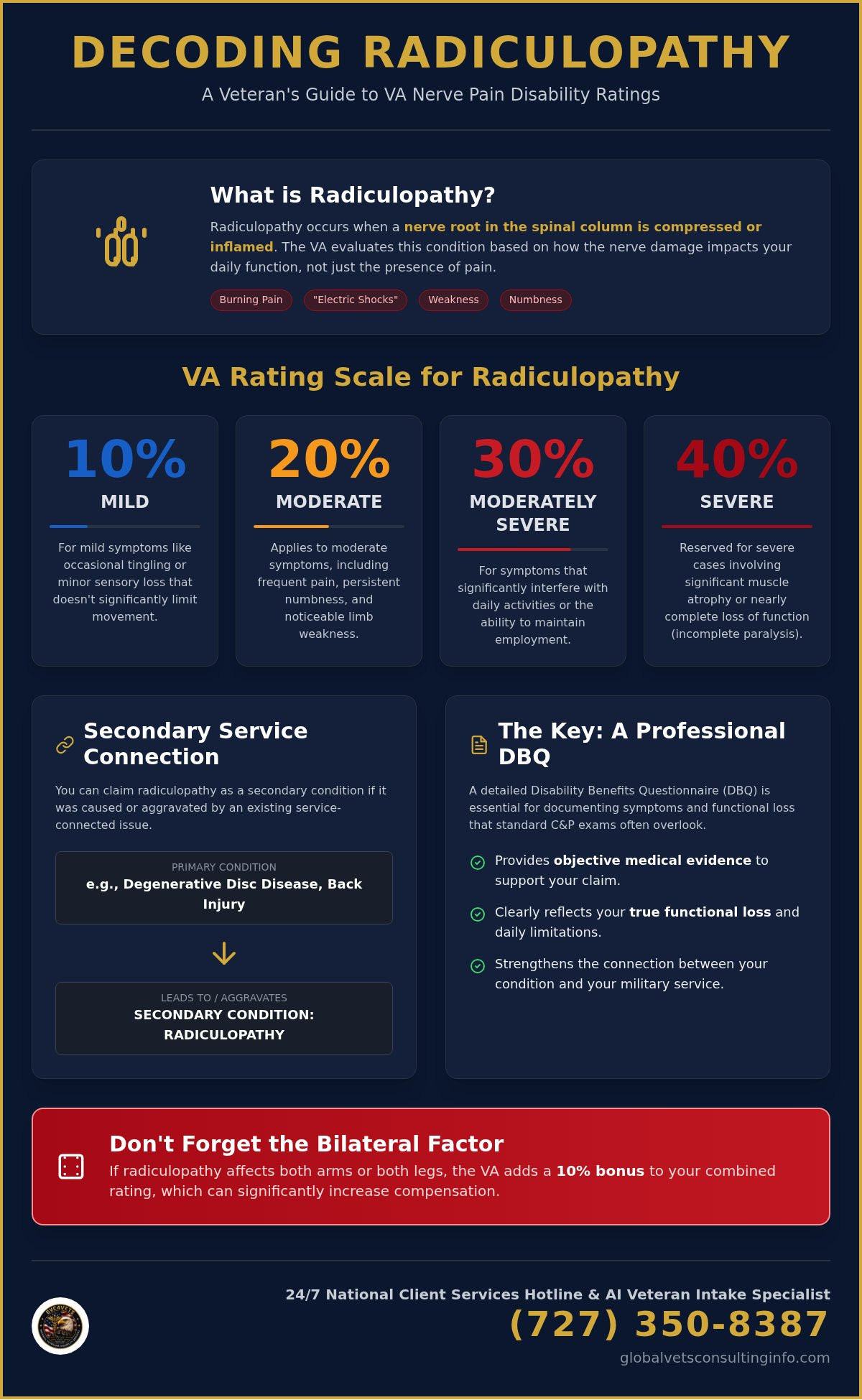
- 10% Rating: This is for mild symptoms, such as occasional tingling or minor sensory loss that doesn’t significantly limit movement.
- 20% Rating: This applies to moderate symptoms, characterized by frequent pain, persistent numbness, and noticeable weakness in the affected limb.
- 30% Rating: This tier is for moderately severe symptoms that significantly interfere with your daily activities or your ability to maintain employment.
- 40% Rating: This is reserved for severe symptoms, often involving significant muscle atrophy or nearly complete loss of function, also known as incomplete paralysis.
The Bilateral Factor Boost
If your radiculopathy affects both legs or both arms, you may qualify for the bilateral factor. This rule adds a 10% “bonus” to your combined rating before the VA applies its standard math. Documenting symptoms in both limbs is critical, even if one side feels less severe, as it can push your total compensation higher. If you’re unsure where your symptoms fall, exploring Secondary VA Claims Education can help you identify the right path forward for your claim.
Sciatica vs. Other Nerve Ratings
The sciatic nerve is the most common focus of a Radiculopathy VA Rating. While mild sciatica starts at 10%, severe cases can reach 40% for radiculopathy. In rare instances of complete paralysis, the rating can climb to 80%, though most veterans fall within the 10% to 40% range. To ensure your evidence is accurate, call our 24/7 hotline at (727) 350-8387 or visit https://www.GlobalVetsConsultingInfo.com for assistance worldwide.
Secondary Service Connection: Linking Radiculopathy to Back Pain
Most veterans don’t realize their back pain and leg numbness are separate rating opportunities. If you have a service-connected condition like degenerative disc disease (DDD) or a herniated disc, you can claim radiculopathy as a secondary condition. To win, you must prove your spinal condition “proximately caused” or “aggravated” your nerve damage. This strategic link is a powerful way to increase your compensation, often moving a veteran from a 20% or 40% rating into the 70% or 80% range due to combined disability ratings.
Success requires three specific elements: a current medical diagnosis of radiculopathy, a service-connected primary back condition, and a medical “Nexus” or link. Without that link, the VA may treat your nerve pain as an unrelated issue. We specialize in Secondary VA Claims Education to help you understand how to bridge this gap and secure the benefits you’ve earned.
The Importance of a Nexus Letter
A Nexus letter is where a medical professional connects your MRI results to your physical symptoms. They must use the specific phrase “more likely than not” to establish that your service-connected back issue is the direct cause of your nerve pain. This professional opinion is what transforms a “maybe” into a “yes” for your Radiculopathy VA Rating, providing the medical evidence the VA requires to grant service connection.
Common Secondary Conditions to Radiculopathy
Nerve damage can lead to other issues like “drop foot” or significant changes in your gait. While the VA’s “pyramiding” rule prevents you from being rated twice for the same symptom, you can maximize your unique nerve ratings for each limb affected. Our team provides 24/7 support to help you navigate these complexities. Call our National Client Services Hotline at (727) 350-8387 or visit https://www.GlobalVetsConsultingInfo.com for worldwide assistance.
Securing Your Rating with a Professional DBQ
A Disability Benefits Questionnaire (DBQ) is the primary tool the VA uses to evaluate the severity of your condition. Many veterans find that C&P examiners spend less than 15 minutes checking their nerves. This often results in a “mild” 10% Radiculopathy VA Rating that doesn’t reflect the true impact on your life. A private DBQ ensures every symptom, from muscle weakness to sensory loss, is documented with the level of detail your claim deserves. A properly filled-out form can be the deciding factor between a 10% rating and a 40% rating.
Global Vets Consulting specializes in providing the detailed medical evidence education required to support VA rating increases. We help you present a clear picture of your functional loss so the VA has the evidence needed to make an accurate decision. Winning your Radiculopathy VA Rating requires this level of meticulous documentation to counter rushed examinations.
The Global Vets Consulting Difference 🇺🇸
We operate under a “Veterans Helping Veterans” model. We understand the symptoms you’re describing because we’ve been in your position. Our process focuses on delivering standardized forms that the VA cannot easily ignore. We’re dedicated to the well-being of the veteran community worldwide. You can reach our 24/7 National Client Services Hotline at (727) 350-8387 to start your intake with our AI specialist or a team member today.
Next Steps for Your Radiculopathy Claim
- Step 1: Obtain a formal diagnosis through an MRI or EMG (Electromyography) to confirm nerve root compression.
- Step 2: Contact Global Vets Consulting for specialized DBQ preparation education.
- Step 3: Submit your Fully Developed Claim with strong medical evidence to ensure the fastest possible processing time.
For more resources and support, visit our primary digital resource at https://www.GlobalVetsConsultingInfo.com. We are available 24/7 to assist veterans across the globe.
Take Control of Your Radiculopathy Claim Today 🇺🇸
Securing a fair Radiculopathy VA Rating requires moving beyond subjective pain to demonstrate measurable functional loss. You now understand how to link nerve damage to your service-connected back pain and why the 10% to 40% rating tiers depend on precise medical evidence. A detailed DBQ remains your strongest tool for ensuring the VA sees the full extent of your symptoms.
As a veteran-owned and operated team, we specialize in neurological conditions and the documentation needed to win your claim. Our 24/7 AI Veteran Intake Specialist is available to assist you regardless of your location worldwide. Ready to secure the rating you deserve? Contact Global Vets Consulting Today or call our 24/7 National Client Services Hotline at (727) 350-8387. You earned these benefits through your service, and we’re here to help you claim them with confidence. It’s time to take the next step in your mission.
Frequently Asked Questions
Can I get a VA rating for radiculopathy if my back claim was denied?
You typically cannot receive a secondary rating for radiculopathy if your primary back claim was denied. Because radiculopathy is usually linked to spinal issues like degenerative disc disease, the VA requires a service connected primary condition to establish a secondary link. If your back claim was denied, you should focus on appealing that decision or providing a Nexus letter that proves your nerve damage was directly caused by your military service.
What is the maximum VA rating for radiculopathy in one leg?
The maximum Radiculopathy VA Rating for incomplete paralysis of the sciatic nerve is 40% for severe symptoms. While complete paralysis can reach 80%, most veterans with radiculopathy fall within the 10% to 40% range. This depends on the severity of your muscle atrophy and functional loss. Documenting these symptoms through a professional DBQ is essential to ensure the VA accurately reflects the limitations you experience in your daily life.
Does the VA consider numbness the same as pain for rating purposes?
The VA evaluates numbness and pain differently when determining your disability percentage. Numbness is considered a sensory loss and often results in a lower 10% rating if it’s mild. Functional loss, such as weakness or a lack of motor control, leads to higher ratings. It’s important to describe how these symptoms affect your ability to walk or grip objects during your exam to ensure your rating reflects your actual level of impairment.
How does the bilateral factor affect my radiculopathy rating?
The bilateral factor provides a 10% boost to your combined rating if you have radiculopathy in both legs or both arms. The VA combines the ratings for the affected limbs first, then adds a 10% increase to that subtotal before finishing the rest of your disability math. This can significantly increase your monthly compensation. For guidance on documenting bilateral symptoms, call our 24/7 National Client Services Hotline at (727) 350-8387 for worldwide support.
Do I need an EMG test to prove radiculopathy to the VA?
While a formal EMG test isn’t a mandatory requirement to secure a Radiculopathy VA Rating, it provides the objective medical evidence needed to strengthen your claim. An EMG or MRI offers proof of nerve root compression that a standard physical exam might miss. This evidence makes it much harder for the VA to downplay your symptoms. You can find more information on gathering medical evidence at https://www.GlobalVetsConsultingInfo.com where we provide 24/7 educational resources.

Article by
Willie Daniel
Willie Daniel is the Founder and Chief Executive Officer (CEO) of Global Vets Consulting (GVC4Vets) – National Veterans Disability Services, a veteran-led educational and medical evidence support organization dedicated to helping veterans better understand VA disability rating increases, DBQ medical evidence, secondary claims education, and C&P examination preparation.
He is a retired U.S. Army Medical Service Corps Officer with more than 27 years of honorable military service, a decorated Iraq combat veteran, and a retired federal official with the U.S. Department of Veterans Affairs. Throughout his military and federal career, Willie Daniel served in leadership, healthcare administration, operational, and veteran-support roles focused on improving services and support systems for servicemembers, veterans, and their families.
Drawing from decades of military leadership, healthcare administration, veteran advocacy, and federal government experience, Willie Daniel brings a practical, veteran-centered perspective to Global Vets Consulting’s educational articles, AI-powered veteran resources, video education initiatives, and outreach programs. His experience navigating military systems, medical documentation processes, and veteran-related administrative operations provides valuable insight into many of the challenges veterans face when seeking to better understand VA disability rating criteria, medical evidence, documentation strategies, and secondary condition education.
Through GVC’s “Veterans Helping Veterans” mission, his focus is on delivering clear, educational, and easy-to-understand information designed to empower veterans with knowledge, resources, and educational tools that may help them make more informed decisions regarding their individual VA disability journeys.
The information provided through GVC is intended for educational and informational purposes only and should not be considered legal or medical advice.
Disclaimer
Disclaimer: Global Vets Consulting, LLC (“GVC”) is a veteran-led educational and medical evidence support organization. GVC is not a law firm, is not a Veterans Service Organization (VSO), and is not affiliated with the U.S. Department of Veterans Affairs (VA) or any government agency.
Global Vets Consulting does not provide legal advice, medical advice, medical treatment, or healthcare services. GVC does not prepare, file, or submit VA disability claims on behalf of veterans. All information provided through this website, blog articles, videos, educational materials, AI tools, dashboards, templates, and communications is intended solely for general educational and informational purposes.
Veterans are encouraged to consult with accredited representatives, licensed attorneys, qualified medical providers, or Veterans Service Organizations regarding their specific legal, medical, or VA-related matters. VA disability decisions, ratings, and outcomes are determined solely by the U.S. Department of Veterans Affairs based on applicable laws, regulations, medical evidence, and individual circumstances. Past results do not guarantee future outcomes.

