

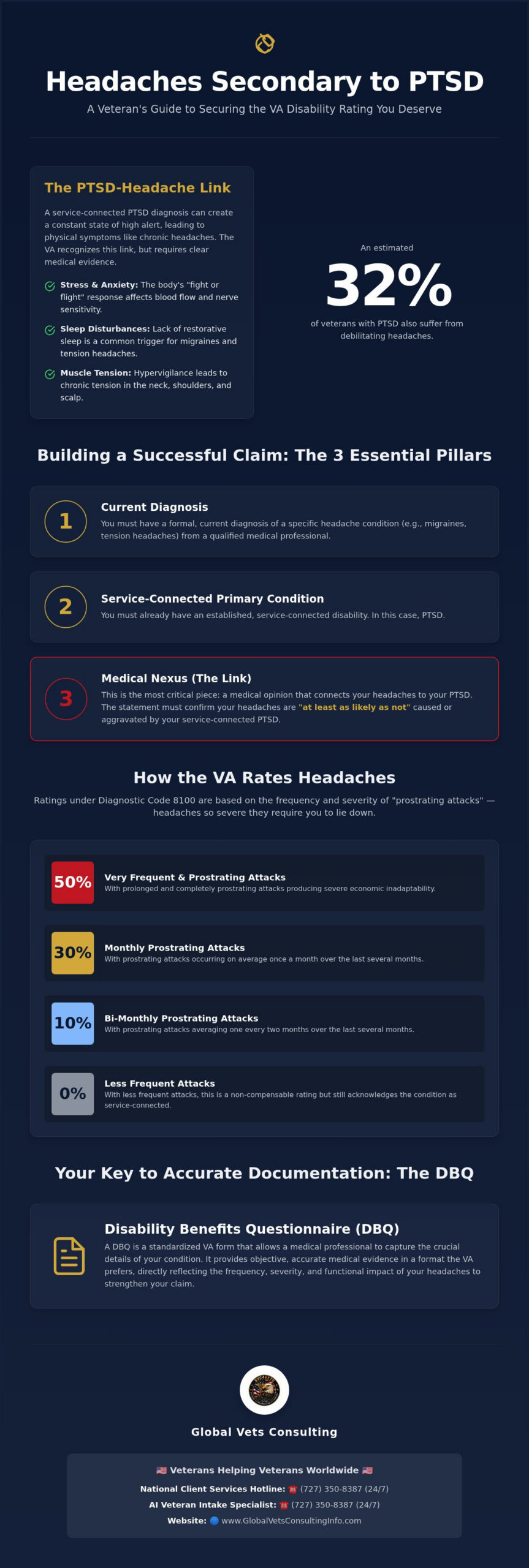
An estimated 32% of veterans living with PTSD also suffer from debilitating headaches that can disrupt their daily lives and ability to work. You likely understand the frustration of seeking a rating for Headaches Secondary to PTSD, only to receive a decision that fails to reflect your true daily struggle. Dealing with frequent, prostrating attacks is exhausting, especially when you’re already managing the weight of your service-connected mental health condition. It’s often confusing to bridge the gap between mental health and physical symptoms in a way the VA accepts.
This guide will show you how to successfully link your headaches to PTSD and secure the disability rating you’ve earned through proper medical evidence. We’ll examine the requirements for a medical nexus, explain how the VA evaluates “economic inadaptability” under Diagnostic Code 8100, and provide a clear path toward documentation that accurately reflects your condition. By the end, you’ll have a step-by-step framework to ensure your benefits align with the 2026 compensation rates.
Key Takeaways
- Learn how the stress, anxiety, and sleep disturbances associated with service-connected PTSD can serve as the primary clinical triggers for chronic headaches.
- Identify the three essential elements for a successful claim, including a medical nexus that links your Headaches Secondary to PTSD as “at least as likely as not” related.
- Understand the VA’s rating criteria for migraines and how the frequency of “prostrating attacks” determines whether you receive a 0%, 10%, 30%, or 50% rating.
- Discover how to use standardized Disability Benefits Questionnaires (DBQs) to provide the VA with the accurate medical documentation needed to reflect your true level of disability.
The Connection Between PTSD and Secondary Headaches Explained
A secondary service connection occurs when a disability is caused or aggravated by an already service-connected condition. In many cases, Post-traumatic stress disorder acts as the primary trigger for chronic neurological issues. When you live with PTSD, the constant influx of stress, anxiety, and sleep disturbances creates a physical environment where headaches can thrive. This makes Headaches Secondary to PTSD a frequent reality for those navigating the VA system.
The link is deeply biological. It centers on the body’s “fight or flight” response. This state of high alert affects blood flow and heightens nerve sensitivity, particularly within the neurovascular system. Chronic activation of these pathways can lead to frequent episodes of pain. It’s helpful to identify whether you’re experiencing migraines, tension headaches, or a combination of both. Specific diagnoses always strengthen your documentation.
Why Migraines are Common Secondary Conditions to PTSD
Hypervigilance often leads to involuntary muscle tension in the neck, shoulders, and scalp. This constant physical strain is a primary contributor to secondary headaches. Beyond physical tension, the medications prescribed for PTSD symptoms can sometimes list headaches as a side effect, further complicating your health. The VA acknowledges that mental health conditions and physical pain are often intertwined. However, success depends on moving beyond general symptoms to provide specific medical evidence.
A strong claim relies on showing how your service-connected PTSD directly influences the frequency and severity of your headaches. You must demonstrate this clear correlation through a professional medical opinion. This evidence acts as the foundation for your secondary service connection, ensuring the VA sees the full impact of your condition on your daily life.
Proving the Nexus: How PTSD Causes Secondary Headaches
A successful claim for Headaches Secondary to PTSD relies on three fundamental pillars. First, you need a current medical diagnosis of headaches or migraines. Second, you must have an established service-connected condition, which in this case is your PTSD. Finally, you must provide a medical nexus that bridges the two. This link is the most critical part of your application. It proves that your headaches aren’t a separate, random occurrence but are proximately due to or aggravated by your mental health symptoms.
The VA defines a medical nexus as a professional opinion stating your condition is “at least as likely as not” caused by your service-connected disability. When establishing a secondary service connection for migraines, this specific phrasing is mandatory. Without it, the VA may deny the claim due to lack of evidence. You can strengthen this connection by submitting personal medical records, buddy letters from those who witness your attacks, and a detailed headache log that tracks frequency and duration. Obtaining an independent medical opinion va provides the expert clinical perspective needed to validate these claims and provides a clear path forward for your documentation.
Medical Evidence Requirements for a Secondary Service Connection
A formal diagnosis is your starting point. You cannot claim “head pain” without a licensed professional confirming the specific type of headache you suffer from. Using a dbq for mental health conditions helps establish the severity of the primary PTSD, which then sets the stage for the secondary link. Continuity of care is equally vital. If your medical history shows gaps in treatment, the VA might question the chronic nature of your symptoms. Consistent documentation ensures your records reflect the true impact of Headaches Secondary to PTSD over time. If you’re struggling to gather this proof, seeking professional guidance can help you strengthen your medical evidence before submission.
Using a DBQ to Document Headache Severity and Frequency
The VA assigns disability ratings based on the severity and frequency of symptoms under Diagnostic Code 8100. A VA rating for Migraines Secondary to PTSD typically falls into brackets of 0%, 10%, 30%, or 50%. These percentages depend entirely on the occurrence of “prostrating attacks” over a specific period. A prostrating attack is a debilitating event that forces you to seek a dark, quiet room because you’re unable to function. The VA defines prostration as a state of extreme exhaustion or powerlessness.
An accurate disability benefits questionnaire (DBQ) acts as a roadmap for a provider to record these specific details. It captures the clinical evidence needed to prove the intensity of your condition. When you’re pursuing a claim for Headaches Secondary to PTSD, this form ensures that every prostrating event is documented using the VA’s own language. If you’re ready to build a stronger case, you can explore our educational resources to better understand the documentation process.
Common Mistakes in Headache DBQs and How to Avoid Them
Vague language is a common pitfall. Instead of saying you have headaches “frequently,” use specific numbers like “two prostrating attacks per month.” You should also clearly document “economic inadaptability,” which describes how your symptoms prevent you from maintaining gainful employment. Many veterans rely solely on a C&P examiner, but these appointments often last less than 15 minutes. This brief window isn’t always enough to capture years of medical history. Bringing your own completed DBQ helps ensure the VA sees the full impact of your Headaches Secondary to PTSD.
How to File Your Secondary Claim with Global Vets Consulting (GVC4Vets) 🇺🇸
Global Vets Consulting (GVC4Vets) operates on the principle of “Veterans Helping Veterans.” We recognize that navigating the VA system for Headaches Secondary to PTSD is often a source of immense stress. Our approach is designed to reduce that anxiety by acting as a knowledgeable advocate. We don’t just provide information; we offer a steady partnership to ensure your medical evidence is thorough and accurate.
Many veterans take a reactive approach by waiting for a C&P exam to explain their symptoms. This often leads to incomplete records. Our intake services streamline the va disability claims process step by step by helping you prepare standardized medical documentation before you file. By submitting a private DBQ, you provide the VA with a clear, professional overview of your condition that the examiner cannot easily overlook.
It’s vital to remember that these benefits aren’t a gift. You earned them through your dedicated service and the sacrifices you’ve made. The mission at Global Vets Consulting (GVC4Vets) is to help you secure the rating that reflects your true level of disability through meticulous evidence preparation.
Step-by-Step Intake Process for Veterans
- Step 1: Contact our 24/7 AI Veteran Intake Specialist at 📞 (727) 350-8387. This allows you to begin your journey at any time, day or night, without waiting for business hours.
- Step 2: Visit 🌐 learn more to explore our educational resources. Learning about the requirements for secondary service connections empowers you to make informed decisions about your claim.
- Step 3: Work with our team to ensure your DBQ accurately reflects your symptoms and limitations. We help you translate your daily pain into the precise terminology the VA requires to understand the full impact on your life.
Secure Your Earned Disability Benefits Today
Securing a fair rating for Headaches Secondary to PTSD requires more than just describing your symptoms to an examiner. It demands a precise medical nexus that bridges your mental health history with your physical pain. By using standardized Disability Benefits Questionnaires and maintaining a detailed headache log, you ensure your documentation reflects the true severity of your prostrating attacks and their impact on your ability to work. You’ve already done the hard work through your service and sacrifice; now it’s time to ensure your medical evidence tells your full story.
As a veteran-owned and operated partner, Global Vets Consulting (GVC4Vets) provides specialized secondary VA claims education to help you navigate this complex system with confidence. Our intake team is available through our 24/7 National Client Services Hotline at (727) 350-8387 to help you begin the process. Ready to get the rating you deserve? 🇺🇸 Start your intake with Global Vets Consulting (GVC4Vets) today! You don’t have to face the VA alone. We are here to help you move forward with the clarity and support you’ve earned.
Frequently Asked Questions
Can I get a VA rating for headaches if they started after I left the military?
You can absolutely receive a rating for headaches that began after your service by filing on a secondary basis. This requires proving that your service-connected PTSD either caused or aggravated the condition. Since many neurological issues develop over time due to chronic stress or sleep disturbances, the timing of the onset doesn’t disqualify you. You simply need a medical nexus connecting the two conditions to establish eligibility.
What is the maximum VA disability rating for migraines secondary to PTSD?
The maximum rating for migraines under Diagnostic Code 8100 is 50%. This highest level is reserved for veterans who experience very frequent, completely prostrating attacks that occur over several months. These attacks must also demonstrate “economic inadaptability,” meaning they significantly interfere with your ability to maintain gainful employment. Ratings of 0%, 10%, and 30% are also possible depending on the severity of your Headaches Secondary to PTSD.
Do I need a C&P exam if I submit a private DBQ for headaches?
The VA often schedules a Compensation and Pension (C&P) exam even if you provide a private Disability Benefits Questionnaire (DBQ). However, submitting a thoroughly completed private DBQ ensures your medical history and specific symptoms are accurately documented before you even enter the room. This evidence acts as a primary source for the rater, making it harder for a brief 15 minute C&P exam to overlook your daily struggles and limitations.
How do I prove my headaches are “prostrating” to the VA?
Proving prostration requires documenting the specific need to seek a dark, quiet room and lie down until the pain subsides. You should maintain a detailed headache log that tracks the date, duration, and severity of each attack. Using precise language in your DBQ to describe “extreme exhaustion or powerlessness” is essential. Providing statements from family members or coworkers can also corroborate how these episodes prevent you from functioning or working.
What happens if my VA claim for headaches secondary to PTSD is denied?
If your claim is denied, you have several options for appeal, including a Supplemental Claim or a Higher-Level Review. A denial often stems from a lack of a clear medical nexus or insufficient evidence of prostration. You can address these gaps by gathering more robust medical documentation or an independent medical opinion. Reviewing your decision letter carefully will reveal exactly what evidence was missing, allowing you to strengthen your Headaches Secondary to PTSD claim.

Article by
Willie Daniel
Willie Daniel is the Founder and Chief Executive Officer (CEO) of Global Vets Consulting (GVC4Vets) – National Veterans Disability Services, a veteran-led educational and medical evidence support organization dedicated to helping veterans better understand VA disability rating increases, DBQ medical evidence, secondary claims education, and C&P examination preparation.
He is a retired U.S. Army Medical Service Corps Officer with more than 27 years of honorable military service, a decorated Iraq combat veteran, and a retired federal official with the U.S. Department of Veterans Affairs. Throughout his military and federal career, Willie Daniel served in leadership, healthcare administration, operational, and veteran-support roles focused on improving services and support systems for servicemembers, veterans, and their families.
Drawing from decades of military leadership, healthcare administration, veteran advocacy, and federal government experience, Willie Daniel brings a practical, veteran-centered perspective to Global Vets Consulting’s educational articles, AI-powered veteran resources, video education initiatives, and outreach programs. His experience navigating military systems, medical documentation processes, and veteran-related administrative operations provides valuable insight into many of the challenges veterans face when seeking to better understand VA disability rating criteria, medical evidence, documentation strategies, and secondary condition education.
Through GVC’s “Veterans Helping Veterans” mission, his focus is on delivering clear, educational, and easy-to-understand information designed to empower veterans with knowledge, resources, and educational tools that may help them make more informed decisions regarding their individual VA disability journeys.
The information provided through GVC is intended for educational and informational purposes only and should not be considered legal or medical advice.
Disclaimer
Disclaimer: Global Vets Consulting, LLC (“GVC”) is a veteran-led educational and medical evidence support organization. GVC is not a law firm, is not a Veterans Service Organization (VSO), and is not affiliated with the U.S. Department of Veterans Affairs (VA) or any government agency.
Global Vets Consulting does not provide legal advice, medical advice, medical treatment, or healthcare services. GVC does not prepare, file, or submit VA disability claims on behalf of veterans. All information provided through this website, blog articles, videos, educational materials, AI tools, dashboards, templates, and communications is intended solely for general educational and informational purposes.
Veterans are encouraged to consult with accredited representatives, licensed attorneys, qualified medical providers, or Veterans Service Organizations regarding their specific legal, medical, or VA-related matters. VA disability decisions, ratings, and outcomes are determined solely by the U.S. Department of Veterans Affairs based on applicable laws, regulations, medical evidence, and individual circumstances. Past results do not guarantee future outcomes.