Walking into a Compensation and Pension evaluation with a hidden recording device might feel like the only way to protect yourself from a biased examiner, but it often creates more problems than it solves. You’ve likely spent months worrying about “VA math” or the possibility of a low rating because an examiner didn’t listen to your concerns. It’s frustrating to feel like your future depends on a twenty minute conversation with someone you just met. If you’re wondering, “can i record my c&p exam,” you aren’t alone in wanting a safety net for your disability claim. 🇺🇸
The reality is that VA policy and federal law regarding recordings can be a minefield for the unprepared veteran. We understand that you need your medical evidence to be bulletproof; you’ve earned your benefits through service and shouldn’t have to worry about a single appointment derailing your future. In this guide, we’ll clarify the 2026 rules so you don’t risk a “refusal to cooperate” notation on your file. You’ll learn why controlling the evidence before you even step into the room is a far more effective strategy than trying to catch an examiner in a mistake. We’re going to break down how to document your symptoms accurately and use tools like private Disability Benefits Questionnaires (DBQs) to ensure your rating reflects the true impact of your service.
Key Takeaways
- Understand the 2026 DMA C&P Disability Examination Procedure Manual rules to avoid a “refusal to cooperate” notation on your claim.
- Learn the legal risks surrounding the question “can i record my c&p exam” and how state consent laws can impact your strategy.
- Discover how to use a “Statement in Support of Claim” or a “Memo for Record” to document examiner behavior without violating VA policy.
- Explore why submitting a private DBQ acts as a powerful fail-safe to ensure your medical evidence is accurate and comprehensive.
VA Policy on Recording C&P Examinations in 2026
Walking into a room with a medical stranger is stressful, especially when your rating is on the line. You want a record of the conversation to ensure your symptoms are heard. However, the official answer to can i record my c&p exam is not what most veterans hope to hear. Understanding the rules regarding can i record my c&p exam helps protect your claim from unnecessary denials.
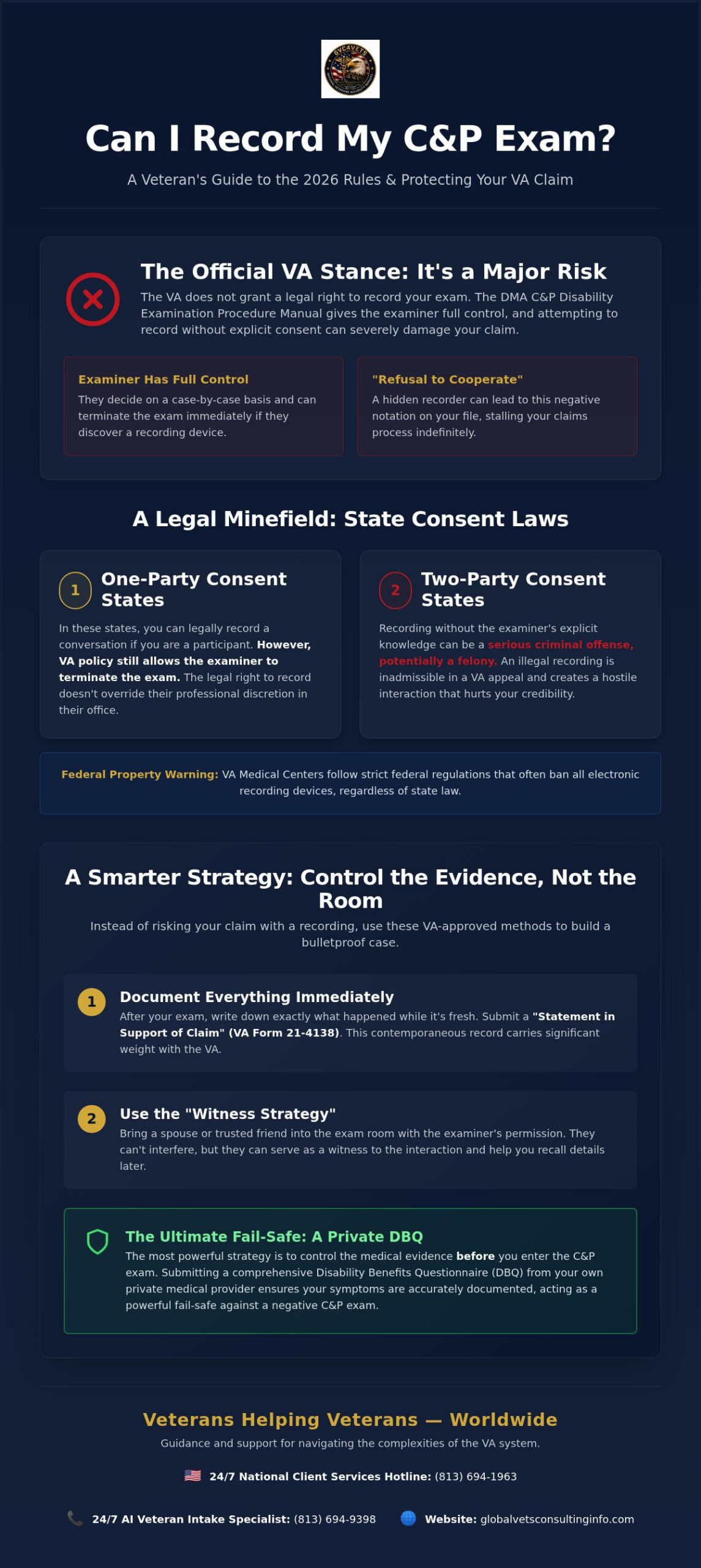
- The VA does not grant you a guaranteed legal right to record any part of your exam.
- The DMA C&P Disability Examination Procedure Manual gives the medical examiner full control over their professional space.
- Individual examiners decide whether to allow recording devices on a case-by-case basis.
- Recording without explicit consent can lead to the immediate termination of your appointment.
The Examiner’s Right to Refuse
Examiners prioritize their privacy and the security of their medical tools. If they discover a recording device, they may take the following actions:
- Stop the appointment immediately and ask you to leave the premises.
- Mark your file with a “refusal to cooperate” or “failure to report” notation.
- Stall your VA disability claims process indefinitely.
Official VA Policy vs. Real-World Practice
While the manual is strict, the real-world experience varies between clinics. You must understand the risks involved in different one-party vs. two-party consent states before attempting any recording. Consider these practical realities:
- Audio recording is sometimes permitted if you ask the examiner respectfully before the session begins.
- Video recording is strictly prohibited to protect the privacy of other patients and proprietary medical equipment.
- A respectful request builds trust, while a hidden device often creates a hostile environment that hurts your credibility.
Legal Risks: One-Party vs. Two-Party Consent States
Your physical location is the most important factor in the legal debate over recording. If you are asking, “can i record my c&p exam,” you must first understand the wiretapping statutes in your state. Recording an examiner without their knowledge is not just a policy violation; it can be a serious legal offense. 🇺🇸
Understanding Consent Laws
- In one-party consent states, you can legally record a conversation if you are a participant.
- In one-party vs. two-party consent states, recording without the doctor’s explicit knowledge can be charged as a felony.
- Federal property, like VA Medical Centers, follows strict security regulations that often ban all electronic recording devices.
- Private contractor sites (VES, QTC, LHI) usually follow the specific wiretapping laws of the state where the office is located.
The Impact on Your VA Claim
Going rogue with a hidden recorder can backfire during the rating process. Raters look for consistency and integrity in your medical evidence. A hostile interaction over a recording device creates a “behavioral note” that can haunt your file for years. 🌎
- Illegal recordings are almost always inadmissible in a VA appeal or at the Board of Veterans’ Appeals.
- Bypassing the VA policy on recording exams can lead to a “refusal to cooperate” notation.
- Examiners who feel recorded may become defensive, which often results in a less thorough physical evaluation.
- Focusing on medical evidence education is a more reliable way to protect your claim than trying to “catch” a doctor on tape.
Better Ways to Document Your C&P Exam Experience
Since the answer to “can i record my c&p exam” is usually a “no” from the medical examiner, you need a strategy that doesn’t rely on a microphone. Your best defense against a bad exam is a contemporaneous record. This is a fancy way of saying you should write down exactly what happened while it’s fresh in your mind. The VA gives significant weight to a “Statement in Support of Claim” (VA Form 21-4138) when it’s submitted immediately after an appointment. If you’re worried about an examiner’s bias, the best defense is educating yourself on medical evidence documentation before your appointment.
You can also use the “Witness Strategy” by bringing a spouse or a friend into the room. While they shouldn’t interfere with the exam, they can act as an observer. Their job is to sit quietly and take notes on the examiner’s demeanor, the duration of the physical tests, and any symptoms the examiner ignored. This provides a second perspective that can bolster your claim if the examiner’s report comes back inaccurate.
How to Write a Memo for Record
A Memo for Record is your personal account of the examination. It’s a professional way to document red flags without needing a recording device. Follow these steps immediately after leaving the office:
- Step 1: Record the exact start and end time of the physical examination. If the doctor only spent five minutes with you for a complex condition, that’s a critical detail.
- Step 2: List every tool used. For example, if you’re there for a back injury, note if the doctor used a goniometer to measure your range of motion or if they just “eyeballed” it.
- Step 3: Note specific questions the examiner asked or ignored. This is especially vital when dealing with a dbq for mental health conditions, where the nuances of your daily struggle must be captured correctly.
Submitting a Formal Complaint
If your exam was rushed, incomplete, or the examiner was unprofessional, don’t wait for a denial. You should contact the VA’s Patient Advocate or the specific contractor (like VES, QTC, or LHI) immediately. Inform them that the exam was “inadequate” and request a new one. Doing this before a rating decision is made shows that your concern is about medical accuracy, not just a low percentage.
The Ultimate Solution: Private DBQs and Better Evidence
Relying solely on a C&P examiner is a gamble you don’t have to take. While many veterans ask can i record my c&p exam to protect their interests, the real power lies in the medical evidence you submit before the appointment even begins. Global Vets Consulting helps you take control of your rating journey with documentation that speaks the VA’s language. 🇺🇸
Private DBQ vs. C&P Exam
- A private provider often spends more time documenting your symptoms than a rushed C&P examiner.
- The VA is legally required to consider private medical evidence as equal to their own internal exams.
- Using a private DBQ allows you to submit a complete picture of your disability without the stress of “catching” a doctor on a recording.
- Professional medical documentation is the most reliable way to secure a VA disability rating increase.
Next Steps for Veterans
Global Vets Consulting — Worldwide — is dedicated to streamlining the evidence-gathering process for our fellow veterans. We specialize in medical documentation that meets strict VA standards, ensuring your claim is accurate and professional. 🌎
- 📞 24/7 National Client Services Hotline: Immediate support is just a phone call away.
- 🤖 24/7 AI Veteran Intake Specialist: Get started with your intake process anytime, day or night.
- Veteran-owned and operated team that understands the complexities of the VA system.
Don’t leave your financial future to the chance of a single appointment. Contact Global Vets Consulting today for expert DBQ support! 🇺🇸
Take Command of Your Medical Evidence Today
You’ve spent your career following a chain of command; now it’s time to apply that same discipline to your VA disability claim. While the question “can i record my c&p exam” comes from a place of wanting protection, the legal and administrative risks often outweigh the benefits. You’ve learned that state consent laws and VA manual policies make recording a high risk strategy that can lead to a “refusal to cooperate” notation. Instead of relying on a hidden device, you can protect your future by arriving with a solid foundation of medical evidence and using structured tools like a Memo for Record to document the appointment details immediately.
We believe that no veteran should have to gamble their rating on a single appointment with a stranger. By prioritizing expert DBQ preparation and independent medical evidence education, you ensure that the VA sees the full reality of your service connected conditions. Global Vets Consulting is veteran owned and operated, providing the meticulousness and duty your claim deserves. Our expert DBQ preparation specialists are here to streamline the process and reduce the anxiety of the “wait and see” game.
Ready to take control of your claim? Get started with your private DBQ at Global Vets Consulting today! 🇺🇸 With our 24/7 National Client Services Hotline, help is always available when you need it. You’ve done the hard work of serving our country; now let us help you finish the mission of securing your benefits.
Frequently Asked Questions
Can the VA deny my claim if I record my C&P exam?
The VA won’t deny your claim solely because you asked to record, but they can deny it for a “refusal to cooperate.” If the examiner instructs you to turn off your device and you refuse, they have the authority to end the session immediately. This results in an incomplete exam, which often leads to a quick denial. It’s always safer to follow the examiner’s instructions and document any issues in writing after the appointment.
Is it a crime to record my VA doctor without them knowing?
It can be a crime depending on your specific location. In two-party consent states, recording a conversation without everyone’s permission is a felony wiretapping violation. Even if you’re in a one-party state, VA facilities often have strict security rules against electronic recording. If you’re asking “can i record my c&p exam” secretly, you’re risking legal trouble and the total loss of your credibility with the Rater.
Can I bring a witness to my C&P exam instead of recording it?
Bringing a witness is a highly effective strategy that avoids the legal mess of recording. You can usually have a spouse or friend join you to take notes on the examiner’s actions and the duration of the physical tests. This person acts as a credible observer who can verify if the examiner used the correct tools or if they ignored your reported symptoms. This is a much safer alternative to asking “can i record my c&p exam” during the session.
What should I do if my C&P examiner was rude or didn’t listen?
If an examiner is unprofessional, you must act before a rating decision is issued. Contact the VA Patient Advocate or the contractor, such as QTC or VES, to report the inadequate exam. You should also submit a Statement in Support of Claim detailing the examiner’s behavior. This creates a formal record of the problem, making it much easier to justify a request for a new examination from a different provider.
Does a private DBQ replace the need for a C&P exam?
While the VA still has the right to order a C&P exam, a private DBQ can often serve as the primary evidence for your claim. If your private medical evidence is considered “actionable and sufficient,” the VA may skip the C&P process entirely. Using a private DBQ is a powerful way to ensure your symptoms are documented by a provider who understands your history, which is essential for a successful VA rating increase.
Article by
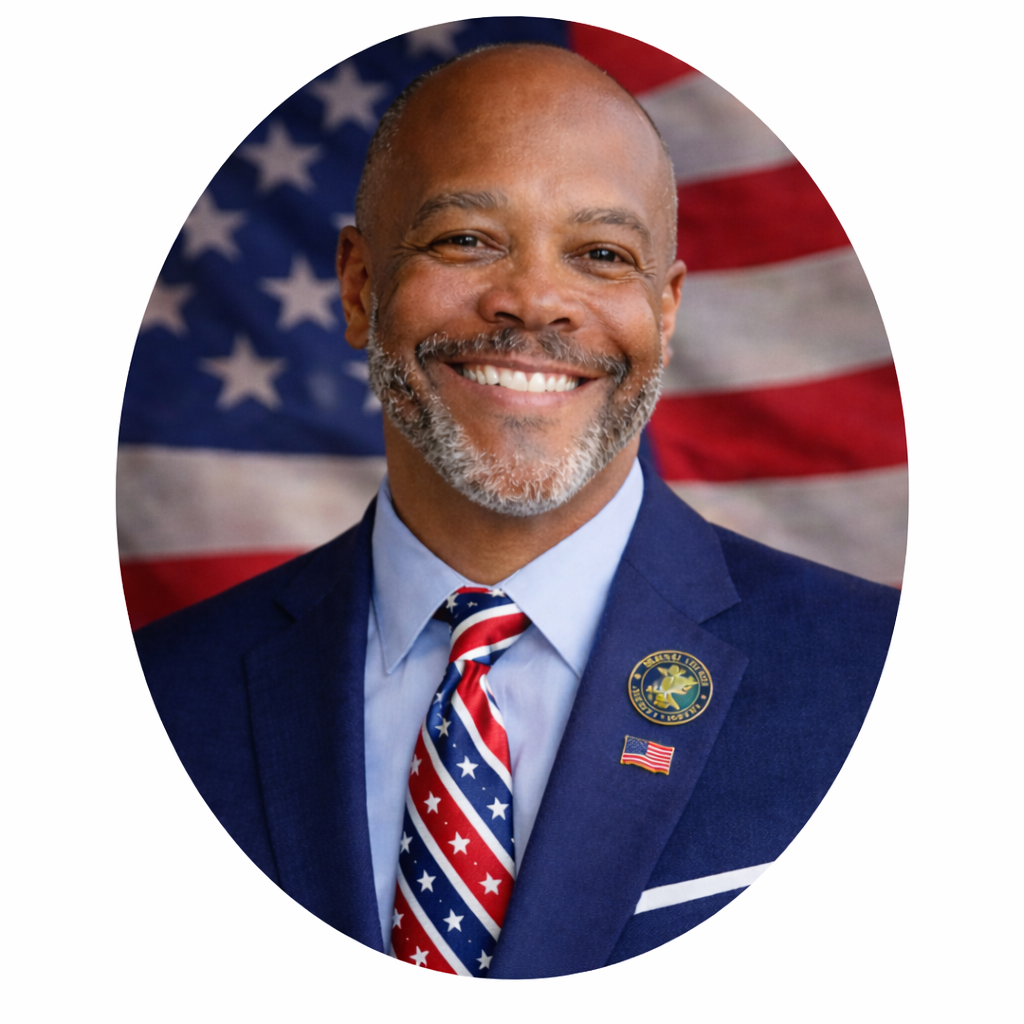
Willie Daniel
Willie Daniel is the Founder and Chief Executive Officer (CEO) of Global Vets Consulting (GVC4Vets) – National Veterans Disability Services, a veteran-led educational and medical evidence support organization dedicated to helping veterans better understand VA disability rating increases, DBQ medical evidence, secondary claims education, and C&P examination preparation.
He is a retired U.S. Army Medical Service Corps Officer with more than 27 years of honorable military service, a decorated Iraq combat veteran, and a retired federal official with the U.S. Department of Veterans Affairs. Throughout his military and federal career, Willie Daniel served in leadership, healthcare administration, operational, and veteran-support roles focused on improving services and support systems for servicemembers, veterans, and their families.
Drawing from decades of military leadership, healthcare administration, veteran advocacy, and federal government experience, Willie Daniel brings a practical, veteran-centered perspective to Global Vets Consulting’s educational articles, AI-powered veteran resources, video education initiatives, and outreach programs. His experience navigating military systems, medical documentation processes, and veteran-related administrative operations provides valuable insight into many of the challenges veterans face when seeking to better understand VA disability rating criteria, medical evidence, documentation strategies, and secondary condition education.
Through GVC’s “Veterans Helping Veterans” mission, his focus is on delivering clear, educational, and easy-to-understand information designed to empower veterans with knowledge, resources, and educational tools that may help them make more informed decisions regarding their individual VA disability journeys.
The information provided through GVC is intended for educational and informational purposes only and should not be considered legal or medical advice.
Disclaimer
Disclaimer: Global Vets Consulting, LLC (“GVC”) is a veteran-led educational and medical evidence support organization. GVC is not a law firm, is not a Veterans Service Organization (VSO), and is not affiliated with the U.S. Department of Veterans Affairs (VA) or any government agency.
Global Vets Consulting does not provide legal advice, medical advice, medical treatment, or healthcare services. GVC does not prepare, file, or submit VA disability claims on behalf of veterans. All information provided through this website, blog articles, videos, educational materials, AI tools, dashboards, templates, and communications is intended solely for general educational and informational purposes.
Veterans are encouraged to consult with accredited representatives, licensed attorneys, qualified medical providers, or Veterans Service Organizations regarding their specific legal, medical, or VA-related matters. VA disability decisions, ratings, and outcomes are determined solely by the U.S. Department of Veterans Affairs based on applicable laws, regulations, medical evidence, and individual circumstances. Past results do not guarantee future outcomes.