
Losing a veteran is a profound hardship, and the last thing you should face is financial uncertainty or a confusing mountain of VA paperwork. You’ve likely heard the term mentioned in passing, but what is dic (dependency and indemnity compensation) and how does it actually function as a lifeline for survivors? It’s more than just a monthly check; it’s a formal recognition of your loved one’s sacrifice and a benefit they earned through their service to our country 🇺🇸.
We understand that the fear of a claim denial due to a lack of medical proof can be paralyzing, especially when you’re already dealing with grief. You deserve a clear, predictable path forward that replaces confusion with confidence. This 2026 guide is designed to provide exactly that, ensuring you have the knowledge to secure the support your family needs without the stress of guessing.
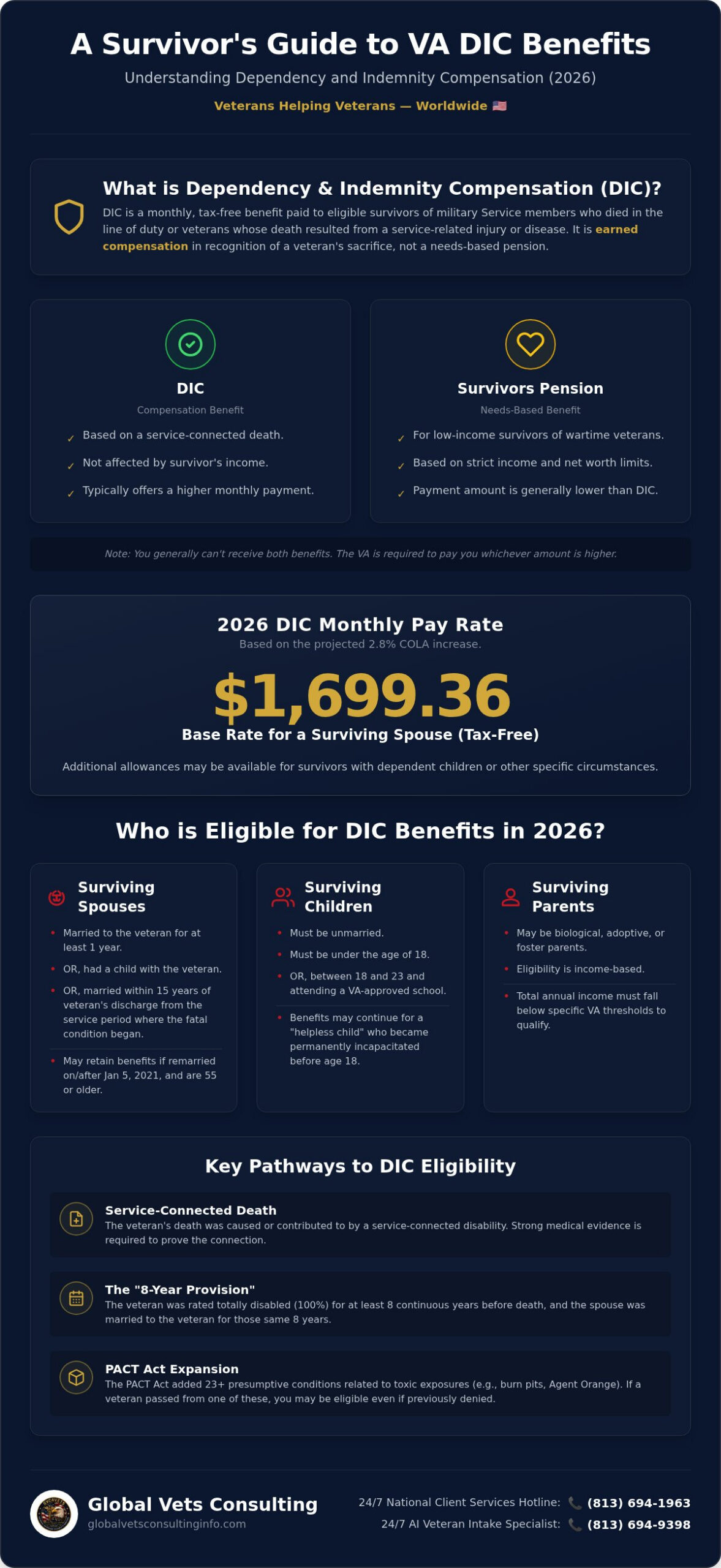
In the following sections, we’ll detail the updated 2026 pay rates, including the $1,699.36 base monthly amount, and explain the critical role of medical evidence in the application process. You’ll also learn about the 2.8% COLA increase and how the PACT Act has expanded eligibility for survivors across the nation.
Key Takeaways
- Understand what is dic (dependency and indemnity compensation) and why this tax-free benefit is earned compensation rather than a needs-based pension.
- Review the 2026 eligibility requirements for surviving spouses and children to ensure you meet the VA’s specific marriage and dependency criteria.
- Identify the current 2026 monthly pay rates, including the $1,699.36 base rate and additional allowances for survivors with dependent children.
- Learn how to leverage medical evidence and DBQs to establish a clear service connection and protect your claim from unnecessary denials.
What is VA Dependency and Indemnity Compensation (DIC)?
When a family loses a service member or veteran, the financial impact can be just as heavy as the emotional one. Understanding what is dic (dependency and indemnity compensation) is the first step toward securing the support you’ve earned. Managed by the Veterans Benefits Administration (VBA), this benefit is a tax-free monthly payment designed to support survivors of those who died in the line of duty or from a service-connected condition. It isn’t a gift or a welfare program; it’s a formal recognition of the ultimate sacrifice made by your loved one 🇺🇸.
The VA differentiates between two main scenarios for DIC eligibility. The first involves a service member who died while on active duty, active duty for training, or inactive duty training. The second involves veterans whose death resulted from a service-connected injury or disease. Even if the veteran wasn’t on active duty at the time of death, you may qualify if their service-connected disability was the primary cause or a contributing factor. This is where medical evidence becomes the cornerstone of your claim. Proving that a specific condition led to the veteran’s passing requires a clear medical link, often supported by detailed documentation that connects the dots for the VA rater.
DIC vs. Survivors Pension: Knowing the Difference
It’s common to confuse DIC with the Survivors Pension, but they serve very different purposes. DIC is based on service connection and is not affected by your income. In contrast, the Survivors Pension is a needs-based benefit for low-income survivors of wartime veterans. Because DIC is compensation for a service-related loss, it typically offers higher monthly payments than the pension. While you generally can’t receive both at the same time, the VA is required to pay you whichever amount is higher. This ensures you receive the maximum support available to your family during a difficult transition.
Who is Eligible for DIC Benefits in 2026?
Determining your eligibility is the first hurdle in securing long-term financial stability. To understand what is dic (dependency and indemnity compensation) in terms of qualifying, you must look at the veteran’s service history and your relationship to them. One of the most critical pathways is the “8-year provision.” If the veteran was rated as totally disabled for at least eight years leading up to their death, and you were married during those same eight years, you may qualify for benefits even if the service-connected condition wasn’t the primary cause of death.
The landscape of eligibility changed significantly with the PACT Act. This legislation added 23 new presumptive conditions related to toxic exposures, such as burn pits and Agent Orange. If your loved one passed away from a respiratory cancer or another condition now recognized by the VA, you may be eligible even if a previous claim was denied. You can find official details on the VA Dependency and Indemnity Compensation (DIC) website to see if your specific situation aligns with these expanded rules 🇺🇸.
Eligibility for Surviving Spouses
A surviving spouse must generally have been married to the veteran for at least one year before their death. You also qualify if you had a child with the veteran or if the marriage took place within 15 years of their discharge from the service period where the qualifying condition began. While remarriage often ends benefits, those who remarry on or after January 5, 2021, and are 55 or older can typically retain their eligibility. Understanding the VA disability claims process step by step can help you organize the marriage certificates and service records needed for your filing.
Eligibility for Surviving Parents and Children
Children must be unmarried and under the age of 18 to qualify, though this extends to age 23 if they’re attending a VA-approved school. For “helpless children” who became permanently incapacitated before age 18, benefits can continue indefinitely. Surviving parents may also be eligible, but their benefits are income-linked, meaning their total annual income must fall below specific VA thresholds. If you’re unsure about your specific documentation requirements, learning about medical evidence education can clarify what the VA rater is looking for in your application.
2026 DIC Pay Rates and Monthly Allowances
Knowing what is dic (dependency and indemnity compensation) from a financial perspective helps you plan for the future with confidence. For 2026, the standard monthly rate for a surviving spouse is $1,699.36. This amount is a tax-exempt benefit at both the federal and state levels, ensuring that the full compensation stays in your household where it’s needed most. Unlike many other forms of income, this payment isn’t subject to the fluctuations of the economy, as it’s adjusted annually to keep pace with the cost of living 🇺🇸.
Beyond the base rate, several “Added Amounts” can significantly increase your monthly support. If you qualify for the 8-year provision, which applies if the veteran was rated totally disabled for eight years prior to their death and you were married during that time, you’ll receive an additional $360.85 per month. For those with dependent children under age 18, the VA adds $421.00 per child to the monthly total. You can find the full table of these figures on the official 2026 DIC Pay Rates page.
Special Allowances: Aid and Attendance
Survivors who require assistance with daily living activities, such as bathing, dressing, or managing medications, may be eligible for an additional $421.00 per month. Aid and Attendance is a critical benefit for survivors who are housebound or need regular help from another person to remain safe and healthy. This allowance recognizes that the cost of care increases as we age or face health challenges, providing the extra resources needed to maintain your quality of life.
Transitional Benefits for Surviving Spouses
The first few years after a loss are often the most financially volatile. To help with this shift, the VA provides an additional $359.00 monthly for the first two years after a veteran’s death if there are minor children in the home. This transitional benefit serves as a financial bridge, allowing families to adjust to their new reality without the immediate pressure of reduced household income. If you’re unsure which allowances apply to your situation, reviewing our educational resources on VA survivors pension and DIC can help you identify every dollar you’re eligible to receive.
How to Secure DIC Benefits with Strong Medical Evidence
Securing survivor benefits requires more than just submitting a form; it requires a clear medical narrative. To successfully navigate what is dic (dependency and indemnity compensation) in the eyes of a VA rater, you must understand that the burden of proof rests on the survivor. You must demonstrate that a service-connected disability was either the principal cause of death or a significant contributory factor. While a veteran’s existing disability rating provides a helpful foundation, it does not automatically guarantee a DIC approval. The VA needs to see a direct link between that service-connected condition and the information listed on the death certificate 🇺🇸.
The death certificate is often the most scrutinized document in your claim. If a veteran passes away at home, the listed cause of death might be broad, such as “natural causes” or “cardiac arrest.” These vague terms can lead to a denial if they don’t explicitly reference the veteran’s service-connected conditions. Proving this link requires meticulous medical records and a professional medical opinion that “connects the dots” for the VA. This is where specialized documentation becomes your strongest advocate in the claims process.
The Role of DBQs in Survivor Claims
A private DBQ for VA claims offers the clinical clarity needed to bridge the gap between a veteran’s service-connected condition and their passing. For instance, if a veteran was rated for a respiratory condition and later died of heart failure, a DBQ can provide the medical evidence showing how the respiratory strain put an undue burden on the heart. Without this level of detail, many survivors find their VA claim denied for lack of evidence, simply because the medical nexus wasn’t clearly defined.
Next Steps: Filing Your DIC Claim
Success starts with organization. Before you file, ensure you have gathered these essential items:
- The official death certificate listing the cause of death.
- A marriage license or birth certificates for dependent children.
- Military discharge papers (DD214) and all relevant medical records.
- Strong medical nexus evidence, such as a DBQ or independent medical opinion.
If you’re unsure where to start, our 24/7 AI Veteran Intake Specialist is ready to provide immediate guidance on your next steps. You’ve honored your loved one’s service; now let us help you secure the recognition and support you deserve. Connect with Global Vets Consulting for medical evidence education to build a claim that stands up to VA scrutiny 🌎.
Protecting Your Family’s Future with Confidence
Navigating the VA system after a loss is a heavy burden, but you don’t have to carry it alone. Understanding exactly what is dic (dependency and indemnity compensation) is just the first step toward securing the benefits your family has earned through service and sacrifice. By focusing on the 2026 pay rates and the specific medical evidence required to prove service connection, you can move from a place of uncertainty to a position of steady confidence. A well-documented claim, supported by precise medical evidence and DBQs, is your best defense against a denial.
As a veteran-owned and operated team, we specialize in providing the DBQ educational resources you need to build a rock-solid case. We offer 24/7 global support to ensure that no survivor is left without a guide in this complex administrative process. Your peace of mind is our mission, and we are committed to helping you document the medical facts with meticulous accuracy. Our goal is to replace your anxiety with a clear, predictable path forward.
📞 Contact our 24/7 National Client Services Hotline for assistance with your medical documentation. You’ve honored your loved one’s legacy; now let’s ensure their service continues to protect your family’s future.
Frequently Asked Questions
Is DIC a lifetime benefit for surviving spouses?
Yes, DIC is generally a lifetime tax-free benefit for surviving spouses as long as they do not remarry before meeting specific age requirements. This compensation provides a stable monthly income to help maintain your household and recognize the service of your loved one. Because it’s not a needs-based pension, your other income or assets don’t cause the benefit to end, ensuring long-term financial peace of mind.
Can I receive DIC if my spouse died of a non-service connected condition?
You can receive benefits even if the primary cause of death was non-service connected, provided you meet the “8-year provision.” This rule applies if the veteran was rated 100% disabled for at least eight years prior to their death and you were married during that entire period. Additionally, if a service-connected condition contributed to or hastened the death, you may still qualify by providing strong medical evidence to the VA.
How much is the VA DIC payment for 2026?
The standard monthly base rate for what is dic (dependency and indemnity compensation) in 2026 is $1,699.36 for a surviving spouse. This amount reflects a 2.8% COLA increase that became effective on December 1, 2025. You may receive additional monthly allowances for dependent children, the 8-year provision, or if you require Aid and Attendance care, which can increase your total monthly compensation significantly.
Does the PACT Act affect DIC eligibility for survivors?
The PACT Act significantly expanded eligibility by adding 23 new presumptive conditions related to toxic exposures like burn pits and Agent Orange. If your spouse died from a respiratory cancer or another recognized condition, the VA now presumes the death was service-connected. This allows many survivors who were previously denied to refile and successfully secure the compensation their families earned through their military service 🇺🇸.
What happens to DIC if a surviving spouse remarries?
Your DIC benefits will typically stop if you remarry, but there are important age-based exceptions that protect your eligibility. If you remarry on or after January 5, 2021, and are 55 or older, you can keep your monthly compensation. For those who remarried on or after December 16, 2003, the age threshold is 57. Understanding these specific dates is vital for protecting your family’s long-term financial stability.

Article by
Willie Daniel
Willie Daniel is the Founder and Chief Executive Officer (CEO) of Global Vets Consulting (GVC4Vets) – National Veterans Disability Services, a veteran-led educational and medical evidence support organization dedicated to helping veterans better understand VA disability rating increases, DBQ medical evidence, secondary claims education, and C&P examination preparation.
He is a retired U.S. Army Medical Service Corps Officer with more than 27 years of honorable military service, a decorated Iraq combat veteran, and a retired federal official with the U.S. Department of Veterans Affairs. Throughout his military and federal career, Willie Daniel served in leadership, healthcare administration, operational, and veteran-support roles focused on improving services and support systems for servicemembers, veterans, and their families.
Drawing from decades of military leadership, healthcare administration, veteran advocacy, and federal government experience, Willie Daniel brings a practical, veteran-centered perspective to Global Vets Consulting’s educational articles, AI-powered veteran resources, video education initiatives, and outreach programs. His experience navigating military systems, medical documentation processes, and veteran-related administrative operations provides valuable insight into many of the challenges veterans face when seeking to better understand VA disability rating criteria, medical evidence, documentation strategies, and secondary condition education.
Through GVC’s “Veterans Helping Veterans” mission, his focus is on delivering clear, educational, and easy-to-understand information designed to empower veterans with knowledge, resources, and educational tools that may help them make more informed decisions regarding their individual VA disability journeys.
The information provided through GVC is intended for educational and informational purposes only and should not be considered legal or medical advice.
Disclaimer
Disclaimer: Global Vets Consulting, LLC (“GVC”) is a veteran-led educational and medical evidence support organization. GVC is not a law firm, is not a Veterans Service Organization (VSO), and is not affiliated with the U.S. Department of Veterans Affairs (VA) or any government agency.
Global Vets Consulting does not provide legal advice, medical advice, medical treatment, or healthcare services. GVC does not prepare, file, or submit VA disability claims on behalf of veterans. All information provided through this website, blog articles, videos, educational materials, AI tools, dashboards, templates, and communications is intended solely for general educational and informational purposes.
Veterans are encouraged to consult with accredited representatives, licensed attorneys, qualified medical providers, or Veterans Service Organizations regarding their specific legal, medical, or VA-related matters. VA disability decisions, ratings, and outcomes are determined solely by the U.S. Department of Veterans Affairs based on applicable laws, regulations, medical evidence, and individual circumstances. Past results do not guarantee future outcomes.