
The era of the “automatic” 50% CPAP VA Rating is facing its biggest challenge yet as the VA considers a shift toward symptom-based evaluations. You’ve likely heard the rumors about new rules and feel the pressure to protect the benefits you earned through your service. It’s frustrating to feel like the goalposts are moving when you’re just trying to breathe easier at night. We understand that anxiety because we’ve been in your boots. This guide will show you exactly how to navigate the 2026 landscape, ensuring your medical evidence is ironclad so you can maintain or increase your disability compensation.
While a CPAP prescription currently qualifies many for a 50% rating and a monthly payment of $1,132.90, staying ahead of proposed changes is vital for your financial security. We’ll break down the specific criteria the VA uses, the impact of the 2.8% COLA increase, and how a professional Disability Benefits Questionnaire (DBQ) can bridge the gap between a denied claim and the rating you deserve. You’ll gain a clear, step-by-step understanding of how to document your condition to meet the VA’s rigorous standards.
Key Takeaways
- 🇺🇸 Understand how the VA is shifting from rating based on device use to evaluating your specific functional impairment and treatment results.
- 📋 Learn the specific medical criteria required to maintain your CPAP VA Rating or pursue an increase if your symptoms remain severe despite treatment.
- 🔗 Identify the most effective strategies for establishing a secondary service connection by linking sleep apnea to existing conditions like PTSD or Rhinitis.
- 🛡️ Discover how a professional Disability Benefits Questionnaire (DBQ) provides the “fully developed” medical evidence needed to protect your claim when it’s time for your C&P exam.
Understanding the CPAP VA Rating Schedule in 2026
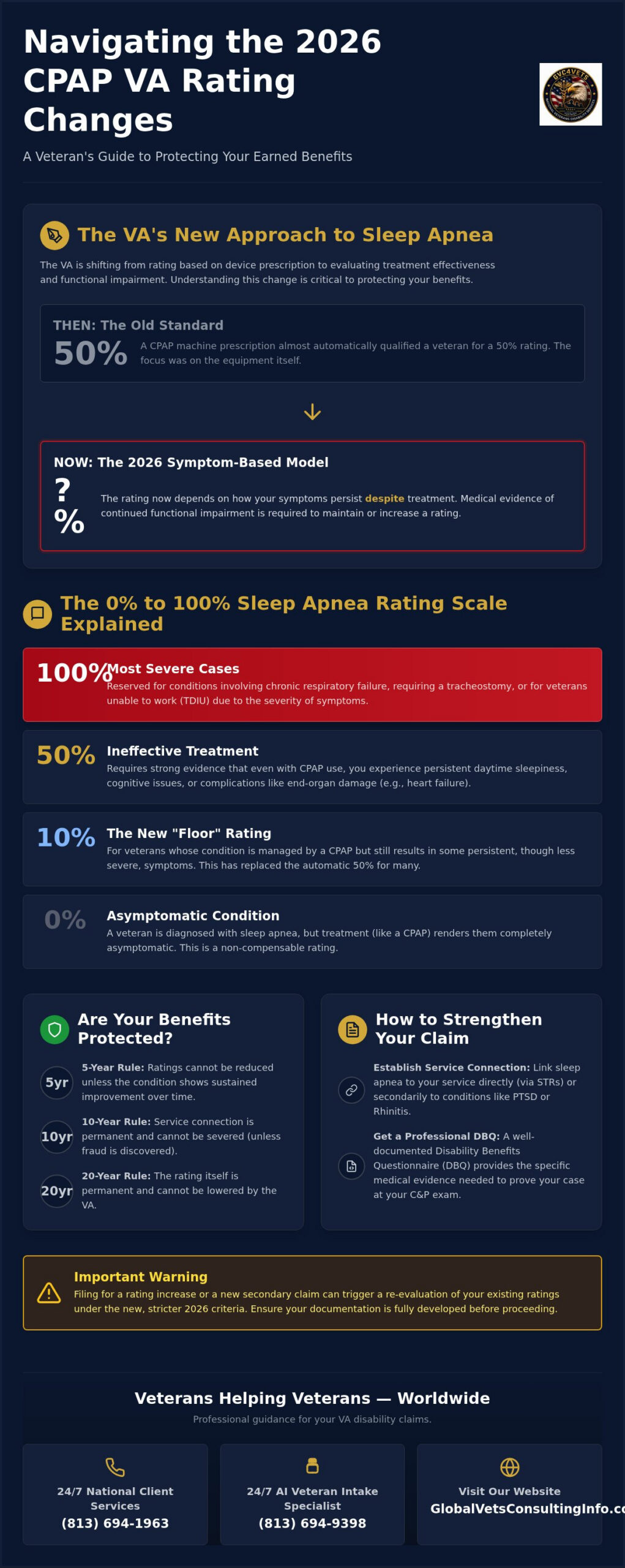
The VA’s approach to the CPAP VA Rating has undergone a significant transformation. Historically, simply being prescribed a machine for sleep apnea guaranteed a 50% rating. As of mid-2026, the VA’s Schedule for Rating Disabilities (VASRD) focuses on treatment effectiveness rather than the mere presence of medical equipment. For a single veteran with no dependents, a 50% rating provides a monthly payment of $1,132.90, reflecting the 2.8% COLA increase. The 2026 VA evaluation model moves away from mechanical requirements toward a qualitative assessment of a veteran’s residual functional impairment.
The Shift from 50% to 10%: What Changed?
The VA now prioritizes whether a veteran is “asymptomatic” with treatment. If your CPAP provides complete relief, the VA may argue for a 10% or even 0% rating. To maintain a higher CPAP VA Rating, your medical evidence must prove you have persistent symptoms, like chronic fatigue or cognitive fog, despite using the device. The automatic 50% threshold for owning a machine is no longer the standard for new claims or those seeking increases.
Grandfathering and Rating Protection
If you already have a 50% rating, you’re generally protected by grandfathering rules. These regulations follow specific timelines for protection:
- 5-Year Rule: Ratings cannot be reduced unless the condition shows sustained improvement over time.
- 10-Year Rule: Service connection is considered permanent and cannot be severed unless fraud is found.
- 20-Year Rule: The rating is protected and cannot be lowered by the VA.
Be careful; filing for a VA rating increase or a new secondary claim can trigger a re-evaluation of your existing sleep apnea rating. This re-opening of your file might expose you to the stricter 2026 criteria, putting your current compensation at risk. You can check your status at GlobalVetsConsultingInfo.com to ensure your documentation is ready.
The 0% to 100% Sleep Apnea Rating Scale Explained
The new rating structure for sleep apnea is more rigorous than ever. Under the updated Official VA Rating Schedule, the previous 30% mid-tier has been removed in favor of a system that rewards symptom documentation. Now, ratings are strictly based on how the condition impacts your body’s function. If you are diagnosed but asymptomatic, you’ll likely receive a 0% rating. A 10% rating serves as the new “floor” for veterans whose apnea is managed by a CPAP but still results in persistent symptoms. Securing a higher CPAP VA Rating now requires documenting that the treatment isn’t providing full relief.
Criteria for a 50% Rating in 2026
A 50% rating is no longer guaranteed just by owning a machine. It requires evidence of “ineffective treatment.” This means even with a CPAP, you still experience excessive daytime sleepiness or oxygen desaturation during sleep. The VA also looks for “end-organ damage,” which refers to complications like congestive heart failure or chronic kidney disease caused by long-term oxygen deprivation. If your CPAP use is hindered by another service-connected issue, like severe PTSD-related claustrophobia, you may still qualify for this level. To understand how these tiers apply to your specific medical history, you can explore our sleep apnea claims education resources.
When Does Sleep Apnea Qualify for 100%?
The 100% rating is reserved for the most severe cases. This typically involves chronic respiratory failure or the necessity of a tracheostomy. While these cases are rare, the impact is life-altering. Additionally, if your sleep apnea symptoms are so debilitating that you cannot maintain substantial gainful employment, you might consider a Total Disability Individual Unemployability (TDIU) claim. This path allows you to be paid at the 100% rate even if your individual CPAP VA Rating is lower. Documenting these severe functional limitations is the only way to reach the maximum benefit level.
Establishing Service Connection: Secondary Claims and Medical Evidence
Securing your CPAP VA Rating requires a clear link between your military service and your diagnosis. Direct service connection is the most straightforward path. It relies on Service Treatment Records (STRs) showing you sought care for sleep issues while on active duty. If you lack these records, you must establish a “Nexus.” This is a medical bridge proving your condition is “at least as likely as not” related to your service. Proper Medical Diagnosis and Treatment records from a sleep study are the first step in building this bridge.
Sleep Apnea Secondary to PTSD
Many veterans find success by filing sleep apnea as secondary to PTSD. The physiological state of hyperarousal common in PTSD can significantly worsen breathing patterns during sleep. Also, many mental health medications lead to weight gain. This weight gain acts as an intermediate medical step that connects your sleep apnea to your service-connected PTSD. Utilizing DBQs for mental health conditions ensures your mental health symptoms are fully documented to support this secondary claim.
Toxic Exposure and the PACT Act
The PACT Act has changed the landscape for respiratory claims. Although sleep apnea isn’t a presumptive condition, exposure to burn pits and fine particulate matter often causes chronic rhinitis or sinusitis. These conditions are presumptive. By establishing service connection for rhinitis first, you can then link your sleep apnea as a secondary condition. This strategy is often more successful than attempting a direct connection for toxic exposure alone. Documentation is everything when proving these complex links.
🇺🇸 Evidence Checklist for Secondary Claims:
- A current medical diagnosis from a clinical sleep study.
- A formal Nexus Letter from a qualified medical provider.
- Medical records linking your primary condition to your apnea.
If you’re struggling to connect the dots, our Secondary VA Claims Education can help you understand the evidence needed for a successful filing.
How a Professional DBQ Protects Your Sleep Apnea Rating
A Compensation and Pension (C&P) exam is often a brief encounter that doesn’t capture the full scope of your daily struggle. These exams frequently overlook the nuances of your CPAP VA Rating, such as the frequency of your symptoms or the specific ways sleep deprivation impacts your ability to work. By submitting a private Disability Benefits Questionnaire (DBQ), you provide the VA with “fully developed” medical evidence. This documentation ensures the doctor accurately records your functional loss and persistent symptoms, which are now the primary factors for your rating in 2026. You can get your DBQ reviewed by our expert team to ensure no detail is missed.
The Power of Independent Medical Evidence
The VA is legally required to give private medical evidence equal weight to their own C&P examinations. This is a critical protection for veterans facing the 2026 rating shifts. If your condition has worsened or your current rating doesn’t reflect your symptoms, you can use a DBQ for a VA disability rating increase. This proactive approach prevents the VA from relying solely on a single, potentially flawed exam. It places the power back in your hands by providing a thorough medical record that supports your claim for higher compensation.
Veterans Helping Veterans: The Global Vets Consulting Approach
We operate with a mission-driven focus because we’re veterans who have navigated this complex system ourselves. Our 24/7 AI Veteran Intake Specialist and National Client Services Hotline 📞 are always available to help you start the process. We prioritize an education-first approach, empowering you to speak the “VA language” during your evaluation. This preparation ensures you can clearly articulate your symptoms and their impact on your life, reinforcing the legitimacy of your CPAP VA Rating. Our goal is to provide a clear, predictable path forward for those the system has neglected. 🇺🇸
Secure Your Sleep Apnea Benefits for the Long Term
The 2026 shift toward symptom-based evaluations means that your medical evidence must be more precise than ever. You’ve learned that a CPAP VA Rating is no longer just about owning a machine; it’s about proving how sleep apnea impacts your daily life and functional capacity. Whether you’re navigating direct service connection or complex secondary claims like apnea linked to PTSD, having a “fully developed” claim is your best defense against rating reductions. A professional DBQ ensures that your specific symptoms, from daytime sleepiness to oxygen desaturation, are documented in the exact language the VA requires.
As a veteran-owned and operated team, we understand the pressure of these regulatory changes. We specialize in complex secondary claims and offer a 24/7 National Client Services Hotline to ensure you never have to face the system alone. Ready to secure your CPAP VA rating? Contact Global Vets Consulting today for expert DBQ support! 🇺🇸 Don’t let your hard-earned benefits slip away; take the next step to protect your health and your financial future today.
Frequently Asked Questions
Is sleep apnea still a 50% rating in 2026?
Yes, as of August 2026, a veteran prescribed a CPAP machine for a service-connected sleep apnea diagnosis is still assigned a 50% disability rating. This provides a monthly payment of $1,132.90 for a single veteran. Although the VA proposed shifting toward a symptom-based system that could lower this to 10%, no final rule has been published yet. Your current rating remains secure under existing regulations.
Can the VA reduce my sleep apnea rating if I am already at 50%?
The VA can’t reduce your rating without proving your condition has significantly improved over time. If you’ve held your 50% rating for over five years, you have additional protections. However, be cautious when filing for an increase or a new secondary claim. Reopening your file allows the VA to re-examine your CPAP VA Rating under the most current medical evidence and rating criteria.
What is the new 10% rating for CPAP users?
The 10% rating is a proposed tier for veterans who experience incomplete relief from their symptoms while using a CPAP. In the new proposed schedule, the VA aims to move away from rating based on the machine itself. Instead, they would assign 10% if treatment is only partially effective. If the treatment makes you completely asymptomatic, the VA has proposed a 0% non-compensable rating.
How do I prove my sleep apnea is secondary to PTSD?
Proving a secondary connection requires a medical Nexus letter that explicitly links your sleep apnea to your PTSD. You should document how PTSD symptoms, like chronic stress or medication-induced weight gain, directly impact your respiratory health. Using a detailed DBQ can help capture these links accurately. This evidence shows the VA that your apnea wouldn’t be as severe without the underlying service-connected mental health condition.
Do I need a new sleep study for a VA rating increase in 2026?
A recent sleep study is highly recommended when seeking a VA rating increase. The VA needs current data on your Apnea-Hypopnea Index (AHI) and oxygen levels to justify a higher evaluation. If your last study was conducted several years ago, it may not reflect your current level of impairment. Providing updated medical evidence ensures the VA has a clear picture of your worsening symptoms and treatment needs.

Article by
Willie Daniel
Willie Daniel is the Founder and Chief Executive Officer (CEO) of Global Vets Consulting (GVC4Vets) – National Veterans Disability Services, a veteran-led educational and medical evidence support organization dedicated to helping veterans better understand VA disability rating increases, DBQ medical evidence, secondary claims education, and C&P examination preparation.
He is a retired U.S. Army Medical Service Corps Officer with more than 27 years of honorable military service, a decorated Iraq combat veteran, and a retired federal official with the U.S. Department of Veterans Affairs. Throughout his military and federal career, Willie Daniel served in leadership, healthcare administration, operational, and veteran-support roles focused on improving services and support systems for servicemembers, veterans, and their families.
Drawing from decades of military leadership, healthcare administration, veteran advocacy, and federal government experience, Willie Daniel brings a practical, veteran-centered perspective to Global Vets Consulting’s educational articles, AI-powered veteran resources, video education initiatives, and outreach programs. His experience navigating military systems, medical documentation processes, and veteran-related administrative operations provides valuable insight into many of the challenges veterans face when seeking to better understand VA disability rating criteria, medical evidence, documentation strategies, and secondary condition education.
Through GVC’s “Veterans Helping Veterans” mission, his focus is on delivering clear, educational, and easy-to-understand information designed to empower veterans with knowledge, resources, and educational tools that may help them make more informed decisions regarding their individual VA disability journeys.
The information provided through GVC is intended for educational and informational purposes only and should not be considered legal or medical advice.
Disclaimer
Disclaimer: Global Vets Consulting, LLC (“GVC”) is a veteran-led educational and medical evidence support organization. GVC is not a law firm, is not a Veterans Service Organization (VSO), and is not affiliated with the U.S. Department of Veterans Affairs (VA) or any government agency.
Global Vets Consulting does not provide legal advice, medical advice, medical treatment, or healthcare services. GVC does not prepare, file, or submit VA disability claims on behalf of veterans. All information provided through this website, blog articles, videos, educational materials, AI tools, dashboards, templates, and communications is intended solely for general educational and informational purposes.
Veterans are encouraged to consult with accredited representatives, licensed attorneys, qualified medical providers, or Veterans Service Organizations regarding their specific legal, medical, or VA-related matters. VA disability decisions, ratings, and outcomes are determined solely by the U.S. Department of Veterans Affairs based on applicable laws, regulations, medical evidence, and individual circumstances. Past results do not guarantee future outcomes.