

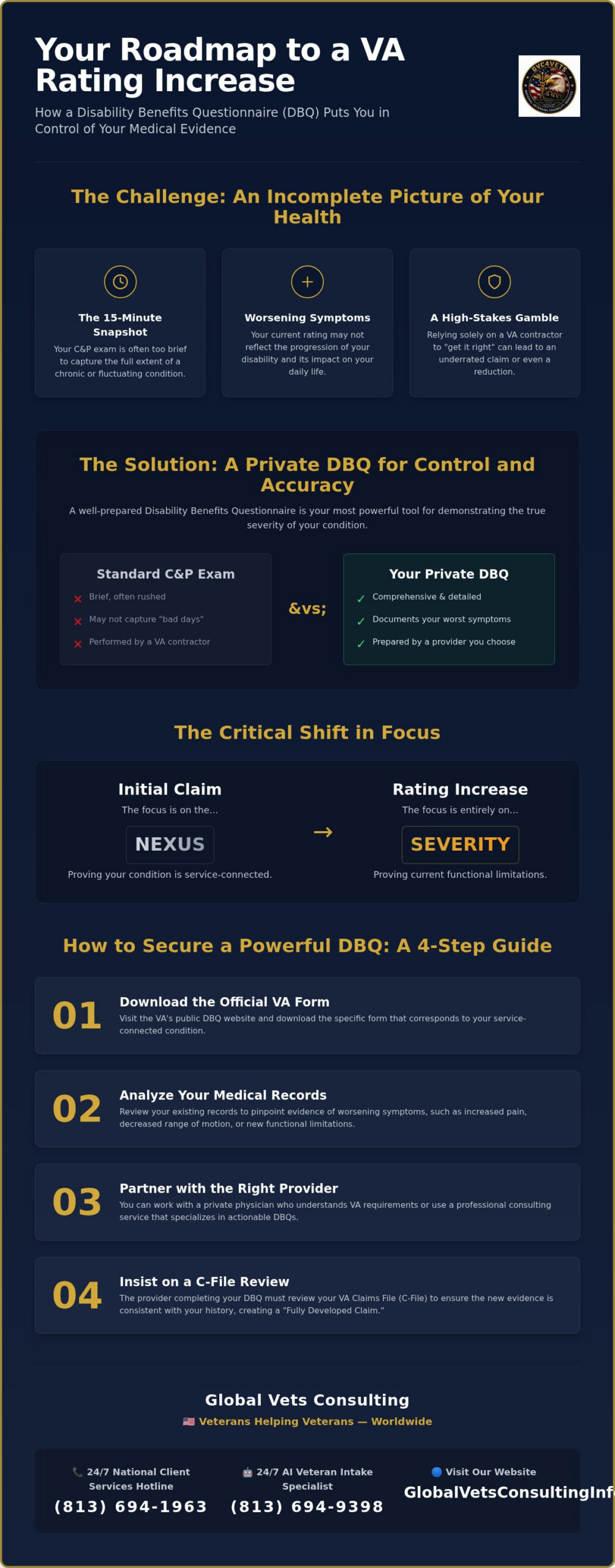
Your C&P exam is often just a fifteen minute snapshot of your health, but it shouldn’t be the only thing determining your future. If your symptoms have worsened, relying solely on a VA contractor to “get it right” is a gamble many veterans can’t afford to take. Learning how to get a dbq for a condition already service connected is the most effective way to take control of your medical evidence. You deserve a rating that reflects your actual physical or mental limitations, not just how you felt on one specific morning.
It’s frustrating to feel underrated, and we know the anxiety that comes with requesting a re-evaluation. This guide provides a clear roadmap to obtaining a high-quality Disability Benefits Questionnaire (DBQ) that accurately documents your worsening condition. You’ll learn the exact steps to secure private medical evidence under 38 CFR § 3.326 and how to use it to support a successful rating increase in 2026. We’ll walk through the process of bridging the gap between your medical reality and the VA’s strict documentation requirements so you can secure the benefits you’ve earned.
Key Takeaways
- Understand why a private DBQ is your strongest tool when filing a Claim for Increase for symptoms that have worsened over time.
- Discover exactly how to get a dbq for a condition already service connected by downloading the correct public-facing form and identifying critical gaps in your medical records.
- Learn how to document your condition’s worst days and flare-ups to ensure the VA rater has an accurate picture of your disability’s true severity.
- Master the submission process through the Fully Developed Claim (FDC) program and learn how to navigate a C&P exam even after providing your own evidence.
- Secure the VA rating increase you’ve earned by bridging the gap between your daily medical reality and the VA’s documentation requirements.
Why Get a DBQ for a Condition Already Service Connected?
Securing service connection is a significant milestone, but it’s rarely the end of the road. Injuries often progress, and symptoms that were manageable years ago may now limit your ability to work or care for your family. Understanding how to get a dbq for a condition already service connected allows you to provide the Veterans Benefits Administration (VBA) with a current, accurate medical picture.
- Documenting Progression: A new DBQ captures functional loss that wasn’t present during your initial claim.
- Strategic Counter-Evidence: It serves as a professional rebuttal to a potentially rushed or inaccurate C&P exam.
- Protecting Your Benefits: A high-quality DBQ establishes a “floor” for your rating, ensuring you aren’t underrated.
- Filing for Increases: It provides the specific clinical data needed to move your rating to the next percentage tier.
The Difference Between Initial Claims and Rating Increases
Initial claims focus on the “Nexus,” or proving your injury happened in service. In contrast, rating increases focus entirely on “Severity.” When you’re researching how to get a dbq for a condition already service connected, remember that the VA is looking for clinical evidence of current limitations. Your roadmap for this process is 38 CFR Part 4, the Schedule for Rating Disabilities. A private DBQ ensures every checkbox on that form aligns with the legal requirements for a higher rating.
Routine Future Exams (RFEs) and the Need for Fresh Evidence
The VA often schedules re-evaluations to determine if a condition has improved. These Routine Future Exams can be high-stakes. By submitting fresh medical evidence through a private DBQ, you provide a proactive defense against an unjustified rating reduction during these VA-mandated reviews. This keeps your benefits stable while you focus on your health.
How to Get a DBQ Filled Out for Your Existing Disability
Obtaining the right documentation is a methodical process that requires precision. The first step is to visit the official VA website to download the specific VA Public DBQ Forms that correspond to your diagnostic code. Once you have the form, you must review your current medical records to identify exactly where your symptoms have progressed. Look for specific mentions of increased pain, decreased range of motion, or new functional limitations that weren’t present during your last evaluation. This preparation ensures that when you speak to a provider about how to get a dbq for a condition already service connected, you are presenting a clear, evidence-based case for an increase.
Choosing the right provider is equally critical. You can work with a private physician, a VA provider, or a professional consulting service. Regardless of who completes the form, they must review your “C-File” (Claims File). This ensures that the new medical evidence is consistent with your history while clearly highlighting the current worsening of your condition. This consistency is what makes a claim “Fully Developed” and ready for a faster decision in 2026.
Option A: Working with a Private Doctor
Many primary care physicians are hesitant to sign VA paperwork because they don’t understand the specific legal language required. If your doctor says they “don’t do disability forms,” try providing them with the specific rating criteria from 38 CFR Part 4. Explain that the DBQ is a clinical tool, not a legal one. If they still refuse, you may need to seek an independent medical opinion from a provider who specializes in veteran disability evaluations and understands the nuances of functional loss.
Option B: Professional DBQ Preparation Services
Using a specialized service can remove the guesswork from the process. These experts understand What is a DBQ for VA Claims? and how to translate your daily struggles into the clinical terms the VA requires. Professional consulting ensures your DBQ is “actionable and sufficient” under 38 CFR § 3.326, which can significantly reduce the likelihood of the VA ordering a redundant C&P exam. If you’re feeling overwhelmed by the paperwork, you can connect with a veteran-led team to help guide your documentation strategy.
Ensuring Your DBQ Supports a VA Rating Increase
VA raters aren’t medical doctors; they’re essentially data processors who match the evidence on your form to the legal requirements in the rating schedule. This is the “check-box” reality of the system. If your doctor fails to check the specific box that corresponds to a higher percentage, the rater cannot grant that increase, regardless of how much pain you’re in. When you’re figuring out how to get a dbq for a condition already service connected, the focus must be on clinical precision and technical accuracy.
A major pitfall for many veterans is the “snapshot” problem. If you’re having a rare “good day” during your medical appointment, the Public Disability Benefits Questionnaires (DBQs) must still reflect your condition during a flare-up. Your doctor needs to document functional loss—the actual inability to perform a task—rather than just the presence of pain. For musculoskeletal conditions like back or knee issues, Range of Motion (ROM) testing is the gold standard. Ensure your provider uses a goniometer to measure exactly where your movement stops or where pain begins, as these numbers directly dictate your rating.
Mapping Symptoms to the 38 CFR Part 4
The 38 CFR Part 4 is the VA’s rulebook for assigning percentages. For example, in a DBQ for Mental Health Conditions, the difference between a 50% and 70% rating often hinges on whether the doctor checks a box for specific symptoms like “suicidal ideation” or “impairment in most areas.” If your symptoms match the 70% criteria but the box isn’t checked, you’ll likely stay at 50%. You must ensure your symptoms are mapped correctly to these legal definitions before you submit your claim.
Common Mistakes That Lead to Denied Increases
The most common error is leaving sections blank. A blank section on a DBQ is often interpreted by the VA as “no symptoms present,” which can lead to a denial or even a rating reduction. Additionally, submitting a private DBQ that directly contradicts your existing VA medical records without a clear clinical explanation creates “conflicting evidence.” If your condition has worsened significantly, your doctor must provide a brief rationale explaining why the new findings differ from previous records. If you need help ensuring your documentation is airtight, reach out for expert medical evidence education to protect your claim.
Next Steps: Submitting Your DBQ and Navigating the C&P Exam
Learning how to get a dbq for a condition already service connected is only half the battle; the other half is ensuring the VA receives your evidence correctly. Once your doctor has completed the questionnaire, you must submit it as part of a Fully Developed Claim (FDC). This process signals to the VA that you’ve included all necessary medical evidence, which often results in a faster decision. In 2026, the VA continues to prioritize FDC submissions to reduce the growing backlog of rating increase requests.
Filing for an Increase: The Step-by-Step Submission
- Use VA Form 21-526EZ: This is the standard form for a claim for increase.
- Upload Supplemental Evidence: Submit your private DBQ as a PDF through the VA.gov portal.
- Check for Completeness: Ensure every page of the DBQ is signed and dated by your provider.
Navigating the digital portal can be complex, but it’s the most direct way to get your evidence in front of a rater. For a detailed breakdown of the entire timeline, see our guide on the VA Disability Claims Process Step by Step.
Preparing for the VA’s C&P Exam
Even if you submit a high-quality private DBQ, the VA may still order a Compensation and Pension (C&P) exam. Don’t skip this appointment. Skipping a VA-ordered exam is the fastest way to receive a technical denial. Instead, take a copy of your private DBQ with you. Use it as a reference guide to ensure your verbal statements about your symptoms remain consistent with your written medical evidence. If the VA examiner’s findings lead to a VA Claim Denied for Lack of Evidence, your private documentation will be the foundation for your appeal.
When you understand how to get a dbq for a condition already service connected, you can use that document as your primary piece of medical evidence during the “Evidence Gathering, Review, and Decision” phase. Monitoring your claim status daily on VA.gov will keep you informed of any additional requests for information from the rater.
🇺🇸 Global Vets Consulting
🌐 Worldwide
💻 GlobalVetsConsultingInfo.com
📞 24/7 National Client Services Hotline
🤖 24/7 AI Veteran Intake Specialist
Secure the VA Rating You Deserve in 2026
Your disability rating should be a true reflection of your daily health challenges, not a bureaucratic oversight. By now, you understand that a high-quality DBQ is the most effective way to document the progression of your symptoms and provide the clinical evidence the VA requires. Don’t leave your financial future to the chance of a brief C&P exam. Instead, take control by ensuring your medical documentation captures your functional loss and your worst flare-ups. Learning how to get a dbq for a condition already service connected is more than just a paperwork task; it’s a strategic move to protect your benefits.
If you’re ready to bridge the gap between your medical reality and the VA’s requirements, our team is here to guide you. We’re veteran-owned and operated, providing the expert education you need to navigate rating increases with confidence. You don’t have to face this complex system alone. Our 24/7 National Client Services Hotline is always available to support your journey toward a fair evaluation.
🇺🇸 Global Vets Consulting
🌐 Get Expert Help with Your DBQ Today at Global Vets Consulting
You’ve earned these benefits through your service. Now, let’s make sure your rating accurately reflects the person you are today. We’re standing by to help you secure the outcome you deserve.
Frequently Asked Questions
Can I get a DBQ for a condition that is already service connected at 0%?
Yes, you can and should obtain a DBQ for a condition rated at 0%. This “non-compensable” rating acknowledges that your condition is related to your service but doesn’t currently qualify for monthly payments. By submitting a new DBQ that documents increased symptom severity, you provide the clinical evidence needed to move to a compensable rating level, such as 10% or higher.
Will the VA automatically increase my rating if I submit a private DBQ?
No, the VA does not grant automatic increases based on a private form. While they’re required to consider your evidence, a rater must still determine if the documentation is “actionable and sufficient” for rating purposes. Understanding how to get a dbq for a condition already service connected helps ensure your evidence meets these standards, but the VA may still order a C&P exam to verify the findings.
How much does it cost to have a private doctor fill out a DBQ for a rating increase?
The cost for a private physician to complete a DBQ varies significantly depending on the provider’s expertise and the complexity of your medical history. It’s important to remember that the VA will not pay or reimburse you for any expenses related to private medical evidence. This is an out-of-pocket cost that many veterans view as an investment in securing a more accurate and fair disability rating.
What happens if my private DBQ conflicts with the VA C&P exam results?
When evidence is conflicting, the VA rater must weigh both opinions. A high-quality private DBQ serves as “conflicting medical evidence,” which is vital if you need to file a Higher-Level Review or an appeal. It prevents the VA from relying solely on a potentially rushed C&P exam and forces them to address the clinical findings provided by your own medical professional.
Can a DBQ be used to add a secondary condition to an existing service connection?
Yes, a DBQ is a primary tool for establishing secondary service connection. When you learn how to get a dbq for a condition already service connected, you can apply those same steps to document a new condition caused or aggravated by your primary disability. The form must clearly capture the clinical symptoms and functional loss to show the VA how the two conditions are linked.

Article by
Willie Daniel
Willie Daniel is the Founder and Chief Executive Officer (CEO) of Global Vets Consulting (GVC4Vets) – National Veterans Disability Services, a veteran-led educational and medical evidence support organization dedicated to helping veterans better understand VA disability rating increases, DBQ medical evidence, secondary claims education, and C&P examination preparation.
He is a retired U.S. Army Medical Service Corps Officer with more than 27 years of honorable military service, a decorated Iraq combat veteran, and a retired federal official with the U.S. Department of Veterans Affairs. Throughout his military and federal career, Willie Daniel served in leadership, healthcare administration, operational, and veteran-support roles focused on improving services and support systems for servicemembers, veterans, and their families.
Drawing from decades of military leadership, healthcare administration, veteran advocacy, and federal government experience, Willie Daniel brings a practical, veteran-centered perspective to Global Vets Consulting’s educational articles, AI-powered veteran resources, video education initiatives, and outreach programs. His experience navigating military systems, medical documentation processes, and veteran-related administrative operations provides valuable insight into many of the challenges veterans face when seeking to better understand VA disability rating criteria, medical evidence, documentation strategies, and secondary condition education.
Through GVC’s “Veterans Helping Veterans” mission, his focus is on delivering clear, educational, and easy-to-understand information designed to empower veterans with knowledge, resources, and educational tools that may help them make more informed decisions regarding their individual VA disability journeys.
The information provided through GVC is intended for educational and informational purposes only and should not be considered legal or medical advice.
Disclaimer
Disclaimer: Global Vets Consulting, LLC (“GVC”) is a veteran-led educational and medical evidence support organization. GVC is not a law firm, is not a Veterans Service Organization (VSO), and is not affiliated with the U.S. Department of Veterans Affairs (VA) or any government agency.
Global Vets Consulting does not provide legal advice, medical advice, medical treatment, or healthcare services. GVC does not prepare, file, or submit VA disability claims on behalf of veterans. All information provided through this website, blog articles, videos, educational materials, AI tools, dashboards, templates, and communications is intended solely for general educational and informational purposes.
Veterans are encouraged to consult with accredited representatives, licensed attorneys, qualified medical providers, or Veterans Service Organizations regarding their specific legal, medical, or VA-related matters. VA disability decisions, ratings, and outcomes are determined solely by the U.S. Department of Veterans Affairs based on applicable laws, regulations, medical evidence, and individual circumstances. Past results do not guarantee future outcomes.

